The Arkansas Colonel's Photographs
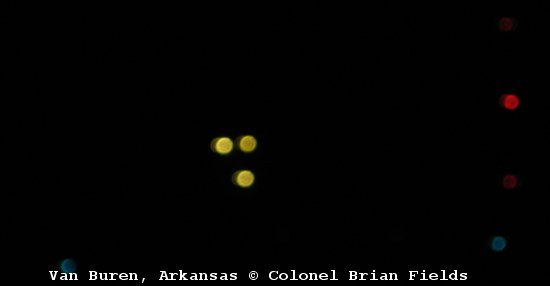
Just before 7 p.m. on the evening of 9 January 2007, retired Air Force Colonel Brian Fields, 61, was cooking chicken at his home in Van Buren, in western Arkansas, when he looked to the southeast, low near the horizon, and saw two intensely bright lights. This case file covers what witnesses reported, the official narrative, and a two-pass assessment with its evidence tier.
What did witnesses see at Van Buren?
Just before 7 p.m. on the evening of 9 January 2007, retired Air Force Colonel Brian Fields, 61, was cooking chicken at his home in Van Buren, in western Arkansas, when he looked to the southeast, low near the horizon, and saw two intensely bright lights. He had flown F-16s for close to 32 years with the 188th Fighter Wing of the Arkansas Air National Guard, so his first read was the obvious one. "At first I thought they were landing lights from an aircraft," he told WorldNetDaily reporter Joe Kovacs.
The lights did not behave like landing lights. As Fields watched, they began to slowly fade out, then one reappeared, followed by two, then three. On at least one pass four or five were lit at once. Each time they would hold for ten minutes or more, fade, and then come back in a different count and a different arrangement: sometimes a triangular shape, sometimes stacked on top of each other, sometimes line abreast. The colors he described were white, yellow and orange. His wife watched with him. The display ran for roughly an hour and fifteen minutes.
Fields grabbed his Canon digital camera, a 6-megapixel model, and snapped a series of images. The frame that became the signature picture of the case shows three soft, out-of-focus yellow-orange spheres clustered in a loose triangle against a black sky, with a vertical string of smaller red and blue points off to the right edge. The original WND caption identifies those right-hand lights plainly: "The red lights at right are from a local radio tower." Fields told WND he was certain it was not a conventional aircraft, and he ruled out flares to the reporter because, in his words, the lights did not descend the way he expected flares to descend. "I believe these lights were not of this world, and I feel a duty and responsibility to come forward," he said. "I have no idea what they were. It's not anything I ever had any experience with."
What is the official explanation?
There was no formal Blue Book-style investigation here, because the case broke in 2007 and ran entirely through the press. The story was published by WorldNetDaily on 17 January 2007 in a piece by Joe Kovacs headlined "Air Force colonel reports lights 'not of this world.'" It was picked up by the Drudge Report and became, by WND's own account, one of the most-viewed news reports in the outlet's history. A 19 January follow-up by Kovacs, "UFO frenzy ignited by Air Force officer," gathered a wave of reader sightings from around the country.
The official explanation came one week after the first story. On 24 January 2007 WND published Kovacs's "Lights 'not of this world' mystery finally 'solved,'" carrying named statements from three separate military offices. Jessica D'Aurizio, chief of public affairs for the 917th Wing of the Air Force Reserve at Barksdale Air Force Base in Louisiana, said: "We were flying A-10s in that area and they were using flares." She added of the flares: "They go down in parachutes, so they're very bright." Lt. Col. Pete Gauger, executive staff officer at Fields's own former unit, the 188th Fighter Wing of the Arkansas Air National Guard, confirmed that A-10s had been dropping suspended flares on the Fort Chaffee bombing range on the night in question. Kim Kimmey, a chief warrant officer at Fort Chaffee, supplied facility background. The account described four A-10s working the range and dropping LUU-2 illumination flares.
The geography fits the explanation tightly. The air-to-ground gunnery range at Fort Chaffee, Razorback Range, sits to the southeast of the Fort Smith and Van Buren area, the exact direction Fields reported looking. The munition named, the LUU-2, is a parachute illumination flare. Per the GlobalSecurity.org munitions reference, it produces about 1.8 million candlepower and "burns for approximately 5 minutes while suspended from a parachute," using "magnesium which burns at high temperature emitting an intense bright white light," inside an aluminum housing that "may add some orange to the light" as the casing is consumed. White, with yellow and orange tints, is precisely the color set Fields recorded. A flare hangs nearly motionless under its canopy, glows hard for about five minutes, then dies, and a fresh drop lights elsewhere in the sky, which reproduces Fields's account of lights that held for ten-odd minutes, faded, and reappeared in changing numbers and formations.
Fields accepted the finding once it was laid out for him. "I did not know that such 'parachute flares' existed," he told WND, and said he was grateful "the truth has been determined."
What did the witnesses think it was?
Fields was not an excitable witness. He was a retired colonel with roughly three decades of fighter time, and his own working assumption at the start was aircraft, not aliens. What pushed him past that was the behavior of the lights, the fading and reappearing in shifting formations, which did not match anything in his flying experience, and his belief that flares fell faster than what he was watching. On those grounds he went public, framing it as a duty. He later told WND he personally connected the display to biblical End Times imagery, which is part of why he felt compelled to speak.
The 19 January follow-up produced a string of people who said they had seen something similar, though none of them anchored the Van Buren event itself. Will Childers of Camden, Arkansas reported nearly identical lights the next night, 10 January, around 7:15 p.m., and said, "When I read this story, I literally got chill bumps all over my body, because it was exactly as I remember it also." A pilot named Rick Armellino of Lancaster, Pennsylvania described a two-year-old sighting over northwest Arkansas and said air traffic control had told him there was no radar traffic in the area. Richard Mobley, a software developer in Scottsdale, Arizona, reported a 15 November 2006 sighting. Jim Martin, a radio sales manager in Belton, Texas, cited 22 December 2006. Jeff Pement reported sightings near Pensacola, Florida. These are corroborations of a type of light show, not of the specific Fort Chaffee event, and several of the offered explanations in the same article cut against the witnesses, including a reader who suggested illumination rounds and another who proposed a kite-and-candle setup.
One claim from the frenzy deserves to be named and set aside. Mark Kirby, president of EIC Research, Inc. in Columbia, South Carolina, ran Fields's images through digital filters and reported that the enhanced yellow light showed "a clean silhouette of someone sitting behind a console or flight control," and that the orange light resembled a face with visible eyes and a mouth. This is pareidolia produced by aggressively filtering a tiny, blurred, out-of-focus blob in a 6-megapixel night frame. It is not analysis that survives contact with the source image, and it is not evidence of anything beyond the human tendency to find faces in noise.
The dispute
The counter-explanation is that the lights Colonel Brian Fields photographed near Van Buren, Arkansas, just before 7 p.m. on January 9, 2007, were LUU-2 parachute illumination flares dropped by A-10 aircraft on the Razorback Range at nearby Fort Chaffee. This was not an offhand official brush-off but a sourced, method-backed identification advanced by three named military officials: Jessica D'Aurizio, chief of public affairs for the 917th Wing at Barksdale AFB; Lt. Col. Pete Gauger, executive staff officer of the 188th Fighter Wing of the Arkansas Air National Guard; and Kim Kimmey, chief warrant officer at Fort Chaffee. The identification names a specific munition with measurable, checkable properties.
The method behind the claim is the documented behavior of the identified object rather than a bare assertion. The LUU-2 produces roughly 1.8 million candlepower, burns for about five minutes suspended beneath a parachute, and uses a magnesium charge that emits bright white light inside an aluminum housing that can add an orange cast. Every element of Fields's account lines up: Razorback Range sits southeast of Van Buren, matching the direction he watched; the white, yellow, and orange colors match the flare's output; and the lights holding steady, fading, and reappearing in shifting formations matches a sequence of flares being dropped and burning out. Fields's own objection, that the lights did not descend the way he expected flares to, rested on his not knowing the flares were suspended from parachutes, which slows and holds the descent.
What pushes this past an ordinary official debunk is the witness's concession. Fields is a retired Air Force colonel and 32-year F-16 pilot, exactly the kind of high-pedigree observer whose word would otherwise anchor a case, and his wife also saw the display. Once he learned about the parachute suspension that explained his single remaining objection, he accepted the finding. The page treats the flare confirmation as the load-bearing fact: the event is historically real, the witness credible, the photographs structured and genuine, but the identification is sourced, physically consistent, and conceded by the primary witness himself, which is what closes the case rather than merely contesting it.
Is the Arkansas Colonel's Photographs real? The two-pass assessment
Pass one, the ordinary reading. Everything about this event points to military parachute flares, and the explanation is not a vague hand-wave but a named, method-shown identification. The Air Force Reserve's own public affairs chief, the witness's former unit's staff officer, and a Fort Chaffee warrant officer all independently confirmed that A-10s were dropping LUU-2 flares on the Razorback Range that night. The range lies to the southeast of Van Buren, the direction Fields was looking. The LUU-2 burns magnesium for about five minutes under a parachute at roughly 1.8 million candlepower, in an aluminum case that adds orange to the white burn, which matches the white-yellow-orange colors Fields reported and photographed. Flares hanging under canopies appear nearly still, glow, fade, and are replaced by fresh drops in new positions, which matches the fading-and-reappearing, formation-changing behavior point for point. The photograph itself shows three soft, defocused glows in a triangle with the radio-tower lights labeled off to the side, exactly what a row of suspended flares looks like through a consumer camera at night. The witness's one stated reason for rejecting flares, that they did not fall fast enough, is itself explained by the parachute suspension he said he had not known about. The single piece of contrary "analysis," Mark Kirby's silhouette and face, is filter-induced pareidolia on a blurred point of light. This is the rare UFO case where the mundane explanation is specific, sourced to named officials, and confirmed by the witness.
Pass two, if it were genuinely unexplained. Strip the flare confirmation away and you would still have a strong-pedigree witness: a 32-year fighter pilot, two observers, a long duration, and physical photographs of structured, formation-shifting lights of unknown origin near the horizon. That is the kind of report that earns serious attention. But the flare confirmation is not strippable. It is the load-bearing fact, multiply sourced and accepted by the witness himself.
Tier: Disputed. The case is historically real and well documented, and the witness's credibility is not in question, which is why it is not dismissed outright as a hoax or a misremembering. But a specific, method-shown counter-explanation exists, the LUU-2 flare drops at Fort Chaffee, confirmed by three named military sources and conceded by Colonel Fields, and that explanation accounts for the direction, the timing, the colors, the behavior, and the photograph. The identification is effectively settled even though the event remains a notable entry in the public UFO record.
Sources
- www.wnd.com/2007/01/39744/
- www.wnd.com/2007/01/39765/
- www.wnd.com/2007/01/39860/
- web.archive.org/web/20070127020757/http://www.worldnetdaily.com:80/news/article.asp?ARTICLE_ID=53766
- web.archive.org/web/20230809023416/https://www.ufocasebook.com/arkansaspilot.jpg
- www.globalsecurity.org/military/systems/munitions/luu2.htm
- www.globalsecurity.org/military/facility/razorback.htm
- clui.org/ludb/site/razorback-range-fort-chaffee-maneuver-training-center
More cases from this region: UFO sightings in United States