Two Parallel Lights Over Austin, Texas, 6 October 2026
Two witnesses in Austin filmed a pair of white lights holding a fixed side by side spacing. The spacing holds to within three per cent, and almost nothing else about the sighting can be measured.
What did witnesses see at Austin?
Two white points of light crossed the sky over Austin, Texas on the evening of 6 October 2026, holding a fixed side by side spacing. One of the two witnesses filmed them on an iPhone 17 Pro and filed a structured report the same night.
The filing gives the time as 7:49 PM CDT on 6 October 2026, which is 00:49 UTC on 7 October. It records two objects, described as lights, moving "straight and steady, extremely fast, parallel", with the observer facing southwest and a stated duration of five seconds. The witness wrote: "Looking SSW objects moving SSE. Nothing on ADSB or Satellitemap. 7:49 pm on 10/6. Taken with my phone as quickly as I could get it out. Both of us said wtf why are they parallel with each other."
The surviving video is short. The copy distributed through Reddit runs 3.72 seconds at 720 by 1280 and 30 frames per second, 111 frames. Two disclosures matter for anyone reasoning from it. The filing itself flags that the file was "exported by editing software", and the reporter stated plainly why: he removed roughly the first half second because it showed the guardrail he filmed from and could identify the apartment where he lives. That is a declared edit for a stated privacy reason rather than a concealed one, but it means the earliest moments of the recording are not in the public file. The Reddit copy is also a re-encode, carrying a container rewritten by libavformat, so it holds no camera timestamp of its own.
This archive could not retrieve the untouched original. The media archive at the filing service serves originals to plain requests, but the filing page that carries the media links sits behind a bot gate that did not clear without a browser on this run, so the file analysed here is the Reddit re-encode and every measurement below should be read against that limitation.
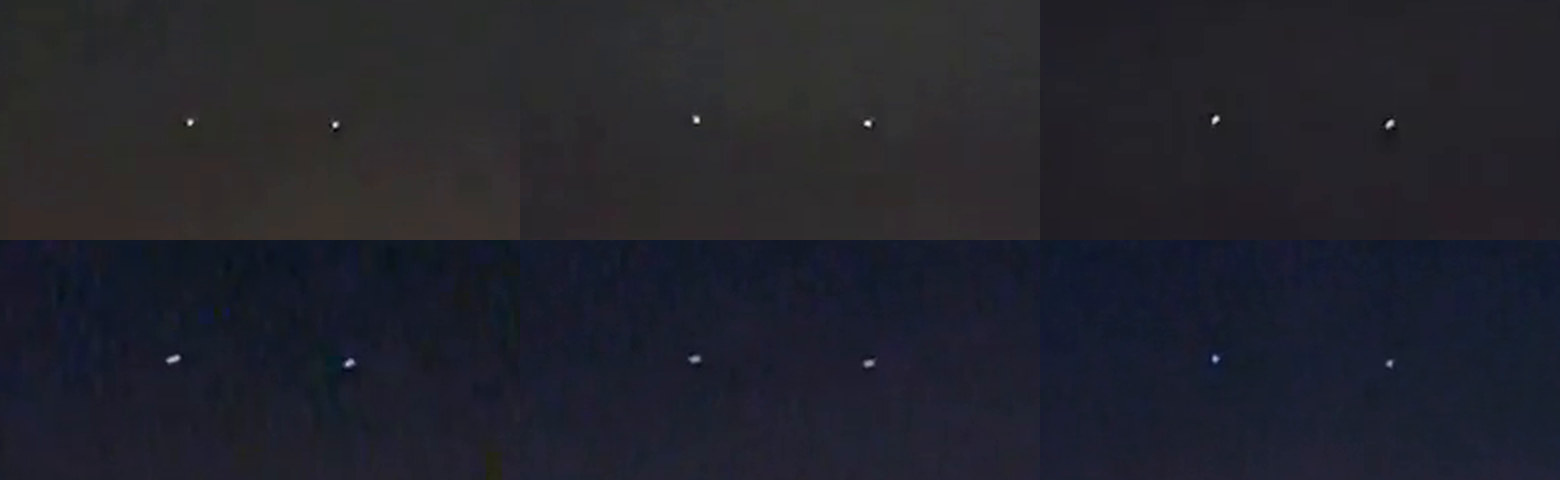
What the footage shows is two separate white points, close together, both rendering as short motion-blur streaks of equal length and identical tilt. No shape, no structure and no navigation colour resolve at this scale. The objects are a few pixels across.
More footage and images of this sighting
What is the official explanation?
There is no official narrative for this sighting. No agency has commented on it, no incident number from any national reporting body is attached to it, and the archive found no news coverage of any kind.
The filing carries an automatically generated sky-context block, computed from a 7 October 2026 orbital catalogue, which asserts two separate Starlink trains overhead near the time of the sighting: "5 satellites from one launch (ENE/ESE/N, around 00:40 UTC)" and "5 satellites from one launch (ENE/N/SW, around 00:34 UTC)".
That block is an automated lead, not a finding, and on this occasion its central word does not survive checking. A visible Starlink train, meaning a tight line of satellites still bunched together, is a short-lived post-launch phenomenon. The launch record for the twelve days before the sighting contains exactly one Starlink launch of any kind, Starlink Group 31-1 aboard Starship Flight 14 on 28 September 2026, nine days earlier, and no Falcon 9 Starlink launch at all. There was no freshly deployed train over Texas that evening. Individual Starlink satellites from older launches certainly passed overhead, as they do constantly, but that is a different claim from the one the block makes.
This is the third occasion on which this archive has found that automated block pointing at the wrong thing, after the Monterey County and Terrebonne cases.
What did the witnesses think it was?
The report records two witnesses and gives the apparent size as a pinhead at arm's length, the closest distance as "as high as a star", and the duration as five seconds. Against the standard observables checklist the reporter answered "unsure" to wings, rotors, exhaust plume, noise and sudden acceleration, and "yes" to extreme speed with no signatures, hard to observe clearly, and flight without visible means of lift. Asked why it could not be a common object, he wrote: "Nothing on ADSB or Satellitemap. 2 parallel objects."
That the witness ran those two checks himself is worth recording, and so is the fact that this archive cannot verify either of them. Public flight-tracking coverage is not complete, and a negative result on a consumer tracking site is weaker evidence than it feels.
The thread argued the case out in a way that was more useful than most. One commenter replied flatly that "those are aircraft wing lights. Nothing UFO about this." The reporter answered that depth was hard to judge from the angle but that the objects were "MUCH higher up" and "thousands of feet apart". A third commenter then made the observation that actually decides it: "How you can tell these are thousands of feet apart? The video is less than 5 seconds, so theres almost nothing to reference."
He is right, and the measurements below confirm it. The separation the witness is describing is an angular separation on a phone screen. Converting it into a distance requires knowing how far away the objects were, and nothing in this recording establishes that.
Is the Two Parallel Lights Over Austin, Texas, 6 October 2026 real? The two-pass assessment
Pass one, how this could be mundane.
Start with what can actually be measured, because most of this clip cannot be. Running the whole sequence through a background-subtracted frame analysis, the two objects track cleanly across a 50 frame window, from 0.33 to 1.97 seconds. Over that window the distance between them averages 86.2 pixels with a standard deviation of 2.95 pixels, a coefficient of variation of 3.4 per cent, and the axis joining them sits 1.20 degrees off horizontal with a standard deviation of 0.32 degrees. Both objects move together, the left at 1.93 pixels per frame in x and the right at 2.05, with straight-line fit residuals of 1.9 to 5.3 pixels.
That is a genuinely tight result and it is the one solid thing here. Two lights held a fixed angular separation and a fixed orientation, to within a few per cent and a third of a degree, while travelling in a straight line. Whatever they were, they were either one rigid object carrying two lights or two objects in close formation. This measurement is a comparison made inside each frame, between the two objects, so unlike everything else in this case it survives the camera being handheld.
Now the limits, which are severe. There is no static reference anywhere in the frame: the median of the background-subtracted frames peaks at 13.3 grey levels against a per-pixel temporal noise of 8.7, a ratio of 1.5, so no star is detectable and no plate scale can be derived. Without a plate scale there is no angular rate, and without an angular rate the words "extremely fast" cannot be tested at all. The 63 pixels per second measured for the pair is a number about a phone screen, not about the sky. Camera motion is also unmeasurable: phase correlation between frames returns a peak of roughly 0.007 against the featureless twilight sky, which is the low-peak case where the registration has nothing to lock onto, so no claim about the objects' absolute motion is supportable in either direction.
So the two headline claims both fail for the same reason. "Thousands of feet apart" requires a range nobody has. "Extremely fast" requires an angular rate the footage cannot yield.
The prosaic candidates are wide open. The sun was 9.4 degrees below the horizon at the time, from a JPL Horizons query for the site, which places the sighting in nautical twilight and puts the zenith Earth-shadow cutoff at about 87 kilometres. Every satellite above that altitude, in every direction, was in sunlight. Satellites were not merely possible, they were lit.
Aircraft are equally open, and the thread's answer deserves weight. Austin-Bergstrom International lies south-southeast of central Austin, which is close to the direction the witness reported the objects moving. Two steady lights at fixed separation is what an aircraft's lights look like.
Two measurements push gently against parts of that. The pair axis sits 1.2 degrees off horizontal while the direction of travel runs about 19 degrees off horizontal, so the two lights were side by side and roughly 20 degrees off their own line of travel. That is the wrong geometry for a satellite train, which strings out nose to tail along the track, and it is a normal geometry for a wing. On colour, both objects measure as effectively white, with a mean separation between the strongest and weakest colour channel of 14.0 and 12.1 grey levels, so no red or green navigation colour resolves. That is weaker evidence than it sounds, because the objects are only a few pixels across and a bright white landing light would swamp wingtip colour at this scale.
On flashing, both objects vary in brightness by about 21 and 24 per cent across the window, but they vary together, correlating at 0.830, and the frame mean luminance moves with them. That is the camera's automatic exposure, not the objects. No isolated bright spike of the kind an anti-collision strobe produces appears in the 1.67 seconds measured. A strobe typically fires about once a second, so that window should have caught one or two, which is a real if limited point against a conventional transport aircraft presenting its strobes toward the observer. It is not decisive: strobes can be masked by the airframe depending on aspect, and the clip is very short.
Weather removes one variable and adds nothing exotic. The automated station at Austin-Bergstrom reported clear skies and ten statute miles visibility at 19:53 local, four minutes after the sighting, with calm wind, and a second station northwest of the city reported the same. There was no cloud deck to put a ceiling on the objects, and no wind at the surface to carry anything.
Pass two, if it is not any of those.
Two lights holding formation to within three per cent of their separation and a third of a degree of their orientation, travelling in a straight line, with no colour and no detected strobe, is a real observation and the witnesses were not imagining the geometry. The archive can confirm that much and no more. What it cannot do is convert that geometry into a size, a distance, a speed or an altitude, and without any one of those the observation does not discriminate between an aircraft a few miles away and something else entirely.
The tier is Disputed rather than Strongly Disputed, and the reason is specific. In the Campo Largo, Spring Hill and Milwaukee cases this archive was able to name the prosaic answer and show it. Here it cannot. The satellite window was open but the side by side geometry fits a train poorly; the aircraft answer fits the geometry well but no strobe was detected and the witness's own flight-tracking check came back empty; and the recording is too short, too small and too far from its original to settle it. Asserting a prosaic identification would mean asserting a range this footage does not contain, which is the same error the witness made in the other direction.
Sources
- www.reddit.com/r/UFOs/comments/1wzksuy/two_parallel_fast_lights_moved_straight_and/
- ufosighting.report/sighting/13093/two-parallel-fast-lights-moved-straight-and-steady-over-aust
- ssd.jpl.nasa.gov/api/horizons.api
- ll.thespacedevs.com/2.2.0/launch/?net__gte=2026-09-25T00:00:00Z&net__lte=2026-10-07T23:59:59Z&search=Starlink&limit=60&mode=list
- mesonet.agron.iastate.edu/cgi-bin/request/asos.py?station=AUS&data=skyc1&data=skyl1&data=vsby&data=drct&data=sknt&year1=2026&month1=10&day1=6&year2=2026&month2=10&day2=7&tz=America%2FChicago&format=onlycomma&report_type=3
- geocoding.geo.census.gov/geocoder/geographies/coordinates
More cases from this region: UFO sightings in United States