Jimmy Carter's Leary, Georgia Sighting (1969)
Before he was President, Jimmy Carter saw a UFO. On a winter evening in 1969, waiting outside for a Lions Club meeting in the small town of Leary, Georgia, Carter and a group of other men watched a bright, color-changing light in the western sky for some ten minutes. Four years later he filed a written report describing it, and during his 1976 campaign he became the most famous American to say openly that he had seen one. Carter never claimed it was extraterrestrial, and skeptics make a strong case that the brilliant object low in the west was the planet Venus, or possibly a chemical cloud from a rocket launched that same evening. The sighting is real and well documented; what it was remains disputed.
What did witnesses see at Leary?
The sighting happened just after dark, around 7:15 p.m., as Carter and roughly ten to twelve members of the Leary Lions Club stood outside waiting for their meeting to begin. Carter, then a Georgia state senator and the district governor of the Lions Club, was the scheduled speaker that night.
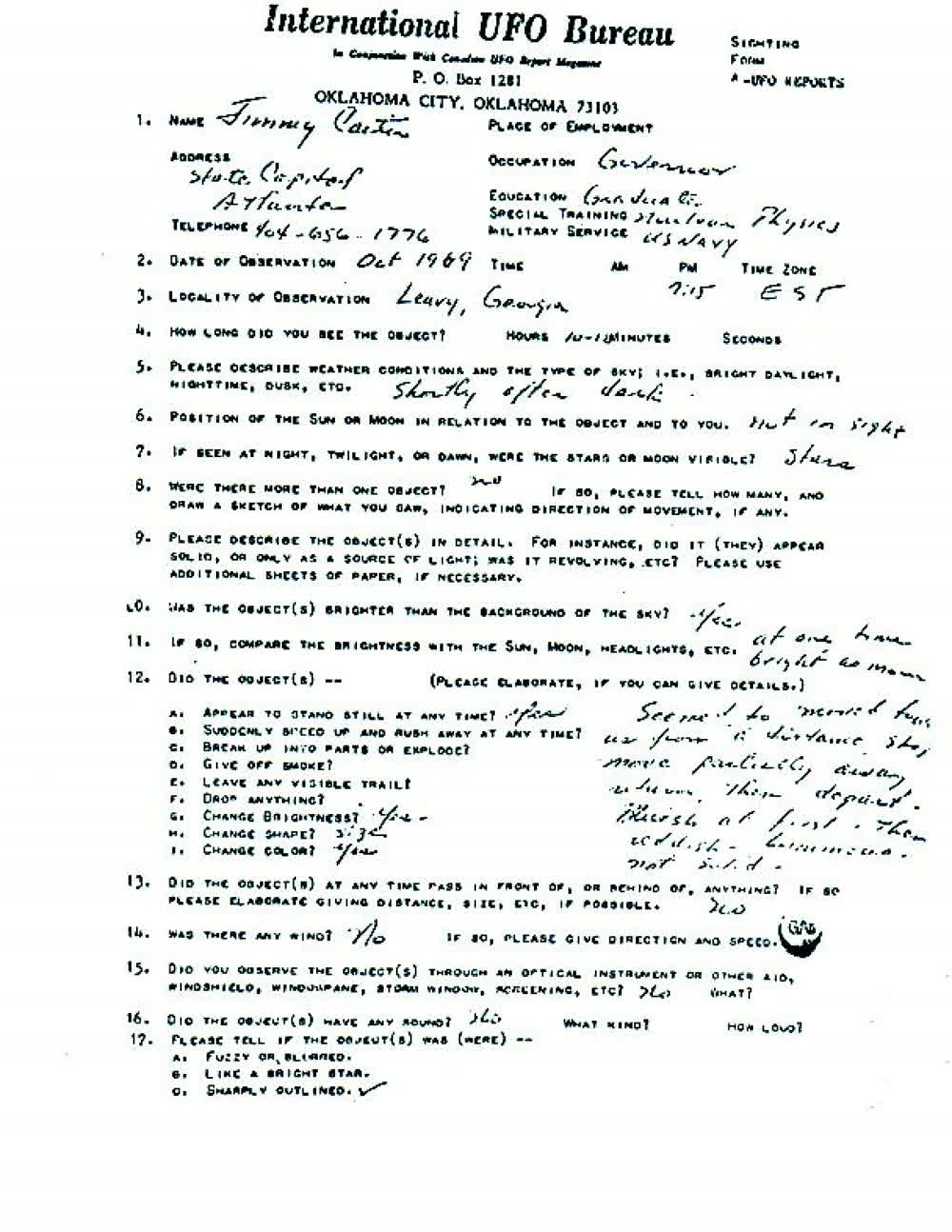
In the report he wrote later, Carter described a single self-luminous object in the western sky, about thirty degrees above the horizon. He marked it as "sharply outlined" and, at its brightest, "as bright as the moon" and about the same apparent size, "maybe a little smaller." Asked to describe its motion and color, he wrote: "Seemed to move toward us from a distance, stop, move partially away, return, then depart. Bluish at first, then reddish, luminous, not solid." He gave the duration as ten to twelve minutes, recorded no sound and no use of any optical instrument, and noted that the whole group watched it. In a separate interview he summed it up as "obviously there, and obviously unidentified," and on another occasion called it "probably an electronic occurrence of some sort."
What is the official explanation?
There was no government investigation of the Leary sighting. The defining document is not an official file but the questionnaire Carter completed for the International UFO Bureau, a private group in Oklahoma City run by Hayden Hewes. The Bureau wrote to Carter during the wave of UFO interest in 1973; he filled out and signed the two-page form on 18 September 1973, roughly four years after the event, and wrote on it, "You may use my name." The original is preserved in the Jimmy Carter Presidential Library and Museum under the National Archives.
A notable wrinkle sits on the form itself: Carter wrote the date of the sighting as "Oct 1969." Later research established that the Leary Lions Club meeting he addressed actually took place on 6 January 1969. Skeptic Robert Sheaffer traced the date through Lions Club International's own records of Carter's speaking engagement, and the January date is reinforced by the fact that Carter's term as district governor and the Leary chapter itself did not run into the autumn of 1969. The four-year gap between the event and the report, and the nine-month error in the remembered month, are part of why the details are weighed carefully.
As President, Carter did not order any broad release of UFO records. In 1977 his science adviser Frank Press asked NASA to consider taking up UFO study; NASA Administrator Robert Frosch declined in a letter that December, citing the absence of physical evidence to analyze and recommending no new research program. No NASA study followed.
What did the witnesses think it was?
Carter is, by almost any measure, a credible witness: a Naval Academy graduate trained in nuclear engineering, a careful and famously truthful man, and someone who filed his account under his own name and invited its use. The other witnesses are recorded only as the group of Lions Club members present; no individual corroborating report of evidentiary weight has surfaced, and some locals at the time offered prosaic guesses, with one club member reportedly thinking it a weather balloon. So the multiple-witness character of the case rests on Carter's account of the group rather than on separate filed statements.
The sighting entered national politics in 1976. The National Enquirer ran a piece headlined "Jimmy Carter: The Night I Saw a UFO," carrying the much-quoted line, "If I become President, I'll make every piece of information this country has about UFO sightings available to the public." Carter's actual campaign-trail wording appears to have been more guarded than the tabloid version, along the lines of agreeing to make such data public, and historians who have gone back to the record caution that he was less committal than the headline suggested.
What stayed consistent for the rest of his life was his interpretation. Carter repeatedly said he had seen something genuinely unidentified, while rejecting the idea that it was a craft from another world. In a 2005 interview he said, "I saw an unidentified flying object. I've never believed that it came from Mars," adding that he did not think tangible vehicles were flying in from another planet. He also said he had seen no evidence of any government cover-up. His position never wavered: he saw something he could not explain, and he declined to call it alien.
Is the Jimmy Carter's Leary, Georgia Sighting (1969) real? The two-pass assessment
Pass one, the mundane reading, is unusually strong in this case because there are two specific, well-grounded candidates, both pointing at the same patch of sky.
The classic explanation, argued by Robert Sheaffer for the skeptic group CSICOP in the late 1970s, is the planet Venus. On the evening of 6 January 1969, Venus was a brilliant evening star low in the west-southwest, about twenty-five degrees above the horizon at magnitude near minus four, far brighter than any star and roughly where Carter placed his object. Venus does not literally approach a viewer or change size, but, as Sheaffer noted, descriptions exactly like Carter's are typical of misidentifications of a brilliant planet near the horizon, where atmospheric turbulence makes it shimmer, flash colors, and seem to advance and recede. He pointed out that wartime aircrews repeatedly tried to shoot down Venus, mistaking it for an aircraft. A bright planet is the single most common source of sincere UFO reports.
Sheaffer later added a second, arguably better-fitting candidate. Researchers found that two rockets launched from Eglin Air Force Base in Florida on the evening of 6 January 1969 released chemical clouds, a barium cloud that glows red and a tri-methyl aluminum cloud that glows white to blue, which from Leary would have appeared in the same direction and height as Carter's object, around the same time, and would have shifted from bluish to reddish. That color sequence matches Carter's wording closely. Sheaffer treats this as an intriguing possibility rather than a settled answer, but combined with Venus it gives a powerful prosaic account of the sighting.
The witness's own memory works against the more exotic reading too. A report filed four years late, with the month wrong by nine months, is exactly the kind of recollection in which a fixed bright light or a slowly expanding cloud can be remembered as an object that moved, stopped, and returned.
Pass two, if it was not that. The case for an unexplained object rests on the credibility and number of the witnesses and on Carter's own conviction, as an amateur astronomer, that what he saw was not simply Venus. Those are real points, but they are points about the witness rather than independent evidence about the object, and no photograph, instrument reading, or separately filed account exists to test them.
Weighed honestly, this is a credible, multiple-witness sighting with a strong and specific prosaic explanation that was never conclusively proven. No one has shown that Carter fabricated anything; at most he, like many sincere witnesses, may have misidentified a brilliant natural or man-made light. That places the case as Disputed: genuinely contested, leaning toward a mundane source, but never closed. It is emphatically not discredited, and Carter remains the most credible public figure ever to go on record describing a sighting of his own.
Sources
- www.nicap.org/waves/CarterSightingRptOct1969.pdf
- www.debunker.com/texts/carter_ufo.html
- catalog.archives.gov/id/6277769
- badufos.blogspot.com/2017/01/jimmy-carters-ufo-sighting-was-it-venus.html
- badufos.blogspot.com/2020/06/widespread-sightings-clinch-that-jimmy.html
More cases from this region: UFO sightings in United States