The Cussac Encounter: Two Children, Four Beings and a Sphere
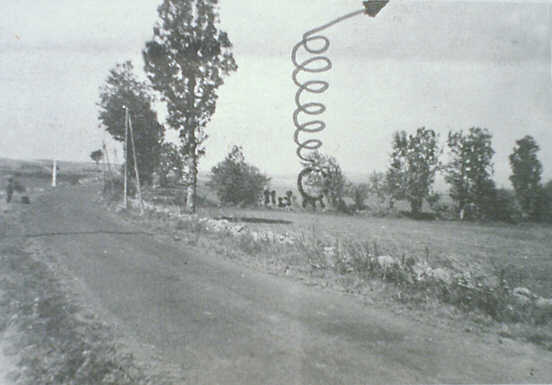
On a clear August morning in 1967 two farm children minding cows on a Cantal plateau said four small black figures rose into a brilliant sphere and left a sulphur smell behind. Eleven years later the French state investigated, concluded they had watched an unknown inhabited vehicle leave in a hurry, and then classified its own report confidential.
What did witnesses see at Cussac?
The morning of Tuesday 29 August 1967 was clear on the Cussac plateau, 1,042 metres up in the Cantal, with a light westerly wind and a temperature somewhere between 12 and 16 degrees. Francois Delpeuch, thirteen and a half, and his sister Anne-Marie, nine, had left the village at about eight o'clock with about ten of the family's cows and their dog Medor, walking roughly 800 metres west to a meadow beside departmental road D57. They sat behind a dry stone wall and played cards.
At about half past ten the cows tried to push through into the neighbouring pasture and Medor began barking. Francois stood up and turned to send the dog after them. Looking the other way, across the road and through a hedge of trees and shrubs, he saw four small figures dressed entirely in black. He took them at first for other children and said to his sister, who had her back turned, "Oh ! il y a des enfants noirs !" She asked without turning round, "Tu les appelles ?" and he answered simply, "Regarde." That exchange is recorded in GEPAN's own 1978 investigation file.
The figures stood between one metre and one metre twenty. Their arms were long and thin, their legs short and thin, their skulls slightly elongated and pointed, the chin marked, the nose pointed. The children described a sort of beard at the sides of the head with a small tuft under the chin. No eyes or ears were made out. Two of the four faced each other. One held a rectangular object at head height that caught the sun like a mirror. The fourth appeared to be kneeling on the ground.
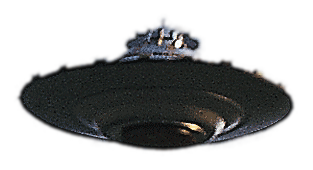
Beside them, partly screened by the hedge, sat an intensely bright object. The first press account in La Montagne on 1 September 1967 gave it as four metres long by two metres high. In every later telling it became a sphere, silvery and smooth, of roughly two to four metres. Anne-Marie insisted she had seen three or four straight legs beneath it fitted with circular pads about ten centimetres across. Francois never saw them and suggested to the investigators that she had mistaken the branches of the hedge.
Francois climbed onto the dry stone wall to see better. The four beings went into the object head first, rising and diving in through the top. One came back out, took a few steps, picked up the mirror-like object from the ground and dived back in when the machine was already fifteen to twenty metres up. Francois told GEPAN he heard "un sifflement plus un souffle, comme un canot a moteur au demarrage" while it was still on the ground. It climbed in a helical path, about six turns clockwise seen from below, then went away towards the west-northwest, in the direction of the Plomb du Cantal.
The cows bellowed, Medor barked at the object, and about twenty-five to thirty cattle in a field a few hundred metres away came over to join the children's herd. A smell the children called sulphur spread across the ground. Francois could not keep looking: "Je n'ai pas pu la regarder plus longtemps, j'avais mal aux yeux, je pleurais. Alors je me suis occupe des vaches parce qu'elles s'etaient toutes mises a beugler. Le chien aboyait." He had watering eyes for the next quarter of an hour and again on waking for several mornings; GEPAN recorded red eyes for close to ten days. Anne-Marie, who wore no glasses, reported nothing. Both slept badly for a night or two. Walking home early they met a farmer, Monsieur V., who was spreading manure and who saw how frightened they were, then reached the family farm in tears.
More footage and images of this sighting
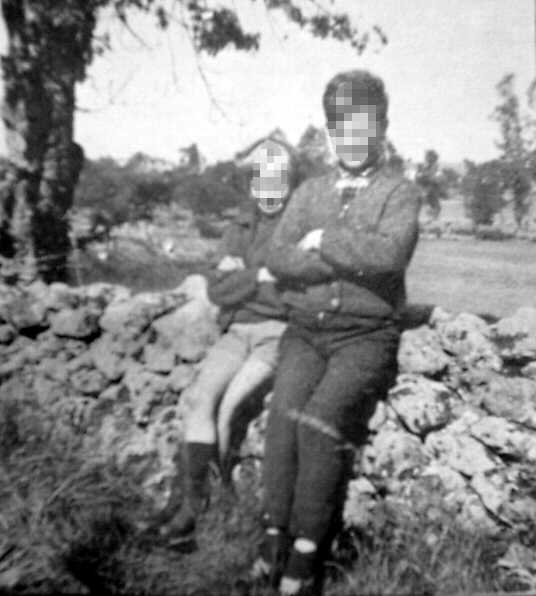
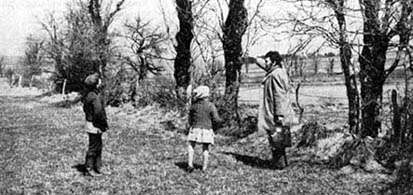
The 30 page scan of the GEPAN 1978 Cussac investigation file, annexe 8 of tome 4 of the presentation to the GEPAN scientific council, CNES/CT/GEPAN n. 0140, June 1978. Released publicly in March 2005 with explicit CNES agreement, carrying a CNES covering note stating it is not the agency's definitive position. Contains the sky chart for 29 August 1967, the filled-in matrice de test des phenomenes connus for Cussac, and sections 8, 9 and 10 with the conclusion. View source
What is the official explanation?
The children's father was mayor of Cussac. He went up to the meadow with his son, then telephoned the gendarmerie, telling GEPAN later that he did so because a prefectural circular two or three years earlier had instructed mayors to report anything abnormal on their territory during military manoeuvres. Gendarmes from the Saint-Flour and Neuveglise brigades reached the field at about four o'clock the same afternoon. Adjudant Azas of Saint-Flour handled the enquiry and was quoted in the La Montagne article of 1 September 1967. One of the gendarmes, identified in the GEPAN file only as S., said he had seen a roughly circular patch four to five metres across where the grass looked yellowed, and that he had noticed a strong smell. Crucially, no proces-verbal was ever drawn up and none has ever been found, despite two brigades attending on a mayor's call. The gendarmes are recorded as having leaned towards a piloted military machine, probably belonging to a foreign power.
The official study came eleven years later. In April 1978 GEPAN, the UAP group set up inside CNES in Toulouse the previous year, sent four people to Cussac for two days: a retired magistrate and former examining judge, a CNES optical engineer, Claude Poher, GEPAN's founding director, and his secretary. They re-interviewed both witnesses on site, took theodolite sightings using the hedge trees as reference points, ran timed re-enactments and carried out an odour identification test. Their report, "Enquete sur l'observation du 29.08.67 de Cussac (Cantal)", is annexe 8 of tome 4 of "Presentation au Conseil scientifique du G.E.P.A.N. des etudes menees pendant le premier semestre 1978", referenced CNES/CT/GEPAN n. 0140, June 1978. It was kept confidential at the request of the scientific council that oversaw the group, and the witnesses themselves were never told what it concluded.
The measured results are specific. The distance from the witnesses to the object came out between 71.5 metres for Anne-Marie and 82 metres for Francois. The distance from the road to the centre of the object came out at 30 metres taking the boy's sightings and 33 metres taking the girl's. The total observation time was reduced to between 21 and 35 seconds. The odour test offered four substances chosen in advance, sulphur dioxide, nitrogen dioxide, kerosene and acetone, to the two children plus the gendarme and the village warden; the answers varied and none of the four really matched. On the alleged ground trace, GEPAN's own report states that the weak colour contrast the gendarme recorded against a Pantone 379 reference does not allow the trace to be taken into consideration, a line that neither Poher nor Jean-Jacques Velasco reproduced in their own later popular accounts.
Section 8 of the report, headed "Consequence de la coherence des recits", states: "La coherence des recits des temoins independants et le fait que la plupart des questions que nous avons posees n'avaient rien a voir avec les recits repetes souvent au cours des 11 ans ecoules, nous conduisent a conclure que les faits rapportes ont ete reellement observes." Section 9 then works through the alternatives: "Nous avons cherche a reduire cette observation a des phenomenes connus. Le seul phenomene qui nous semble convenir pour expliquer tous les aspects (et en particulier les quatre occupants) serait un helicoptere. Neanmoins, la forme de l'objet, sa couleur, sa brillance, sa trajectoire, le silence au sol, la disparition inexplicable dans le ciel, la vitesse de montee, la vitesse de parcours de la trajectoire helicoidale, la taille et l'habillement des occupants, leur fuite, la proximite des arbres de la haie, l'odeur degagee, tout cela ne permet pas de retenir l'hypothese de l'helicoptere." Section 10 concludes: "Nous estimons que le 29 aout 1967, les observateurs de CUSSAC ont assiste au depart precipite d'un vehicule habite tout a fait inconnu, aux caracteristiques et aux performances depassant largement nos connaissances technologiques personnelles."
The dossier also contains GEPAN's "matrice de test des phenomenes connus" filled in for Cussac on sheets A8.40 and A8.41, with the case entered as type RR3, daytime, short duration, fine weather, distance under 150 metres, noise yes, round, white, intense luminosity, several witnesses, reaction fear. The stated result is blunt: "Le produit de toutes les probabilites est nul pour toutes les colonnes. Aucun phenomene connu ne convient. Le tableau suggere l'hypothese psychologique mais le fait qu'il y ait des temoignages independants ne permet pas d'accepter celle-ci comme recevable."
The file became public in March 2005, when the journalist Gregory Gutierez obtained CNES agreement to put a redacted version online. Three pages of psychological analysis were withheld because they draw on the witnesses' medical records, but its conclusion is quoted on the release's own cover sheet: "Il n'existe dans ces divers elements aucune faille, aucune discordance qui permette de douter de la sincerite des temoignages, ni d'envisager raisonnablement une invention, une supercherie, une hallucination. Dans ces conditions, malgre le jeune age a l'epoque des temoins principaux et aussi extraordinaire que paraissent les faits qu'ils ont relates, je pense qu'ils les ont reellement observes." That same cover sheet carries a caveat from Arnaud Benedetti, then CNES director of external communication, and David Assemat, technical director of CNES Toulouse: the report "ne represente pas la position definitive du Cnes sur ce cas, mais un travail realise par une equipe dans le cadre d'un processus qui devait se poursuivre devant le Comite scientifique du Gepan. Ce comite a recommande la plus grande vigilance quant aux interpretations des faits rapportes, de quelque nature qu'ils soient."
One further official point matters and is usually got wrong. GEIPAN, the successor body, classifies its public cases A for perfectly identified, B for probably identified, C for insufficient data and D for unidentified after investigation, with D split since 2008 into D1 for strange cases of medium consistency and D2 for very strange cases of strong consistency. Cussac carries no such letter, because it is not in GEIPAN's public case database at all. A query of that database across the whole of 1967 returns exactly one record, Seillons-Source-d'Argens in the Var, classified C. The official French position on Cussac therefore rests entirely on the 1978 GEPAN annex, a document CNES itself has publicly declined to adopt as final.
What did the witnesses think it was?
Neither child has ever taken the story back, and both were pushed hard. Francois Delpeuch was short-sighted and astigmatic, and had been a sickly boy: a badly treated streptococcal infection had left him with acute articular rheumatism and cardiac complications, exempted from sport, on a salt-free diet and puffy from cortisone. At the lycee in Saint-Flour his classmates nicknamed him "le Martien". He told the counter-investigators in 1983 that if he had been alone that morning his parents would have had him treated. He went on to become a lawyer and eventually mayor of Saint-Flour, which is not the career of a man who found the story convenient.
What he believed shifted, and that is worth stating plainly rather than smoothing over. As an adult he refused the extraterrestrial reading. To Thierry Pinvidic, Bertrand Meheust and Jean-Pierre Grangeon in July 1983 he described something closer to a rupture in time and space that he could not explain physically, saying he had been so fixed on the object that he no longer knew whether the surroundings still existed, that time seemed to stop, that he felt petrified. He also told GEPAN that at the moment itself he had "les yeux lourds" and was "comme paralyse", and had struggled to climb onto the stone. He carried a sense of guilt about the episode without being able to say why.
Anne-Marie is the quieter and, in one respect, the more stubborn witness. She was nine, generally deferred to her brother, and yet on one point she flatly contradicted him and never moved: she said the sphere stood on three or four struts with rounded pads, and he said he had never seen them. She is also the source for the pointed nose and for the two swellings on either side of the face. In 1985 Pinvidic, Meheust and Grangeon interviewed her as an adult, along with the village warden, the farmer Monsieur V. and the parents. They had provisionally preferred in 1983 a model in which the episode was a personal experience of Francois that his sister had partly endorsed under folkloric influence. After hearing her they dropped it, judging that she had genuinely seen the scene rather than imagined it, and their two-year counter-investigation ended with the case unidentified.
There is real independent corroboration, and there are real cracks in it. The village warden, D., was in his hayloft about 500 metres away and heard what he told GEPAN in 1978 was "un sifflement melange d'un ronflement", a noise he had never heard before and which was neither a helicopter nor an aeroplane. In 1985, to Pinvidic, he said that at the time he had put that whistling down to a helicopter passing over his house, which is a significant walk-back. He also described a smell so strong it nearly choked him near the edge of the village that evening, more than ten hours after the sighting, a smell that had not troubled the children at half past ten, the mayor at half past eleven or the gendarmes in the afternoon. Monsieur V., driving a tractor and spreading manure a few hundred metres off, saw and heard nothing but met the children in tears minutes later. A further farmer, who reported the cattle's agitation, was already dead when GEPAN arrived and no private investigator ever reached him.
One detail everyone repeats is not the children's. La Montagne, the GEPA investigators and LDLN all carried a line in which Francois calls out to the beings, "Vous voulez bien venir jouer avec nous ?" In 1977 the LDLN investigator Luc Bourdin concluded the phrase was a journalistic invention, and that the children had realised almost at once these were not children. Francois denied it to GEPAN in 1978. The villagers, for their part, were not uniformly kind: Paris-Jour reported on 2 and 3 September 1967 that it was locals who told the gendarmes about a prize offered a fortnight earlier by a regional radio station from Clermont-Ferrand to the first person who saw a Martian. The children kept to their account through that mockery and through six decades of investigators, and never claimed a reward.
The dispute
The dispute is a specific, named, method-showing sceptical reconstruction, not an official assertion. Eric Maillot opened it for the CNEGU group in Les Mysteres de l'Est in 1996 and published it online on 10 January 1999 as "Les ufologues et l'ovni de Cussac : 30 ans dans un cul-de-sac". He later worked it up with David Rossoni and Eric Deguillaume into chapter 10 of "Les OVNI du CNES, trente ans d'etudes officielles (1977-2007)", issued by the Observatoire Zetetique in 2007. Their claim is that the children saw a light helicopter land briefly behind the hedge and take off again, with its crew or passengers mistaken for small black beings, and that the strangest details in the modern version of the story were added between 1967 and 1978 rather than reported at the time.
The method behind it is real work, not assertion. They dated the escalation of the account from the contemporary documents: La Montagne on 1 September 1967 gives a machine "de quatre metres de long sur deux metres de haut", not a sphere; LDLN issue 90 of September to October 1967 has one being step out and get back in while the craft is still on the ground, with no flying dwarfs at all; Francois's letter to Claude Pavy of 3 March 1968 introduces one being rising to about twenty metres; the four flying beings appear only after the GEPA site visit that spring. They showed that Pavy's questionnaires were leading, one of them asking whether the being had bent down and appeared to pick something up before the children had ever mentioned it. They noted that the sun stood behind the witnesses, so any canopy or polished panel would flare, that a hedge running north to south would put figures in shadow and render them uniformly black, that a leather flying helmet with earphones and loose straps produces a pointed skull, ear swellings and side whiskers, that heavy boots produce "webbed feet", and that climbing into a helicopter means launching yourself onto a high step and ducking in head first. They went to the site in August 2004, put a man in a black anorak behind the hedge and photographed the effect, and separately watched a real helicopter come over the hill to the northwest and found its noise brief and hard to distinguish from the tractor that Monsieur V. had been driving that morning at about 100 decibels. They pointed out that the same farmer had spent the morning spreading manure, that anaerobic decomposition produces hydrogen sulphide and ammonia, and that GEPAN's odour test offered only sulphur dioxide, nitrogen dioxide, kerosene and acetone, with no farm odour on the card. They also used GEPAN against itself, quoting the report's own admission that at about 80 metres the witnesses could not have made out details, only a silhouette, and its own finding that the Pantone 379 contrast of the alleged ground trace was too weak for the trace to count.
What the dispute does not have is an identification. Maillot traced the departure azimuth about 160 kilometres to Limoges-Feytiat, where a gendarmerie air detachment existed in 1967, and in November 1995 asked Jean-Jacques Velasco of SEPRA, publicly, at the Vaulx-en-Velin planetarium, to query the Centre d'Archives de la Gendarmerie Nationale. Velasco confirmed in writing months later that the search was under way, and then nothing ever came back. Maillot's own text presents his scenarios, a gendarmerie helicopter recovering a fallen radiosonde with its aluminised radar reflector as the "mirror", a crew stopping for a comfort break, an autorotation training landing, an aerial archaeology survey, under the heading "hypotheses explicatives verifiables", and says that the future will judge. No aircraft, no unit, no flight, no pilot has ever been matched to 29 August 1967 over Cussac. Patrick Gross has further shown that the distance quoted for the sceptics' own on-site simulation photograph, fifty metres, actually measured photographer to hedge and not photographer to figure, and that the figure stood at over a hundred metres, which works against the helicopter reading rather than for it.
So the dispute wounds the case without closing it. The false-memory and contamination arguments are the strongest part of it, and they are genuinely troubling, but they remain a contested psychological reading of two witnesses who have never contradicted their core account, backed by a village warden who reported an unfamiliar whistling from 500 metres and a gendarme who reported a smell and a yellowed patch that afternoon. On this archive's standard, a plausible but unproven reconstruction plus a contested psychological argument is Barely Disputed. It is not Strongly Disputed, because nobody has produced the helicopter.
Is the Cussac Encounter: Two Children, Four Beings and a Sphere real? The two-pass assessment
Pass one, the ordinary reading. The most developed sceptical case is Eric Maillot's, first published for the CNEGU group in Les Mysteres de l'Est in 1996, put online in January 1999 as "Les ufologues et l'ovni de Cussac : 30 ans dans un cul-de-sac", and expanded with David Rossoni and Eric Deguillaume into chapter 10 of "Les OVNI du CNES, trente ans d'etudes officielles", published by the Observatoire Zetetique in 2007. It proposes a light helicopter, either an Alouette II with its large curved plexiglass canopy or a Bell 47, nicknamed the goldfish bowl, both common in France in 1967. The sun at about half past nine solar time sat behind the witnesses, so any glass, plexiglass or polished metal in the field would have flared; Francois himself told Claude de Saint-Etienne in 1968 that it was "un rond en metal brillant mais pas lumineux". Normal-sized men, further back than GEPAN placed them and visually truncated by the half-metre wall and the hedge, would read as short figures with legs too short and arms too long; a hedge running north to south would put them in shadow and make them uniformly black; a period leather flying helmet with earphones and loose straps accounts for the pointed skull, the swellings at the ears and the side whiskers; heavy boots account for the webbed feet. Boarding a helicopter means launching yourself upward onto a high step and ducking in head first, which at eighty metres and in profile can genuinely read as a dive. Maillot and Rossoni went to the site in August 2004 and watched a real helicopter come over the hill to the northwest, and found its noise both brief and hard to separate from a tractor that had passed minutes earlier; the tractor Monsieur V. was driving would have run at about 100 decibels against a helicopter's 80 to 100 at greater range. The smell has a farm candidate that GEPAN never put on its test card: Monsieur V. spent that morning spreading manure, and anaerobic decomposition gives off hydrogen sulphide and ammonia. The trace was disqualified by GEPAN's own Pantone measurement. And the contamination argument is genuinely uncomfortable. Children at Arc-sous-Cicon in the Doubs had reported four small all-black beings on 17 July 1967, six weeks earlier and 340 kilometres away, and it got wide press and radio coverage. A Soviet satellite re-entry on 18 July produced headlines such as "L'invasion de soucoupes volantes" on 19 July. A radio prize for the first Martian was circulating a fortnight before. Claude Pavy of GEPA sent the family leading questionnaires on 17 September and 16 November 1967, one of which asked whether the being "s'est-il baisse ? a-t-il paru ramasser quelque chose ?" before the children had ever said so, and the picking up of the mirror duly appears afterwards. The flying dwarfs escalate from none in the September 1967 accounts, to one in Francois's letter of 3 March 1968, to four after the GEPA visit that spring. Francois had read hundreds of UFO books by the time GEPAN arrived. A pure children's fabrication cannot be ruled out either; the Premanon case in the Jura is a French precedent for exactly that.
But the ordinary reading stops short of an identification, and it stops short by its author's own admission. Maillot traced the departure azimuth 160 kilometres to Limoges-Feytiat, where a gendarmerie air detachment existed in 1967, and in November 1995 asked Jean-Jacques Velasco of SEPRA in public at the Vaulx-en-Velin planetarium to query the Centre d'Archives de la Gendarmerie Nationale. Velasco confirmed in writing that the search was running, and nothing ever came back. Maillot's own headings call his scenarios "hypotheses explicatives verifiables" and he writes that the future will judge. No aircraft has been identified, no flight log produced, no pilot found, no operator matched. Patrick Gross has also shown that the sceptics' own site photographs place the simulated figure at over a hundred metres rather than the fifty they stated, which pushes the reconstruction away from a helicopter rather than towards one.
Pass two, if it happened as described. The official apparatus here did not behave like an apparatus closing a case. GEPAN ran the fullest field investigation it had done, ruled out the helicopter explicitly and item by item, found the psychological hypothesis inadmissible because of the independent secondary witnesses, and then wrote that the children had watched an inhabited vehicle leave in a hurry with characteristics far beyond its own technical knowledge. That report was then made confidential at the request of its own scientific council and the witnesses were not told. Velasco's 1993 book offered three readings of the beings: imagined by frightened children, real and possibly robotic, or images from a holographic film projected from the sphere. The weakest link on this side is Claude Poher's own 2004 reconstruction, in which the spiral grows from 10 to 50 to 100 metres at about one turn per second, giving Mach 2 to Mach 5 with no sonic boom and 70 to 160 megawatts radiated at take-off. That figure sits badly against a meadow with no thermal damage, and it is built on angular gestures the witnesses made with an outstretched finger eleven years later.
Tier: Barely Disputed. There is a real, detailed, method-showing counter-explanation, and it deserves to be taken seriously rather than waved away. What it does not have is the thing that would move this case to strongly disputed: no confession, no recantation, no recovered props, and above all no positive identification of a specific real-world aircraft, unit or flight. It is a reconstruction. Against it stand two witnesses who have never contradicted each other's core account in fifty-nine years, a village warden and a gendarme who reported sound and smell independently, an investigating magistrate who found no fault line in the testimony, and a state report whose conclusion its own parent agency declined to adopt and declined to publish. The false-memory argument is powerful but contested, and by this archive's standard a contested psychological argument does not close a case. The witnesses were children, and children who were mocked for it, which is a reason to weigh their testimony carefully rather than to discard it.
Sources
- extraterrestre.org/wp-content/uploads/1967/08/Rapport_Gepan.pdf
- www.zetetique.fr/wp-content/uploads/2019/03/OvniDuCnes_chapitre10.pdf
- www.zetetique.ldh.org/cussac.html
- ufologie.patrickgross.org/ufology/cussacgepaf.htm
- ufologie.patrickgross.org/ufology/cussacgepa.htm
- ufologie.patrickgross.org/ufology/cussacldln67f.htm
- ufologie.patrickgross.org/ufology/cussaclagarde.htm
- ufologie.patrickgross.org/ufology/cussac-01f.htm
- rr0.org/science/crypto/ufo/enquete/dossier/Cussac/index.html
- gregorygutierez.com/doku.php/ovni/l_obversation_de_cussac_en_1968_historique_des_debats
More cases from this region: UFO sightings in France