The Flatwoods Monster
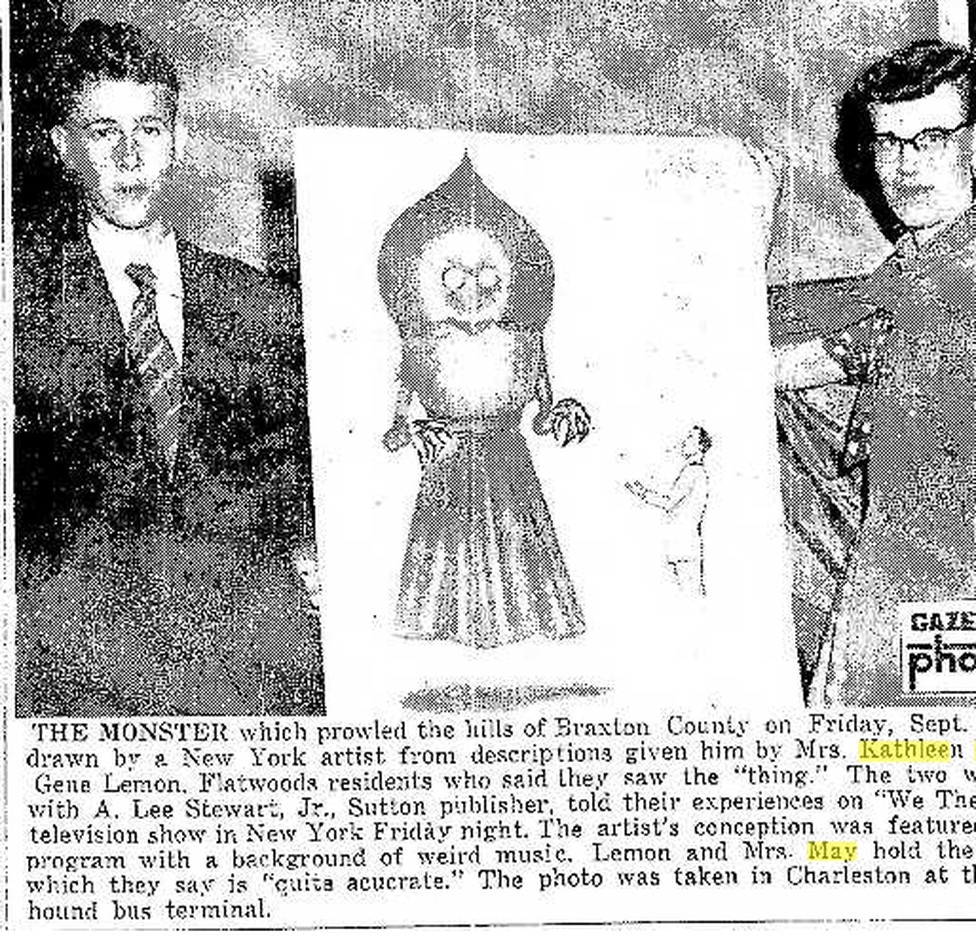
On a September evening in 1952, a mother, a teenage National Guardsman and a handful of schoolchildren climbed a West Virginia hillside to investigate a light that had seemingly come down from the sky, and met something they would describe for the rest of their lives: a towering figure with a blood-red face, a black cowl shaped like the ace of spades, glowing eyes and a draped metallic body that hissed and glided toward them through a sickening mist. They fled in terror; several were ill that night. Decades of skeptical work has explained the light as a meteor and the creature as a startled barn owl, yet the case has never been cleanly closed, and the Flatwoods Monster remains one of the most fiercely disputed encounters of the modern era.
What did witnesses see at Flatwoods?
In the early evening of Friday, 12 September 1952, three boys were playing on the grounds of the Flatwoods School in Braxton County, West Virginia, when they saw a bright object cross the sky at about 7:15 and appear to come down on a hilltop on the G. Bailey Fisher farm. The boys, Edward and Fred May and Tommy Hyer, ran to the nearby home of the Mays' mother, Kathleen May, a local beautician. She agreed to go and look. The party that started up the hill in the dusk grew to seven people and a dog: Kathleen May, a seventeen year old West Virginia National Guardsman named Eugene Lemon, the three boys, and two more local children, fourteen year old Neil Nunley and ten year old Ronnie Shaver, with Lemon's dog running ahead.
Near the crest the dog bolted forward into the dark, barking, then came running back past the group with its tail between its legs. The party pressed on and saw, beyond the rise, a glowing globe or pulsing red light "as big as a house," and a low-lying mist. When Lemon raised his flashlight toward a pair of shining points in a nearby tree, the beam fell on something none of them had words for.
They described a figure perhaps ten feet tall, with estimates ranging wildly from seven to seventeen, with a round, blood-red face and, framing it, a dark pointed cowl shaped like the ace of spades. Two glowing orange or orange-green eyes, which Kathleen May likened to half-dollars, stared from the red face. Below, the body was dark and seemed pleated or draped, like folds of cloth or green metallic armour. The thing made a hissing sound and glided toward the group without seeming to walk or touch the ground. Lemon fainted or dropped his flashlight, the others hauled him up, and the whole party fled down the hill in terror, back to the May home and then to the authorities. Several reported that a foul, metallic, oily mist had stung their throats and noses; Lemon was sick through the night.
What is the official explanation?
The first person up the hill with the witnesses that night was A. Lee Stewart Jr., co-owner and a reporter for the Braxton Democrat in nearby Sutton, who arrived soon after the encounter and interviewed the badly shaken group. He went up the hillside in the dark and, returning at dawn, reported a lingering sickening odour, "a sort of metallic smell," still hanging over the site, along with two long gouges or skid marks pressed into the ground and a thick, gummy black deposit. Those traces became part of the legend, but they did not survive scrutiny: the marks were later attributed to a 1942 Chevrolet pickup driven by a local man, Max Lockard, who had driven up to the site to have a look. The county sheriff and a deputy searched the area that night and the next day and found nothing they could identify.
Within a week the case drew serious investigators. Gray Barker, a Braxton County native writing for Fate magazine, arrived on 19 September, tape-recorded the witnesses, and published "The Monster and the Saucer" in the January 1953 issue; he came away struck by what he called the sincerity of the witnesses and the consistency of their detail, and said he could not break their accounts down. The naturalist and investigator Ivan T. Sanderson was on the ground the same weekend, and the two compared notes. Kathleen May and Gene Lemon were taken to New York to appear on the television program "We the People," where a sketch artist drew the creature from their descriptions; that drawing, published in the Charleston Gazette on 23 September 1952, became the case's defining image.
Contrary to a claim repeated in many retellings, there is no evidence that Project Blue Book ever mounted a formal field investigation of Flatwoods. The Air Force's own program does not appear to have sent investigators to the hill, and the often-quoted "official" verdict of meteor, owl and beacon is a later reconstruction by skeptics rather than a closed government finding. The author Donald Keyhoe wrote in 1953 that Air Force intelligence men had quietly looked into it and called the object a meteor, but that is a secondhand account that cannot be tied to any released document.
What did the witnesses think it was?
What anchors the case is the witnesses themselves. There were seven of them, plus the dog, and they gave broadly consistent accounts the same night, before the press and the public could shape the story. They were ordinary people, a mother, a guardsman, and a cluster of schoolchildren, with nothing obvious to gain and a great deal of ridicule to lose, and several of them were genuinely, physically unwell afterward, with irritated throats and nasal passages and, in Lemon's case, vomiting that lasted into the night. Fright alone is the usual explanation offered for those symptoms, and it may be right, but the illness was real enough to be noted by everyone who dealt with them that night.
Kathleen May in particular held to the core of her account for the rest of her life. Her one consistent complaint was not about the encounter but about the famous drawing: she told the later researcher Frank Feschino that the New York artist had added features she never described, including arms. Asked why the figure in the published sketch had arms, she said she had told the artist as much at the time, "but that's what he drew on it, to make it look more like a monster I guess," and that what she had actually described near the head was something more like antennae. The original artwork, long thought lost, was reportedly rediscovered in Braxton County years later and is held privately; the museum in Sutton displays reproductions.
Some details that circulate widely could not be confirmed against a primary source and are left out of the verified account here: the name sometimes given for the investigating sheriff, and the frequently repeated claim that the dog sickened and died days later, which the contemporary accounts do not support, recording only that it fled.
Is the Flatwoods Monster real? The two-pass assessment
Pass one, how this could be mundane. The skeptical case, assembled most fully by the investigator Joe Nickell in Skeptical Inquirer in 2000, stacks several ordinary things that happened to coincide. First, the object in the sky: a bright, slow meteor crossed the eastern United States at dusk that evening, confirmed by a staff member of the Maryland Academy of Sciences who logged a meteor over Baltimore minutes before the Flatwoods sighting, with further reports from Pennsylvania and West Virginia. The boys, on this reading, saw a fireball appear to "land" beyond the hill. Second, the pulsing red light on the ground: a local teacher pointed out that red aircraft beacons were visible from that hilltop, and Nickell identified three. Third, and most cited, the monster itself: a barn owl perched in a tree, its eyes shining when the flashlight hit it, its talons and pale heart-shaped face suggesting claws and a face, the foliage of the branch below reading as a pleated skirt, and its startled hiss and sudden launch from the branch supplying the sound and the lunge. Add the genuine human tendency to misjudge size and distance under fear, and a four-foot owl becomes a ten-foot giant. The nausea, on this account, was fright and the lingering smell of the mist, not a chemical agent, and the ground traces were Max Lockard's pickup. Nickell's own summary was that a mystery is often "an ordinary thing out of place," and that Flatwoods was probably several unusual but ordinary things in the same place at the same time.
Pass two, what the explanation leaves unaccounted for. The meteor is well documented and almost certainly explains the light in the sky; that much is solid. The owl is where the reconstruction becomes a hypothesis rather than a finding. No owl was ever produced, and the theory has to carry a great deal: seven witnesses, including an adult, converging on a single ten-foot figure that hissed and glided toward them, the consistent description of a spade-shaped cowl and a draped lower body that does not obviously map onto a perched bird, and the physical illness that followed. Skepticism is owed in both directions, and the owl-meteor-beacon synthesis is itself a claim with its own burden of proof, one it has never fully met. Against it stand the number and consistency of the witnesses, Gray Barker's inability to shake their stories, Kathleen May's lifelong steadiness, and the simple fact that no official body ever actually resolved the case on the record. The honest position is that Flatwoods is strongly disputed: there is a coherent, widely accepted prosaic explanation that probably accounts for much of the night, and a residue of testimony and physical symptoms that it does not cleanly close. It is not demonstrated, and so it is not discredited; it is contested, and it remains one of the most argued-over encounters in American UFO history.
Sources
- braxtonwv.org/the-flatwoods-monster/folklore/
- skepticalinquirer.org/2000/11/the-flatwoods-ufo-monster/
- aiptcomics.com/2019/01/16/history-channels-project-blue-book-the-real-story-of-the-flatwoods-monster/
- www.history.com/articles/flatwoods-monster-west-virginia
- theresashauntedhistoryofthetri-state.blogspot.com/2018/09/the-braxton-county-monster-drawing.html
- appalachianhistorian.org/the-flatwoods-monster-how-a-1952-hilltop-sighting-shaped-west-virginias-ufo-folklore/
More cases from this region: UFO sightings in United States