The Galileo Project's Fourth Observatory, at Carl Sagan's Former House in Ithaca, New York (5 November 2026)
Harvard astrophysicist Avi Loeb and the recycling entrepreneur Adam Weitsman announced on 5 November 2026 that the Galileo Project will build its fourth observatory, pairing passive radar with a 0.7 metre telescope, inside the Ithaca house once owned by Carl Sagan.
What did witnesses see at 900 Stewart Avenue?
This case file records the announcement of a scientific instrument, not a sighting. The pin marks 900 Stewart Avenue in Ithaca, New York, the building that is to house the observatory, and no anomalous object has been reported there.
A press release datelined ITHACA, N.Y., November 5, 2026 announced that Harvard University astrophysicist Avi Loeb is developing a first-of-its-kind Galileo Project observatory in Ithaca with funding from the entrepreneur and philanthropist Adam Weitsman. Loeb reproduced the release in full in a post on his own Medium page on 10 November 2026 at 18:30:43 GMT, which is the version this archive worked from and cites. Local coverage followed: 607NewsNow, the news service of News Talk WHCU in Ithaca, published its own report on 13 November 2026 under the byline of news director Joe Salzone.
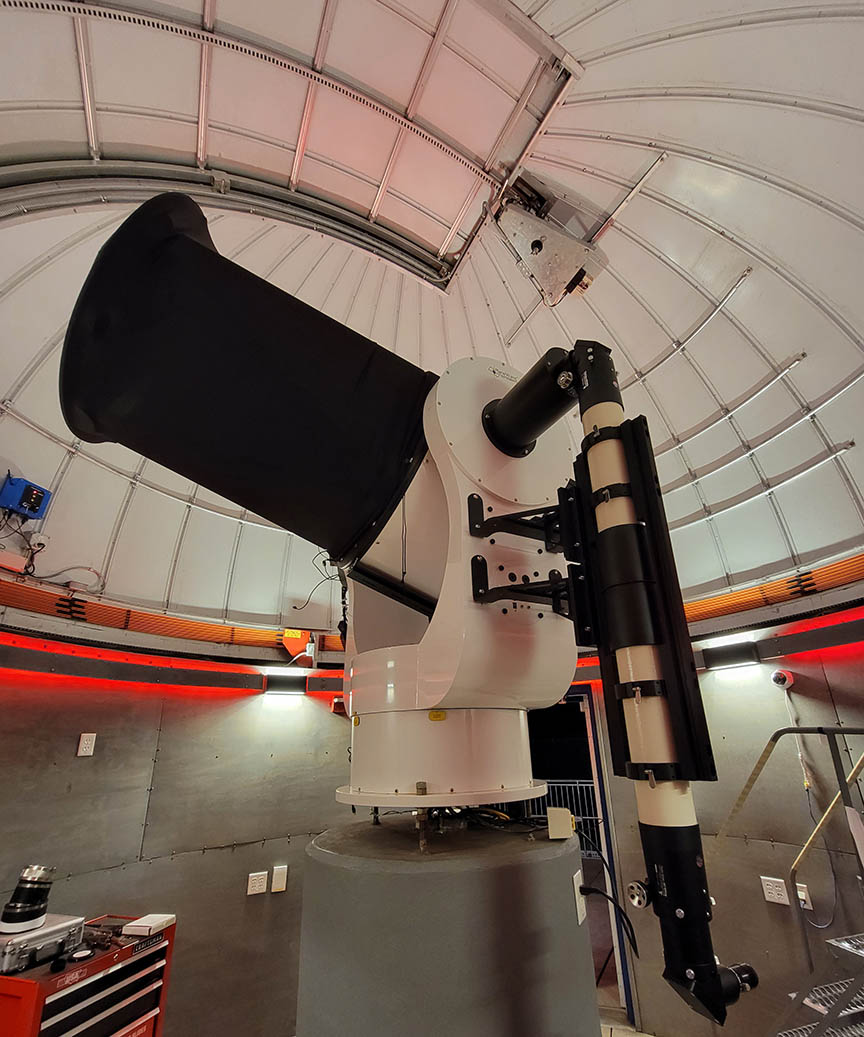
The announced instrument is specific enough to check. The facility is to combine a passive radar system, artificial intelligence and a 0.7 metre PlaneWave CDK700 astronomical telescope. The radar monitors the sky continuously using reflected radio signals; when it detects an object of interest, the telescope is directed onto it for high-resolution imaging and spectroscopy. The release states that this is the first Galileo Project site to pair continuous radar monitoring with a large professional-class optical telescope, and that the project's three existing observatories, in Massachusetts, Pennsylvania and Nevada, primarily use smaller imaging systems to monitor the sky. Construction was expected to begin in November 2026 with completion anticipated in about a year.
The telescope model is a real and well-documented product, and its published specification matches the announcement. PlaneWave Instruments gives the CDK700 an aperture of 700 mm, stated on the same page as 27.56 inches, a focal length of 4540 mm, a focal ratio of f/6.5, a Corrected Dall-Kirkham optical design, a central obstruction of 47 per cent of the primary mirror, and a weight of 1,200 pounds, which is 544 kilograms, on an alt-azimuth mount.
The building is the reason this story travelled, and its history is a good deal stranger than the astronomy. According to The Ithaca Voice, the local outlet of record, 900 Stewart Avenue was completed in 1926 in the Egyptian Revival style as the headquarters of Cornell's Sphinx Head secret society, designed to resemble a pharaonic tomb from the outside. The society sold it in 1969 to its next-door neighbour, the physicist Robert Wilson, who used it as a sculpture studio. Carl Sagan owned it afterwards. Weitsman bought it in 2024, and in his own words to that paper at the time of sale it is a small building: "This isn't a big building, it's kinda like a one-bedroom space with a loft and half a bath. It's basically one big room."
Loeb's own account dates the idea precisely and the dates check out. He writes that he invented the observatory concept "a couple of months ago" and that it "materialized into a construction plan within just a couple of months." His earlier Medium post setting out that concept, A New Observatory Concept for Imaging UAP Orbs, carries a datePublished value of 2026-09-05T13:26:55Z. From concept to announced construction plan is therefore two months to the day.
More footage and images of this sighting
What is the official explanation?
There is no government involvement in this facility and no official narrative to report. The Galileo Project is a privately funded research programme at Harvard University and the Ithaca observatory is funded by a private individual, so no agency has commented and none is expected to.
One official thread does run through it. The release describes Loeb as chair of the UAP Science Advisory Council to the White House, Pentagon, FBI and intelligence agencies, a role this archive already holds as its own case file, and it states that the observatory's focus is "unexplained orb-like objects reported in recent U.S. government disclosures." So the instrument is explicitly being built to look for the class of object that the Department of War PURSUE releases describe, by the person the government has appointed to chair its own scientific advisory body on the subject. The release does not claim any government funding, tasking or data-sharing arrangement, and this archive does not imply one.
The other official layer is municipal rather than federal, and neither the press release nor the local coverage mentions it. The Ithaca Voice reported at the time of the 2024 sale that 900 Stewart Avenue is a contributing property to the Cornell Heights Historic District, with the consequence that "any exterior modifications or interior renovations readily seen from the outside will require the approval of the Ithaca Landmarks Preservation Commission." An alt-azimuth telescope of 544 kilograms cannot observe the sky from inside a closed 1926 stone building; it needs a pier and an aperture to the sky, which means a dome, a roll-off roof or a comparable opening. That is an exterior modification to a landmark-protected structure.
This archive did not establish what has been filed. The City of Ithaca publishes Landmarks Preservation Commission agendas through its Agenda Center, but the commission's agenda series could not be enumerated from this machine during this run, so no statement is made here about whether an application exists, has been heard, or has been approved. What is recorded is narrower and is sourced: the property carries that review requirement, the announcement sets a construction start in the same month it was issued, and neither the release nor the local reports address the permission the building will need.
The announcement was picked up independently of Loeb's own page. PARADIGM's weekly UAP briefing Signs of Life, published 12 November 2026, records in its notes section that "Harvard's Galileo Project unveiled details of its plans for a UAP-sensing observatory in Ithaca, New York, funded by entrepreneur Adam Weitsman," which is a second outlet carrying the same three load-bearing facts, the project, the place and the funder.
What did the witnesses think it was?
There are no witnesses in the ordinary sense. The parties are Avi Loeb and Adam Weitsman, both quoted in the release under their own names, with a named press contact at an Ithaca public-relations firm.
Weitsman's stated motive is the Sagan connection: "Carl Sagan changed the way people around the world think about the universe and our place in it. When I acquired his former property, I wanted to do something that would honor that legacy in a meaningful way." Loeb's is methodological: "Science advances when we collect evidence and remain open to what that evidence tells us," and, on the research case, "We need more data on these mysterious objects."
The announcement makes public-participation commitments that are unusually concrete for this field and are worth recording so they can be checked later. The release says plans include an online platform through which people anywhere can explore observational data and examine images collected by the telescope, that the team is exploring letting the public suggest targets for observation, and that outreach will include educational videos, livestreamed discussions and public question-and-answer sessions. A project that publishes its data is a project whose claims can be audited, which is the opposite of how most UAP imagery reaches the public, and this archive regards the promise as the most consequential thing in the document if it is kept.
Two care points on the sourcing. First, Loeb's Medium post opens with several paragraphs of unrelated personal commentary about a news story concerning a technology executive before it reaches the press release, which is characteristic of that page and is noted so a reader is not surprised by it. Second, 607NewsNow renders the astrophysicist's first name as "Ari Loeb" rather than Avi, a small error in an otherwise accurate local report.
The imagery accompanying the announcement is not usable as evidence and is not reproduced here. The lead image on Loeb's post carries the credit "Image Credit: AI/Gemini," meaning it is an artist's impression generated by a model and not a photograph of anything; a second is credited to an account on X. This archive does not publish AI-generated imagery, and a concept image of a facility that has not been built would illustrate nothing in any case.
Is the Galileo Project's Fourth Observatory, at Carl Sagan's Former House in Ithaca, New York (5 November 2026) real? The two-pass assessment
Pass one, how could this be mundane. It is mundane, in the sense that there is nothing anomalous here at all: this is an announcement that a privately funded research group intends to build a telescope. No observation has been made, no object detected, no data published. Announced instruments are not delivered instruments, and the only schedule on offer is the proponents' own, with construction beginning in the same month as the press release and completion "anticipated within approximately one year, depending on construction progress, equipment installation and scientific commissioning," which is a sentence carrying three separate escape clauses. The landmark review described above is a real and unaddressed obstacle, and the owner's own 2024 description of the structure as essentially one room with a loft and half a bath does not obviously accommodate a 544 kilogram instrument. A reasonable prior is that this takes longer than a year.
The strongest deflating observation is about the science rather than the schedule. A passive radar cue followed by an optical slew only works if the cue is accurate enough and fast enough to put a moving target inside a narrow field of view, and the release gives no detection range, no angular accuracy, no slew rate and no field of view. Those are the numbers on which the whole concept turns and none of them has been published.
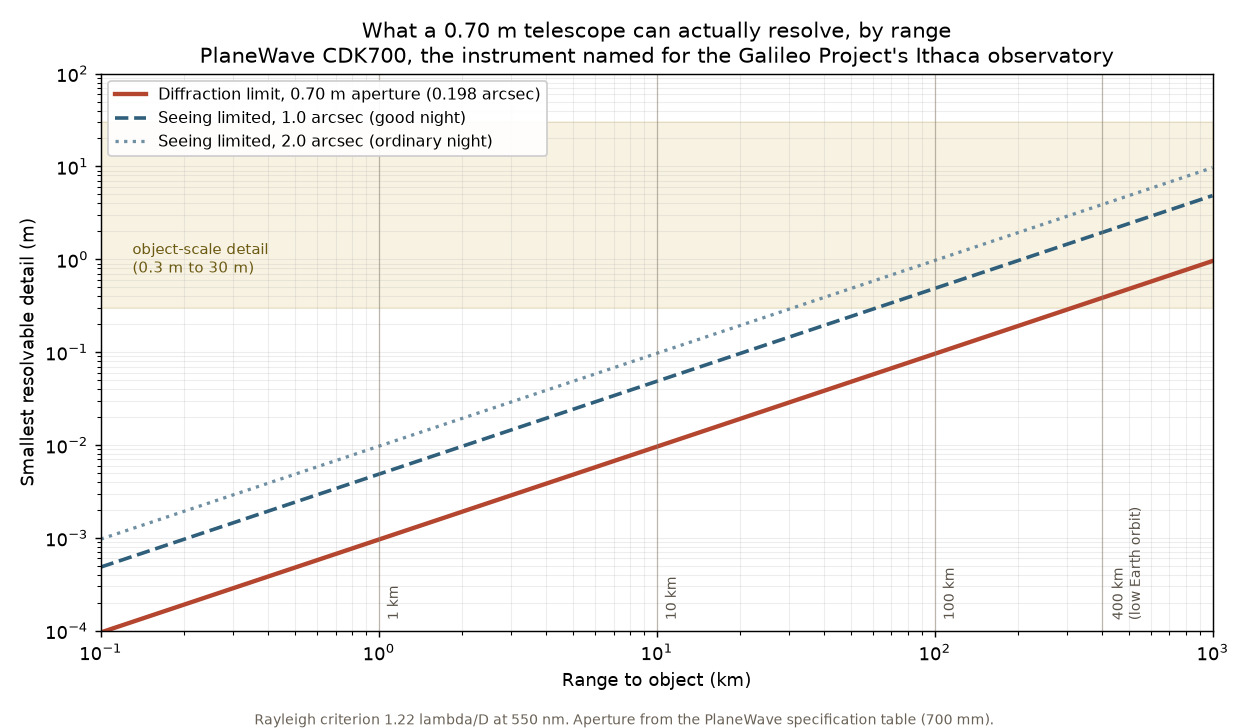
Pass two, taking the instrument at its stated specification, what could it actually do. This is checkable without waiting for the building, and the answer is favourable to the claim Loeb has been making in interviews, within a limit he has not stated. For a 0.70 metre aperture at 550 nm the Rayleigh diffraction limit is 1.22 lambda over D, which is 9.59 times ten to the minus seven radians, or 0.198 arcseconds. Ground-based imaging is not usually diffraction limited; atmospheric seeing of 1 to 2 arcseconds is ordinary. Converting both to linear detail at a given range gives the result plotted as this case's hero image.
At 1 kilometre the diffraction limit corresponds to 1.0 millimetre and 2 arcsecond seeing to 9.7 millimetres. At 10 kilometres the figures are 9.6 millimetres and 9.7 centimetres. So for an object a few kilometres away, Loeb's claim that "if you have a large telescope, let's say a meter-scale telescope, and you point it at the direction of these mysterious orbs, you can actually resolve them and figure out what they are" is quantitatively sound by a wide margin, even on a poor night. The unstated limit is range. At 100 kilometres, 2 arcsecond seeing gives 0.97 metres, so a metre-class object is barely more than a single resolution element, and at a low Earth orbit altitude of 400 kilometres the same seeing gives 3.9 metres. The instrument resolves nearby objects in fine detail and distant ones hardly at all, which means its scientific value depends entirely on whether the reported orbs are close. Nothing in the announcement addresses that, and it is the question the facility will answer first whether it intends to or not.
Tier Unknown, and the word is doing unusual work here. There is no anomalous claim to adjudicate, no official narrative and no evidence either way, because the subject of the file is a plan. The archive records it because an instrument purpose-built to image this class of object, by the chair of the government's own UAP science advisory council, with a public-data commitment attached, is a development the field has not previously had, and because its stated specification can be tested against physics today while its delivery cannot.
Sources
- avi-loeb.medium.com/a-new-galileo-project-observatory-for-high-resolution-imaging-and-spectroscopy-of-uap-d16daccd0cdb
- avi-loeb.medium.com/a-new-observatory-concept-for-imaging-uap-orbs-748fc8b0d435
- 607newsnow.com/news/258852-weitsman-to-transform-sagan-house-in-ithaca-into-observatory/
- ithacavoice.org/2024/12/sagan-house-sold-to-billionaire-scrap-metal-mogul/
- planewave.com/product/cdk700/
- www.reddit.com/r/UFOs/comments/1xv6iyb/
- www.paradigm.news/p/ex-senior-national-security-official
More cases from this region: UFO sightings in United States