A Sunlit Trail Photographed over Lough Foyle from Greencastle, County Donegal
The witness rejected the aircraft explanation because the object was falling slowly. Falling slowly is what the aircraft explanation predicts.
What did witnesses see at Greencastle?
A bright golden trail appeared over Lough Foyle before sunrise on 18 October 2026. Fergal Owens photographed it from his home at Greencastle in County Donegal and asked online what it was, giving the time as about 7.15am.
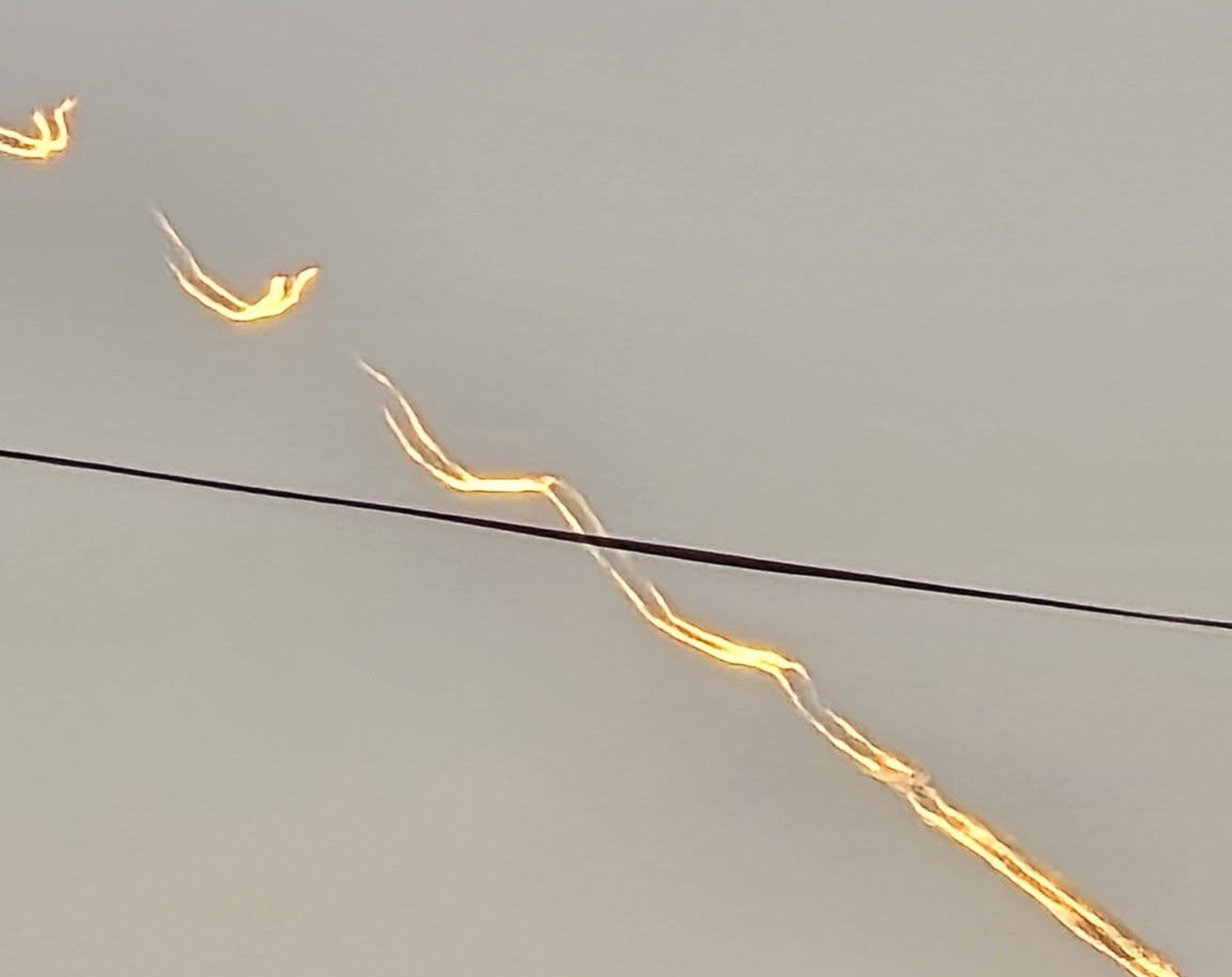
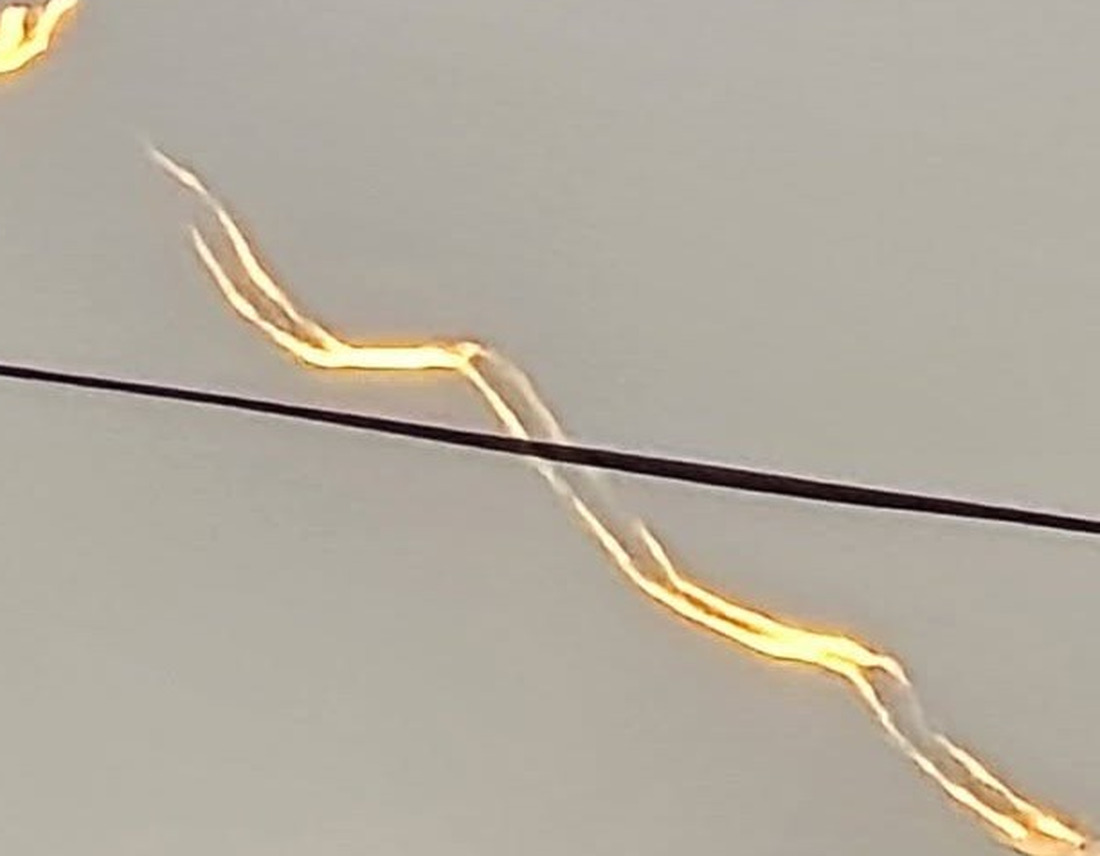
The published frame shows a narrow luminous ribbon crossing a featureless grey sky from lower right to upper left, with an overhead wire running across the foreground. Enlarged, the ribbon resolves into two roughly parallel filaments lying alongside each other rather than a single line. Along most of its length one edge is a saturated gold and the other is plain grey, and the gold stays on the same side throughout.
The trail is not smooth. It carries a series of sharp switchback kinks of roughly regular amplitude and spacing, where the ribbon doubles back on itself at an acute angle and then resumes its original heading. Above and to the left of the main trail, two shorter segments sit detached from it, each curled into a hook. The upper tip of the main trail tapers to a fine grey point that is not lit at all.
That combination, two parallel filaments, a regular growing wave along them, and detached closed loops beyond the end, is the documented life cycle of an aircraft wake vortex pair. The two filaments are the two wingtip vortices, the regular wave is the Crow instability growing along them, and the hooks are what remains after the two vortices touch and pinch off into discrete rings.
More footage and images of this sighting
What is the official explanation?
No Irish or United Kingdom authority has commented on this sighting and none is known to have been asked. The Irish Aviation Authority, the Air Accident Investigation Unit and the Police Service of Northern Ireland, whose jurisdiction covers the eastern shore of Lough Foyle, have published nothing about it.
There is no official narrative to weigh, which is why the prosaic reading on this page rests on the photograph and on the physical record rather than on anyone in authority having ruled.
One point about the coverage matters for counting sources. The story appeared at Ireland Live and at Donegal Live under the same headline, the same byline and the same photograph. Both titles are published by Formpress Publishing Limited, so that is one article appearing twice and not two outlets independently covering an event.
What did the witnesses think it was?
Fergal Owens published the photographs himself and asked, in his own words, "Can anyone tell me what is this falling from the sky??"
He gave the circumstances plainly. "Took them this morning at 7.15am. I took the photos myself from Greencastle over Lough Foyle. It was awesome. It was falling slowly. Never seen anything like this in my life."
The thread that followed offered an aircraft contrail, a jet and fireworks. One person said they had been watching a jet pass overhead themselves. Owens rejected that reading directly, replying "No it wasn’t. It was falling slowly," and afterwards repeated that he had seen the thing with his own eyes and could not believe it.
Nothing in his account is evasive and nothing in it is embellished. He reports a time, a place, a direction of view and a single behaviour, and the behaviour he reports is the one that turns out to matter most.
Is the A Sunlit Trail Photographed over Lough Foyle from Greencastle, County Donegal real? The two-pass assessment
Pass one, how could this be mundane.
The shape in the photograph is close to diagnostic. A twin filament trail that develops a regular sinusoidal wave and then pinches off into detached rings is the Crow instability, the standard decay mode of the counter rotating vortex pair shed by an aircraft wing. Nothing else in the sky produces two parallel condensation filaments that fold into evenly spaced switchbacks and then close into loops. The grey unlit tip at one end is the youngest part of the trail, still thin and not yet caught by the light.
That also answers the witness’s own objection, and it answers it in his favour as an observer. A vortex pair transports itself downward. The two vortices induce velocity on each other and the whole structure sinks several hundred feet below the flight path over a minute or two, which is visible from the ground as a trail that drifts steadily downward while holding its shape. So "it was falling slowly" is not evidence against an aircraft. It is one of the few things that specifically indicates one, and it is the detail that distinguishes a decaying wake from a static cirrus streak. The same mechanism explains why he was sure it was not the jet another commenter was watching, because by the time a wake has gone through Crow instability the aircraft that laid it is long out of frame.
The weather record supports a contrail and excludes a cloud. Belfast Aldergrove, the nearest station reporting cloud through the relevant hours, logged NCD, no cloud detected, at every observation from midnight to 07:20 UTC, with surface winds light and easterly at 1 to 3 knots. The sky was clear, so this was not a lenticular or any other low formation, and the object sat above the ceilometer reach.
One prosaic candidate is excluded rather than supported. A rocket exhaust plume at twilight produces comparable golden corkscrew structure, but there was no launch anywhere in the window. The launch record shows a single flight between 16 and 19 October 2026, a Falcon 9 carrying USSF-481 at 00:01 UTC on 16 October, more than two days before the photograph and from the wrong hemisphere to leave a plume over Donegal.
The real difficulty is the clock, and it is worth stating precisely rather than glossing.
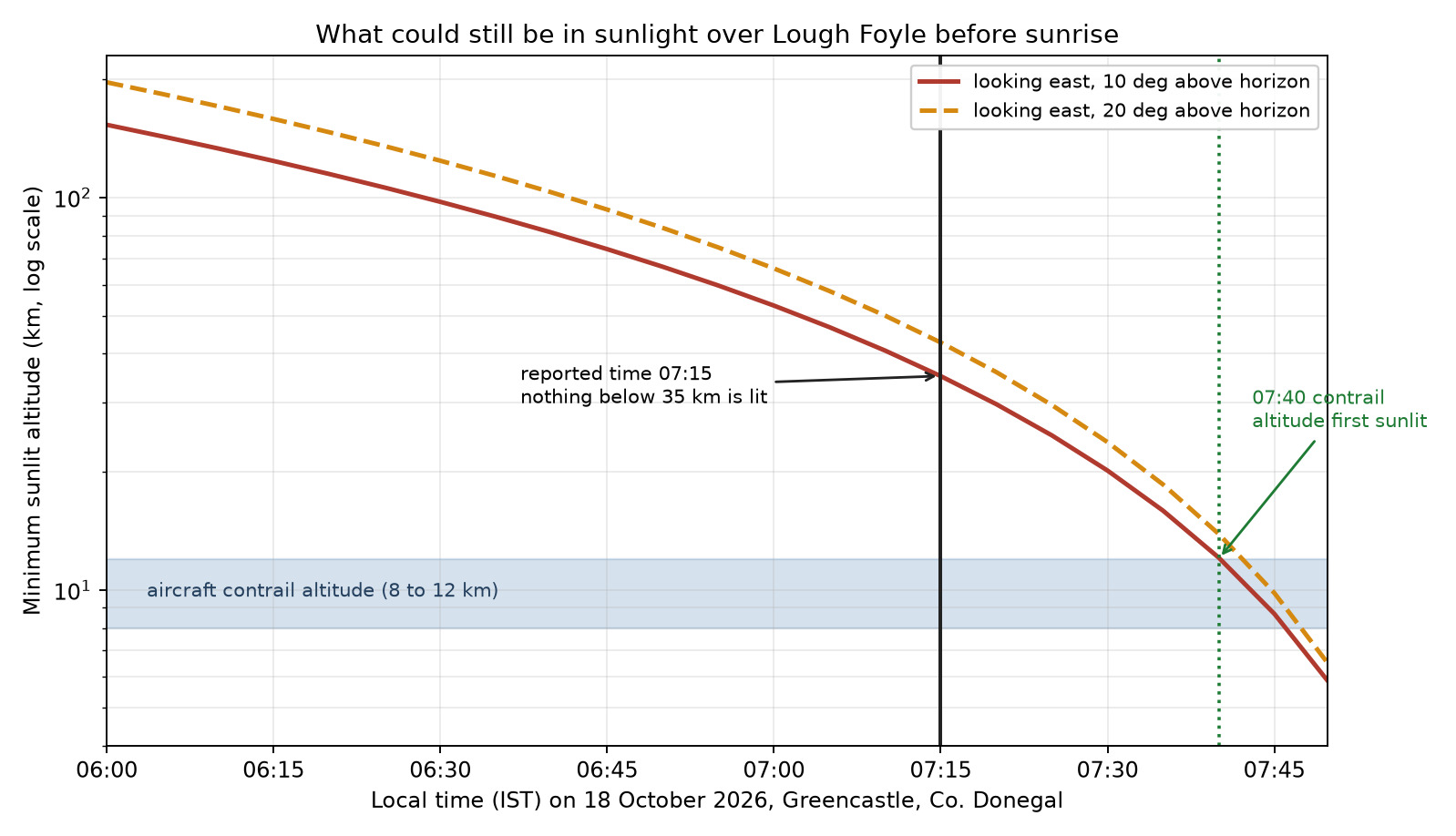
Sunrise at Greencastle on 18 October 2026 was at about 08:10 local. At the reported 7.15am the Sun was 7.6 degrees below the horizon at an azimuth of 96 degrees, which is almost due east, the same quadrant the witness was facing across Lough Foyle. Because the Sun and the line of sight share a quadrant, the usual overhead shadow figure is meaningless here and the calculation has to be done along the actual look direction. Done that way, the lowest altitude still in sunlight toward the east at 7.15am is about 35 kilometres at 10 degrees elevation and about 43 kilometres at 20 degrees.
Aircraft contrails form between roughly 8 and 12 kilometres. At the reported time that band is well inside the shadow of the Earth, so a contrail could not have been glowing gold. It would have been grey.
The same calculation gives the size of the discrepancy exactly. Contrail altitude first comes into sunlight along that line of sight at about 7.40am, and is comfortably lit by 7.45am. So the photograph is consistent with an illuminated contrail if it was taken roughly 25 to 35 minutes later than the witness recalled, and inconsistent with one if 7.15am is exact to the minute.
That is not a reason to dismiss the witness. A time recalled and typed into a social media post after the fact is the least reliable field in any sighting account, and half an hour is an ordinary error. It is a reason to say what would settle it, which is the original camera file. The EXIF DateTimeOriginal on the unprocessed photograph would fix the capture to the second and close the case in one reading. The published copies have been resized and stripped by the publisher, so that check could not be run here.
Pass two, if it is not that.
If 7.15am is exact, then whatever was photographed was above about 35 kilometres and therefore not an aircraft contrail, because no aircraft flies there. The altitude band that was lit at that moment, from roughly 35 kilometres upward, is occupied by very little: high altitude balloons near 30 to 40 kilometres, and the persistent trains left by bright meteors at 80 to 100 kilometres, which are sheared by upper atmosphere winds into exactly this kind of twisted ribbon within minutes. The date is inside Orionid activity, and the radiant stood 48 degrees above the horizon at the reported time, so a bright pre dawn Orionid leaving a persistent train is geometrically available.
It is offered as the surviving alternative and not as a finding, for a specific reason. A persistent meteor train glows and twists, but it does not produce two parallel filaments, and it does not pinch off into the regular closed loops visible at the upper left of this frame. The morphology argues for the wake and against the train. The fireball databases that would have settled whether any bright meteor was reported over Ireland that morning, the American Meteor Society and International Meteor Organization event services, were both unreachable from here for the whole of this run, so no check was made in either direction and none is claimed.
The case is tiered Disputed rather than Strongly Disputed on that single unresolved point. The structure in the photograph is strong evidence for a decaying aircraft wake, the witness own strongest objection supports it rather than undermining it, and the weather and launch records are consistent with it. Against that stands one stated time which, taken literally, the illumination geometry will not allow. Until the original file is read, the archive records the mechanism as very probably identified and the timestamp as unreconciled.
Sources
- www.ireland-live.ie/north-west/donegal-live/donegal-man-baffled-by-strange-object-falling-from-sky-9295244
- www.donegallive.ie/news/inishowen-md/donegal-man-baffled-by-strange-object-falling-from-sky-9295240
- mesonet.agron.iastate.edu/cgi-bin/request/asos.py?station=EGAA&data=skyc1&data=skyl1&data=drct&data=sknt&year1=2026&month1=10&day1=18&year2=2026&month2=10&day2=18&tz=UTC&format=onlycomma&report_type=3&report_type=4
- ll.thespacedevs.com/2.2.0/launch/?net__gte=2026-10-16T00:00:00Z&net__lte=2026-10-19T00:00:00Z&limit=40&mode=list
- www.amsmeteors.org/
More cases from this region: UFO sightings in Ireland