The Rex Heflin Santa Ana Photographs (3 August 1965)
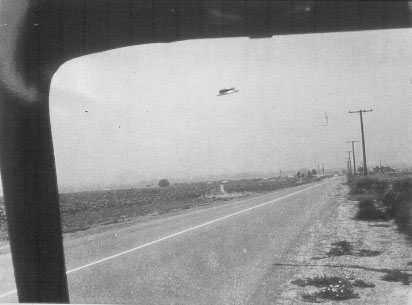
A county traffic investigator with a Polaroid loaded in his work van shot four frames of a hat-shaped disc, then photographed the black smoke ring it left hanging in the sky. Within weeks two men flashing a salmon-and-green ID card and claiming to be from NORAD walked off with three of the four originals and never gave them back. The prints reappeared in a stranger's manila envelope in 1993, and a peer-reviewed reanalysis of those recovered originals found no string, no seam, and a particle wake behind the craft. It remains one of the most heavily investigated UFO photo cases ever taken, and one of the most stubbornly unresolved.
What did witnesses see at Santa Ana?
At about 12:30 to 12:37 p.m. PDT on 3 August 1965, Rex E. Heflin, age 38, a highway maintenance engineer for the Orange County Road Department, stopped his work van near the intersection of Myford Road and Walnut Avenue, on the boundary of Orange County near Santa Ana, roughly half a mile north of the El Toro Marine Corps Air Station. He had pulled over to photograph a railroad-crossing sign partly obscured by tree branches, part of his job keeping traffic signs visible. He tried to radio his supervisor about the obscured sign and found the van radio had gone dead.
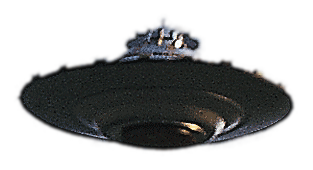
According to his 18 September 1965 signed statement, Heflin caught a flash of motion at the edge of his left eye and saw a silvery craft moving slowly from left to right across Myford Road. He assumed it was an experimental aircraft from El Toro. He judged it to be about an eighth of a mile away, at roughly 150 feet altitude, and about 20 feet across, comparing it to the 20-foot-wide traffic lanes it flew over. The object had the general shape of a hat seen from the side, with a dome on top and a broad dark band around its midsection.
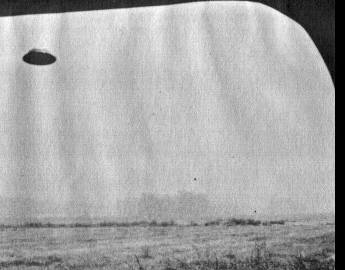
Heflin photographed it through his windshield with his Polaroid Model 101 work camera (114 mm focal length, loaded with ASA 3000 black-and-white film). As the craft tipped and showed its dark underside he said he saw a greenish-white beam rotating clockwise around the bottom, from center out to the rim, each rotation taking about two seconds. He shot a second frame through the passenger window, and a third as the object turned and moved further east. Throughout, it seemed to wobble slightly, in his words like a gyroscope losing stability.
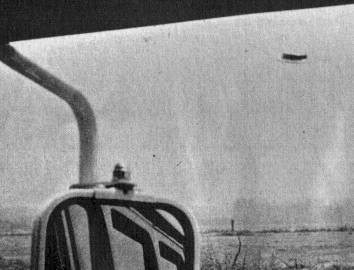
The craft then gained altitude and speed and departed to the north-northeast over the Santa Ana Freeway, leaving behind a ring of bluish-black smoke hanging at the altitude and azimuth it had occupied. Heflin drove a hundred or two hundred yards toward the ring, which was slowly rising and drifting northeast with the wind at about a 50-degree elevation, got out of the van, and took his fourth photograph. He judged the ring three to four times the diameter of the craft and was struck that it looked solid and did not dissipate like ordinary smoke. His radio then worked normally again.
Heflin numbered the four prints 1 through 4 in blue ink in the lower left corner to record the sequence. He thought little of them at first, showing them only to a few coworkers that afternoon. The smoke-ring frame unsettled some of them, so he stopped showing it, deciding three pictures were enough for one day.
More footage and images of this sighting
What is the official explanation?
Heflin sought no publicity and lent the originals around freely. His relatives passed copies to the Santa Ana Register, whose chief photographer Clay T. Miller made six sets of negatives of the first three frames (cropped for publication, cutting off the foreground pole shadow). The Register first published the three craft photos on 20 September 1965, about six weeks after the event. The Register checked with El Toro, which reported no other sightings and denied the object was one of theirs.
Marine Corps Intelligence officers came to Heflin's home, interviewed him, and borrowed and copied the first three prints, returning them unmarked. The U.S. Air Force then opened an official inquiry: investigating officer Captain Charles F. Reichmuth interviewed Heflin for more than three hours, checked with his supervisors, found him mature, alert and trustworthy, and wrote that from all appearances he was not attempting to perpetrate a hoax. He forwarded his report to Project Blue Book at Wright-Patterson AFB.
Despite Reichmuth's positive report, a Project Blue Book Photo Analysis Report described a comparison experiment in which other Air Force personnel tossed a 9-inch tray into the air at 15 to 20 feet from a camera. That experiment satisfied Blue Book that the photos were faked, and the case was officially listed as a hoax. NICAP strongly disputed this, noting Reichmuth's own finding.
The most notorious episode came next. On 20 September a man phoned identifying himself as a NORAD colonel and warned Heflin not to discuss the matter further with the press. On the evening of 22 September two men in civilian clothes claiming to be from NORAD came to his door; one flashed a salmon-and-green card without a photo, resembling the IDs carried by El Toro Marines. Expecting them back as the Marines and Air Force had returned his prints, Heflin lent them the three originals of the craft photos. They never returned them. NORAD disclaimed all knowledge. Heflin's congressman, Representative Utt, inquired and was told NORAD offices had been searched top to bottom with nothing found. The identity of the NORAD men was never established. A separate visit in October 1967 by a man calling himself Captain C. H. Edmonds, also bearing a salmon-and-green ID without a photo and arriving with a parked car emitting an odd purplish glow that seemed to disrupt Heflin's hi-fi, deepened the strangeness.
The case reached the Air Force-funded University of Colorado study (the Condon Committee). Dr. William Hartmann, who handled photo cases for the project, investigated the site in January 1968 with physicist Dr. James E. McDonald. In the 1969 Condon Report, Hartmann judged the photos of little probative value, arguing that a replication shot of a Leica lens cap suspended by a thread two feet from a camera was a good match to Heflin Photo 2. Critics, including the reanalysis authors decades later, called this an early example of the assumption that because a photograph could ostensibly be faked, it therefore was.
What did the witnesses think it was?
Rex Heflin was, by every account that investigated him, an unlikely hoaxer. He was a 15-year veteran of the Orange County Road Department who used photography routinely in his work. The Los Angeles NICAP Subcommittee (LANS), led first by biophysicist Dr. Leslie K. Kaeburn and then by Idabel Epperson, ran a two-year character and work-record check and was assured by his superiors and coworkers that he was straightforward, responsible, and not the type to risk his job on a prank. Captain Reichmuth's Air Force inquiry reached the same conclusion. Over five expert photo-analysis teams studied the prints during the three years after the sighting and none found evidence of a hoax.
Heflin never sought publicity, never copyrighted the photos, and never took any payment for their worldwide reproduction across some three decades. He had been a skeptic at the time, genuinely believing for weeks that he had photographed an experimental aircraft from El Toro, and only came to think it was something unusual after scientists took interest and the originals vanished. He never recanted. Forty years on, days before his death, he left a message on Ann Druffel's answering machine wanting to catch up on the photos he had taken in 1965.
His account was internally consistent and held up under hostile questioning. At a packed January 1968 LANS meeting, visiting scientists interrogated him aggressively; when Hartmann doubted anyone could take three Polaroids in roughly 20 seconds, Heflin noted LANS had asked the same thing two years earlier and he had simply demonstrated it with his own camera. The radio failure was independently corroborated: his supervisor Herm Kimmel described the cutoff as like a button release but without the usual blip of noise, other Highway Department radios in the area had failed at the same time, and a technician who checked the radio afterward found nothing wrong.
A possible corroborating event occurred the same first week of August 1965 about ten miles away. Mr. and Mrs. Ralph Joseph, driving the Santa Ana Freeway near Anaheim around 9 p.m., reported a large glowing disc-shaped object with a rounded dome sitting atop high-voltage lines, with other motorists stopped and staring; NICAP and McDonald interviewed them and judged them solid, reliable witnesses. No further witnesses were located, so the link is suggestive rather than proven.
Heflin developed a serious illness late in life, an accumulation of tetraethyl lead in his bone marrow attributed to decades working in heavy traffic, and moved to northern California around 1985. He died on 19 October 2005 after a long illness, still maintaining his account.
Is the Rex Heflin Santa Ana Photographs (3 August 1965) real? The two-pass assessment
Pass one, the mundane reading. From the start the case attracted ordinary explanations. The simplest is that Heflin photographed a small model or a thrown object close to the camera and presented it as a distant craft. The Air Force's own Blue Book experiment tossed a 9-inch tray into the air at 15 to 20 feet to mimic the disc, and concluded hoax. The Condon Committee's William Hartmann suspended a Leica lens cap on a fine thread two feet from a camera and judged it a good match for Photo 2, filing the case as of little probative value. A model-on-a-thread or hubcap-in-the-air hypothesis is attractive because Heflin's Polaroid could indeed focus sharply at close range; LANS' own Zan Overall had found the work camera, set at infinity, produced sharp images at three feet, and Hartmann's close shots came out surprisingly crisp.
The most damaging skeptical claim came in the mid-1970s from William Spaulding of Ground Saucer Watch (GSW) in Arizona. GSW's computer enhancement, run by consultant Fred Adrian on copies of unknown (probably fourth) generation, reported a linelike marking above the object suggestive of a supporting string, and listed the Heflin photos as crude and grandiose hoaxes. Spaulding said the string appeared on four separate sets. James McDonald, meanwhile, never accepted the fourth frame; his meteorological reading of cloud conditions led him to suspect the smoke-ring photo had been shot at a different time and place, perhaps at an air show, and he chased a parallel 1957 Fort Belvoir atomic-bomb-simulator smoke-ring case as a possible mundane analogue.
Pass two, the case for authenticity. Each mundane strand frayed under scrutiny. Robert Nathan, an independent aerospace scientist, computer-enhanced first-generation copies for LANS in the 1960s and found absolutely no strings or supporting mechanism, brought out the wedge of light on the underside of Photo 2 consistent with Heflin's described rotating beam, and identified the dark band as particulate matter and the smoke ring as a vortex ring of the same particulates left behind by the craft. The string claim collapsed further when GSW's own Spaulding later conceded the line might be a scratch and that all four sets might trace to a single uncertain source; in 1993 MUFON photo analyst Jeffrey Sainio rejected the string hypothesis outright. The focus argument cut both ways: photogrammetrists showed the truck window frame, the distant freeway power lines, and everything between were all in sharp focus, which a steady hand and Heflin's camera could produce, and Hartmann's lens-cap replication notably failed to reproduce the wedge of light.
The decisive new evidence came after the originals reappeared. In 1993 a woman twice phoned Heflin asking if he had checked his mailbox; he found an unstamped manila envelope holding the three lost originals, his blue-ink numbers 1 through 3 intact, but now bearing the word original in white grease pencil and a faint pencil 13 on the backs, along with fingerprints, marks Heflin never made and which the reanalysis team read as signs of a covert official analysis. With the genuine originals in hand, Ann Druffel, aerospace physicist Dr. Robert M. Wood, and Dr. Eric Kelson reanalyzed all four frames with 1990s computer enhancement and published in the peer-reviewed Journal of Scientific Exploration in 2000. Their seven conclusions: the clouds in all four photos are consistent; they detected a previously unreported wake suggesting a real object moving through the atmosphere; the GSW string was a stunning error not based on legitimate copies and possibly itself hoaxed onto the copies GSW used; the back-of-print notations suggest a covert analysis; McDonald had been misled into thinking Photo 4 was taken elsewhere; the particulate trail behind the craft in Photo 4 shows the smoke ring is the same black band seen around the object in Photos 1 and 3; and all the photographic evidence remains totally consistent with Heflin's account, with no sign of a hoax.
Why this is filed Disputed and contested, not Discredited. The hoax hypotheses were asserted but never demonstrated. No model, thread, or hubcap was ever shown to reproduce the images, the central string claim was retracted in substance and rejected by later analysts, and the one peer-reviewed study working from the recovered originals affirmed authenticity and found a wake and a particle trail that a thrown object would not produce. Yet authenticity is not proven either: it is logically impossible to declare any UFO photo genuine without the object to compare it against, McDonald's cloud objection was never fully reconciled to everyone's satisfaction, and the chain of custody was irreparably broken by the 1965 confiscation. The confiscation itself, two men with a fake-looking ID claiming a NORAD authority that disclaimed them, plus the later Captain Edmonds visit and the mysterious 1993 return, is not a footnote; an official apparatus that takes prints and denies it ever happened is evidence the case mattered, not evidence of a hoax. With strong testimony, multiple expert teams finding no fakery, a peer-reviewed pro-authenticity reanalysis, an unrefuted hoax case on the other side, and no physical object to settle it, the only honest tier is Disputed.
Sources
- tustinhistory.com/wp-content/uploads/2019/01/Reanalysis-of-the-1965-Heflin-UFO-Photos-Society-for-Scientific-.pdf
- www.nicap.org/reports/Goodbye_Rex_Heflin.pdf
- ufologie.patrickgross.org/htm/heflin65.htm
- rr0.org/time/2/0/0/6/03/Heflins1965PhotosFinallyValidated/
- www.thinkaboutitdocs.com/1965-rex-heflin-ufo-photographs/
- www.researchgate.net/publication/237243956_Reanalysis_of_the_1965_Heflin_UFO_Photos
More cases from this region: UFO sightings in United States