The Jack LeMonde Horseback Photograph
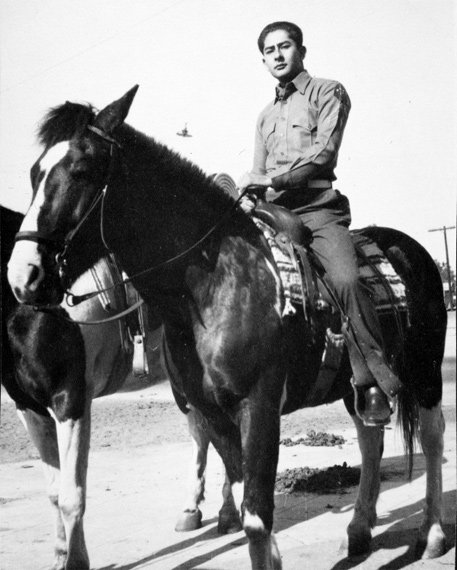
A souvenir snapshot of a young Marine on horseback outside Burbank's Pickwick Riding stables sat in a family album for over fifty years before anyone noticed the small domed disc hanging in the sky behind him. When it finally surfaced in 2000, it briefly carried the title of the best pre-Arnold UFO photograph ever taken. Then a French researcher turned up the contrast and found a wire.
What did witnesses see at Pickwick Riding stables area?
The photo shows Jack LeMonde, a pseudonym for a twice-wounded US Marine home on leave, sitting on a horse near the Pickwick Riding stables in Burbank on a June morning in 1945. Between his torso and the horse's neck, well above the background terrain, is a small object with a flat underside and a domed top, sharply resolved against the sky. The camera was LeMonde's own German Voigtlander with a Carl Zeiss lens, shot at roughly f-11 and 1/50th of a second on Kodak 120 film, and the optics were good enough that the object shows visible structure under magnification.
What is the official explanation?
No government agency ever examined this photograph. It was taken two years before the words flying saucer existed and did not surface publicly until February 2000, when it appeared on the CAUS website run by attorney Peter Gersten. The only brush with the official apparatus came secondhand: investigator John Alexander consulted a retired member of the FBI's Special Photographic Unit for guidance on dating the print, and was told the paper archives needed for authentication no longer exist and that only a destructive emulsion test could date it chemically.
What did the witnesses think it was?
LeMonde told investigators the photo was taken by his father, a motion picture producer with serious technical experience, while LeMonde was home on leave from the Pacific in June 1945. The family noticed the odd shape when the film came back, wrote it off as a distant airplane or a speck on the negative, and filed the print in the family album. LeMonde rediscovered it more than fifty years later while scanning family photos after his father's death, enlarged the blemish, and realized what it looked like. He refused all payment, saying money would contaminate the photo's authenticity, and kept his real name out of it to protect his professional reputation. The original negative is missing.
The dispute
The dispute turns on a single mundane reading: that the small domed disc in the 1945 Burbank horseback photograph is not an aerial object at all, but a radial-reflector lamp suspended from an overhead wire, the kind of fixture that was common in 1930s and 1940s California. French researcher Jerome Beau advanced it in a 2006 RR0 analysis. His method was not an assertion but a repeatable image operation: adjusting the contrast and brightness of this specific photograph, Beau surfaced a faint thread crossing the sky and passing exactly through the position of the object. That same thread was then independently illustrated by James Neff, so the finding rests on two pairs of eyes rather than one. If the thread is a real wire, the disc is a lamp hanging from it, and the case collapses into something thoroughly ordinary. This is a serious, method-based counter-explanation, and it is why the case is filed as disputed rather than open.
Where it falls short is identification. The thread is a candidate wire, not a confirmed one, and RR0's own case file, the primary source for the debunk, says as much. It records the skeptic counter that the "wire" may simply be a scratch on the negative that crosses the lamp position by chance, logs the object as only "very probably" a lamp, and grades the case as disputed but leaning toward explanation, not closed. With the original negative gone, the thread-versus-scratch question cannot be resolved at the source, so the lamp can never be forced. Against the wire stands the authentication pass: John Alexander and former Air Force photo analyst Peter Stankiewicz examined the print under a microscope and reported no supporting structure beneath the object, while a drive-in theater sign behind the horse gives a height reference placing the object well in the background, too distant and too large for a streetlight, and Burbank's actual 1945 streetlights used a different post design not seen in the frame.
So the photograph has been worked from both directions, and neither has won. There is no confession from the pseudonymous photographer, no recovered lamp or rig tied to this event, and no positive identification of the specific object, only a contrast-amplified thread on a print whose negative is lost. The debunk is genuine and it lends real weight to the lamp reading, but it leaves the disc itself unidentified. That is exactly why the case sits at Barely Disputed: the counter-explanation is real and method-based, yet it closes nothing, and the central anomaly still stands.
Is the Jack LeMonde Horseback Photograph real? The two-pass assessment
First pass, the ordinary reading. John Alexander of the National Institute for Discovery Science borrowed the original contact print in March 2000 and examined it with Peter Stankiewicz, a former US Air Force photo analyst who ran the largest photographic laboratory in Las Vegas. They found no manipulation at the grain level and ruled out a thrown object at 1/50th of a second, which left a real photograph of a real small object. The skeptical question was always what that object was, and the leading answer is a streetlight or an overhead lamp. In March 2006 the French researcher Jerome Beau published an analysis on RR0 showing that adjusting the contrast and brightness of the digitized print surfaces a faint thread crossing the sky exactly through the object's position, a result independently illustrated by James Neff. If that thread is a wire, the disc is a radial-reflector lamp hanging from it, a common fixture in 1930s and 1940s California, and the case is ordinary. That is a named analyst applying a repeatable method to this exact image, and it lends real weight without declaring the matter final.
Second pass, what survives. The wire finding is a candidate, not a confirmation. RR0's own case file, the primary source for the debunk, records the counter that the "wire" may simply be a scratch on the negative that happens to cross the lamp position by chance, and logs the object as "very probably" a lamp and the case as disputed but leaning toward explanation, explicitly not closed. The original negative is gone, so the thread-versus-scratch question can never be resolved at the source, and no identification can be forced. Against the lamp reading stand specifics that were never answered: the Alexander and Stankiewicz microscope exam found no supporting structure under the object, the drive-in theater sign behind the horse gives a height reference that places the object well in the background, too distant and too large for a streetlight, and Burbank's actual 1945 streetlights sat on granitized concrete posts of a different design, with no post visible in the frame.
Verdict: Barely Disputed. This is not Strongly Disputed because none of the things that would close it exist. There is no confession and no recantation, the pseudonymous witness never walked the photo back. There is no recovered rig, no lamp or wire ever produced and tied to this morning. And there is no positive identification, only a candidate lamp resting on a contested feature, a thread visible only after digital amplification of a digitized print whose negative is lost, which RR0 itself cannot separate from a chance scratch. The debunk is real, method-based and independently illustrated, and it is the strongest mundane reading on offer. It still does not identify the object, so the central anomaly stands and the case is held at the lower disputed tier.
Sources
- web.archive.org/web/20000511091013/http://www.nidsci.org/news/lemonde.html
- web.archive.org/web/20000620191653/http://www.nidsci.org/news/lemonde_commentary.html
- www.ufoevidence.org/photographs/section/1940s/photo81.htm
- rr0.org/Dossier/1945_LeMonde/
- web.archive.org/web/20111018075424/http://ufoupdateslist.com/2006/mar/m12-004.shtml
More cases from this region: UFO sightings in USA