The Mothman of Point Pleasant
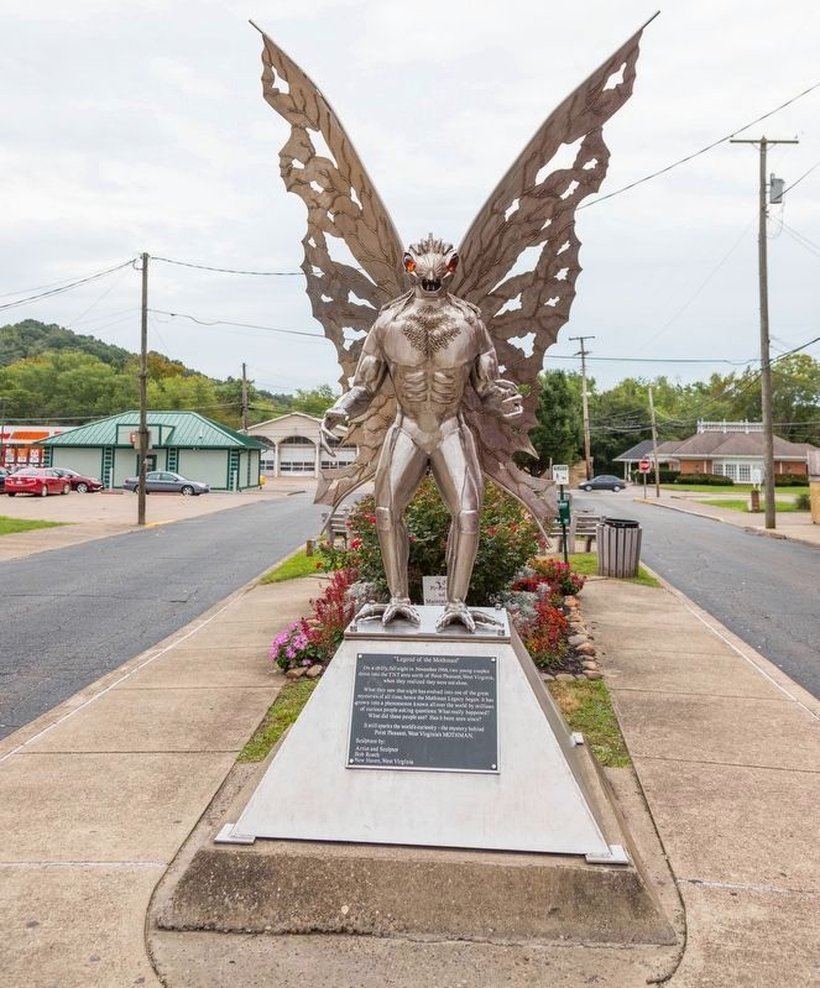
The first widely reported encounter came late on the night of 15 November 1966. This case file covers what witnesses reported, the official narrative, and a two-pass assessment with its evidence tier.
What did witnesses see at TNT area (West Virginia Ordnance Works / McClintic Wildlife Station)?
The first widely reported encounter came late on the night of 15 November 1966. Two young married couples from Point Pleasant, Roger and Linda Scarberry and Steve and Mary Mallette, were driving through the TNT area north of town in the Scarberrys' 1957 Chevrolet. The TNT area is the old West Virginia Ordnance Works, a World War Two munitions plant, by 1966 a half-abandoned landscape of concrete storage "igloos" and a derelict generator building, surrounded by the McClintic Wildlife Station bird sanctuary. According to the account John Keel took directly from the witnesses, as they pulled alongside the old power plant near the unlocked gate, Linda Scarberry gasped and all four saw two bright red circles in the blackness, about two inches in diameter and six inches apart. "What is it?" Mary Mallette cried from the back seat. The lights moved away from the building and the foursome realized they were the eyes of a large animal.
Roger Scarberry described it later as "shaped like a man, but bigger, maybe six and a half or seven feet tall, and it had big wings folded against its back." Linda said, "It had two big eyes like automobile reflectors," and Roger added, "They were hypnotic. For a minute we could only stare at it. I couldn't take my eyes off it." Keel records that the thing was grayish, walked on sturdy manlike legs, and shuffled toward the open door of the generator plant. Steve Mallette yelled, "Let's get out of here," and Roger drove for State Route 62. They saw it again, or another like it, on a small hill by the road, and it spread batlike wings and lifted straight up into the air. "We were doing one hundred miles an hour," Roger said, "and that bird kept right up with us. It wasn't even flapping its wings." Mary Mallette said, "I could hear it making a sound. It squeaked like a big mouse." They reported passing a large dead dog by the roadside that was gone when they returned minutes later.
The contemporary Point Pleasant Register account of 16 November 1966 gave the same figures in print: Steve Mallette of 3305 Jackson Avenue and Roger Scarberry of 809 30th Street described "a man-sized, bird-like creature" about six or seven feet tall with a wingspan of ten feet and red eyes about two inches in diameter and six inches apart. The paper recorded Scarberry's words, "If I had seen it while by myself I wouldn't have said anything, but there were four of us who saw it," and the witnesses' comparison that it resembled "maybe what you would visualize as an angel." It chased the car until they reached the city limits and the National Guard Armory on Route 62, then rose "straight up, like a helicopter."
The two couples drove straight to the Mason County courthouse and reported to Deputy Sheriff Millard Halstead, who followed them back to the TNT area in his patrol car. He found no creature but recorded that when he switched on his police radio a loud garbled signal "like a record or tape recording being played at very high speed" blasted out and drowned the dispatcher. Within days the sightings multiplied. On the night of 16 November 1966, near one of the igloos, Marcella Bennett, in a car with Raymond and Mrs. Wamsley, said a big gray thing rose up slowly from the ground behind their parked car: "Bigger than a man, with terrible glowing red eyes." She was so frightened she dropped the baby in her arms and stood transfixed before Raymond Wamsley pulled her and the child inside the Ralph Thomas bungalow and bolted the door, after which the red eyes appeared at the window. On the evening of 26 November 1966 a St. Albans housewife, Mrs. Ruth Foster, found the creature on her front lawn and was one of the few to describe a face: "a funny little face, I didn't see any beak, all I saw were those big red poppy eyes."
What is the official explanation?
No federal agency ever opened a formal Mothman file. Project Blue Book, the United States Air Force UFO program, was running in 1966 but the Point Pleasant sightings were treated as a local newspaper and law-enforcement matter, not an aircraft report. The nearest thing to an official position came from the county. Mason County sheriff George Johnson handled the public-order side as armed crowds began driving into the TNT area at night to hunt the creature, and Deputy Millard Halstead took the original report and went on record that he believed the witnesses. "I've known these kids all their lives," Halstead told Keel. "They'd never been in any trouble and they were really scared that night. I took them seriously."
The closest thing to an official scientific verdict was delivered within days of the first sighting by Dr. Robert L. Smith, an associate professor of wildlife biology at West Virginia University. Smith told Sheriff Johnson that the creature frightening people around Point Pleasant was almost certainly a large bird that had stopped off while migrating south. As reported in West Virginia newspapers in late November 1966, Smith stated, "From all the descriptions I have read about this thing, it perfectly matches the sandhill crane." He noted that sandhill cranes stand close to five feet tall, have red flesh around the forehead, and a wingspan that can reach toward six and a half feet, and that one wandering off its normal migration route would be unfamiliar to local people because the species is not native to the region. This sandhill crane identification became the standard "official" explanation repeated in the press through the flap.
The other strand of officialdom was the bird sanctuary itself. The TNT area sat inside the McClintic Wildlife Management Area, a 2,500-acre preserve known to hold owls, which would later become the backbone of the leading skeptical explanation. There was no government report, no recovered specimen tied to the witnesses, and no physical trace beyond the "strange pile of dust" or coal-field debris that deputies noted at the scene and the anomalous radio interference Halstead described. The only documentary residue of the official response is contemporary law-enforcement testimony, the sheriff's crowd-control problem, and Smith's on-the-record crane statement to the sheriff.
What did the witnesses think it was?
The four original witnesses never recanted and consistently rejected the bird explanations offered to them. Reporter Mary Hyre, the Point Pleasant correspondent for the Athens Messenger who wrote the case up on 16 November 1966 under the headline "Winged, Red-Eyed Thing Chases Point Couples Across Countryside," interviewed the Scarberrys and Mallettes repeatedly. When a local resident shot a large white owl with an unusual wingspan and odd claws and offered it as the answer, Hyre took it back to the original couples, and all four said the owl did not match what they had seen. When the Ohio sandhill crane theory circulated, Keel carried a photograph of a sandhill crane in his briefcase and, by his account, "not a single witness recognized it or thought it resembled what he or she had seen." Linda Scarberry described the eyes as red as the devil and the experience as the most frightening of her life, a position she held for decades afterward.
Crucially, the witness pool was not just two couples. John Keel, the New York journalist who moved into the area to investigate and whose 1975 book The Mothman Prophecies remains the fullest primary record, wrote that "altogether, more than one hundred adults would see this winged impossibility in 1966-67. Those who got a close look at it all agreed on the basic points. It was gray, apparently featherless, as large or larger than a big man, had a wingspread of about ten feet, took off straight up like a helicopter, and did not flap its wings in flight." The face was the one consistent puzzle: most witnesses could describe nothing but the two dominating red eyes. That convergence of independent strangers on a gray, roughly seven-foot, ten-foot-winged, red-eyed, vertically-launching form is the case's strongest internal evidence.
Corroborating witnesses with names and addresses, not anonymous rumor, run through the record: Marcella Bennett and the Wamsleys at the igloos on 16 November, Mrs. Ruth Foster at St. Albans on 26 November, and the separately documented Newell Partridge incident near Salem, West Virginia. Partridge, a building contractor, told both Gray Barker and Keel that on the night of 14 November 1966 his television blanked into a herringbone pattern and emitted a loud winding whine "like a generator winding up," his German shepherd Bandit howled and bolted toward two red eyes by the hay barn, and the dog was never seen again. Keel himself ultimately did not read the creature as a stray bird. He came to frame Mothman as one fragment of a larger pattern he called "ultraterrestrial," beings he argued coexist with us outside our normal space-time rather than visitors from another planet. Whatever one makes of that interpretation, the witnesses he interviewed believed they had seen a real, physical, frightening living thing.
The dispute
The dispute centers on two competing bird identifications, neither of which closes the case. The contemporary explanation came from Dr. Robert L. Smith, an associate professor of wildlife biology at West Virginia University, who told Mason County sheriff George Johnson within days of the first sighting that the creature "perfectly matches the sandhill crane," a large migratory bird that he argued had wandered off its route and gone unrecognized because it is not native to West Virginia. The sandhill crane reading is weak on its own terms: the bird stands about five feet rather than six or seven, has a long neck and a long pointed bill that no witness reported, and a wingspan under seven feet rather than the ten feet repeatedly described. Keel tested it directly by carrying a sandhill crane photograph to witnesses, and none recognized it.
The stronger modern counter-explanation comes from Joe Nickell of the Committee for Skeptical Inquiry, who identified the barred owl as the likely culprit. Nickell's method is genuine and is the reason this case is disputed at all: barred owls have a documented crimson eyeshine, caused by blood vessels in the eye reflecting light, which neatly explains the glowing red eyes that anchor every account, and the species is known to live in the McClintic Wildlife Management Area surrounding the TNT site. An owl flushed at night and judged against a black background can be badly misjudged for size. Nickell rejected the barn owl for having weaker eyeshine and rejected the crane for the reasons above.
What keeps the owl theory from settling the case is that it is a reconstruction, not a demonstration, and it collides with the testimony of the people who were there. A barred owl is under two feet tall with a wingspan near three and a half feet. The witnesses described a gray, upright, manlike figure six and a half to seven feet tall with a ten-foot wingspan that kept pace with a car at a hundred miles an hour without flapping and rose vertically like a helicopter, and they were shown owls and rejected them. More than one hundred independent adults, by Keel's count, converged on the same unusual description. No confession exists, no hoax apparatus was ever recovered, and no specific identified animal has been matched to the sightings to the witnesses' satisfaction. The eyeshine mechanism is real and important, but as an unproven explanation contested by the primary witnesses it leaves the case standing rather than overturned, which places it in the Barely Disputed tier rather than Strongly Disputed.
Is the Mothman of Point Pleasant real? The two-pass assessment
Pass one, the ordinary readings. The dominant skeptical explanation, advanced most rigorously by investigator Joe Nickell of the Committee for Skeptical Inquiry, is a large owl misperceived in the dark. Nickell identified the barred owl as the best fit: it has a rounded head, large dark eyes, and a dramatic crimson eyeshine produced by the dense blood vessels in the eye, which directly accounts for the glowing red eyes every witness fixed on. Barred owls are documented in the McClintic Wildlife Management Area where the TNT area sits, and an owl flushed from a roost and flying low across a car's path at night, judged for size and distance against a black background, can read as far larger and taller than it is. Nickell rejected the barn owl as having weaker eyeshine and rejected the contemporary sandhill crane theory of Dr. Robert L. Smith on the grounds that the bird is not native to West Virginia and that witnesses described no neck. The eyeshine mechanism is real, demonstrable, and is the single most powerful natural explanation on offer. A second ordinary strand is simple flap dynamics: once the first dramatic Register story ran, armed crowds poured into a spooky abandoned munitions site at night primed to see a monster, and misidentified owls, herons, and shadows would naturally follow.
Pass two, if the reports describe what the witnesses say they describe. The witnesses, who actually saw the thing, were shown the owl and the crane and rejected both. A barred owl stands under two feet tall with a wingspan near three and a half feet, not a gray, headless-looking, manlike form six and a half to seven feet tall with a ten-foot wingspan that paced a car at a hundred miles an hour without flapping and lifted vertically like a helicopter. The vertical takeoff, the absence of wingbeats at speed, the manlike upright posture and legs, the squeaking sound, and the convergence of more than a hundred independent adults on the same unusual body plan are not trivially explained by a startled owl. If real, the most economical reading is an unidentified large flying animal or an anomalous aerial phenomenon that the period's UFO context folded into a single "Mothman" identity. John Keel's own ultraterrestrial framing is unfalsifiable and is logged here as the investigator's interpretation, not as established fact.
Weighing the two passes: a genuine, method-shown natural mechanism exists for the defining detail, the red eyeshine, and that earns this case a disputed tier. But there is no confession, no recovered hoax prop, no photograph of a faked creature, and above all no positive identification of a specific real-world object that the witnesses themselves accept. The owl reconstruction is plausible but unproven, and it strains against the reported size, flight behavior, and the sheer number of consistent independent witnesses. Under the archive's rules a plausible-but-unproven natural reconstruction and a contested official assertion are "Barely Disputed," not "Strongly Disputed." The case largely stands on its witnesses and its contemporary newspaper record, with a real but partial counter-explanation hanging over it. Tier: Barely Disputed.
Sources
- www.unionleader.com/news/back_page/couples-see-man-sized-bird-creature-something-55th-anniversary-of-mothmans-appearance/article_29d2777a-b499-53cd-b0ad-318b1fd955df.html
- pearl-hifi.com/06_Lit_Archive/14_Books_Tech_Papers/Keel_John/The_Mothman_Prophesies.pdf
- www.athensmessenger.com/news/mothman-myth-rooted-in-messenger-reporters-work/article_eae63596-c338-576c-97b2-3c445379ad1c.html
- www.johnkeel.com/?p=220
- www.audubon.org/magazine/mothman-west-virginia-owl
- www.hmdb.org/m.asp?m=124131
More cases from this region: UFO sightings in United States