The Pasadena Police Helicopter Encounter
On a fog-edged night in October 1972, two members of the Pasadena Police Department air crew were flying routine night patrol over the northeast corner of the city, close to the San Gabriel foothills. This case file covers what witnesses reported, the official narrative, and a two-pass assessment with its evidence tier.
What did witnesses see at Pasadena?
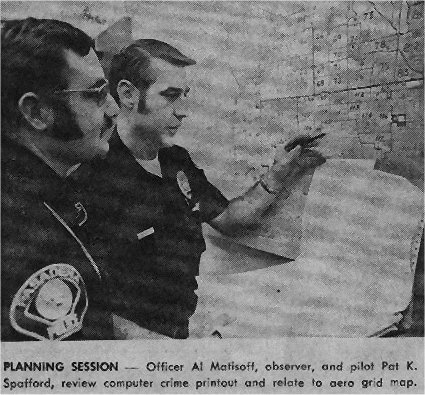
On a fog-edged night in October 1972, two members of the Pasadena Police Department air crew were flying routine night patrol over the northeast corner of the city, close to the San Gabriel foothills. The observer was Officer Al Matisoff. The pilot was Pat K. Spafford. Both are named, and both are pictured together, in a Pasadena Star News photograph that ran on 13 February 1972, captioned "Officer Al Matisoff, observer, and pilot Pat K. Spafford, review computer crime printout and relate to aero grid map." This was a professional, well-trained crew. The Pasadena Police Department had stood up one of the earliest police helicopter sections in the country in 1969, and by the mid-1970s its pilots had flown more than 20,000 hours.
In Matisoff's own account, the crew first noticed what looked like a military Sikorsky helicopter hovering very low over a residential area, turning its landing light off and on. As the police ship drew closer, the "helicopter" gained altitude and started heading westbound. Curious, the crew followed it. They were at roughly 1,000 feet above ground level. The object then appeared to lose altitude quickly, "as if it was going into auto rotation." Then, about 300 meters past it, the crew saw something else entirely: a large object that at first looked like "a bunch of big balloons tied together." It was round, it appeared to be rotating, and Matisoff saw no lights on it at all. It was pacing them at their exact airspeed, about 60 mph.
Spafford, the pilot, began yelling over the intercom that he was seeing a UFO. Matisoff immediately moved to act. He shut off the helicopter's running lights so he could power up their "night star" searchlight and illuminate the object, which was standard operating procedure because running both at once risked popping a breaker. Spafford questioned what he was doing, and when Matisoff said he was going to "light it up," Spafford said "No" and turned the running lights back on. The two had a short argument about it, but the pilot had the final word. Because of that, no searchlight was ever put on the object and no photograph was taken. The crew watched the round object for a few minutes as it flew abeam of them, heading west.
With fog rolling into the Los Angeles basin, the crew turned back toward Brackett Field in Pomona, where the helicopter was hangared, to avoid getting caught in it. As they approached the west end of the city near the Rose Bowl, the object suddenly gained speed. In just a few seconds it accelerated toward the Los Angeles skyline and disappeared out of sight. Matisoff said the speed was "faster than supersonic" and that both men were amazed at how fast it accelerated. The whole encounter lasted several minutes.
What is the official explanation?
There is no official military or scientific investigation of this case, and that absence is itself a documented fact rather than a gap in the research. The US Air Force had shut down Project Blue Book in December 1969, nearly three years before this sighting, so by October 1972 there was no federal body tasked with collecting or evaluating civilian UFO reports. The only "official" handling the encounter received came from the witnesses themselves and from the agencies they phoned that night.
Immediately after landing, the crew began making calls. Spafford called Los Angeles International Airport to ask whether they had any such object on their radar. He got a flat "negative" from them. Matisoff called the Jet Propulsion Laboratory in Pasadena, JPL being a few miles from the sighting area, to ask whether they had any kind of experiment running. They told him no. Matisoff later remarked that the person he spoke to at JPL "sounded like this was an everyday occurrence," which struck him at the time. Both officers then wrote up incident reports and turned them in to the Pasadena Police Department.
What happened to those reports is unknown. Matisoff states plainly that he never found out whether anyone forwarded the report or investigated it further. The only institutional response he ever heard of was informal and dismissive: about two weeks later the police chief saw him in a hallway and yelled, "Hey Al, did you see any more giant Frisbees?" Matisoff kept the story largely to himself after that. He left the Pasadena Police Department in 1979 to join the San Luis Obispo County Sheriff's Department, and only years later submitted his firsthand account to MUFON, where it is logged as submitter 15633.
The operational context can be checked against primary documents even though the UFO report itself cannot. The City of Pasadena's own Air Operations page records that the department created its Helicopter Section in 1969, quoting retired Chief Robert McGowan from a February 1978 article in The Police Chief magazine describing how Pasadena "entered the aerial patrol field during its infancy." A US Department of Justice Office of Justice Programs abstract on the Pasadena program records that aerial police patrol there began in 1970 and that, after nearly eight years and more than 20,000 flight hours, the unit's pilots had been involved in only one accident, with pilots selected and trained in-house. So the witnesses were exactly who the report says they were: a professional police air crew on a sanctioned night patrol, not casual observers.
What did the witnesses think it was?
The two witnesses were both sworn members of the Pasadena Police Department air unit, and both believed they had seen something genuinely anomalous. Pilot Pat K. Spafford was emphatic in the moment, shouting over the intercom that he was seeing a UFO. Observer Al Matisoff was measured but clear that the object's behavior had no ordinary explanation he could offer. His instinct as a trained observer was to gather evidence, which is why he moved at once to kill the running lights and put the searchlight on the object. Had Spafford not overruled him, there might have been a documented illumination or even a photograph. That decision, made in seconds by the pilot in command, is the reason this case rests on testimony alone.
Matisoff's belief is reflected in how he described the object across the encounter. He stressed that it had no visible lights, that it was round and rotating, and that it first resembled a cluster of balloons tied together. He noted that it held their exact airspeed of about 60 mph for several minutes before accelerating away faster than supersonic toward the LA skyline. He also flagged the detail that the JPL contact reacted to his call as though such reports were routine, which left an impression on him. These are the observations of someone trying to be precise about what he could and could not account for, not someone reaching for a dramatic story. He explicitly says he never made a big deal of it and only shared it because he thought it was worth telling.
The corroboration here is real but limited, and it should be stated honestly. There are two named professional witnesses who experienced the event together, and a contemporaneous newspaper photograph confirms that Matisoff and Spafford were the actual Pasadena PD observer and pilot of that period. That establishes the witnesses' identities, roles, and competence beyond reasonable doubt. What does not survive is a second independent published account: Pat Spafford died before the report surfaced, so the only first-person narrative we have is Matisoff's, and the incident reports both men filed have not been located. No ground witnesses came forward, no radar return was logged at LAX, and no photograph exists. The case is strong on the credibility of the observers and weak on independent physical confirmation.
Is the Pasadena Police Helicopter Encounter real? The two-pass assessment
Pass one, the ordinary explanations. The object was first taken for a low-hovering military Sikorsky helicopter blinking its landing light, and another helicopter at night, including a news, traffic, or military aircraft over a residential area, is a real possibility for the opening of the encounter. A cluster of escaped balloons would match the "bunch of big balloons tied together" appearance, the round shape, the apparent rotation, and the lack of lights, and balloons can drift at the same modest pace as a slow-flying helicopter, which would account for the 60 mph match while the crew flew alongside. The harder facts to fit into a mundane frame are the reported "faster than supersonic" departure toward the LA skyline and the absence of any lights, since a balloon cannot accelerate and a lit aircraft would show navigation lights at that range. Acceleration judged by eye at night against a city skyline is notoriously unreliable, and a balloon caught in a sudden wind shear or simply left behind as the helicopter banked away toward Pomona could read to observers as a rapid vanishing. No radar confirmation exists, because LAX returned a negative, which is consistent with a small uncooperative target but also with there being no solid object at all. Critically, the crew never put their searchlight on it, so the one chance to resolve the object visually was lost to a cockpit disagreement, and there is no photograph, film, or instrument trace of any kind.
Pass two, if it was real. Then two trained police aviators watched an unlit, rotating, roughly spherical craft hold formation with their helicopter at 1,000 feet over a populated city for several minutes before accelerating out of sight at a speed they could only call faster than supersonic. The witnesses are about as credible as civilian UFO witnesses get: sworn officers, a sanctioned night patrol, an air unit with thousands of logged hours, and a contemporaneous newspaper photo that fixes their identities and roles. The detail that JPL treated the inquiry as routine, if accurately recalled, is provocative but is a single secondhand impression and cannot be independently checked.
Weighing the two passes, the honest verdict is that this case neither resolves cleanly into a known object nor proves anything anomalous. It has no official narrative, because Blue Book was already closed and the department's own reports vanished, and it stands or falls entirely on the testimony of its two witnesses and a single photograph of those witnesses. There is no physical evidence, no second independent published account, no radar, and no image of the object itself. There is also no counter-explanation that has been demonstrated with a shown method: nobody has identified a specific balloon launch, a named aircraft, or any traced cause, so the case cannot be pushed toward disputed either. With strong witnesses but nothing to test, the appropriate tier is Unknown.
Sources
- web.archive.org/web/20250130132217/https://www.ufocasebook.com/2009/california1972.html
- web.archive.org/web/20200914233315/https://www.ufocasebook.com/2009/california1972.jpg
- www.cityofpasadena.net/police/divisions-and-sections/special-operations-division/air-operations/
- www.ojp.gov/ncjrs/virtual-library/abstracts/police-helicopters-part-2
- thinkaboutitdocs.com/1972-pasadena-california-helicopter-crew-encounter-ufo/
More cases from this region: UFO sightings in United States