The George Stock Photographs
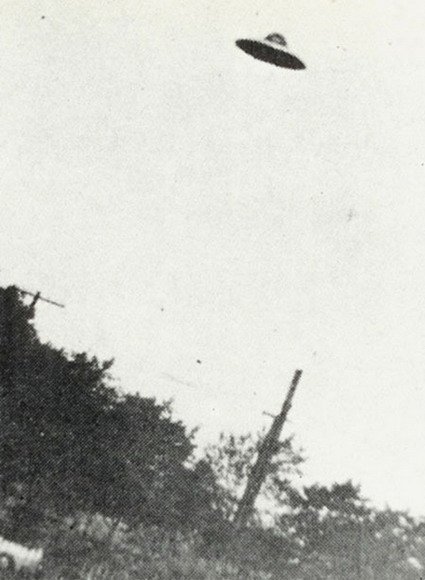
At 10:15 on the morning of July 31, 1952, at the height of the biggest UFO wave in American history, a Passaic machinist named George J. Stock looked up from his yard on Brooks Avenue and called to his father, I think I see a flying saucer. Over the next few minutes he worked a Kodak Duaflex II through five exposures of a grey domed disc as it drifted, tilted, and hovered over the utility lines of his neighborhood, producing what may be the most complete close-range photo sequence of the entire 1952 flap.
What did witnesses see at 200 block of Brooks Avenue?
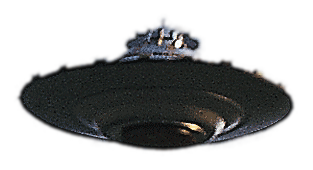
A greyish metallic disc, estimated around 30 feet across, with a large semi-transparent dome jutting from its center. It approached at a leisurely pace, came nearly to a stop and hovered about 200 feet up, tilted as though to observe the ground, and made no sound at any point. The five frames track it across the sky of a dense residential block: above the treeline and wires, tilted near two utility poles, edge-on past the corner of the house, and twice nearly straight overhead, showing the dark circular underside ringed by the rim.
What is the official explanation?
The case drew the full weight of the official apparatus. The Passaic Herald-News forwarded prints and a data sheet to the Air Technical Intelligence Center at Wright-Patterson, where Project Blue Book under Captain Edward Ruppelt logged the case. Colonel Donald L. Bower, chief of ATIC's Technical Analysis Division, ordered a background investigation, noting internally that an object this large should have drawn other witnesses in so dense an area. Air Force OSI Special Agent George H. Wertz then ran a genuine field investigation, interviewing both Stocks, inspecting the family machine shop, canvassing neighbors and employers, who vouched for the men's reliability, and checking the nearby Federal Telephone and Radio Corporation tower for experimental activity on July 31, finding none. The Blue Book file was nonetheless closed with a hoax stamp, without any demonstrated fabrication method. That stamp is logged here as proof the case commanded Air Force attention, not as a verdict on the imagery.
What did the witnesses think it was?
George J. Stock took the photographs; his father William J. Stock, who shared the house at 221 Brooks Avenue, watched the object with him. The early press record was scrambled by John H. Riley, the 28-year-old Paterson photo finisher who developed Stock's roll the same afternoon: Riley distributed prints to East Coast newspapers as his own work, and the first wire copy lists Riley as photographer with Stock as witness. The OSI investigation untangled this, with Riley admitting Stock took the pictures. The garbled version survives in later UFO literature, which often promotes Riley to a friend standing in the yard. Neither Stock ever recanted, and no investigator ever impeached their character; the OSI canvass found both men regarded as reliable.
The dispute
The dispute over George J. Stock's five Passaic photographs (July 31, 1952, 10:15 AM, the 200 block of Brooks Avenue, New Jersey) of a greyish metallic disc roughly 30 feet across with a large semi-transparent central dome rests on two pillars, neither of which actually demonstrates fabrication. The primary counter-explanation is the official one: the Air Force closed the Project Blue Book file with a hoax stamp. By the archive's own standard this is an apparatus debunk, not a verdict, because it came with no demonstrated method. The investigating officers themselves, Colonel Donald L. Bower and Special Agent George H. Wertz, found no evidence of fabrication, and the men who reported the object, photographer George J. Stock and his father William J. Stock, never recanted and were regarded as reliable by neighbors and employers. A hoax classification stamped over the conclusions of its own investigators, with no shown technique for how the disc was faked, is a claim, not a finding.
The second strand is ATIC's internal single-vantage objection: a 30-foot object hovering over a packed residential block at midmorning should have produced a second household of witnesses, and none came forward. That objection has, per the page, never been answered, so it remains a genuine open question rather than a debunk. It raises doubt about the event but identifies nothing, names no mundane object, and offers no mechanism by which the five sequential frames were produced. It weakens the case without closing it.
A third complication is provenance rather than authenticity. Photo finisher John H. Riley developed the film the same afternoon and then hustled prints to newspapers under his own name, initially misrepresenting himself as the photographer, which muddied who controlled the negatives during the critical first week. The frequently repeated claim that the object merely resembles a lady's sun hat circulates without any author who did optical work on the negatives. Crucially, no named civilian analyst has ever published a method-based analysis of the actual frames that this archive could verify.
Because the imagery stands unrebutted by any qualifying optical analysis and the only formal debunk is an unsubstantiated official stamp, the dispute does not close the case. The page classifies it as Disputed, not discredited: the unanswered single-vantage problem and the provenance tangle keep it short of Verified Unexplained, but the hoax allegation is an assertion with no shown fabrication method behind it, so the photographs largely stand.
Is the George Stock Photographs real? The two-pass assessment
Pass one, the evidence on its own terms: five sequential frames from a documented camera and film stock, internally consistent in vantage, lighting, and neighborhood detail, developed within hours by a commercial finisher, with a second named witness in the household. The day, time, address, weather, and altitude estimate all survive in the contemporary data sheet. The genuine weakness is chain of custody: Riley's same-day hustle of prints to newspapers under his own name muddied who controlled the negatives during the critical first week, and ATIC's internal objection, that a 30-foot object hovering over a packed residential block at midmorning produced no second household of witnesses, has never been answered. Pass two, the counter-claims: the Air Force hoax classification came with no demonstrated method and sits in the file alongside an OSI report that found the witnesses reputable, so under this archive's rules it counts as apparatus attention, not counter-evidence. No named civilian analyst has published a method-based analysis of the actual frames that this research could verify; the often-repeated quip that the object resembles a lady's sun hat circulates without an author who did optical work on the negatives. Verdict: Disputed. The imagery is unrebutted by any qualifying analysis, but the provenance complications and the unanswered single-vantage problem keep it short of Verified Unexplained.
Sources
- www.saturdaynightuforia.com/html/articles/articlehtml/thephotographerstale.html
- www.openminds.tv/ufo-new-jersey-1952/7087
- web.archive.org/web/20260313110233/https://www.ufocasebook.com/bestufopictures.html
- web.archive.org/web/20070808143628/http://www.ufoevidence.org/photographs/section/1950s/Photo318.htm
- web.archive.org/web/20130409010019/http://www.ufoevidence.org/photographs/photosmain/PicHist5a.jpg
- www.topfoto.co.uk/asset/4467/
More cases from this region: UFO sightings in USA