The Pentagon UAP Videos That Flicker at Bird Wingbeat Rates
The government filed six objects as unidentified and moving at 480 miles per hour. Measuring how fast they blinked turned out to say more than any attempt to measure how fast they flew.
What did witnesses see at Galileo Project?
On 13 October 2026 six researchers published a measurement of a declassified military infrared video. They argue that its six unidentified objects flicker at the rate of beating wings. The paper is the first analytical publication connected to the UAP Science Advisory Council, the scientific body formed in June 2026 to advise the White House and the intelligence agencies, and it is unusual in this field for showing its full method and its own limits.
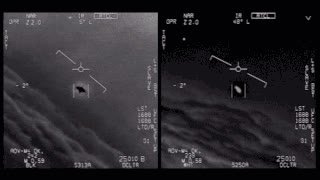
The subject is DOW-UAP-PR135, a sensor video released on 18 September 2026 in the sixth tranche of records published under the Presidential Unsealing and Reporting System for UAP Encounters. It was released together with its mission report, DOW-UAP-D108, filed by a United States Air Force crew for an encounter over the Middle East on 29 July 2025. The report describes six small spherical objects, grouped together, which it records as seeming to be agile and frequently changing direction, with an estimated speed of 480 miles per hour.
The paper is titled Six objects reported at 480 mph in a declassified military infrared video show brightness flicker at bird wingbeat rates, catalogued as arXiv:2610.08692. Its authors are Jacob Haqq-Misra of Blue Marble Space, Ravi Kopparapu of the NASA Goddard Space Flight Center, Richard Cloete and Omer Eldadi of the Galileo Project at Harvard University, Michael Shermer of the Skeptics Society, and Abraham Loeb of the Galileo Project, who chairs the Advisory Council.
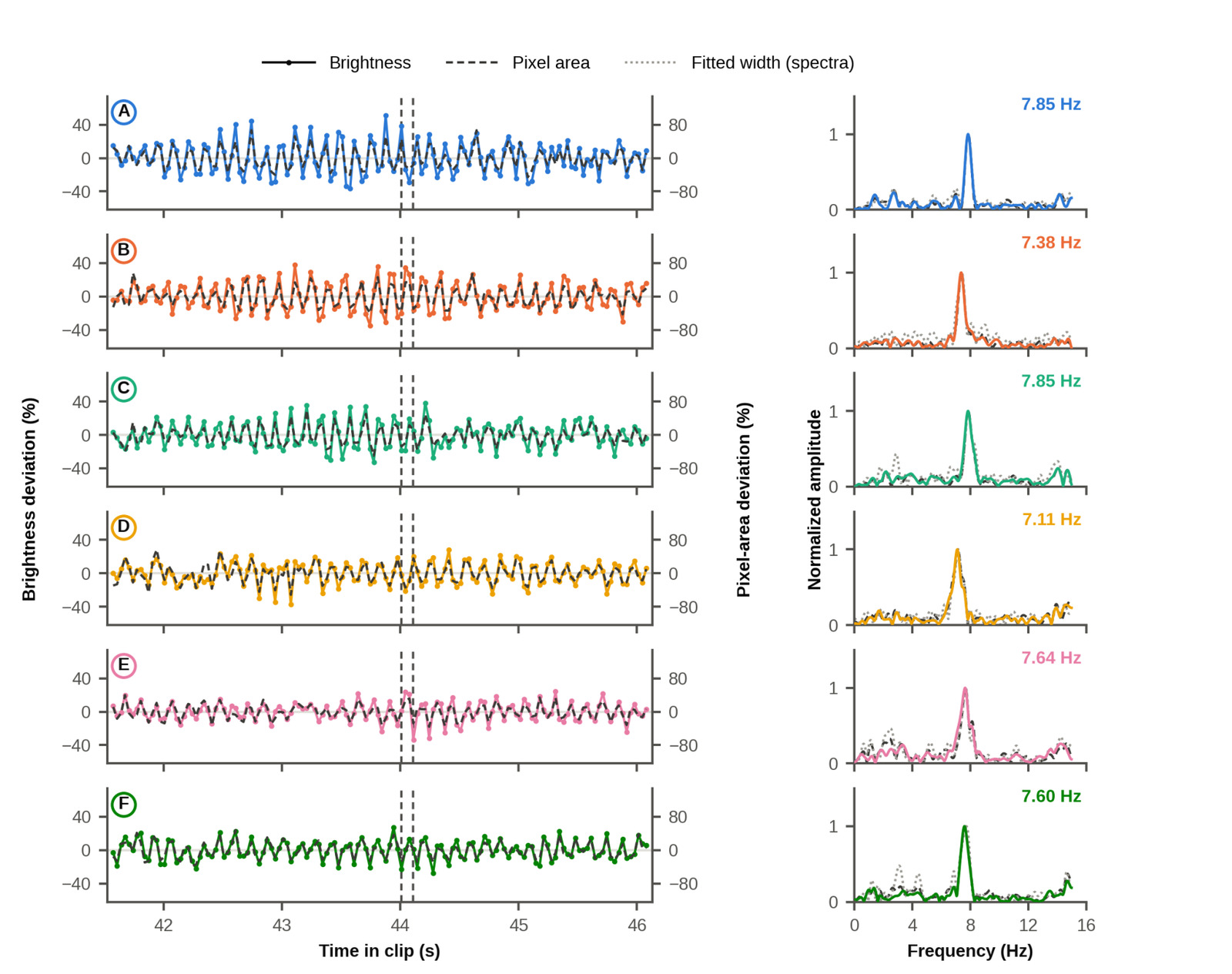
Their measurement is simple to state. They recorded the brightness of each object in every frame and found that all six brighten and dim steadily between 7.1 and 7.9 times per second, each at its own rate and out of phase with the others. The individual figures, listed in the paper's Table 1 for frames 1247 to 1382, are 7.85, 7.38, 7.85, 7.11, 7.64 and 7.60 cycles per second. The apparent pixel area of each object beats in step with its brightness, which is what a wing presents as it turns through a stroke.
The authors then ran the controls that make the result meaningful. They planted artificial objects of constant brightness into the footage and confirmed that neither the video compression nor the sensor generates the flicker. They verified that the background immediately beside each object does not beat, and that the rhythm is not a repeating cadence of the encoding, noting that the files are H.264 streams at exactly 30 frames per second. For a positive comparison they applied the identical analysis to infrared footage of real flying animals recorded by the Galileo Project's ground-based cameras near Las Vegas, and measured those animals beating between 3.4 and 10.0 times per second, with brightness and apparent size again moving together.
The speed claim is addressed separately, by geometry rather than by photometry. None of the PURSUE sensor videos publish the range from the sensor to the object. Without a range, the only distance the targeting system can assign to a point in the image is the distance to where the line of sight meets the ground, so a speed read off the imagery is the speed of that ground point and not of the object. The authors calculate that a nearly stationary object at 60 to 80 per cent of the aircraft's altitude would reproduce the reported ground-projected figure of 480 miles per hour.
The analysis was afterwards extended beyond the single video. In a post of 16 October 2026 Loeb reported that the same method applied across all six PURSUE tranches brought the count to 10 videos containing 25 bird candidates, about 8 per cent of the sensor videos released so far, naming PR41, PR44, PR077, PR079, PR085, PR088, PR097, PR099 and PR141 alongside PR135. He notes that PR097 appears to show a flock of four followed by four more later in the clip, and that PR141 displays infrared and optical channels side by side with a similar variability frequency in both. Other videos, he writes, probably show birds but are too faint and grainy to yield a reliable beat frequency.
What is the official explanation?
The official position on these objects is the one recorded in the mission reports, which filed them as unidentified. The Department of War has not responded to the analysis, has not revised any record, and has published nothing in answer to it. The paper is therefore not an official reclassification, and the videos it discusses remain unidentified anomalous phenomena in the government's own catalogue.
The status of the authors is worth stating precisely because it is easy to overstate in either direction. Abraham Loeb chairs the UAP Science Advisory Council, the body formed in June 2026 to advise the White House, the Department of War, the FBI and intelligence community members, and this paper is described as the first to come from that effort. That gives the work proximity to the official process. It does not make it an official finding, and the paper itself is published as a preprint on arXiv rather than through any agency channel.
The central request the paper makes of the government is specific. The authors state that releasing the redacted sensor and platform data would provide information that could refute their hypotheses, and they identify the aircraft's redacted altitude as the measurement that would test the bird interpretation directly. The redactions applied to the on-screen displays in the PURSUE releases are what reduced these videos to an unresolvable state in the first place, a point the authors develop in a companion paper on the limits of kinematic inference from the same material, arXiv:2608.12445.
The work is unusually reproducible by the standards of this subject. The analysis code, the figures, the unmodified PR135 video file, the D108 report, and short clips of the Galileo Project animals cut without re-encoding are archived together under the digital object identifier 10.5281/zenodo.23021686, with scripts to regenerate every measurement and figure. The paper also discloses, in its own text, that the analysis code, the figures and drafts of the text were developed with a large language model.
What did the witnesses think it was?
There are no witnesses to interview here beyond the aircrew whose report is already published, so the relevant testimony is what the analysts claim and, more usefully, what they decline to claim. This paper is notable for the quantity of ground it gives away, and those concessions are reproduced here because they are the part most often stripped out when the result is retold.
The authors state plainly that the imagery cannot exclude a fast object far from the aircraft. Their parallax argument establishes only that the reported speed does not require a fast-moving object, not that the object was slow. They state that a tumbling or rotating body could also flicker periodically, and rest their preference for birds on simplicity, arguing that six such objects moving together while each beats at its own steady rate of seven to eight cycles per second is a less economical explanation than six birds.
The most important concession is a genuine ambiguity in their own signal. A wing can brighten the image once per beat or twice, on the downstroke and the upstroke. Two of the Galileo Project animals show the twice case, producing spectral peaks at roughly 3.9 and 7.7 to 7.8 cycles per second. In the PR135 objects the peak at half the main frequency is only 10 to 17 per cent of the main peak, which is why the authors read the measured rate as the wingbeat itself. But they write that a double pulse of two equal brightenings would leave no peak at half the frequency and cannot be excluded, in which case the true wingbeat would be 3.6 to 4.0 cycles per second. Both readings fall within the range of birds, so the ambiguity does not damage the conclusion, but it does mean the specific figure of 7.1 to 7.9 is less settled than the headline implies.
The species question is where the paper argues against its own convenience, and this is the detail most worth preserving. From the geometry the authors propose that the encounter occurred near Qaruh Island, Kuwait. That location supports birds in general: five species of tern breed on Kuwait's offshore islands and some five to six thousand nest on Kubbar, Umm al-Maradim and Qaruh from May to July, placing a 29 July observation at the end of the nesting season. But the obvious local candidates do not fit the headline rate. Terns measured in cruising flight beat at 3.3 and 4.5 cycles per second and gulls at 2.7 to 3.8, all slower than the objects flicker, which pushes the case toward the double-pulse reading rather than the direct one. The timing is awkward too: the encounter falls at 23:22 local time, several hours after sunset, and the authors note that breeding common terns tracked by satellite stay at their colonies for nearly all of the night, so a flock aloft then is possible but not typical.
They also decline to name a species. Of 153 species measured by radar and cine camera in the reference literature, twelve have a median wingbeat within 7.1 to 7.9 cycles per second in at least one flight condition, among them the northern shoveler, grey plover, bar-tailed godwit, turtle dove, the common and pallid swifts and several swallows and thrushes. Birds also beat faster in thinner air, by roughly 0.4 cycles per second per kilometre of altitude in flap-gliding species and 1.1 in bounding ones, so birds at two to three kilometres could beat one to three cycles per second faster than the same birds near sea level. The authors conclude that frequency alone does not constrain a species.
Loeb's own language in announcing the extension is similarly hedged and is quoted here as written. His post is titled in the conditional, that the UAP might be birds; he calls the 25 objects bird candidates; and he describes the outcome as changing an officially declared unidentified phenomenon to a potential identified phenomenon in terms of flying animals.
Is the Pentagon UAP Videos That Flicker at Bird Wingbeat Rates real? The two-pass assessment
Pass one, the ordinary reading, which in this case is the paper's own. Six compact infrared sources, grouped loosely, each modulating its brightness and its apparent area together at a steady individual rate within the measured range of beating wings, with the background still and the artefacts excluded by planted controls, is a very good description of a small flock of birds nearer the aircraft than the crew assumed. The reported speed, which is the single fact that made the encounter sound extraordinary, dissolves once it is understood as the speed of a ground point rather than of an object, and the mission report itself marks the figure as estimated and records no laser range. The qualitative details the crew reported, that the objects seemed agile and frequently changed direction and that their arrangement shifted, are what a flock does. This is a strong, method-shown, reproducible result, and it is the most substantial prosaic identification yet applied to any part of the PURSUE corpus.
It also matters that the method is range-independent. Almost every dispute about military sensor footage stalls on the unknown distance to the object, which governs size and speed and is redacted from these releases. A periodic brightness signature does not depend on range at all, which is why this approach can resolve material that kinematic analysis cannot, and why it is likely to be applied much more widely.
Pass two, kept separate, and shorter than usual because the authors have already made most of it. The analysis does not demonstrate that these objects were birds; it demonstrates that they flicker the way birds do and that nothing in the released data requires them to be anything exotic. The authors concede that a fast distant object is not excluded and that a tumbling body can also beat. Their own preferred frequency may be wrong by a factor of two. The nearest plausible local species beat too slowly for the direct reading, and the encounter occurred at an hour when those birds are not usually aloft. None of that overturns the result, and the simplest explanation remains the one they give, but it does mean the correct description is a well-supported candidate identification rather than a closed case.
Two cautions apply to how this result travels. The first is scope. The peer-review-track paper analyses PR135 plus four further videos, PR41, PR44, PR088 and PR099, totalling thirteen objects. The widely quoted figures of 10 videos, 25 candidates and about 8 per cent come from Loeb's later post describing supplementary work, not from the body of the paper, and anyone citing the larger number should say so. The second is the inversion that the 8 per cent figure invites. Identifying birds in 8 per cent of released sensor videos says nothing whatever about the remaining 92 per cent, which have not been resolved in either direction; Loeb poses that explicitly as an open question. Neither a vindication of the archive's unexplained cases nor a dismissal of them can be read out of this work.
This entry is tiered Disputed because that is now the honest status of the objects in these particular videos. They are officially unidentified and they are the subject of a serious, reproducible, independently checkable analysis proposing a mundane answer, which the analysis itself declines to call conclusive. The archive's own pages for the two affected encounters, the July 2025 Middle East video and the May 2022 Middle East video, have been updated to carry this finding and its limits.
Sources
- arxiv.org/abs/2610.08692
- arxiv.org/pdf/2610.08692
- avi-loeb.medium.com/in-more-than-8-of-the-sensor-videos-declassified-by-pursue-the-uap-might-be-birds-17e9ebcbaf81
- avi-loeb.medium.com/the-six-infrared-dots-in-a-declassified-uap-video-is-a-flock-of-birds-3a0a38f33ca7
- doi.org/10.5281/zenodo.23021686
- arxiv.org/abs/2608.12445
- www.war.gov/UFO/
- www.reddit.com/r/UFOs/comments/1x8g3ij/in_more_than_8_of_the_sensor_videos_declassified/
More cases from this region: UFO sightings in United States