The Adamski Scout Ship
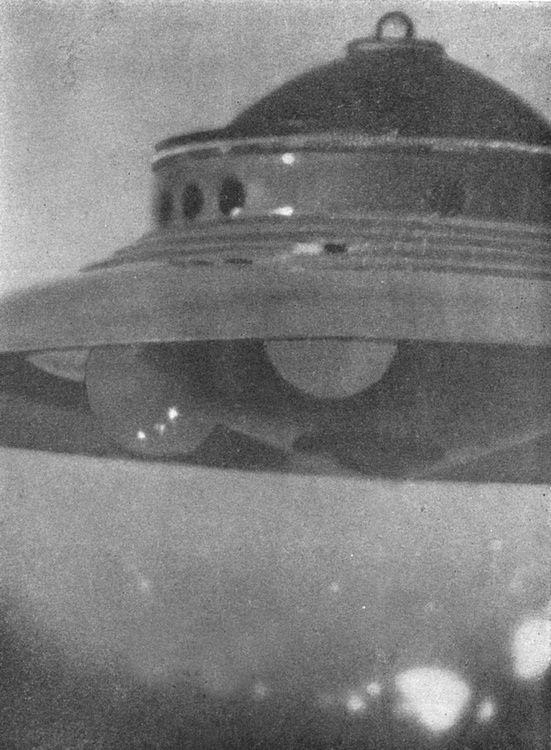
The Adamski scout ship is the most famous flying saucer photograph ever taken and the most thoroughly dismantled. It defined the look of the flying saucer for the whole world, sold books in a dozen languages, put its photographer in front of European royalty, and has now been identified, measurement by measurement, as the steel shade of a 1930s pressure lantern that Sears sold for about six dollars. This file lays out the full story: the man, the photographs, the witnesses who walked it back, and the named analysts who took it apart.
What did witnesses see at Palomar Gardens?
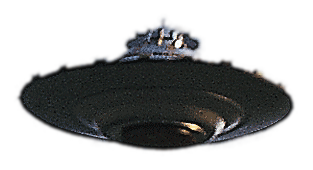
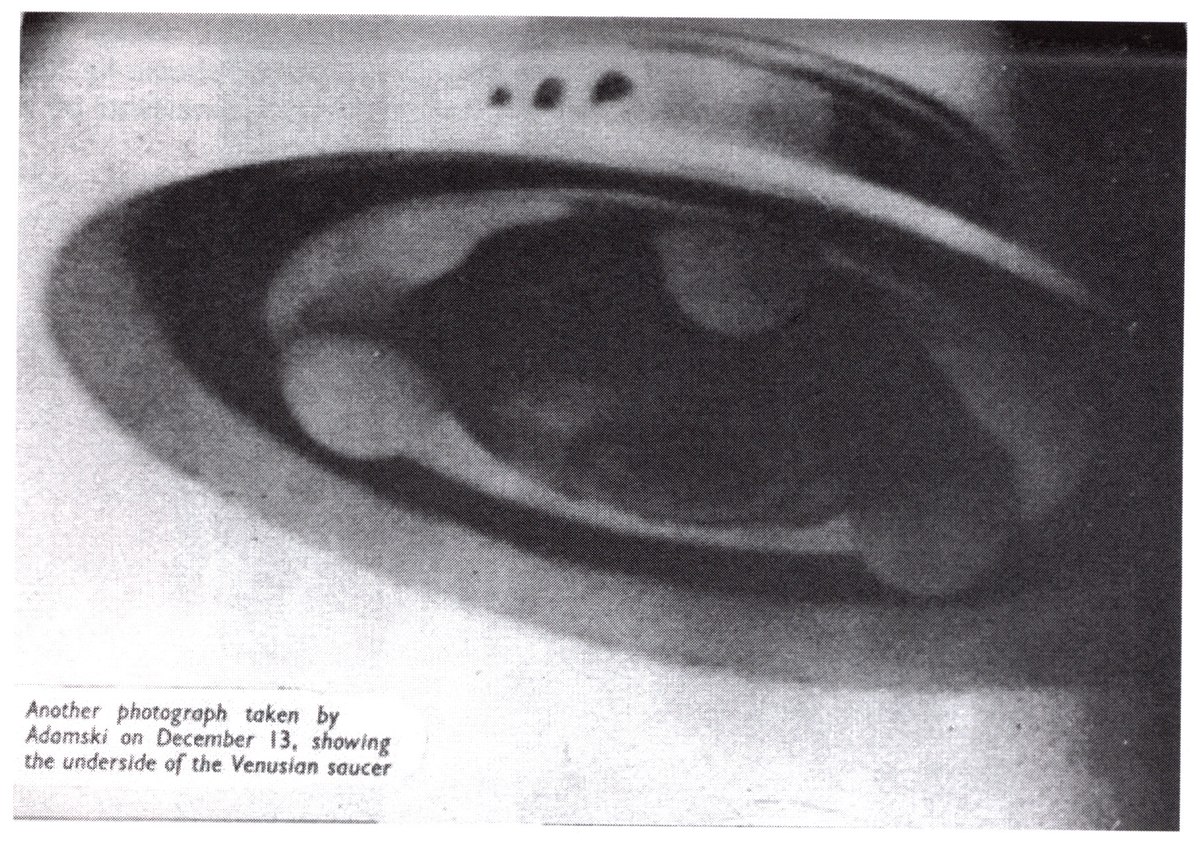
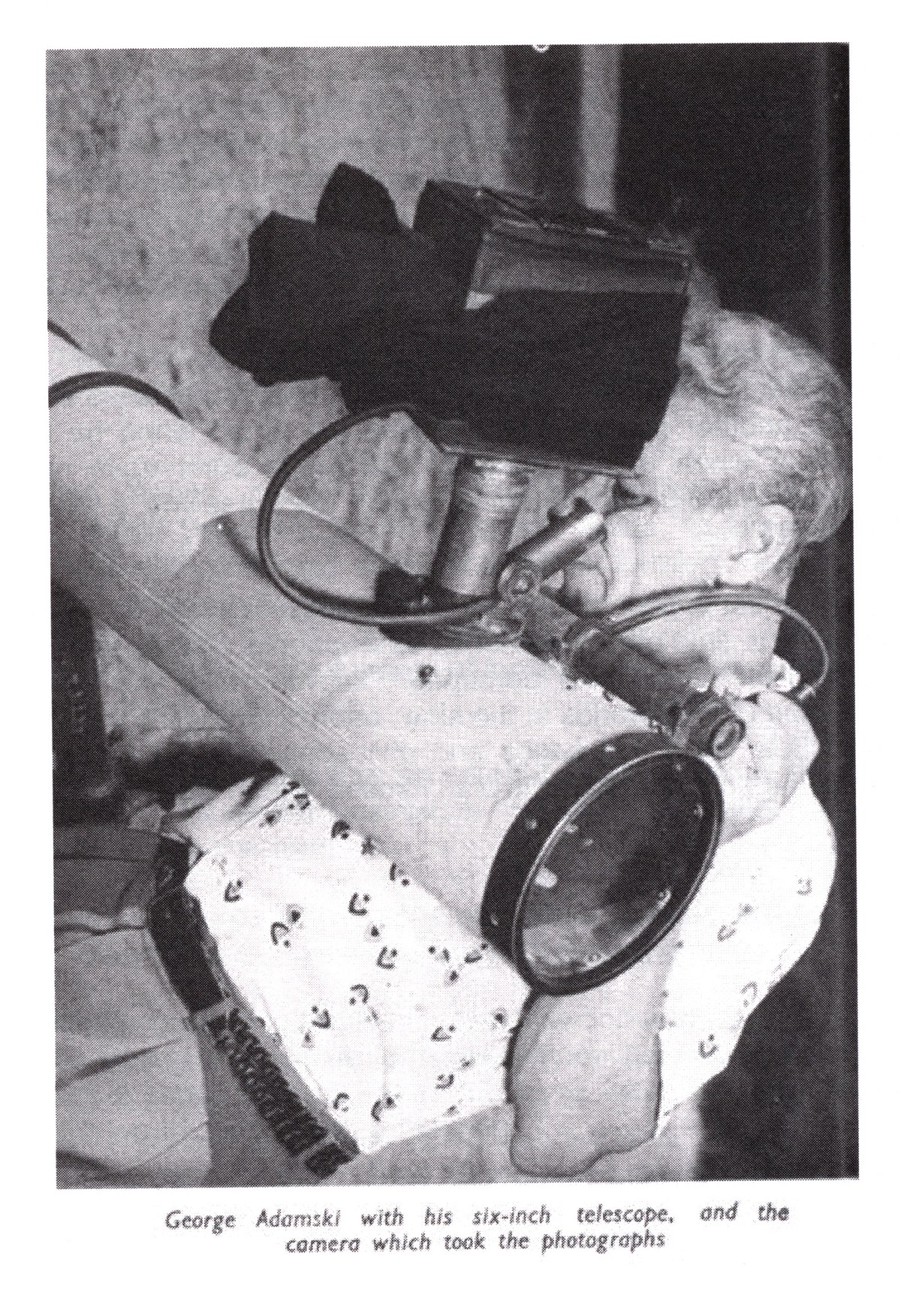
The canonical image was made on December 13, 1952 at Palomar Gardens, the property on the southern slope of Mount Palomar, California where George Adamski lived and worked at the cafe run by Alice K. Wells. Adamski said a Venusian scout craft returned that morning, hovered close to him, and that he exposed four photographic plates in rapid succession through his six-inch Newtonian reflector with a camera fixed at the eyepiece. The result is the picture everyone knows: a bell-shaped craft with a high dome, a ring of dark portholes, a wide flange, and three ball-shaped landing spheres underneath. It was published in Flying Saucers Have Landed in 1953, co-written with Desmond Leslie, and became the template of what a flying saucer was supposed to look like for the next half century.
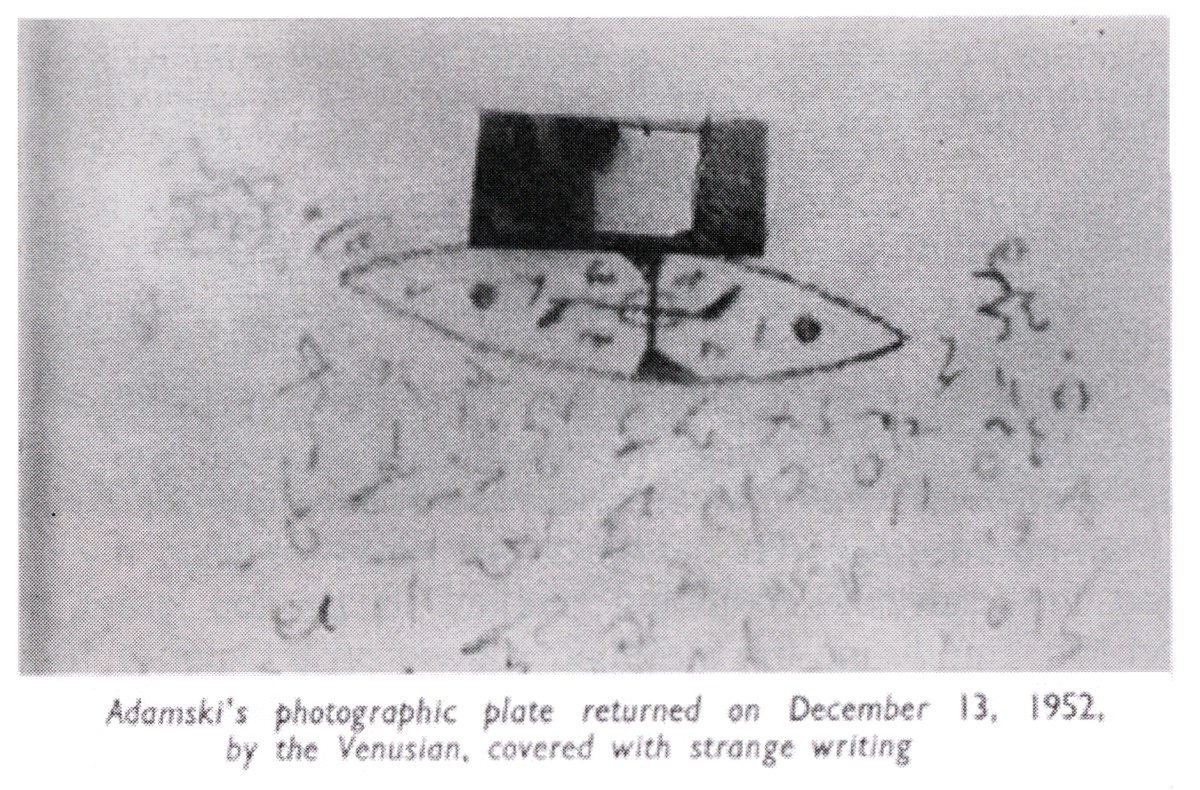
The same session produced the story of the returned plate. Adamski said the craft's window opened, a hand emerged, and a photographic plate holder he had handed over in the desert weeks earlier was dropped back to the ground. When the plate was developed, the original image was gone and in its place was an oval design surrounded by dense symbol-like markings, reproduced as a plate in the book and shown above. As the saucer departed northward over the property, a fifth photograph was supposedly snapped near the well with a Kodak Brownie, a picture whose authorship later blew up in Adamski's face, as covered below.
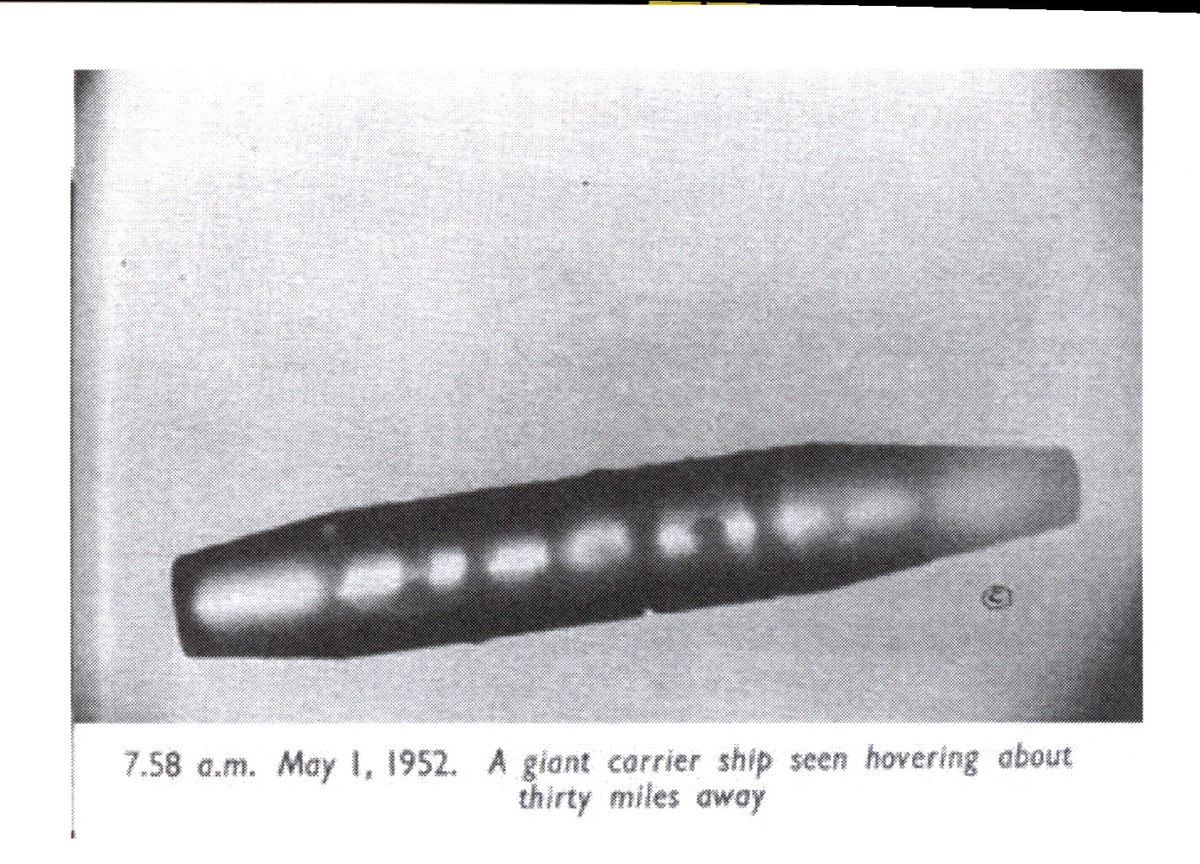
The December photos sit inside a longer photographic career. Adamski had been showing saucer pictures since 1950, including a June 6, 1950 image of a craft supposedly passing between the Earth and the Moon, and a May 1, 1952 photograph captioned as a giant carrier ship hovering about thirty miles away, both reproduced as book plates shown on this page. On November 20, 1952, in the desert near Desert Center, California, Adamski and six companions reported watching a huge wingless cigar-shaped ship, the event that produced his claimed face-to-face contact with the Venusian pilot Orthon.
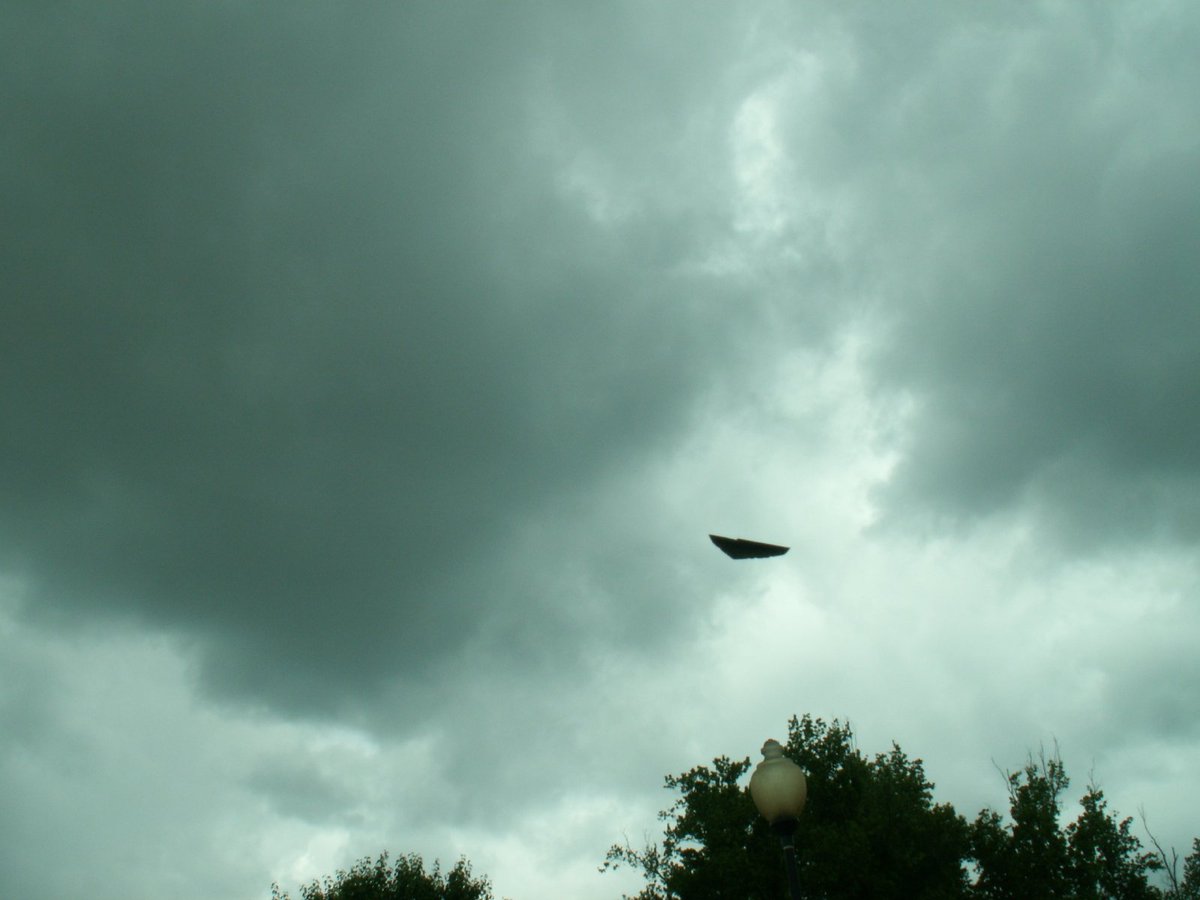
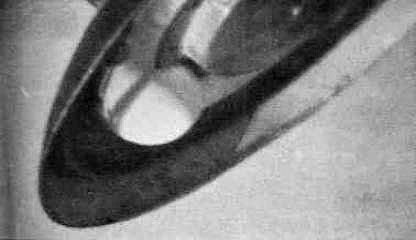
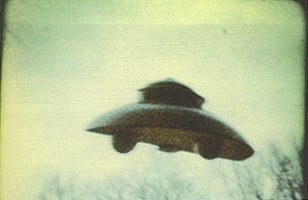
The photographs themselves carry detail that matters to the analysis: the portholes show no glass, one landing sphere reflects three distinct concentrated light sources, and what Coker describes as suppressed frames show a sizable dent in the saucer's outer rim. In 1965, in the last weeks of his life, Adamski also produced short color 8mm films of a scout ship bobbing over a wooded Maryland landscape, one frame of which appears above.
More footage and images of this sighting
What is the official explanation?
No government verdict exists and none is used here: under this archive's rules an official debunk would count as apparatus attention, not evidence. What discredits this case is entirely independent, entirely civilian, and it all shows its method.
The centerpiece is photographic analyst Joel Carpenter's 2012 study, Preliminary Notes on the Adamski Scout Ship Photos, the full text of which sits in this file's sources. Carpenter started from the depth of field: the near rim of the craft is sharp while the far side goes progressively soft, the signature of a small object close to a lens, not an airliner-sized machine at distance through a telescope. He estimated a model 30 to 45 centimeters across. The art deco ribbing below the portholes pointed him to 1930s industrial design, and from there to pressurized-gas lanterns. The match he landed on is specific: the stamped-steel shade of the Prentiss-Waber (Preway) model L46S pressure lantern, sold by Sears as model 742-461 and through the Spiegel catalog, priced around six dollars, on the market from the mid 1930s into the early 1940s. He obtained the actual hardware and measured it: about 33 centimeters tall, shade diameter just over 26.7 centimeters. The two slot-like features visible on the Adamski craft correspond to the two slots stamped into the shade to pass the lamp's handle posts. Veteran lamp collectors he consulted concurred with the identification and supplied Sears catalog pages from 1935 to 1941 showing the model. Carpenter's conclusion was measured: the dome, the landing balls and other parts were separate components assembled onto the shade, which is precisely why the object resisted identification for sixty years. Marc Hallet's book credits a pseudonymous researcher, Strato, with first raising the lantern trail on a French forum in April 2010, and credits Carpenter with carrying it to demonstration.
The landing gear had already given the game away once, decades earlier. Rocket engineer Walther Riedel, a senior figure from the German Peenemunde program then working in American aerospace, told researcher James Moseley in December 1953 that examining one of Adamski's prints under a microscope reveals the round General Electric trademark on one of the bulb-like landing spheres, an account documented in Moseley and Pflock's Shockingly Close to the Truth (2002, page 69). Physicist R. L. Coker's analysis page adds two further reads from the same frames: one landing sphere carries the reflections of three separate concentrated light sources, the signature of photoflood lamps rather than open sky, and the bulb appears to be an infrared brooder-heater type. A frequently repeated claim that a scientist once identified the craft as a surgical lamp could never be traced to any named person in any verifiable document, and per this archive's sourcing rules it does not appear in this file.
The astronomy failed separately. Amateur astronomer Lonzo Dove, writing in Moseley's magazine in 1955, showed that the Moon in Adamski's June 6, 1950 photograph does not match the real Moon's appearance for that date. Dove also pointed out a quieter problem: the Moon in the frame appears as it does through an inverting telescope, which means the image is flipped, which means the saucer photographed dome-up was actually, if the scene were real, flying upside down.
The films fared no better than the stills. Marc Hallet, the Belgian researcher whose 258-page A Critical Appraisal of George Adamski is the standard critical biography and sits in this file's sources, examined a first-generation copy of the 1965 Adamski-Rodeffer film under a microscope and reports finding it incontestable that the film had been faked. Carpenter's paper separately notes, citing researcher Kentaro Mori, that many circulating Adamski images are heavily retouched or wholesale re-illustrated copies of the originals, retouching that Hallet documents was often applied to disguise the light-bulb landing gear.
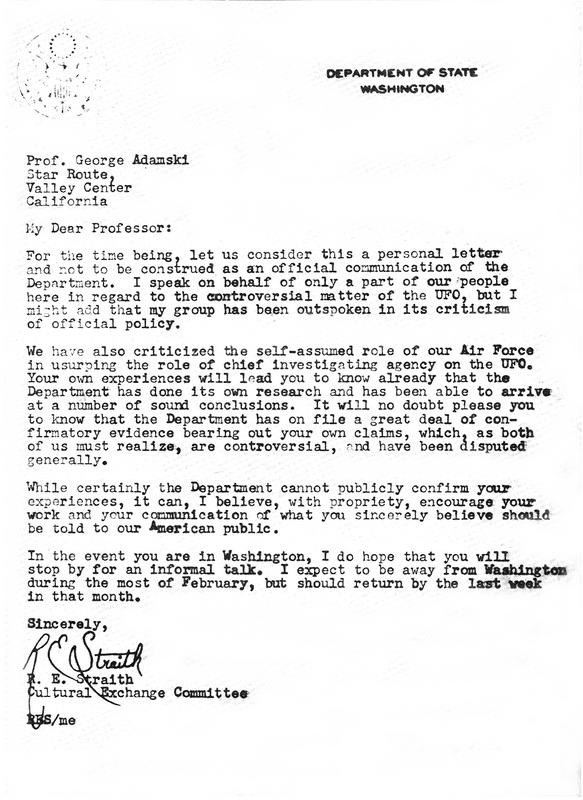
Then there is the paper trail Adamski built himself. In 1957 he began touting a letter of encouragement on US State Department letterhead signed by one R. E. Straith of a Cultural Exchange Committee. James Moseley and Gray Barker later confessed in print to forging it on stolen government letterhead, an episode documented in Moseley and Pflock (pages 124 to 127) and in Barker's own Book of Adamski. Hallet records that in late September 1958 the State Department itself wrote to Adamski stating the letter was a forgery and advising him to stop citing it. He kept citing it for the rest of his life, and the Adamski Foundation defended it as authentic after his death. The letter is reproduced above.
What did the witnesses think it was?
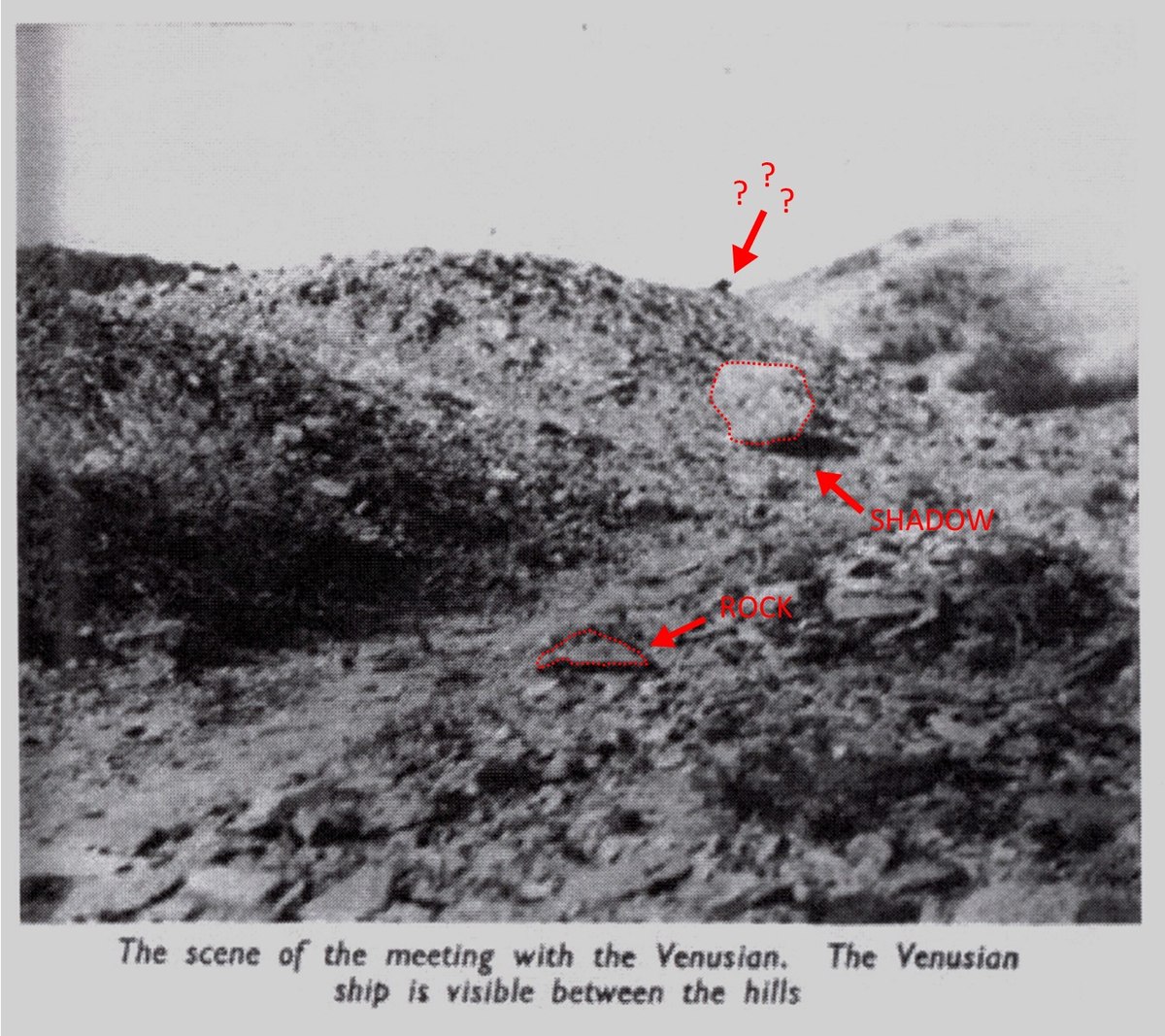
The November 20, 1952 desert party was seven people: Adamski, his secretary Lucy McGinnis, Palomar Gardens cafe owner Alice K. Wells, and two couples, Al and Betty Bailey of Winslow, Arizona and George Hunt and Betty Williamson of Prescott. All six companions signed witness statements that appear in Flying Saucers Have Landed. What they actually attested to seeing was a distant elongated craft and, later, Adamski far off near the hills talking to a figure. The close encounter, the conversation by gesture and telepathy, the footprints with symbol-bearing soles that Williamson cast in plaster, the handover of the photographic plate: all of that rested on Adamski alone, standing roughly a mile and a half from his witnesses.
Jerrold E. Baker, a young Air Force veteran who lived on the Palomar Gardens property that autumn, later described what the run-up to the event looked like from inside. By his account, Adamski announced in a trance-like session before the trip, with the Baileys and Williamsons present, that contact with a being from another world was coming, and instructed that plaster of Paris be acquired in advance; Baker and Lucy McGinnis bought it in Escondido shortly before November 20. Baker also said he heard a sound recording in which a future extraterrestrial contact was narrated as a kind of metaphysical speech, and Williamson independently described the same staged preparations to researcher Ray Stanford years later, an account preserved in Hallet's appendices. Adamski also brought along a large corrugated box that no one else was permitted to touch; it never appears again in any of his accounts.
Within two years the supporting cast collapsed. Questioned by Irma Baker in April 1954, George Hunt Williamson said he had seen nobody in the desert besides Adamski and that the whole thing had probably been of a psychic nature. Al Bailey wrote to Jerrold Baker on June 1, 1954 that he remembered exactly where each member of the party stood and that in his opinion nobody had been able to see more than he did, which was nothing special. Questioned by James Moseley, Bailey acknowledged he had seen the large flying cigar but neither the saucer nor the Venusian, at most some luminous flashes in Adamski's direction. When an Adamski loyalist wrote to Bailey in 1958 asking him to repudiate those statements, Bailey did not answer.
The fifth photograph from December 13 produced its own defection. Adamski published the Brownie snapshot taken near the well under Jerrold Baker's name. Baker insisted he had not taken it, and in a January 31, 1954 letter to writer Frank Scully reported that Adamski urged him to keep his name on the picture anyway, saying you have to enter the back door sometimes to get the truth across. Baker and another property resident, Karl Hunrath, also reported finding a modestly sized object behind Adamski's cabin that closely resembled a skeleton for a saucer mock-up; Adamski told them it was his television antenna and stuck to that explanation whenever asked.
Adamski himself never wavered publicly. He claimed ongoing contact with Orthon and other Venusians, Martians and Saturnians, trips aboard their carrier ships, and a philosophy of planets as schools through which souls pass by reincarnation. He carried the story to a world tour in 1959, including a genuine two-hour private audience with Queen Juliana of the Netherlands that caused a public scandal, and he attributed every setback to a Silence Group of world financiers suppressing the truth. He died of a heart attack in Maryland on April 23, 1965, weeks after producing the final scout ship films.
Not every voice was hostile, and this archive records the other side. Pev Marley, Cecil B. DeMille's cameraman and a wartime aerial-photo interpreter, examined the prints at a June 1, 1953 meeting attended by Project Blue Book press officer Al Chop and said that if the pictures were faked they were the cleverest he had ever seen, noting that the shadows on the saucer and the ground corresponded remarkably. And when researcher Richard Ogden asked the Air Force in 1956 whether anything had happened near Desert Center on November 20, 1952, the reply, published in Flying Saucer Review in 1958, was that a pilot had reported sighting a UFO in that area on that date.
Is the Adamski Scout Ship real? The two-pass assessment
Pass one asks how this could be ordinary, and no case in this archive answers louder. Start with the man before the saucers. Adamski ran the Royal Order of Tibet from a Laguna Beach mansion in the 1930s, lecturing as Professor Adamski at a Temple of Scientific Philosophy, a career documented in the South Coast News of November 1933 and January 1934. By Ray Stanford's account, Adamski told him and others in 1959 that the order's real value had been the wine he was licensed to make for religious purposes during Prohibition, boasting he had been the biggest bootlegger in Southern California and that when Roosevelt ended Prohibition he had to get into this saucer crap; Hallet notes the chronology of the brag does not even work, since Prohibition ended before the Laguna Beach temple opened, but the self-description is Adamski's own. In 1949, three years before Desert Center, Adamski self-published a 260-page science fiction novel, Pioneers of Space: A Trip to the Moon, Mars and Venus. Its Moon has a belt of trees and vegetation, a small lake, a small city, breathable air that takes some effort, and a kangaroo-like animal. His 1955 nonfiction book Inside the Space Ships, presented as a factual account of rides aboard Venusian carriers, describes a Moon with snow, lakes, forests and inhabitants. Hallet's book lays the two texts side by side and shows the alleged contacts recycling the novel. The space age then falsified the Moon claims outright, which is the rare luxury of a contactee story checkable by Apollo.
The photographs fall to named, method-shown analysis at every layer. Carpenter identified the body of the craft as a catalog lantern shade with real measurements, real hardware and collector-verified catalog pages, the model of a method-shown debunk. Riedel found the GE trademark on the landing gear in 1953. Coker read three photoflood reflections off a landing sphere, putting the scene indoors. Dove failed the 1950 Moon photo on its own astronomy and noted the inversion problem besides. Hallet found the 1965 film faked under the microscope. Each of these is an independent route to the same conclusion, and any one of them would carry pass one alone.
The witness structure adds the human layer. The contact was announced in advance, the plaster was bought in advance, a narration of a future contact existed on tape in advance, and the close encounter itself happened a mile and a half from the people brought along to witness it. Within two years Williamson had reduced his testimony to possibly psychic, and Al Bailey to nothing special and no saucer and no Venusian. The fifth photo's claimed photographer says he did not take it and that Adamski asked him to lie about it, and the same man reported a saucer-shaped mock-up frame behind Adamski's cabin. This archive weighs hostile testimony cautiously by rule, but almost none of this is hostile testimony in the usual sense: Moseley's Straith confession is a statement against his own interest, and Baker, Bailey and Williamson were Adamski's own inner circle walking back their own signatures.
Pass two asks what remains if the case were real, and honesty requires listing it: an Air Force acknowledgment that some pilot reported something near Desert Center that day, a first-rank Hollywood cameraman who found the shadow geometry remarkably consistent, six signed statements that a distant cigar was seen, and a worldwide crop of later photos resembling Adamski's craft, of which the most famous, the 1954 Darbishire photo from England, is itself judged a copy-fake in Hallet's analysis. None of this survives contact with the lantern. A distant unidentified cigar does not rescue a close-up photograph of a lamp shade, and resemblance to the most reproduced saucer image in history is evidence of influence, not of Venus.
Verdict: Discredited, on independent, named, method-shown grounds, with no government verdict needed or used. The claim is enormous and the discrediting record matches it: a specific catalog object with measurements and overlays, a trademark on the landing gear, studio reflections in the chrome, an impossible Moon, a film faked under the microscope, a forged endorsement letter brandished after its forgers confessed and its supposed issuer disavowed it, witnesses who recanted their own signed statements, and a science fiction novel that wrote the script three years early. This verdict was reviewed and approved by the archive's editor on 2026-06-12.
Sources
- archive.org/stream/JoelCarpenterMcMinnvilleUFOphoto/Prelim_Notes_Adamski_Scout_Ship_mini2_djvu.txt
- archive.org/details/JoelCarpenterMcMinnvilleUFOphoto
- archive.org/details/ACriticalAppraisalOfGeorgeAdamskiTheManWhoSpokeToTheSpaceBrothersREVISEDANDENLARGEDEDITION2016
- web2.ph.utexas.edu/~coker2/index.files/adamski.htm
- www.jimmoseley.com/2014/02/george-adamski-r-e-straith-and-the-seven-letters-of-mischief/
- www.jimmoseley.com/2014/05/saucer-news-presents-the-george-adamski-expose/
- archive.org/details/leslie-desmond-adamski-george-flying-saucers-have-landed_202407
- archive.org/details/george-adamski-inside-the-spaceships_202012
- history.denverlibrary.org/news/western-history/man-who-boarded-flying-saucer-allegedly
- history.denverlibrary.org/news/western-history/man-who-met-venusian-allegedly
More cases from this region: UFO sightings in United States