The Aguadilla Thermal Video (2013)
A U.S. Customs and Border Protection surveillance plane spent almost three minutes chasing something it could not name across the runway lights of Rafael Hernandez Airport. On the aircraft's military-grade thermal camera, a small warm object skims rooftops in total darkness, dips toward the Atlantic, and then appears to split into two. A six-author team of scientists studied the footage for a year and a half and concluded it matched no known aircraft, balloon, bird, or drone. A decade later the Pentagon's own anomaly office answered with one word: lanterns. Both analyses are public, detailed, and irreconcilable, which is exactly why this case sits unresolved rather than closed.
What did witnesses see at Aguadilla?
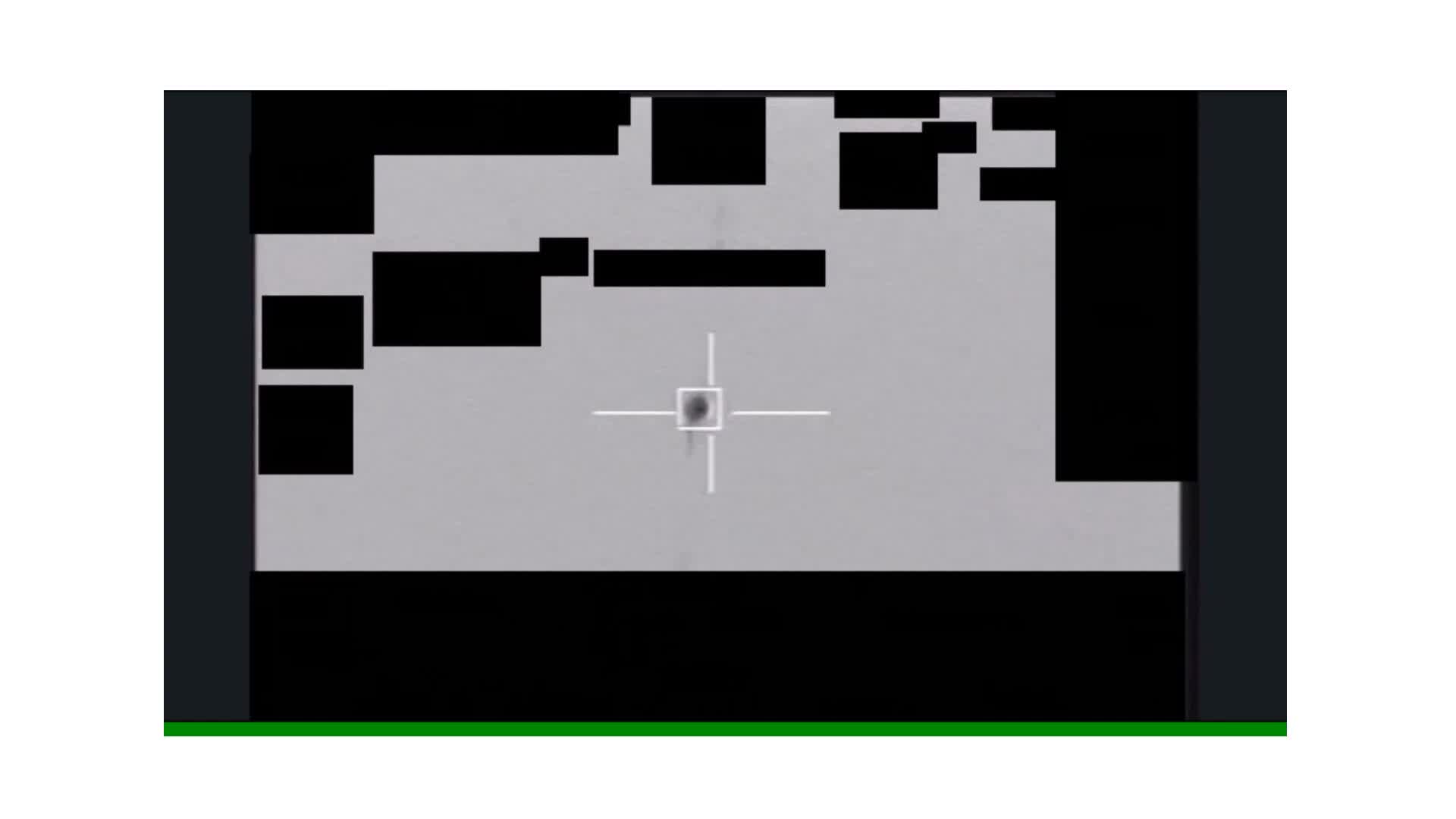
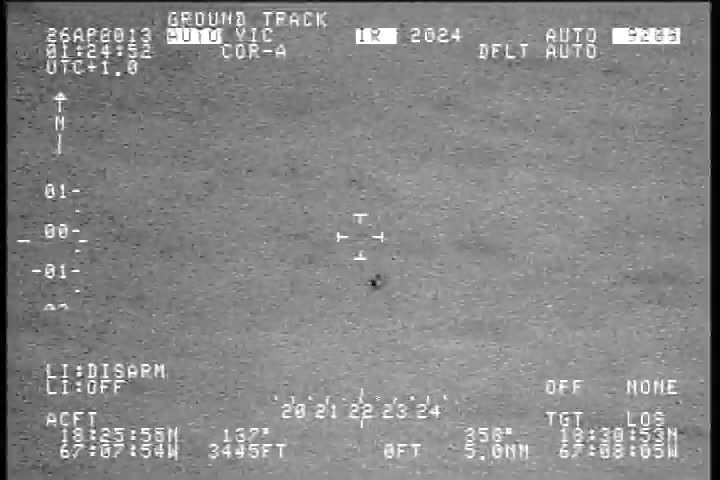
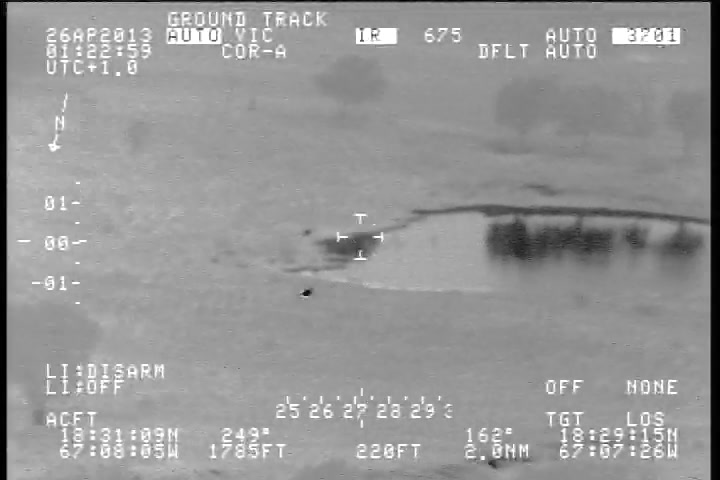
The evidence is a single thermal-infrared video, three minutes and 54 seconds long, of which about two minutes and 56 seconds shows the object. It was recorded on the night of 25 April 2013, beginning around 9:20 pm local time, from a De Havilland Canada DHC-8 turboprop operated by U.S. Customs and Border Protection. The camera was an L-3 WESCAM MX-15D electro-optical and infrared turret, which uses an indium-antimonide sensor sensitive in the 3-to-5 micron band. Crucially, the WESCAM system burns its telemetry onto the frame: the aircraft's latitude and longitude, date, time, heading, the bearing and slant range to whatever sits in the cross-hairs, and the target's own coordinates. That on-screen data is what later let analysts reconstruct the geometry instead of guessing at it.
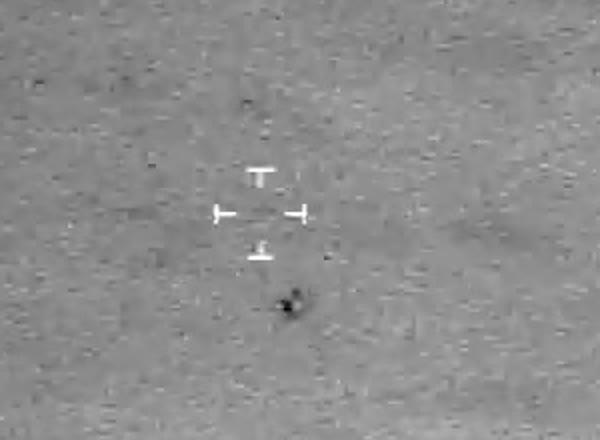
In the footage, the object arrives from over the ocean and crosses into northwestern Puerto Rico, traverses the airspace of Rafael Hernandez Airport twice, then heads back out to sea. In the thermal palette used here, black is hot and white is cold, and the object reads hotter than the ambient air. It flies low, at times below treetop height. At one point it briefly disappears behind a tree, which the analysts used to fix its altitude at under 40 feet. It carries no navigation lights. According to the source's account, the crew first saw a pinkish-to-reddish light approaching from the sea; that light went out as the object neared the airport, after which it was visible only on thermal.
The two behaviors that made the clip famous come near the end. First, the object descends to the water and appears to enter it with almost no disturbance, travels close to or through the surface, and continues, with its heat signature still present. Second, the thermal blob grows momentarily larger and then divides into two separate objects of roughly equal size, both of which then move at the same speed. The object also shows an irregular tumbling motion in the air that the analysts noted gives it a non-aerodynamic appearance, with no visible wings, rotors, exhaust plume, or control surfaces.
More footage and images of this sighting
What is the official explanation?
There is no official statement from Customs and Border Protection or the Department of Homeland Security acknowledging the footage as such at the time. The video did not come through an agency press release. By the analysts' own account, an original AVI copy was obtained from an anonymous source on 21 October 2013, roughly six months after the event; the source was a secondary witness, an acquaintance of the flight crew, rather than a member of the crew, and the investigators say they verified the source's identity, occupation, and background while agreeing to keep them anonymous. The footage surfaced publicly when the civilian report built around it was released in August 2015.
The paper trail the investigators did assemble is itself part of the record. A Freedom of Information Act request to the U.S. Air Force 84th Radar Evaluation Squadron for FAA-originated radar was granted, yielding data from the QJQ long-range site and the San Juan secondary site; that radar confirmed the CBP aircraft's track matched the on-screen telemetry and showed additional transponderless targets two to three miles north and northwest of the airport. A second request, for data from the military Punta Borinquen radar on the west end of the runway, was denied. A request for the airport control-tower logs from that night failed on a technicality: the tower is run by a private contractor, Robinson Aviation, which is not subject to FOIA, and the analysts were told the tower's logs and recordings are routinely destroyed 90 days after any event. The tower manager reportedly confirmed awareness of the events but declined to participate further.
The most consequential official word came years later. On 20 March 2025 the Pentagon's All-domain Anomaly Resolution Office published a case-resolution report on the incident, assessing with moderate confidence that the objects were sky lanterns of the kind released by area resorts during celebrations, that there were two objects rather than one that split, that the apparent high speed was motion parallax, and that the objects never entered the water, the sensor simply lost thermal contrast against the background. AARO stated the objects did not exhibit anomalous speeds or behavior exceeding known state-of-the-art performance. Notably, AARO dated the capture to 26 April 2013, which matches the date burned onto the camera's own clock, while the civilian report uses 25 April for the local evening event; the one-day discrepancy has not been reconciled in public.
What did the witnesses think it was?
The civilian investigation was conducted under the Scientific Coalition for UAP Studies, originally the Scientific Coalition for Ufology. The monograph, titled "2013 Aguadilla Puerto Rico: The detailed analysis of an Unidentified Anomalous Phenomenon captured by the Department of Homeland Security," was first published in August 2015 and updated in April 2023. Its six authors are Robert M. Powell, Morgan Beall, Larry Cates, Carl Paulson, Richard Hoffman, and Daina Chaviano; their backgrounds span chemistry, physics, mathematics, and environmental science, with experience in air-defense and semiconductor industries. The report states the team logged a minimum of 1,000 work-hours over about a year and a half.
The method was frame-level. The video was decomposed into 7,027 individual frames, each roughly one-thirtieth of a second and 720 by 480 pixels, with each pixel's 0-to-255 value standing for relative infrared intensity. Because the WESCAM overlay gives the aircraft's position and the slant range and bearing to the target, the team could fix the object's ground position at points where its location was determinable, then use trigonometry to derive distance, angular size, and therefore physical size and speed. Their numbers: the object measured roughly three to five feet in length; its airspeed varied between about 40 and 120 mph with a median near 80 mph; its speed through the water peaked at 95 mph and averaged 82.8 mph; and its speed immediately before water impact was 109.7 mph. They emphasized that it did not noticeably decelerate on entering the water, which they called difficult to explain for any unpowered object, since a projectile striking water decelerates sharply.
Frame analysis of the splitting led the team to rule out a reflection or a second object rising from the water; they describe the thermal image growing before dividing into two equal parts that then moved at the original object's speed. On temperature, an appendix modeling the sensor response put the object's center near 105 degrees Fahrenheit with a cooler exterior, hotter than ambient but generally cooler than the jet engines and automobiles also visible in the footage, and they note it kept emitting heat after exiting the water. The authors' stated conclusion is that the object is of unknown origin and that its combination of speed, sustained underwater velocity, low-altitude maneuvering through a populated area without lights, and division into two eliminates aircraft, blimps, balloons, wind-blown objects, birds, and known drones. The report closes by inviting any reasonable explanation that accounts for all of those characteristics at once.
Is the Aguadilla Thermal Video (2013) real? The two-pass assessment
Pass one, the mundane case, is unusually well developed for a UFO clip, and most of it predates the Pentagon's review. The skeptic investigator and tool-builder Mick West runs the long-standing Metabunk thread, opened in July 2017, titled "Aguadilla Infrared Footage of UFOs, Probably Hot Air Wedding Lanterns." Drawing on work by Ruben Lianza and a 3D reconstruction by Lance Moody, and later West's own modeling, the argument is this: the object is a pair of heart-shaped hot-air wedding lanterns tied together and released downwind of a nearby resort. The candle flame sits at the bottom, matching the infrared hot-spot; two tethered lanterns drift close together and only intermittently resolve as two, which reads on a low-resolution sensor as one object that splits. The dramatic speed is parallax, an object drifting at roughly 10-to-16 mph wind speed looks fast when the camera platform is itself circling. The water entry is, on this reading, not real at all; West argues the object never goes near the ocean, and the ghostly fade happens even over land with no foreground, so it is a thermal-contrast and compression artifact, not submersion. The Pentagon's AARO reached essentially the same conclusion in March 2025: moderate confidence sky lanterns, two objects not one, parallax for the speed, lost thermal contrast rather than water for the disappearance, and no anomalous performance.
Pass two, the anomalous case, is the SCU report, and it is not naive about lanterns. The authors explicitly address the balloon and Chinese-lantern hypothesis and reject it on several grounds: airspeeds up to 120 mph against winds of only 8-to-18 mph; multiple directional changes, including a turn into the wind, that wind drift cannot produce; a 105-degree-Fahrenheit core with a steep thermal gradient that a near-ambient lantern would not show; survival and continued heat emission through an underwater transit at an average 82.8 mph, which a buoyant paper lantern cannot manage; the division into two equal parts; and line-of-sight geometry from the aircraft's logged position, which they say constrains any slow balloon to within about 1,520 feet of the plane and produces major inconsistencies. They also work through and reject large birds and advanced drones for the same reasons of speed, behavior, and the lack of any visible structure.
So two serious, public, technical analyses look at the same 7,027 frames and disagree at the level of basic geometry: SCU says the object moves behind background objects and is therefore genuinely traversing the scene at high speed, while West and AARO say the apparent motion is the camera's, the targets are slow lanterns, and the strangeness is sensor artifact. The disagreement is live, not historical. The SCU's April 2025 response did not concede AARO's verdict; it suspended judgment and listed specific data requests, including the reconstructed 3D flight path, the source of the cloud-layer data, positional coordinates with error bars, the radar and tower records, and the pixel analysis of the object passing behind a foreground object, saying it would complete its review once AARO provided them. That is the definition of a disputed case rather than a closed one: not an absence of analysis but a surplus of it, with a named civilian scientific team and the named federal office holding incompatible reconstructions, and the raw data the dispute hinges on not yet shared between them. We do not record this as Discredited, because no one has demonstrated the SCU measurements wrong frame by frame; the AARO counter-reconstruction is itself a claim with its own evidence tier and its own moderate-confidence hedge. The honest verdict is that the case is disputed and open.
Sources
- zenodo.org/records/7844175
- www.explorescu.org/post/2013-aguadilla-puerto-rico-uap-incident-report-a-detailed-analysis
- www.explorescu.org/post/scu-announcement-on-the-aaro-investigation-of-the-aguadilla-video
- www.metabunk.org/threads/aguadilla-infrared-footage-of-ufos-probably-hot-air-wedding-lanterns.8952/
- www.theblackvault.com/documentarchive/dod-report-says-aguadilla-ufo-was-just-sky-lanterns-previous-scientific-studies-claim-otherwise/
More cases from this region: UFO sightings in Puerto Rico (United States)