The Falkville Metal Man
On the night of 17 October 1973, Jeff Greenhaw, the twenty-six-year-old police chief of Falkville, Alabama, took a call at his home. This case file covers what witnesses reported, the official narrative, and a two-pass assessment with its evidence tier.
What did witnesses see at Falkville?
On the night of 17 October 1973, Jeff Greenhaw, the twenty-six-year-old police chief of Falkville, Alabama, took a call at his home. An agitated, anonymous woman told dispatch that an object had come down in a field outside town, in pasture that several accounts place on land owned by a man named Bobby Summerford. Greenhaw, who had been hired to the chief's job only that January, was off duty. He logged where he was going, picked up his Polaroid camera, and drove out to look. He found no landed craft. He spent fifteen or twenty minutes searching the dark pasture and was about to give up when, by the side of a dirt road, he saw a figure standing in the dark.
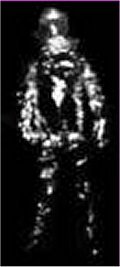
The thing was a little over six feet tall and looked, in his words, like it was sheathed head to foot in metal. "It looked like his head and neck were kind of made together," Greenhaw said. "He was real bright, something like rubbing mercury on nickel, but just as smooth as glass. Different angles give different lighting." He said he called out, "something to the effect of howdy stranger," and got no response at all, so he did not push his luck. Instead he raised the Polaroid and fired off four frames as the figure stood and then began to move toward him. The first photograph came back as little more than inky darkness and a flash of silver. The next three show a roughly human-shaped form wrapped in a wrinkled, brilliantly reflective suit, throwing the camera's flash straight back at the lens.
When Greenhaw put the patrol car's blue lights on the figure, it turned and fled. He said it did not run like a person. "It wasn't moving like you or I would move. It's like it had springs on its feet or something." He gave chase across the field in the cruiser and got the car up to about thirty-five miles an hour over the rough ground, but the figure pulled away from him at a pace he could not match. He lost it after the chase ended with his patrol car bogged down or wrecked in the field, and the metal man was gone into the night. The whole sighting was the work of a few minutes. The only witness to the entity itself was Greenhaw, but the anonymous caller who started the night was never publicly identified or interviewed.
What is the official explanation?
There was no military or federal investigation. Project Blue Book had closed in December 1969, so by 1973 there was no Air Force apparatus left to take a report of this kind. What investigation there was came from the civilian UFO community. Greenhaw's Polaroids were sent to Walt Andrus, then a leading figure in organized American UFO research and the founder of the Mutual UFO Network, for analysis. The verdict that came back was skeptical. According to the accounts that survive, Andrus and his analysts judged the encounter "most likely a fabrication," probably inspired by the furor over the Pascagoula abduction of Charles Hickson and Calvin Parker, which had happened only six days earlier on 11 October 1973 and was front-page news across the South. The proposed method was that someone had used aluminum foil, or possibly an asbestos fire-proximity suit coated in reflective aluminum, to fake the metal look.
That skeptical reading is not the only thing on record, and the photographic record is genuinely strange in both directions. A competing account holds that the same images were examined and "judged to be genuine," and that the negatives carried faint saucer-like shapes that did not print in the positives, even though no one ever claimed to have photographed the object the caller originally reported. Nobody produced a hoaxer. No foil costume, no fire suit, and no accomplice was ever recovered or identified. The only named hoax theory that ever circulated, that local high-school kids had set it up, traces to anonymous commenters years later and was never substantiated.
The harder, verifiable record is what happened to Greenhaw himself, and it reads as an account of a small town turning on its police chief. He was mocked relentlessly and got threatening phone calls. His car engine blew, which he and others suspected was sabotage. His trailer home burned down under what were called suspicious circumstances in the weeks after the sighting. His marriage came apart. Within roughly a month the Falkville town council pressured him out of the chief's job, ending a tenure that had begun only that January. Greenhaw kept the four Polaroids for about ten years and looked at them often. Then, around 1983, someone broke into his home and stole them along with his service revolver and a shotgun, the only three things he still had from that night. He filed a report; the photographs were never recovered, which is why no original prints survive for modern forensic analysis.
What did the witnesses think it was?
Greenhaw never wavered that he had photographed something real that he could not explain. His first instinct was mundane: "My initial thoughts were maybe aluminum foil," he later said, "but there were no pieces around there after it was all over. I don't know what to believe at that point." He reached, as many witnesses of that generation did, for the only reference he had. "Whenever I think about it, when I was a child, I used to watch the movie Lost in Space. The robot in the movie, it kind of reminded me of that to some extent."
He paid a heavy personal price and said so plainly decades later. "I turned out to be a person I never dreamed I would be because of what happened. It made me hard, but it made me strong as well. I came close to losing my sanity, but my wife and God kept me from losing my sanity." He withdrew from public life for years: "People who were supposed to be my friends, the only thing I found out is that I really couldn't trust anyone. I withdrew, I ran and I went places to try to get away from it." The experience changed what he believed. "I am still a believer in life after death and at one point, I didn't believe there was any other life source in the universe, but that really changed."
What gives the testimony weight is its source and its cost. The witness was a sworn law-enforcement officer with a Polaroid in hand, not a thrill-seeker, and the encounter gained him nothing. It cost him his job, his marriage, his home, and his standing in town, and he kept telling the same story for nearly fifty years, raising five children with his wife, three of them adopted, while declining to monetize or recant any of it. The only direct corroboration is physical, the photographs themselves, and the chain of custody on those was broken by the 1983 burglary, leaving the contemporary descriptions of the images as the surviving record.
The dispute
The case sits in the disputed column because of a hoax verdict that was advanced early and has stuck, not because anyone ever proved a hoax. The strongest counter-explanation on record comes from the civilian UFO investigation itself: Walt Andrus, founder of the Mutual UFO Network, received Greenhaw's Polaroids and concluded the encounter was "most likely a fabrication," probably a copycat of the Pascagoula abduction six days earlier, with the metallic figure produced by aluminum foil or an aluminum-coated asbestos fire suit. The timing argument is real and worth stating fairly. Pascagoula broke on 11 October 1973 and saturated Southern news, and a reflective-suit prank in that climate is entirely plausible.
But the hoax claim never rose above hypothesis, which is why this is barely disputed and not strongly disputed. Andrus named a method in the abstract, foil or a fire suit, but he never produced the suit, never identified a person who wore it, and never demonstrated that this specific image was faked. There is no confession. There is no recovered prop. There is no named accomplice who held up under scrutiny; the only name-an-accomplice version, that high-school kids did it, traces to anonymous internet commenters decades later and was never substantiated. Cutting the other way, a separate strand of the same MUFON examination is reported to have judged the photos "genuine" and to have found faint saucer-like forms on the negatives that did not print, which is hardly the signature of a teenager in kitchen foil. The photographic evidence is therefore contested at the level of expert opinion rather than settled by it.
Weighed against an official-apparatus debunk standard, what exists here is a skeptical opinion from one investigator plus a plausible-but-unproven copycat reconstruction. That is exactly the kind of counter-explanation that lowers a case to barely disputed without closing it. Greenhaw was a sworn officer who gained nothing and lost almost everything, kept the same account for half a century, and the originals that might have settled the question were stolen in 1983 before any modern forensic pass could be made. A plausible hoax mechanism that no one ever tied to a real person or to this specific photograph does not amount to a positive identification of the cause, so the case largely stands.
Is the Falkville Metal Man real? The two-pass assessment
Pass one, the ordinary readings. The most economical explanation is a hoax. The Pascagoula abduction had been front-page news for six days, the country was in the middle of the 1973 UFO wave, and a brand-new, untested police chief was an easy and tempting target for a prank. A person in a reflective fire-proximity suit or wrapped in aluminum foil would photograph almost exactly like this under a Polaroid flash in a dark field, throwing the light straight back and looking metallic and featureless. This is precisely the mechanism Walt Andrus of MUFON proposed. A second ordinary reading is misperception of a real but mundane person, someone in reflective safety gear, lost or up to mischief in a field at night, with low-light conditions exaggerating the strangeness of the gait. Either way the prank or the misperception would explain everything in the photographs without anything unknown.
Pass two, if it is real. Then a self-luminous-looking, six-foot, foil-skinned figure with a fused head and neck and an unnatural spring-footed gait outran a patrol car across open ground and vanished, after an anonymous caller reported a landed object that was never found. That is a close encounter of the third kind in Hynek's terms, with rare law-enforcement provenance and four contemporaneous instant photographs, and the unprinted saucer-like shapes reported on the negatives would make it stranger still.
The deciding facts are these. The hoax case is plausible but was never closed: no suit, no costume, no confession, no identified person, and no demonstration that this specific image was faked, only an investigator's opinion and a copycat-timing argument. The witness was a sworn officer who profited nothing and lost his job, marriage, and home, and held to the same account for nearly fifty years. The one piece of physical evidence that could have settled it, the original Polaroids, was stolen in 1983. A plausible but unproven natural or hoax reconstruction, plus an official-organization assertion without a shown method tied to a real culprit, is the textbook profile of a case that is dented but still standing. Tier: Barely Disputed.
Sources
- www.nicap.org/falkville731017dir.htm
- www.nicap.org/images/tinfoilalien.jpg
- www.cullmantribune.com/2021/07/10/do-you-believe-in-the-metal-man/
- strangeco.blogspot.com/2025/01/jeff-and-metal-man.html
- www.paranormalcatalog.net/ufos/the-falkville-metal-man
- sentinel63.wordpress.com/2016/12/02/the-speedy-silver-spaceman-adventure-in-falkville/
More cases from this region: UFO sightings in United States