The Alaska Alien Photograph
What people actually have is a single black and white photograph and a short story attached to it. This case file covers what witnesses reported, the official narrative, and a two-pass assessment with its evidence tier.
What did witnesses see at Alaska?
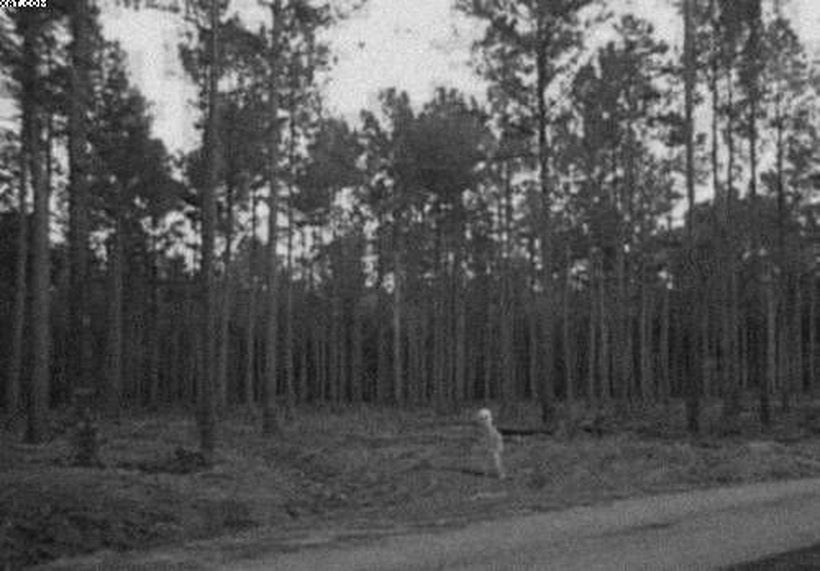
What people actually have is a single black and white photograph and a short story attached to it. The photograph shows a small, pale, upright figure standing in the middle distance of a wooded scene. The figure is roughly humanoid: a disproportionately large, rounded, hairless-looking head on a thin neck, narrow sloping shoulders, slim arms hanging at the sides, and short legs, the whole body lit almost white against the darker ground. In the cropped close-up that circulates as "alaskanalien3.jpg" the head reads as bulbous and the limbs as spindly, which is exactly why people call it an alien rather than a bear cub or a person. Estimates that float around the photo put the creature at about three feet tall, though nothing in the image gives a reliable scale.
The wider, uncropped frame is the part that matters most and is the part most reposts crop away. It shows the figure standing at the edge of what looks like a graded or paved road that runs across the bottom of the picture, with a low earth bank behind it and then a dense stand of very tall, very thin, branchless trees rising into a bright sky. The trees read as a planted or regrown pine stand on flat ground, the kind you see along a roadside in the lower United States, not the spruce and broken sub-arctic country you would expect on the way to a remote 1930s Alaskan lake.
The story that arrived with the picture is brief. The anonymous sender wrote that the photograph "was taken by my grandfather in the early 1930s," that the grandfather lived in Alaska, that he saw the entity while he was "on his way to a lake," and that he chased it until he was close enough to take this one shot. The sender said that because the area was so remote it took "some four months before the photograph was developed," that the grandfather kept it for about seventy years, gave it to the grandson "last week," told him the story, and then died the day after handing it over. The sender said he scanned it immediately and asked not to be contacted. That account, plus the one image, is the entirety of the primary record. There is no second photo, no negative, no named witness, no named lake, no town, and no date more precise than "early 1930s."
What is the official explanation?
There is no official narrative here at all. No government, military, or scientific body ever investigated this image. It is not a Blue Book entry, not a police report, not a FOIA document. It is a private email to a UFO website, so the only "investigations" on record are the editorial assessments of the ufologists who received and catalogued it.
The primary record begins with B.J. Booth, editor of UFO Casebook, who received the image. Booth published the anonymous email and quoted it directly: "The included picture was taken by my grandfather in the early 1930s." His own commentary was openly undecided. He laid out three possibilities in his own words: "an outright hoax, (someone in a suit)," "a single unknown being, origin unknown," or two beings, a parent and a smaller offspring, after he thought he saw a second small shape near the figure's arm. He never claimed to have authenticated anything, and he closed with a line that tells you how little proof he had: "Wouldn't it be something if this was the real thing, even though it may never be proven as such?" and then, "Which is more important anyway, the final solution of a mystery, or that mystery remaining alive and well?" That is a curator enjoying an enigma, not a finding.
John Greenewald's Black Vault filed it as "Alien Photograph, circa 1930s" and reproduced the same anonymous submission, again with no authentication, no chain of custody, and no named source. The most rigorous handling comes from the French cataloguer Patrick Gross, who entered it as URECAT-001718. Gross dated the event "early 1930s, Alaska, USA," logged the seventy-year reporting delay and the single anonymous adult witness, and his honest conclusion was a non-conclusion: "Extraterrestrial visitors or hoax. Unknown credibility." He added the line that every careful writer on this case repeats, that "there is no particular difficulty in making a false photograph of this kind," while also noting he "found no evidence of fraud and did not find any later admission of fraud." His sources are themselves just the UFO Casebook post and the secondary thinkaboutitdocs catalogue entry. In short, every "official" layer of this case is a UFO website re-describing one anonymous email. No institution ever touched it, and no investigator ever traced the photograph, the negative, the grandfather, or the lake.
What did the witnesses think it was?
There is effectively one human being attached to this photograph, and nobody knows who he is. The supposed eyewitness, the grandfather who took the picture, is named nowhere, lived nowhere specific, and was already dead when the image surfaced, so he cannot be questioned, identified, or even confirmed to have existed. The grandson who emailed the image is also anonymous by his own demand. He told Booth he wanted "nothing to do with any research" and asked not to be contacted, which means there is no witness who can be interviewed, no family that can be located, and no document that ties a real person to a real place and a real camera in 1930s Alaska.
What the sender believed, if the email is taken at face value, is simple: that his grandfather genuinely chased a small unknown creature near a lake and photographed it, and that the old man was "telling the truth." The grandson wrote that he scanned it the moment he received it, that he thought it should be "in the right hands," and that this was why he sent it to a UFO archive rather than keeping it private. That is the full extent of the witness testimony, a grandson vouching for a dead grandfather he says he believed.
There are no corroborating witnesses, and this is the decisive gap. No second person in the 1930s saw the creature. No one in the family is on record. No neighbor, no photo lab, no local newspaper, nobody. The detail people point to as a ring of truth is the claim that the film sat undeveloped for four months because the area was so remote, which does fit the logistics of bush Alaska in that era. But a believable logistical detail is not a witness, and an unfalsifiable chain of custody (anonymous living source, conveniently deceased original witness, no negative, no location) is exactly the shape a fabricated provenance takes. The case has a story but, in any verifiable sense, no witness.
The dispute
The dispute is straightforward to state and hard to resolve: this is a single anonymous photograph with an unverifiable backstory, and the strongest objection is internal to the image itself. In the full uncropped frame the small white figure is standing beside what looks like a graded or paved road, with a low bank and then a dense stand of tall, thin, branchless pines on flat ground rising into a bright sky. That scene reads like roadside second-growth woodland in the continental United States, not the spruce and muskeg country a man would cross "on his way to a lake" in remote 1930s Alaska. A road in the frame is difficult to reconcile with a photograph supposedly taken deep in the Alaskan bush in an area so isolated that the film allegedly took four months to reach a developer. No analyst has geolocated the exact spot, so this is an observation about terrain and infrastructure rather than a pinned-down location, but it is the single most damaging feature of the picture.
The second strand of the dispute is provenance, and it was flagged by the very people who archived the image. B.J. Booth, who received it, openly listed "an outright hoax, (someone in a suit)" as one of three options and admitted it "may never be proven" either way. Patrick Gross, cataloguing it as URECAT-001718, wrote that "there is no particular difficulty in making a false photograph of this kind" and classed its credibility as "unknown." The chain of custody is unfalsifiable by construction: the sender is anonymous and refused contact, the original witness is an unnamed grandfather who conveniently died the day after handing over the photo, there is no negative, no second image, no named lake, and no date more specific than "early 1930s." That is the shape a manufactured provenance takes, and ordinary readings of the figure (a small child in pale clothing at distance, an animal, a stump, a staged prop) all fit the low-resolution blob comfortably.
What keeps this at "barely" rather than "strongly" disputed is the absence of any method-shown debunk. Nobody has produced a confession, nobody has recanted, no prop or suit has been recovered, and no one has positively identified the specific person, animal, location, or source image, nor demonstrated the fabrication of this exact photograph. Gross himself found "no evidence of fraud and no later admission of fraud." The terrain mismatch and the anonymous, deceased-witness provenance make a hoax the most reasonable bet, but a reasonable bet is not a proven identification. The case is widely and credibly doubted, yet it has never been closed, which is exactly the definition of barely disputed.
Is the Alaska Alien Photograph real? The two-pass assessment
Pass one, the ordinary readings, and they are strong. The mundane explanations cost nothing. The figure could be a person, very plausibly a small child in pale clothing, standing in the distance where the low resolution erases facial features and swells the head. It could be a small animal such as a bear cub or a dog rearing up, a stump or a snag, or a deliberately staged prop. Booth himself floated "someone in a suit." Crucially, the uncropped frame undercuts the whole premise: it shows a graded or paved road across the foreground and a stand of tall, thin, planted-looking pines on flat ground, which reads as roadside woodland in the lower United States, not the spruce country on the way to a remote Alaskan lake. A photograph supposedly taken deep in 1930s Alaskan wilderness should not have a modern-looking road in it. Add the provenance, which is the textbook unfalsifiable setup: an anonymous sender, an unnamed and conveniently dead grandfather, no negative, no named lake, no date better than "early 1930s," and a request never to be contacted. There is no chain of custody to break because there is no chain of custody at all. By every normal standard this behaves like an undatable found photo with a story bolted on after the fact.
Pass two, if it were real, what is it. If the account were literally true, this would be one of the earliest photographs of a small non-human biped, a roughly three-foot upright entity with an oversized cranium, photographed at close range by a lone Alaskan in the 1930s. That would be extraordinary, and it is exactly why the image has circulated for two decades and been repeatedly "AI enhanced" for fresh attention. But nothing supports that reading beyond the anonymous story. No institution investigated it, no original print or negative has ever been produced, and no corroborating witness exists.
Now the discipline of the tiers. What pushes this case toward dispute is real but soft. There is a strong terrain mismatch (a road and southern-looking pines in a frame claimed to be remote 1930s Alaska) and a provenance that is unverifiable by design. What is absent is anything method-shown: no confession, no recanting witness, no recovered prop, no positive identification of the specific real person, animal, location, or source image, and no demonstrated fabrication of this exact photograph. The most rigorous cataloguer to handle it, Patrick Gross, landed on "unknown credibility" and explicitly found "no evidence of fraud" and no admission of one. A plausible-but-unproven natural reading plus a suspicious anonymous chain is precisely the situation the rules reserve for "Barely Disputed," not "Strongly Disputed." The counter-explanations are sensible and probably right, but none has been proven against this specific image. Tier: Barely Disputed.
Sources
- web.archive.org/web/20251006164251/https://www.ufocasebook.com/alaskaalien.html
- www.theblackvault.com/casefiles/alien-photograph-circa-1930s/
- ufologie.patrickgross.org/ce3/1930-00-00-usa-alaska.htm
- www.thinkaboutitdocs.com/1930-alien-captured-on-film-in-alaska/
- thinkaboutitdocs.com/wp-content/uploads/2013/04/alaskaalien1.jpg
More cases from this region: UFO sightings in United States