The Angus Brooks Encounter

A little after 11:25 a.m. on 26 October 1967, J. B. W. "Angus" Brooks was walking on Moigne Downs, the high open ground above Ringstead Bay on the South Dorset coast, with his two dogs, a Dalmatian and an Alsatian. This case file covers what witnesses reported, the official narrative, and a two-pass assessment with its evidence tier.
What did witnesses see at Moigne Downs?
A little after 11:25 a.m. on 26 October 1967, J. B. W. "Angus" Brooks was walking on Moigne Downs, the high open ground above Ringstead Bay on the South Dorset coast, with his two dogs, a Dalmatian and an Alsatian. A very strong wind was blowing, building toward gale Force 8, so Brooks lay down in a hollow in the ground to shelter and watch the sky. Almost at once he noticed what looked like a condensation trail high overhead. The trail vanished, and in its place an object came down out of the sky at enormous speed and then levelled off sharply, coming to a stop roughly a quarter of a mile from him at an estimated 200 to 300 feet.
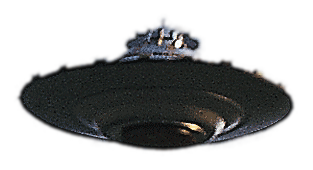
As it settled into a hover Brooks saw its structure clearly. There was a central circular chamber he estimated at about 25 feet across and 12 feet high, with one long thin fuselage projecting from the front and three more fuselages grouped together behind it. Each of the four fuselages he put at roughly 75 feet long, 7 feet high and 8 feet wide. The whole thing appeared to be made of a translucent material that seemed to take on the colour of the sky behind it, with darker shadowing along the undersides of the chamber and the fuselages, and what he described as nose cones and groove-like fins.
Then the object did the thing that made the case famous. While it hovered, the two outer rear fuselages swung outward to the sides until all four fuselages stood at equal spacing around the central chamber, turning the silhouette into a symmetrical cross. The craft rotated about 90 degrees and then held dead still. It stayed motionless in that position for roughly 22 minutes despite the gale, made no sound, and showed no exhaust, jets or visible means of propulsion. Throughout, Brooks' Alsatian was badly agitated, pawing frantically at him and refusing his commands to sit. At the end the two side fuselages swung back into line at the rear, and the object climbed away to the east at great speed and was gone. Brooks, a wartime RAF photographic interpreter trained to read shapes in the air, was certain he had watched a solid, structured craft and not any aircraft he knew.
What is the official explanation?
The case was reported to the authorities and drew an unusually senior response. A team connected to the Air Ministry's UFO section, S4 (Air), the desk later folded into the branch that handled such reports, went to interview Brooks. The named figures who feature in the investigation are Leslie Akhurst of S4 (Air), Dr John Dickinson of the Royal Aircraft Establishment at Farnborough, and Alec Cassie, a psychologist who also had contact with civilian UFO research. The fact that the technical and psychological arms of the establishment both turned out for a single dog-walker's sighting is itself a measure of how seriously the report was taken during the intense "Flying Cross" wave then sweeping southern England.
The official conclusion was that Brooks had not seen a craft at all. The team's explanation was that he had observed a vitreous floater, dead matter drifting in the fluid of his own eyeball, and that the experience had become vivid and dramatic because, lying down sheltered from the wind, he had drifted into sleep or a near-sleep state and effectively dreamed the encounter. The agitation of the dog was folded into the same picture, the animal supposedly reacting to finding its owner lying inert. This "floater seen during a doze" line was a recurring Air Ministry fallback for high-credibility reports that could not be matched to any aircraft, balloon or astronomical object.
It is worth being precise about what this official finding is and is not. It is an assertion by the investigating apparatus, not a demonstration. No document released to date shows that Brooks' specific eye actually contained a floater capable of producing the image he drew, no medical examination of him is reproduced proving the mechanism, and the explanation does not engage with his measurements or the 22-minute fixed position against the landscape. The episode sits inside the broader documented history of the British UFO files, the surviving sequence of which begins in 1962 and which passed from the Directorate of Air Staff and the Defence Intelligence Staff branch DI55 to The National Archives, as set out by Dr David Clarke, who has worked through those files and reproduced many witness drawings of this era in UFO Drawings from the National Archives.
What did the witnesses think it was?
Brooks never accepted the floater explanation, and his rebuttal was specific rather than indignant. He reported that his own eye doctor had told him the eye muscle "moves upwards and downwards," whereas the object had entered his field of vision at 30 degrees, moved across and down to the centre of his vision, hovered there for 22 minutes, and then left the field at 320 degrees. As he put it, this path "hardly conforms" with the theory Akhurst's team had offered, because a floater drifts with the movement of the eye and cannot sit locked against the distant terrain for twenty-two minutes while the eye naturally scans around it. He also pointed out the obvious situational problem with the dream idea, that a man does not doze off lying in a Force 8 gale with a frightened Alsatian clawing at him and ignoring orders to sit.
Brooks' credibility rested on his background. He had served as a photographic interpreter with the RAF during the Second World War, work that is precisely about distinguishing real objects and structures from optical artefacts in imagery, and he later worked as a flight administrative officer with the British Overseas Airways Corporation. He gave careful dimensions, a clear sequence and a consistent account, and he provided a drawing of the object, the kind of detailed witness sketch that the Air Ministry retained in its files. The investigator who took his statement, Julian J. A. Hennessey of NICAP's European subcommittee, treated the report as one of the most detailed of the whole 1967 "Flying Cross" flap and suggested it might explain some of the other, vaguer cross-shaped sightings of that autumn. Brooks' own dating of the encounter to the area between the Winfrith atomic establishment, the Portland underwater defence station and the United States Air Force communications unit at Ringstead Bay added a Cold War edge to the report, since it placed a silent, structured, hovering object directly over a cluster of sensitive installations.
The dispute
The dispute is entirely about the official explanation advanced by the Air Ministry's S4 (Air) team that interviewed Brooks, the people named in the case being Leslie Akhurst of S4 (Air), Dr John Dickinson of the Royal Aircraft Establishment at Farnborough, and the psychologist Alec Cassie. Their conclusion was that Brooks had not seen a craft but a vitreous floater, dead matter in the fluid of his eyeball, which became dramatic because he had fallen asleep or into a near-sleep state and dreamed the encounter while sheltering from the wind. This is the counter-explanation, and it is the only one of substance on the record.
The reason it does not close the case is that it was never demonstrated, only asserted, and it conflicts with the specifics Brooks gave. A vitreous floater drifts with the motion of the eye; it cannot hold a fixed position against distant terrain for 22 minutes while the eye naturally scans. Brooks made exactly this point, reporting that his eye doctor had explained the eye muscle "moves upwards and downwards," whereas the object entered his vision at 30 degrees, crossed and descended to centre, hovered there for 22 minutes and exited at 320 degrees, a path he said "hardly conforms" with the team's theory. The investigation as released does not show that Brooks' eye actually contained such a floater, does not reproduce any medical examination of him, and does not engage with his measurements or the fixed hover.
The companion claim, that he was asleep or dreaming, runs into the conditions at the scene. Brooks was lying in a Force 8 gale and his Alsatian was frantically pawing at him and disobeying commands throughout, which is poor ground for a hypnagogic doze. The dog's agitation was reinterpreted by the team as a reaction to its owner lying inert, but it is at least as consistent with the animal reacting to something real.
Because the counter-explanation is an official assertion without a shown method, with no confession, no recovered hoax material, and no positive identification of any specific real object, balloon, aircraft or astronomical body, it weakens the case without closing it. Under a strict standard this is a Barely Disputed case rather than a strongly disputed one, and the witness's detailed, internally consistent, trained-observer account largely stands.
Is the Angus Brooks Encounter real? The two-pass assessment
Pass one, the ordinary reading. The official line is the strongest mundane candidate and it deserves a fair hearing. A vitreous floater is a real thing, hypnagogic imagery in a tired man sheltering from the wind is a real phenomenon, and the late-October 1967 "Flying Cross" wave shows how readily ordinary stimuli, contrails, aircraft, Venus and the like, were being read as structured craft across southern England that week. If Brooks had genuinely drifted into a half-sleep, a drifting speck in his eye could in principle have been woven into a vivid pseudo-event. But this explanation was asserted, not shown. The investigators never demonstrated that Brooks' eye contained such a floater, never addressed his measured 30-to-320-degree track or the object holding fixed against the landscape for 22 minutes, both of which cut directly against floater behaviour, and never reconciled the dream idea with a gale and a frantic dog. A floater moves with the eye and cannot stay pinned to a point on the distant coast while the eye roves; that single physiological point, which Brooks raised and which was never answered, is why the official case is weak rather than decisive.
Pass two, if it was real. Then a witness trained to read shapes in the air watched a silent, translucent, structured object roughly 175 feet across hold a fixed hover for 22 minutes in a Force 8 wind, with no visible propulsion, and then reconfigure its own geometry by swinging three fuselages from a trailing cluster into a symmetrical cross before climbing away at speed. A hover that ignores a gale and a body that rearranges its own structure are not characteristics of any 1967 aircraft, and the placement over the Winfrith, Portland and Ringstead Bay installations is at minimum a striking coincidence.
Weighing the two passes, this is a Barely Disputed case. There is a counter-explanation on the record and it carries the weight of an official Air Ministry finding, so the case is not Verified Unexplained. But that finding is an unproven assertion, not a method-shown identification: no confession, no recovered prop, no demonstrated floater in this witness's eye, and no positive identification of any real object. The witness's physiological objection stands unanswered and his account is detailed, internally consistent and given by a trained observer. The official debunk is better read, per pass two, as evidence the report was solid enough to need closing than as a solved case. The dispute is real but weak, the case largely stands, and the tier is Barely Disputed.
Sources
- www.project1947.com/shg/hennessey/ufoinv4-3.htm
- www.nicap.org/ar-671026se.htm
- www.thinkaboutitdocs.com/1967-flying-cross-shaped-ufo-hovers-near-moigne-downs/
- ufologie.patrickgross.org/htm/dorset67.htm
More cases from this region: UFO sightings in United Kingdom