The Aurora, Texas Airship Crash (1897)
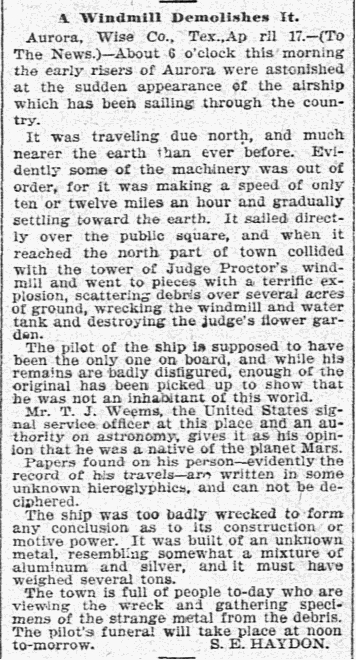
At about six o'clock on the morning of 17 April 1897, according to the only contemporaneous account, the early risers of Aurora, a small farming town in Wise County roughly forty miles northwest of Fort Worth, looked up to see an airship descending over their public square. This case file covers what witnesses reported, the official narrative, and a two-pass assessment with its evidence tier.
What did witnesses see at Aurora?
At about six o'clock on the morning of 17 April 1897, according to the only contemporaneous account, the early risers of Aurora, a small farming town in Wise County roughly forty miles northwest of Fort Worth, looked up to see an airship descending over their public square. The account is a single newspaper story, "A Windmill Demolishes It," filed under the dateline "Aurora, Wise Co., Tex., April 17 (To The News)" and printed in the Dallas Morning News on 19 April 1897, page 5, by a local correspondent named S.E. Haydon.
Haydon wrote that the craft "which has been sailing through the country" was traveling due north and "much nearer the earth than ever before." He reported that "evidently some of the machinery was out of order, for it was making a speed of only ten or twelve miles an hour and gradually settling toward the earth." The airship, he wrote, "sailed directly over the public square, and when it reached the north part of town collided with the tower of Judge Proctor's windmill and went to pieces with a terrific explosion, scattering debris over several acres of ground, wrecking the windmill and water tank and destroying the judge's flower garden."
The pilot, Haydon continued, "is supposed to have been the only one on board, and while his remains are badly disfigured, enough of the original has been picked up to show that he was not an inhabitant of this world." He then quoted a local authority: "Mr. T. J. Weems, the United States signal service officer at this place and an authority on astronomy, gives it as his opinion that he was a native of the planet Mars." Papers found on the body, "evidently the record of his travels, are written in some unknown hieroglyphics, and can not be deciphered."
On the wreck itself Haydon wrote that the ship "was too badly wrecked to form any conclusion as to its construction or motive power. It was built of an unknown metal, resembling somewhat a mixture of aluminum and silver, and it must have weighed several tons." He closed with two lines that gave the legend its lasting hooks: "The town is full of people to-day who are viewing the wreck and gathering specimens of the strange metal from the debris. The pilot's funeral will take place at noon to-morrow."
That funeral, by later local tradition, was held the next day at Aurora Cemetery, where townspeople are said to have given the pilot a Christian burial. The grave was marked, the story goes, with a rough headstone bearing an etched image of the airship. The Town of Aurora today refers to the buried pilot by the nickname "Ned." No body, no metal specimen, and no original grave marker survives in any verified collection.
It is worth stressing how thin the contemporaneous record is. The entire primary case rests on Haydon's roughly 300 words. There is no second 1897 newspaper that independently witnessed the crash, no photograph, no recovered fragment with a documented 1897 provenance, and no named eyewitness apart from the people Haydon mentions in his own copy. Everything richer than the article, the burial, the headstone carving, the named child witnesses, the metal readings, comes from investigations that began seventy-six years later.
What is the official explanation?
There was no military or government investigation of Aurora in 1897, and there is no Project Blue Book file, for the simple reason that the United States Air Force did not exist and powered heavier-than-air flight was still six years away. The Wright brothers' first flight came in December 1903. The case therefore has no official apparatus debunk of the kind that attaches to later UFO incidents, and that absence matters: there was no government machine motivated to close it.
The official record that does exist is documentary and curatorial rather than investigative. The Texas State Historical Association, in its "Texas Day by Day" entry for 17 April, states plainly that on that day in 1897 "S.E. Haydon, a cotton buyer in the small Wise County community of Aurora, released a fictional 'news' story in the Dallas Morning News describing the crash of a mysterious airship just outside of town." The TSHA entry then supplies the economic context that frames the modern hoax reading: Aurora had grown through the mid-1880s, but "an outbreak of spotted fever began in 1888, and by 1889 fear of the epidemic had caused a mass exodus." Two years later "the Burlington Northern Railroad abandoned its plan to lay tracks through Aurora," and most remaining residents moved two miles southeast to Rhome, the new railroad stop. TSHA adds that Haydon's story "succeeded in causing a sensation because tales of UFOs near Fort Worth were already current," but that "Aurora remained comatose."
The Texas Almanac, in Mike Kingston's survey "When Airships Invaded Texas" (Texas Almanac 1990-1991), sets Aurora inside a wider event. Kingston counts 38 airship sightings across 23 Texas counties between 13 and 17 April 1897, naming witnesses in other towns such as Judge Love at Waxahachie, correspondent C.G. Williams at Greenville, and Dr. E. Stuart at Ennis. He records that the Aurora windmill story was "labeled a hoax by 20th-century historians," though he does not name them individually.
The one piece of standing official text about the case is the Texas Historical Commission's state marker at Aurora Cemetery, marker number 240, Wise County, dedicated in 1976. Its inscription recounts the cemetery's real history, the Randall and Rowlett family graves from the 1860s, the three-acre site donated to Aurora Lodge No. 479 in 1877 by Confederate veteran Finis Dudley Beauchamp, the epidemic that added hundreds of graves, and the often-quoted epitaph on infant Nellie Burris's stone, "As I was so soon done, I don't know why I was begun." Then comes the sentence that drives tourism to the spot: "This site is also well known because of the legend that a spaceship crashed nearby in 1897 and the pilot, killed in the crash, was buried here." The State of Texas, in other words, officially records the event as a legend, not as fact.
The Town of Aurora's own government website reproduces what it calls "the original front page of the Dallas Morning News, April 19, 1897," and credits the scan to the late author Jim Marrs, who wrote "Alien Agenda." The town states that "a newspaper article of the event still exists," which is correct: the page is real and is preserved in the Dallas Morning News record. The town frames the rest in the language of local lore, "tall tale," "legend," "the story goes," and refers to the buried pilot as "Ned."
What did the witnesses think it was?
There are no living 1897 witnesses on record and never were any sworn ones. The only named figures in the original article are S.E. Haydon himself, the correspondent who wrote it; Judge J.S. Proctor, on whose property the windmill stood; and T.J. Weems, whom Haydon called "the United States signal service officer at this place and an authority on astronomy." Local historical work has long held that Weems was in fact Aurora's blacksmith, an ordinary tradesman, not a federal signals officer or an astronomer, which would make the line a piece of small-town in-joke embellishment recognizable to anyone in Aurora at the time. That reading is widely repeated by Aurora-area historians, though a primary census image putting "blacksmith" against his name was not located for this file, so it is logged as strong local tradition rather than as a verified document.
The richest witness testimony arrived in 1973, when the case was rediscovered. Bill Case, an aviation writer for the Dallas Times Herald and the Texas state director of the Mutual UFO Network, investigated Aurora that year. Case and MUFON reported locating two elderly people who had been children in 1897: Mary Evans, said to have been about fifteen at the time, who recalled that her parents went to the crash site though she was not allowed to go, and that townspeople found a body; and Charlie Stephens, about ten in 1897, who recalled seeing an airship trailing smoke heading toward Aurora, with his father later going into town and seeing wreckage. These are recollections gathered seventy-six years after the fact from people who were small children, and they describe hearing about the event rather than examining a craft. They corroborate that a story circulated in Aurora, which no one disputes; they do not independently establish a crash.
Hayden Hewes of the International UFO Bureau and the MUFON team pressed to exhume the alleged grave at Aurora Cemetery. The Aurora Cemetery Association refused, and a court injunction blocked exhumation on the grounds that the deceased could not be identified and next of kin could not be notified. Investigators reported that a metal detector registered metal at a small unmarked grave near the 1890s plots. Soon after the 1973 work, the original small marker, the one said to carry the etched airship, vanished from the cemetery and was replaced by a length of pipe set in the ground; later sweeps reportedly picked up no metal, leading investigators to suspect the contents had been removed. The marker has never been recovered.
The believing community treats all of this as corroboration: a real grave, a real (now missing) marker, real metal in the ground, and elderly witnesses who remembered the day. The skeptical reading is that an unmarked grave in a cemetery that suffered a spotted-fever epidemic is unremarkable, that buried iron coffin hardware is exactly what a detector should find, and that childhood memories collected three generations later track the legend rather than the event.
The decisive hostile witness is Etta Pegues. In 1980, Time magazine quoted Pegues, an 86-year-old lifelong Aurora resident, saying the whole thing was invented. In the most-cited line, she said Haydon "wrote it as a joke and to bring interest to Aurora. The railroad bypassed us, and the town was dying." She also stated flatly that Judge Proctor never had a windmill on his property at all, which, if true, removes the physical centerpiece of the story. Under this archive's rule that witnesses are weighed, not dismissed, Pegues has no obvious motive to lie and lived through the period in question, so her testimony carries real weight. It is not unanswerable, though: the 2008 History Channel "UFO Hunters" investigation reported finding the remains of a windmill base near the old well on the property historically tied to Proctor, which would contradict her single sharpest factual claim.
The dispute
The dispute over Aurora is that the whole event was a newspaper hoax, invented by the local correspondent and cotton buyer S.E. Haydon and printed in the Dallas Morning News during the April 1897 airship wave. This reading is endorsed by named institutional authorities: the Texas State Historical Association catalogs the story as a "fictional 'news' story," and the Texas Historical Commission's own state marker files it as legend. The most-cited human source is Etta Pegues, an 86-year-old lifelong Aurora resident who told Time in 1980 that Haydon "wrote it as a joke and to bring interest to Aurora." Unlike a bare official assertion, this counter-explanation comes with a shown method. There is a demonstrated motive, Aurora was a dying town gutted by an 1888 spotted-fever exodus and bypassed by the railroad in favor of Rhome, giving Haydon a concrete reason to manufacture interest. There is textual analysis, the article's tells read as period humor: a Martian corpse diagnosed by a small-town blacksmith dressed up as a "U.S. signal service officer and authority on astronomy," indecipherable "hieroglyphics," and a convenient aluminum-and-silver metal. And there is contextual fit, the piece landed inside a regional newspaper fad of one-upmanship, dozens of airship sightings across Texas counties in a matter of days.
What keeps this from closing as a clean debunk is that the strongest evidence is motive, context, and a secondhand account of Haydon's intent rather than independent forensic proof, and the one checkable factual claim inside the hoax case was contradicted. Pegues anchored the joke reading partly on there being no windmill on the Proctor property, the airship in the story having supposedly struck a windmill. The 2008 History Channel "UFO Hunters" investigation reported finding the remains of a windmill base near the old well on that property, directly undercutting her checkable assertion, and reported well water carrying unusually high aluminum. The physical record is likewise unresolved rather than closed. A real unmarked grave exists near the 1890s plots; the 1973 inquiry by Texas MUFON director and aviation writer Bill Case, working alongside Hayden Hewes of the International UFO Bureau, reported a metal detector registering metal at that grave, after which the marker vanished and later sweeps reportedly found nothing, suggesting the contents had been removed. No exhumation ever tested any of this, the Aurora Cemetery Association refused and a court injunction blocked it because the deceased could not be identified and next of kin could not be notified.
By this archive's method, the hoax reading is the stronger of the two and is backed by real evidence, not just an apparatus ruling, but it does not fully and cleanly close the case. The discrediting rests on demonstrated motive plus a secondhand statement of intent, while the key skeptical witness's only independently checkable claim was challenged by a later site investigation, and the grave that might settle the question was never opened. The case therefore stands as genuinely disputed rather than resolved.
Is the Aurora, Texas Airship Crash (1897) real? The two-pass assessment
Pass one, the ordinary explanation, and it is unusually strong here. The simplest reading is that there was no crash at all and that Haydon's article is a tall tale, a piece of frontier newspaper humor written to draw attention and maybe a railroad to a dying town. The supports stack up. Aurora was demonstrably collapsing: a spotted-fever epidemic from 1888 had driven a mass exodus, and the railroad had just chosen Rhome two miles away instead, exactly the grievance Etta Pegues named when she said the men "meant it for a joke to bring interest to Aurora." The story sits in the middle of the April 1897 airship wave, 38 sightings across 23 Texas counties in five days by the Texas Almanac's count, a fad that newspapers up and down the country were feeding with one-upmanship. The article's own details read as wink-to-the-reader invention: a "United States signal service officer" and "authority on astronomy" in a tiny farm town who happens to diagnose a Martian on sight, undecipherable "hieroglyphics," and a metal "resembling somewhat a mixture of aluminum and silver" at a time when aluminum was a costly novelty. The Texas State Historical Association, the body that keeps the state's history, calls it outright a "fictional 'news' story" by "a cotton buyer," and the Texas Historical Commission's own cemetery marker files it as a "legend." No photograph, no recovered fragment with 1897 provenance, no second contemporaneous paper, and no powered aircraft yet existed on Earth to crash. As an ordinary event, this is close to a textbook newspaper hoax with the method and the motive both visible.
Pass two, taking the case at its highest, what is left if any of it is real. The honest pro-case points are narrower than the legend but not nothing. The newspaper page is genuine and old; this is not a modern fabrication of a document, only a question of whether its contents were true. There is a real grave and there was a real, now-missing marker, and a 1973 metal-detector hit was reported over it. The 2008 on-site investigation reported a windmill base near the old well, which directly contradicts Pegues's sharpest claim that Proctor never had a windmill, and that same investigation reported water from the well carrying unusually high aluminum. The 1973 child-witnesses, however thin, show the story was circulating in living memory and was not purely a 1970s invention. None of this demonstrates an extraterrestrial craft. At most it shows that the legend has a real cemetery, a real (vanished) artifact, and one factual detail in Haydon's article that may have been accurate. That is a long way from a Martian.
Weighing the two passes: this is the rare case where a counter-explanation is method-shown rather than asserted. A named eyewitness to the town and period, Etta Pegues, said in print that it was deliberately written as a joke; the documented economic collapse supplies the motive; the airship-wave context supplies the medium; the state's own historians label it fiction; and the physical claims that could anchor it (the body, the metal specimens, the original marker) have all conveniently disappeared and were never independently examined. Against that stand a still-real grave, a contested windmill, and contradictory third-hand testimony. The hoax reading is the stronger one and is supported by evidence, so this file is logged with a proposed discredit for human review. It does not ship as Discredited, because the discrediting rests on a single hostile witness's account of intent plus circumstantial context rather than on an independent forensic demonstration that the events themselves were faked, and because Pegues's one checkable claim, the missing windmill, was later challenged on the ground. The tier is Disputed: a serious, evidence-backed counter-explanation exists and is probably correct, but it does not fully and cleanly close the case.
Sources
- www.tshaonline.org/texas-day-by-day/entry/118
- atlas.thc.texas.gov/Details/5497000240
- www.texasalmanac.com/articles/when-airships-invaded-texas
- www.auroratexas.gov/community/history/
- www.theordinaryextraordinarycemetery.com/blog/the-legend-of-the-aurora-texas-ufo-crash/
- www.dmagazine.com/frontburner/2021/06/aurora-ufo-crash-texas/
More cases from this region: UFO sightings in United States