The USS Nimitz Tic Tac
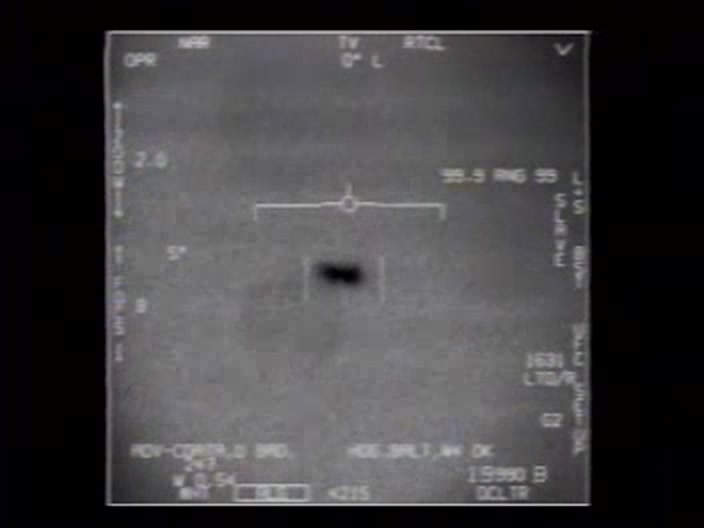
On the morning of November 14, 2004, Commander David Fravor, the commanding officer of Strike Fighter Squadron 41 (the VFA-41 Black Aces) flying off the aircraft carrier USS Nimitz, was leading a two-jet F/A-18F Super Hornet training flight roughly 100 miles out into the Pacific, off the coast of Baja California southwest of San Diego. This case file covers what witnesses reported, the official narrative, and a two-pass assessment with its evidence tier.
What did witnesses see at Off Baja California?
On the morning of November 14, 2004, Commander David Fravor, the commanding officer of Strike Fighter Squadron 41 (the VFA-41 Black Aces) flying off the aircraft carrier USS Nimitz, was leading a two-jet F/A-18F Super Hornet training flight roughly 100 miles out into the Pacific, off the coast of Baja California southwest of San Diego. He flew the lead jet with his weapons systems officer, Lieutenant Commander Jim Slaight, in the back seat. His wingman flew the second F/A-18F with Lieutenant Alex Dietrich at the controls and her own backseater. The flight was diverted from a planned air combat exercise and vectored by controllers aboard the guided-missile cruiser USS Princeton (CG-59) to investigate a contact the ship had been tracking on its AN/SPY-1 Aegis radar.
When Fravor's flight arrived at the location, the crews looked down at the ocean and saw a disturbance in the water. Fravor described a churning, frothing patch on an otherwise calm sea, roughly the size of a Boeing 737, as though something just below the surface was breaking the water or something had recently submerged. Hovering above that disturbance, between roughly 50 and a few thousand feet over the ocean, was a solid white object with no wings, no tail, no exhaust, and no visible means of propulsion. Fravor likened it to a flying Tic Tac, the breath mint, smooth and oblong, white like a whiteboard. He estimated it at about 40 to 46 feet long, roughly the size of his own fighter. As reported by 60 Minutes in 2021, his first words to his wingman were, "Dude, do you, do you see that thing down there?"
The object was moving erratically above the white water, darting side to side in sharp, abrupt motions that did not match any aircraft the four aviators knew. Fravor began a descending spiral to get closer. As he came down, the Tic Tac appeared to react to him. It began climbing and mirroring his arc, as if it was aware the jets were there and was matching his maneuver on the opposite side of a circle. Fravor cut across the circle to close the distance, pointing his nose at the object. When he got within roughly half a mile, the Tic Tac accelerated and was simply gone, faster than anything he had ever seen, with no visible exhaust, sonic boom, or transition. In his words to CBS, "As I got within about a half mile, it rapidly accelerated and disappeared. It was gone." The whole observation lasted about five minutes, with four trained naval aviators watching at once.
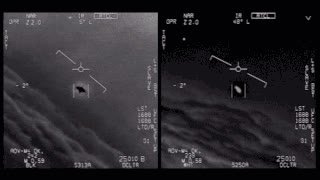
Seconds later, the USS Princeton reacquired a contact on radar at the flight's pre-briefed CAP point (combat air patrol rendezvous), roughly 60 miles away. The object had crossed that distance almost instantly. A second VFA-41 Super Hornet was already airborne and was vectored to the spot. Its crew, with Lieutenant Commander Chad Underwood operating the Raytheon AN/ASQ-228 ATFLIR (Advanced Targeting Forward-Looking Infrared) pod, locked the sensor onto the object and recorded roughly one minute and sixteen seconds of infrared video. That footage, later named FLIR1, shows a smooth white thermal oval with no wings or exhaust plume, and ends with the object appearing to dart sharply to the left off the side of the frame. A Marine F/A-18C pilot from VMFA-232 separately reported seeing the same kind of disturbance on the ocean surface, a calm sea with a churning patch roughly 150 to 300 feet across.
What is the official explanation?
The encounter sat largely buried inside the Navy for over a decade. The first authoritative public record came on December 16, 2017, when The New York Times published "2 Navy Airmen and an Object That Accelerated Like Nothing I've Ever Seen" by Helene Cooper, Leslie Kean and Ralph Blumenthal, alongside the FLIR1 video. The story revealed the existence of the Advanced Aerospace Threat Identification Program (AATIP), a Pentagon UAP study funded at the urging of then-Senator Harry Reid and run in part through Robert Bigelow's company under a contract known as the Bigelow Aerospace Advanced Space Studies (BAASS) effort.
The central official-era document is a leaked unclassified report, roughly 13 pages, with no cover sheet and no date, compiled around 2009 as part of that program and later referred to as the Tic Tac Executive Summary. Investigative reporter George Knapp and the I-Team at 8 News Now in Las Vegas obtained and published it in 2018. The report uses the deliberately neutral term AAV, Anomalous Aerial Vehicle, throughout. It states that the USS Princeton, using its SPY-1 Aegis radar, tracked these AAVs over a span of days in November 2004, that the objects would appear at very high altitude, on the order of 60,000 to 80,000 feet, then drop to just above the ocean surface in a matter of seconds, and that they showed velocities and turn rates beyond any known aircraft. The leaked summary describes the Tic Tac as solid white, smooth, with no wings or pylons, approximately 46 feet in length. It is built on statements from seven pilots and radar operators. As reported in detail by Tyler Rogoway and Joseph Trevithick at The War Zone, the report lists conclusions that the object represented technology not believed to be in the U.S. inventory or that of any known adversary, that it appeared to defeat radar through broadband radio-frequency stealth, that it had no obvious lifting or control surfaces yet performed extreme maneuvers, that it had a propulsion method enabling instantaneous acceleration and abrupt course changes, and that it might be capable of cloaking and even of operating undersea.
The official position hardened in 2019 and 2020. In September 2019 the Navy confirmed to multiple outlets that the videos were real and depicted "unidentified aerial phenomena." Then, on April 27, 2020, the Department of Defense formally released the three clips, FLIR (the Nimitz Tic Tac footage), GIMBAL and GOFAST, through Naval Air Systems Command's FOIA library. The official Pentagon statement read: "The Department of Defense has authorized the release of three unclassified Navy videos, one taken in November 2004 and the other two in January 2015," and stated that "the aerial phenomena observed in the videos remain characterized as 'unidentified.'" Spokesperson Sue Gough said the release was meant to "clear up any misconceptions by the public on whether or not the footage that has been circulating was real." On May 17, 2022, Fravor and the now-retired Alex Dietrich, by then a Commander, gave sworn testimony alongside Ryan Graves before the House Intelligence Subcommittee on Counterterrorism, Counterintelligence, and Counterproliferation, the first open congressional hearing on UAP in more than fifty years. The case also fed directly into the June 2021 Office of the Director of National Intelligence preliminary UAP assessment, which examined 144 military reports and found that the vast majority could not be explained, while explicitly declining to attribute the Nimitz object to any known program.
What did the witnesses think it was?
The witnesses are not anonymous tipsters. They are named, on-the-record naval officers and sailors who have repeated the same account under their own names, on camera, and in some cases under oath. Commander David Fravor is the central witness, a Top Gun-trained F/A-18 pilot and squadron commanding officer with a spotless record. He has never wavered: he saw a 40-odd-foot white object with no wings or exhaust that reacted to his jet, mirrored his turn, then accelerated out of sight faster than any aircraft he knew. To the New York Times he summed it up plainly, saying he had no idea what he saw, only that it was real and it was not ours.
Lieutenant Alex Dietrich, flying the second F/A-18F as Fravor's wingman, corroborates the visual independently from her own cockpit. She has been deliberately conservative in public, stressing that she does not identify as a "UFO person" and warning against jumping to conclusions. As she put it, "We don't know what it was, but it could have been a natural phenomenon in human activity. But the point was that it was weird, and we couldn't recognize it." That restraint makes her corroboration stronger, not weaker: a self-described skeptic who still confirms the same object, the same erratic motion, and the same water disturbance.
The radar side is anchored by Senior Chief Petty Officer Kevin Day, the USS Princeton's air-intercept controller and an experienced SPY-1 operator with more than twenty years on Aegis ships. Day says he tracked groups of these contacts over several days, watching them appear at very high altitude and then drop to near sea level, "going to the deck," at descent rates he considered physically impossible for known aircraft. It was Day who vectored Fravor's flight onto the object. Fire controlman and Aegis technician Gary Voorhis from the Princeton has separately described strange radar returns and an effort to capture the contacts on the ship's systems. Lieutenant Commander Chad Underwood, who filmed FLIR1, has confirmed he locked the ATFLIR onto something he could not identify. Lieutenant Commander Jim Slaight, in Fravor's back seat, saw the same object. Across pilots, backseaters, and shipboard radar operators, the accounts converge on the same November 2004 object from multiple independent sensors and sets of eyes.
Is the USS Nimitz Tic Tac real? The two-pass assessment
Pass one, the ordinary case. The strongest mundane reading of the FLIR1 video comes from independent analyst Mick West of Metabunk, who is the most rigorous, method-showing skeptic on this case. West argues the thermal blob is most likely a distant conventional jet, perhaps 50 or more miles away, flying away from the camera, with its hot engines saturating the infrared sensor into a featureless white oval. He contends the dramatic darting-away at the end of the clip is not the object accelerating at all, but an artifact of a sudden zoom change from 1x to 2x combined with the ATFLIR pod losing track and slewing, noting that when you correct for the zoom step "there isn't actually any speed up, and it all proceeds at more or less the same speed." West attributes apparent rotation in similar Navy clips to the gimballed optics, not the object. These are real, testable points, and they show that the video alone, stripped of context, does not prove anything exotic. A fully ordinary scenario would require the visual intercept to be a misjudged distant aircraft or balloon, the water disturbance to be an unrelated whale, submarine, or surface artifact, and the radar tracks to be glitches or stacked false returns.
Pass two, if real, what is it. The problem for the ordinary reading is that FLIR1 is the least important piece of evidence in this case, not the most. The core of the Nimitz event is not a fuzzy video. It is a multi-sensor, multi-witness intercept. The USS Princeton's SPY-1 radar tracked objects for days before any jet got close, watching them drop from tens of thousands of feet to the deck in seconds, which West's distant-jet model does not touch. Four trained aviators in two jets watched a white Tic Tac maneuver erratically over a churning patch of ocean, react to Fravor's approach, mirror his turn, and then cross 60 miles to the CAP point almost instantly, where the ship's radar reacquired it. A distant aircraft does not get reported as a 40-foot wingless object by a Top Gun pilot at half a mile, does not sit over a 737-sized hole in the water, and does not teleport 60 miles in the time it takes the same radar to slew. The official apparatus did not close this case either. AATIP studied it, the leaked Executive Summary concluded the object was beyond known technology, the Navy confirmed the video was genuine and the phenomenon "unidentified," and the 2021 ODNI assessment left it unexplained. Under the rule that an official debunk would be evidence the case mattered, the striking thing here is that no official body even attempted one; they all landed on "unidentified."
Weighing both passes: the skeptical work fairly degrades the FLIR1 video as standalone proof, but it does not reach the radar tracks, the corroborated visual maneuvers, the water disturbance, or the instantaneous repositioning to the CAP point. The material is authenticated by the Navy itself and officially documented, and the object remains formally unexplained by every body that looked at it. That places the case squarely at Verified Unexplained. The authentication is government-confirmed, the witnesses are named and consistent, and the core observations have no demonstrated ordinary explanation.
Sources
- www.theblackvault.com/casefiles/the-vault-files-the-tic-tac-incident-november-14-2004/
- www.twz.com/21000/highly-detailed-report-on-harrowing-encounter-between-f-a-18s-and-ufo-off-baja-surfaces
- web.archive.org/web/20260628114942/https://www.cbsnews.com/news/tic-tac-ufo-sighting-uap-video-dave-fravor-alex-dietrich-navy-fighter-pilots-house-testimony/
- www.twz.com/33179/navy-officially-releases-infamous-ufo-videos
- www.navair.navy.mil/foia/sites/g/files/jejdrs566/files/2020-04/1%20-%20FLIR.mp4
- www.metabunk.org/threads/2004-uss-nimitz-tic-tac-ufo-flir-footage-flir1.9190/
- www.aviationpros.com/aircraft-maintenance-technology/aircraft-technology/defense/news/21225042/those-amazing-navy-ufo-videos-may-have-down-to-earth-explanations-skeptics-contend
- taskandpurpose.com/news/navy-pilot-nimitz-ufo-sighting/
More cases from this region: UFO sightings in United States