The Phoenix Lights
The night of Thursday 13 March 1997 produced two distinct light shows over Arizona that have been bundled together ever since under one name. This case file covers what witnesses reported, the official narrative, and a two-pass assessment with its evidence tier.
What did witnesses see at Phoenix and across Arizona?
The night of Thursday 13 March 1997 produced two distinct light shows over Arizona that have been bundled together ever since under one name. The first call to reach Peter Davenport's National UFO Reporting Center hotline in Seattle came at 8:16 p.m. from a former police officer near Paulden, in the high country north of Prescott. He reported a cluster of red lights, four or five in the lead followed by a single trailing light, forming a wedge or boomerang moving south. Within a minute callers in Prescott and Prescott Valley reported four or five very bright white lights passing overhead, silent, that one woman said seemed to shift orientation as they went.
Minutes later, near Dewey, five people watched a vast V-shaped arrangement pass low and silent. The caller, by his own flying experience, judged it no more than about 1,000 feet up and said that with his fist held at arm's length he could not cover the size of the thing. Over the next two hours the lights tracked down the spine of the state, roughly following Interstate 17 then Interstate 10, through Chino Valley, the Phoenix metro, and on toward Tucson, a corridor of around 300 miles. Witnesses repeatedly described not separate lights but a single enormous structure that blotted out the stars behind it. A mother near Camelback Mountain watched for several minutes as it hovered. Some accounts put the wingtip-to-wingtip span at a mile or more. There was no engine noise.
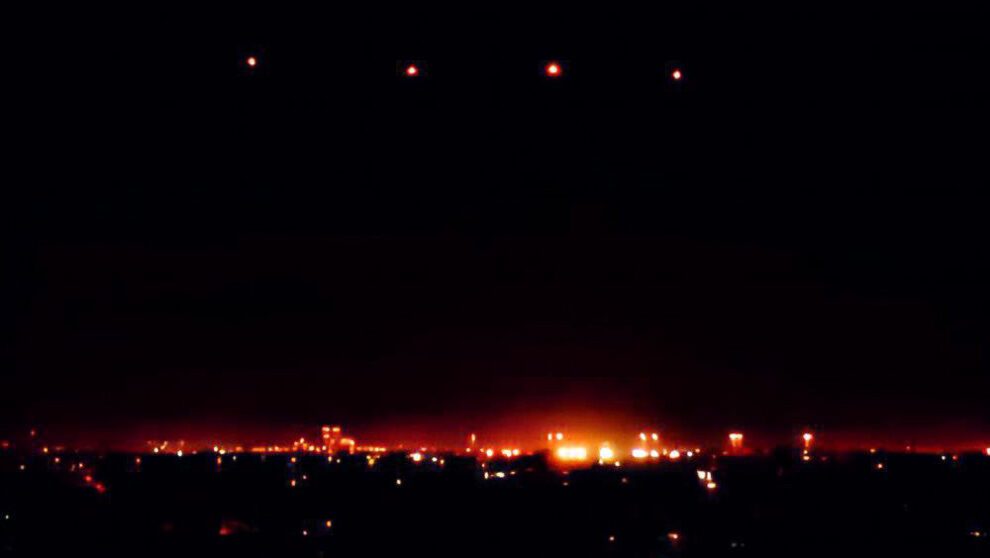
Then, around 10 p.m., a separate event: a row of brilliant amber-white lights appeared in the sky to the south of Phoenix, hung in a slowly shifting line for several minutes, and winked out one by one. Thousands of residents saw this second display, and much of the surviving photography and video, including the footage taken by Mike Kryston and others, is of these 10 p.m. lights rather than the earlier formation. Dr. Lynne Kitei, a Phoenix physician, watched and photographed amber orbs from her Paradise Valley home and would later build a long investigation and a book around them. Phoenix city councilwoman Frances Barwood said she personally spoke with more than 700 witnesses. The two events, the traveling V around 8:30 and the static line of lights around 10, are what people mean when they say "the Phoenix Lights."
What is the official explanation?
The official response came in two parts and took years to fully surface. In the days after the sighting, Luke Air Force Base public affairs said personnel had looked into it and that the lights were flares. A more specific account emerged through investigative reporting and later confirmations. Lieutenant Colonel Ed Jones of the Maryland Air National Guard's 104th Fighter Squadron stated that his unit, in Arizona for winter training under Operation Snowbird flown out of Davis-Monthan Air Force Base in Tucson, dropped a string of LUU-2 illumination flares over the North Tac range on the Barry M. Goldwater Range southwest of Phoenix at about 10 p.m. An Arizona National Guard public information officer placed the drop at roughly 15,000 feet, an unusually high altitude. The LUU-2 burns at a high candlepower under a parachute and drifts; from Phoenix the flares appeared to hang in a line and then extinguish in sequence as they sank behind the Sierra Estrella mountains, which screen that range from the city. This accounts for the 10 p.m. display.
The earlier traveling formation got no clean official statement. Luke radar reportedly showed nothing unusual, and a high-altitude formation of a few aircraft transiting the area would not have flagged as remarkable. NUFORC noted it could not corroborate the dramatic side-claims that reached the hotline later that night, including an anonymous airman's account of F-15s scrambling from Luke. Davenport wrote that investigators "cannot even document the fact that F-15's are stationed at Luke AFB, and no one can be found who can confirm that any military aircraft took off from Luke on the night of March 13." On the civilian-government side, councilwoman Frances Barwood pressed for an official inquiry as a public-safety matter and got no institutional support; she later lost her council seat amid the ridicule. Governor Fife Symington, who had ordered an investigation, instead held a press conference on 19 June 1997 in which his chief of staff Jay Heiler was paraded in handcuffs wearing a rubber alien mask as the "guilty party," a stunt Symington said was meant to defuse public hysteria.
What did the witnesses think it was?
The strongest witness is the governor himself, and he came forward a decade late. In 2007 Fife Symington, a former Air Force captain and pilot, said he had personally watched the craft on 13 March 1997 and had stayed silent at the time. "It was enormous and inexplicable," he said. "A lot of people saw it, and I saw it too." He insisted it was not the flares: "It was dramatic. And it couldn't have been flares because it was too symmetrical. It had a geometric outline, a constant shape." He described a large triangular vehicle of unknown origin moving slowly across the sky, and added, "I'm a pilot, and I know just about every machine that flies. It was bigger than anything that I've ever seen. It remains a great mystery." He explained the 1997 alien-costume stunt as an attempt to calm a public he felt was on the brink of hysteria, while maintaining he never thought the underlying event was a joke.
The corroborating witnesses run into the thousands and include people trained to judge what they see. NUFORC's early callers were a former police officer and pilots. Dr. Bradley Evans, a Tucson psychiatrist, watched with his wife. Trig Johnston, a retired commercial airline pilot in north Scottsdale, watched with his son. Dr. Lynne Kitei, the Paradise Valley physician, photographed the amber lights and spent years documenting the case. Frances Barwood, the councilwoman, logged more than 700 firsthand accounts. The recurring core of the witness testimony, across the traveling-formation reports, is the perception of a single solid structure rather than separate aircraft: lights with no visible sky between them, stars occulted, an outline that held its shape, and total silence.
The dispute
The Phoenix Lights of March 13, 1997 are really two separate events, and the dispute lands differently on each. The later 10 p.m. lights have a strong, method-shown debunk. Lieutenant Colonel Ed Jones of the Maryland Air National Guard's 104th Fighter Squadron, flying under Operation Snowbird, stated his unit dropped a string of LUU-2 illumination flares over the North Tac range on the Barry M. Goldwater Range southwest of Phoenix at about 10 p.m., flares that hang, drift, and burn out in sequence and that, from Phoenix, set behind the Sierra Estrella range. Image analyst Leonid Rudin made this more than an apparatus assertion: he matched witness video against daytime footage and showed the lights sitting above the range and then extinguishing as they dropped behind the ridgeline, just like distant flares. For that half of the night the counter-explanation is named and reproducible, and it closes the 10 p.m. event cleanly.
The earlier 8:30 p.m. V-formation is where the case still stands. Here the counter-explanation is that the formation was high-altitude aircraft, advanced by analysts Tim Printy and Tony Ortega and supported by an actual observation. Printy applied trigonometry to early accounts to place the formation at roughly 35,000 to 40,000 feet, where aircraft are inaudible, and computed ordinary jet speed; astronomer Mitch Stanley pointed a telescope at the lights and reported that each one was actually a pair of lights on the squarish wingtips of a separate airplane, which would mean a string of individual planes rather than one craft. That is a real method, not a bare official ruling, and the page calls the airplane explanation strong.
What keeps the 8:30 event from being settled is that the aircraft case relies on a high-altitude formation no official body ever positively documented for that window, and it sits against a wall of trained witnesses. Thousands of observers, including pilots and physicians, consistently described a single solid structure rather than separate aircraft: lights with no visible sky between them, stars occulted, an outline that held its shape, and total silence. Governor Fife Symington, himself a former Air Force pilot, rejected the flares framing for what he saw and said it could not have been flares because it was too symmetrical and was bigger than anything he had ever seen. Stanley's telescope view and the witness accounts cannot both be fully right, and the page does not resolve that conflict.
So the dispute is split rather than decisive. One real event, the 10 p.m. lights, is explained by named analysts with a reproducible method. The other real event, the 8:30 formation, is argued strongly with geometry and a telescope observation but is not conclusively put to rest, because no official body documented the proposed aircraft formation and a large body of trained witnesses insists on a single silent solid object. The case therefore lands as disputed and contested, not closed.
Is the Phoenix Lights real? The two-pass assessment
Pass one, how this could be entirely ordinary. The 10 p.m. Phoenix display is explained to a high standard and the method is shown, not asserted. Lieutenant Colonel Ed Jones of the Maryland Air National Guard's 104th Fighter Squadron confirmed his Operation Snowbird flight dropped LUU-2 parachute illumination flares over the Barry Goldwater Range at about 10 p.m. at roughly 15,000 feet. Those flares hang, drift, and burn out in sequence, and from Phoenix they would set behind the Sierra Estrella range, which is exactly the behavior witnesses and the surviving video show. Image analyst Leonid Rudin of Cognitech, commissioned after the Discovery Channel had aired contrary claims, matched witness video against daytime footage of the same skyline and showed the lights sitting above the range and then extinguishing as they dropped behind the ridgeline, "just like distant flares." For the earlier 8:15 to 8:45 traveling formation, the leading civilian analysis is by Tim Printy and by Phoenix New Times reporter Tony Ortega. Printy used trigonometry on early, less-embellished accounts, including witness Michael Fortson watching the lights pass between him and the moon at about 40 degrees elevation, to put the formation at roughly 35,000 to 40,000 feet, where aircraft are inaudible. He recomputed the headline Nevada-to-Arizona timing as about 300 to 450 mph, ordinary jet speed, and noted Terry Proctor's video shows the individual lights moving relative to one another after 43 seconds, meaning they were not pinned to one rigid object. The clincher Ortega reported is Scottsdale amateur astronomer Mitch Stanley, who put a 10-inch Dobsonian telescope at roughly 60x on the passing lights and saw that each "light" was a pair of lights on the squarish wingtips of a separate airplane. "They were planes. There's no way I could have mistaken that," he said. The lights tracking the interstate corridor fits a routine high-altitude formation, plausibly Operation Snowbird A-10s.
Pass two, if it is what witnesses describe. Strip out the flares, which are a separate event, and the disputed core is the traveling V. Thousands of people, including a pilot-governor, judged it a single structured craft a mile or more across, low, silent, occulting the stars, holding a constant geometric outline. Symington, who flew for the Air Force, rejected the flare explanation outright on symmetry grounds and described a triangular vehicle of unknown origin. If that perception is accurate, it is a very large, silent, low, slow craft of no identified type.
The honest verdict is split, and that is why this is Disputed, not closed and not unexplained. The 10 p.m. lights are flares, shown by named analysts with reproducible method, and that half of the legend collapses cleanly. The 8:30 formation is genuinely contested: the airplane explanation is strong, anchored by Stanley's telescope and Printy's geometry, but it relies on a high-altitude formation no official body ever positively documented for that window, and it sits against a wall of trained witnesses who insist on a single solid object. The case is not method-shown hoax and there is no civilian demonstration that the formation event was faked, so it does not move toward discredited. It lands as Disputed, contested: one real event explained, one real event argued but not conclusively put to rest.
Sources
- nuforc.org/phoenix/
- www.fifesymington.com/former-arizona-governor-now-admits-seeing-ufo/
- tucson.com/news/state-and-regional/ufos-flew-over-phoenix-in-97-symington-says/article_9b90333a-4280-5288-9f4b-f1034df5d833.html
- www.deseret.com/2007/3/25/20009206/former-governor-says-he-saw-ufo/
- www.astronomyufo.com/UFO/azconc.htm
- skepticalinquirer.org/2015/03/alien-lights-at-phoenix-stephenville-and-elsewhere-a-postmortem/
- www.phoenixnewtimes.com/arts-culture/the-phoenix-lights-ufo-mystery-explanations-19105870/
- www.phoenixnewtimes.com/news/the-great-ufo-cover-up-6422930/
More cases from this region: UFO sightings in United States