The Levelland Sightings
Across about two and a half hours on the night of 2 to 3 November 1957, the Levelland police switchboard took a run of calls from motorists on the farm roads around the town, all describing the same thing: a large glowing object sitting on or just above the road, and a car that died the moment the object was close. This case file covers what witnesses reported, the official narrative, and a two-pass assessment with its evidence tier.
What did witnesses see at Levelland and surrounding farm roads?
Across about two and a half hours on the night of 2 to 3 November 1957, the Levelland police switchboard took a run of calls from motorists on the farm roads around the town, all describing the same thing: a large glowing object sitting on or just above the road, and a car that died the moment the object was close.
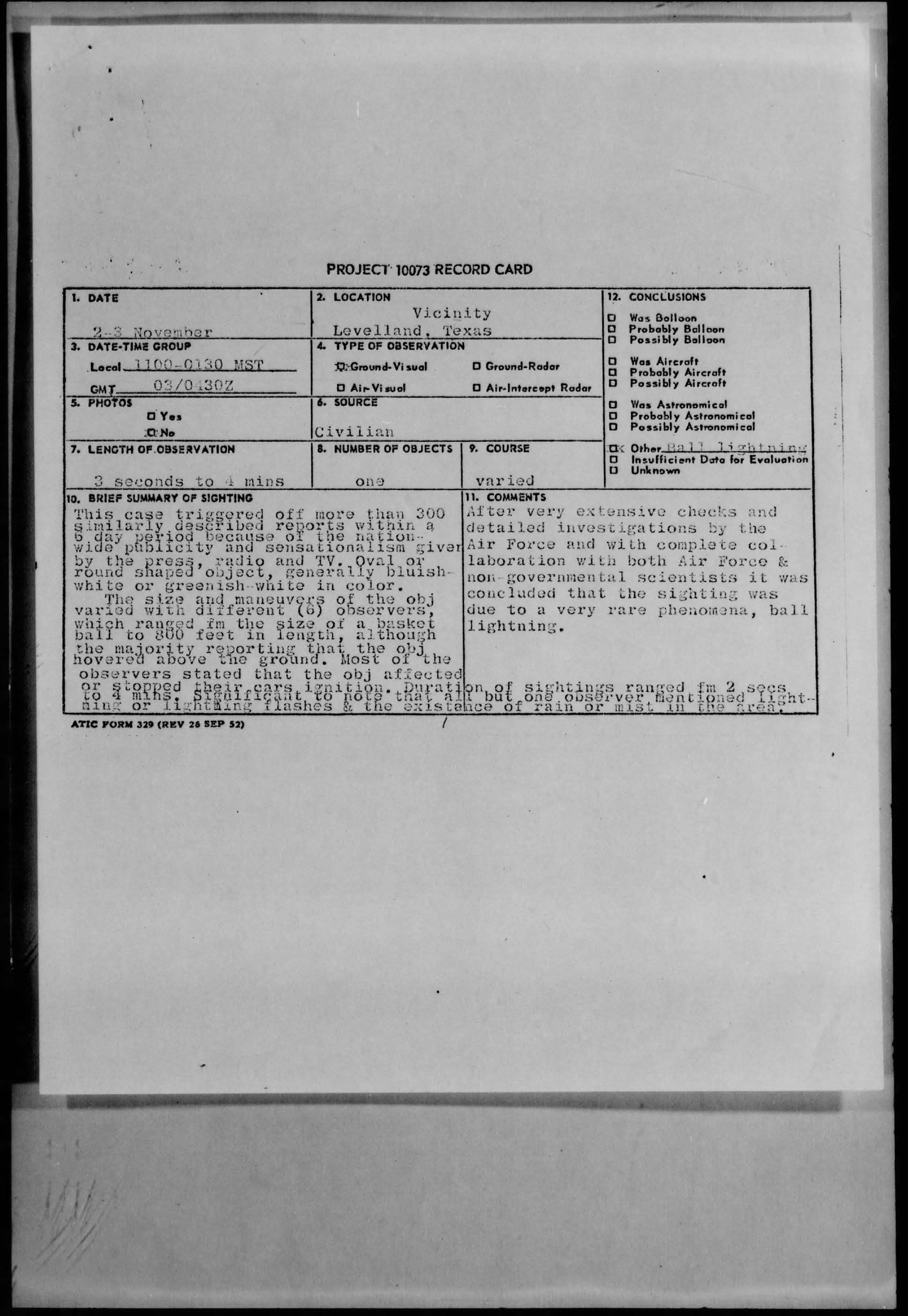
The first call came from Pedro Saucedo, a farmhand and part-time barber, who was driving west of Levelland near the Pettit community late Saturday night with a passenger named Joe Salaz. In the signed account he gave that night, reproduced in the Associated Press wire story, Saucedo said: "We first saw a flash of light. When it got near, the lights of my truck went out and the motor died. I jumped out of the truck and hit the dirt because I was afraid. I called to Joe but Joe didn't get out. The thing passed directly over my truck with a great sound and a rush of wind. It sounded like thunder and my truck rocked from the blast. I felt a lot of heat." He described an object roughly 200 feet long, shaped like an egg, that lit up the road "like it was on fire." When it left, his truck started again.
Patrolman A. J. Fowler, working the desk that night, said Saucedo "and about 14 other" people called in to report the object, and that "everybody that called was very excited." The reports stacked up in a pattern almost too regular to ignore. A married couple, Jim Wheeler, Jose Alvarez, Frank Williams, Ronald Martin, James Long and others all gave versions of the same encounter at different points on the road, at different times, each independently. The object was generally described as oval or egg shaped, glowing bluish-white, greenish-white, or red, somewhere between the size of a baseball at a distance and a 200-foot mass up close. In every close case the car's engine and headlights failed as the object loomed, then recovered once it lifted off and shot away.
Newell Wright, a 19-year-old Texas Tech freshman, was driving about ten miles east of town near midnight when his dashboard ammeter swung to discharge, the engine sputtered as if starved of fuel, and his headlights died. He got out to check under the hood, found nothing wrong, and then saw the object sitting on the highway ahead, a flat-bottomed, oval, bluish-green shape. He said today's cars are well shielded, so it would take a terrific charge to stall them. The object was in view four or five minutes. When it rose and left, his car started normally.
Truck driver Ronald Martin, around 12:45am, reported a glowing object on the road that shifted from orange to bluish-green as it settled; his truck lights and engine stopped, then restarted when it departed. Sheriff Weir Clem himself drove out, and at about 1:30am saw a brilliant red oval light moving in the distance, which he later described as shaped "like a huge football." Levelland fire chief Ray Jones also gave chase and reported his headlights dimming and his engine nearly quitting as a streak of light passed.
By dawn the police had logged roughly 15 separate UFO calls. The striking detail, repeated by stranger after stranger who had no chance to compare notes, was the electrical kill: the object near the car meant a dead engine and dead lights, the object gone meant the car ran again.
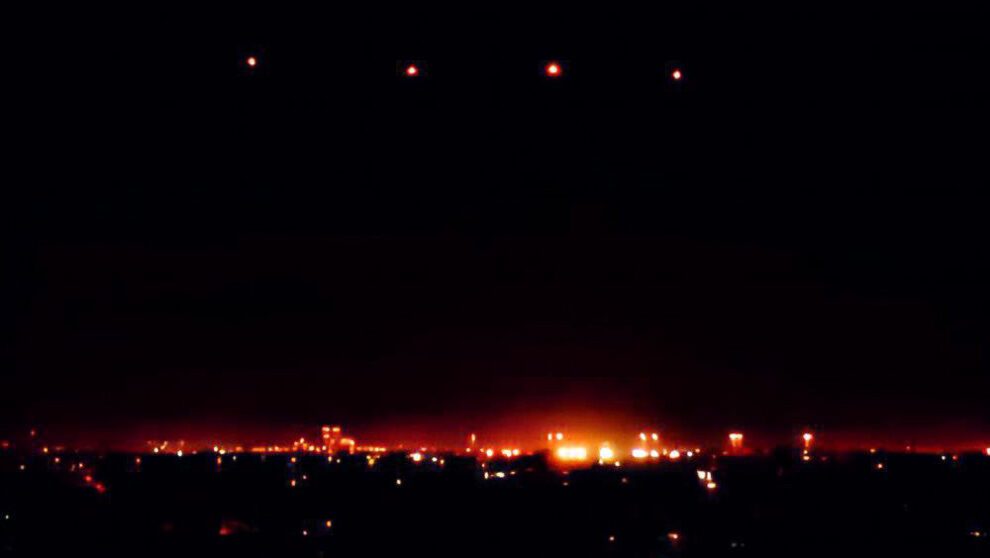
More footage and images of this sighting
What is the official explanation?
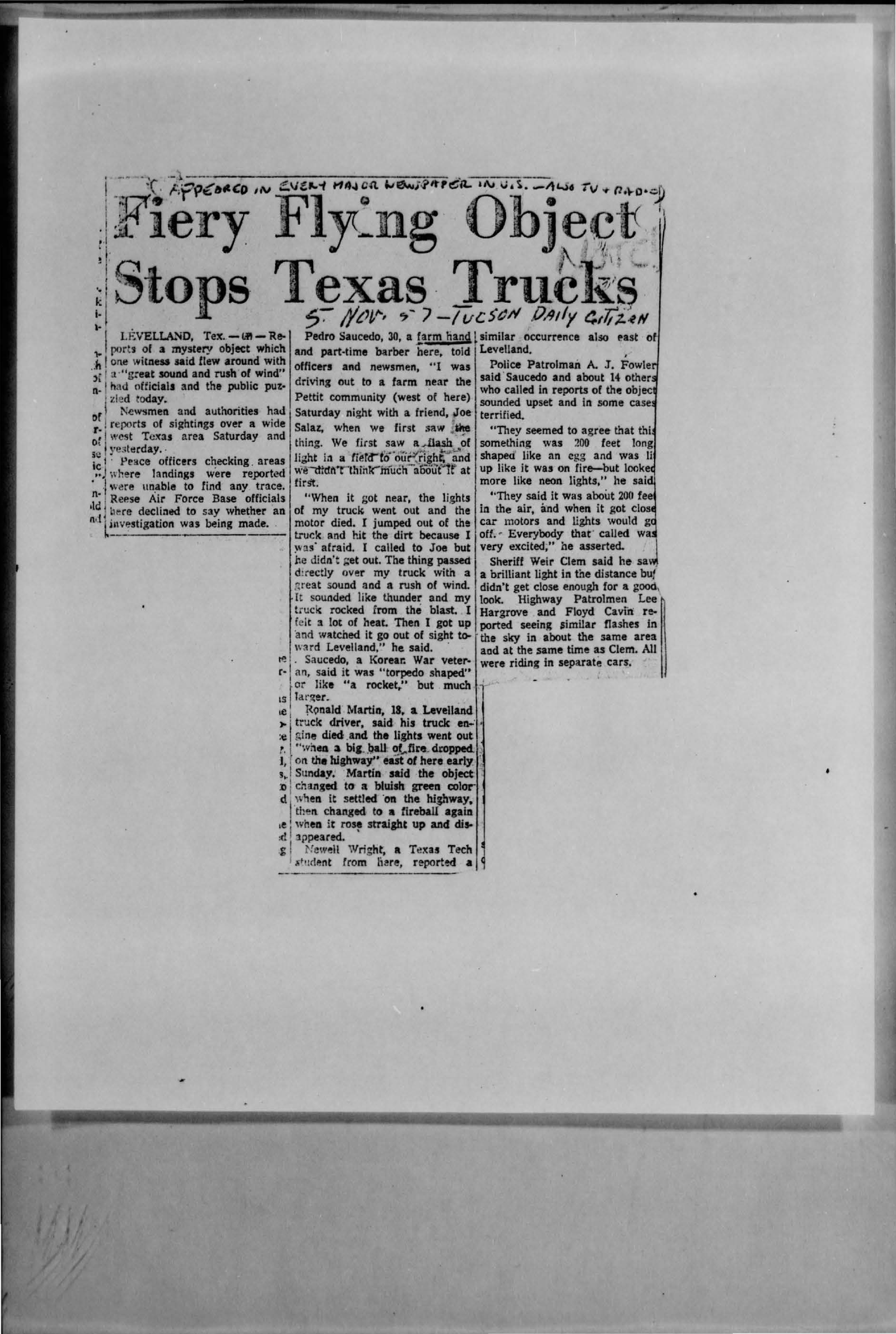
The case was handled by the US Air Force under Project Blue Book. The official Record Card (ATIC Form 329) logs the sighting at "Vicinity Levelland, Texas" on 2 November 1957, checks the conclusion box "Other" rather than Unknown, and summarizes a "round shaped object, generally bluish-white or greenish-white in color" that "varied with different observers" in size "from the size of a basketball to 200 feet in length." The card states the case "triggered off more than 300 similarly described reports" during the period of wide publicity, and concludes that the sighting "was due to a very rare phenomena, ball lightning."
Inside the file, an Air Force investigative report fixes the weather as a "1,000 foot overcast, visibility three miles, light and variable" wind, with "a drizzle or light rain throughout the period," adding that "the area had been subjected to heavy thunderstorms just prior to the sightings." It states: "It is concluded that the cause of the sightings on 2 November 1957 was probably due to a phenomena known as Ball Lightning." On the stalled engines it offers: "The cause for the witnesses cars stopping could be attributed to the sudden disposition of moisture on distributor parts, especially if moisture condensation nuclei were enhanced by increased atmospheric ionization. In one instance a faulty distributor was determined as being the cause for the motor stoppage."
A formal "Analyst's Comments or Conclusions" memo signed by Captain George T. Gregory, the Blue Book project officer, dated 3 January 1958, doubles down: "the phenomenon was undoubtedly related to the meteorological conditions that existed in the area at that time: fog, light rain, mist, very low ceiling (100 feet) and lightning discharges." Gregory leaned on burning oil-field fires nearby as a contributing glow source and cited two named authorities on ball lightning, "Dr. John Trowbridge" and "Prof. T. A. Blair, Univ. of Nebraska." A separate internal request asked the Air Sciences Division to study "missing factors," including what effect nearby lightning has on a vehicle's electrical circuits and whether oil vapor in the air could ignite into a ball of light.
The Air Force position reached the public as an electrical-weather explanation, generally summarized as "ball lightning or St. Elmo's fire." Critics inside the civilian research community immediately noted that the investigator who came to Levelland spent only about seven hours on the ground, and that the Air Force ultimately stressed that only three witnesses had seen the object near the ground, treating the rest as excitement stirred by the press. The card's own line that the case "triggered off more than 300" reports captures how fast the Air Force moved to close a nationally publicized event in the same days Sputnik II went into orbit.
What did the witnesses think it was?
The Levelland witnesses were not a single cohesive group who could coordinate a story. They were strangers scattered along different stretches of road over more than two hours: a farmhand, a college freshman, truck drivers, a married couple, the sheriff, and the fire chief. What ties their accounts together is the one element none of them could easily invent on the spot and have it match: the engine and headlights died as the glowing object closed in, and the car ran again once it left. Saucedo, a Korea combat veteran, was emphatic that the thing physically rocked his truck and threw heat. Newell Wright, a clear-headed young witness with a working knowledge of cars, specifically argued that modern ignition systems are shielded and that it would take "a terrific charge" to stall one the way his stalled. Sheriff Weir Clem, an authority figure with a reputation to protect, did not see the object on the ground but did report a fast-moving brilliant light he could not explain, and he investigated the calls himself.
The most important later witness was atmospheric physicist Dr. James E. McDonald of the University of Arizona, one of the few credentialed scientists to reopen the case. He could not locate the drivers years afterward, but he tracked down Sheriff Weir Clem and a Levelland newspaperman, both of whom had worked the incident that night. They told him the same thing: there had been no rain and no lightning where the encounters happened. McDonald carried that to Congress in 1968. The county sheriff and the local press, the two parties best placed to know the actual conditions on those roads, contradicted the weather story at the center of the official explanation.
Is the Levelland Sightings real? The two-pass assessment
Pass one, the ordinary readings. The Air Force settled on ball lightning, helped by the area's stormy late-October-into-November weather. Astronomer Donald Menzel built this out in his book The World of Flying Saucers, a galley of which sits in the Blue Book file: he argued the month "proved to be the wettest ever recorded in western Texas," that conditions "were ideal for the formation of ball lightning," and that the stalls came from rain seeping under the hood to soak the ignition, a clogged feed line, or oxygen-starved air around the discharge. Menzel also noted that only three witnesses saw the object near the ground and that others may have "unconsciously dramatized" their experiences after hearing Saucedo's story spread. A mundane account therefore exists: a real but rare electrical weather phenomenon plus suggestion plus damp ignitions on 1950s cars. It is a coherent story, and it is the one the Air Force certified.
The trouble is that the mundane story does not survive contact with the primary record. Ball lightning, as the case file's own critics pointed out, is typically a few inches across, lasts seconds, and has never been documented stalling a string of vehicles across miles of road. The Air Force explanation also blurred two different things, "ball lightning or St. Elmo's fire," which are not the same phenomenon, and St. Elmo's fire attaches to solid points rather than floating over a highway. And the weather premise itself is disputed at the source. Dr. James McDonald checked the meteorological data and told the 1968 House Committee on Science and Astronautics: "on checking weather data, I found that there were no thunderstorms anywhere close to Levelland that night, and there was no rain capable of wetting ignitions." He added that Sheriff Clem and a local newspaperman "confirmed the complete absence of rain or lightning activity," and concluded flatly: "The incidents cannot be regarded as explained." J. Allen Hynek, Blue Book's own astronomical consultant, later judged the seven-hour investigation inadequate and the official answer too convenient for the number of independent witnesses.
Pass two, if real, what is it. This is a textbook close-encounter electromagnetic-interference event, and one of the strongest on record precisely because the witnesses were independent and the effect was physical and repeatable: a large luminous object whose proximity killed ignition and lights and whose departure restored them, reported the same way by people who never met. The official apparatus moving fast to close a nationally televised case during the Sputnik II launch, and resting that closure on a weather claim the county sheriff and the local press denied, reads as evidence the event was real enough to need closing, not as a debunk that holds.
Weighing both passes: the documentation is authentic and official, the object remains unexplained, and the leading mundane explanation collapses on its own weather premise under primary-source scrutiny. The counter-explanation is a claim, not a verdict, and it does not close the case. Verified Unexplained.
Sources
- documents2.theblackvault.com/documents/projectbluebook/projectbluebook-levellandufocase-november2-3-1957.pdf
- www.theblackvault.com/casefiles/project-blue-book-levelland-ufo-case-november-2-3-1957/
- ufologie.patrickgross.org/htm/levelland57.htm
- ufologie.patrickgross.org/books/mcdonaldhcsa68hostility.htm
- archive.org/details/nara-pbb
More cases from this region: UFO sightings in United States