The Valensole Lavender-Field Landing
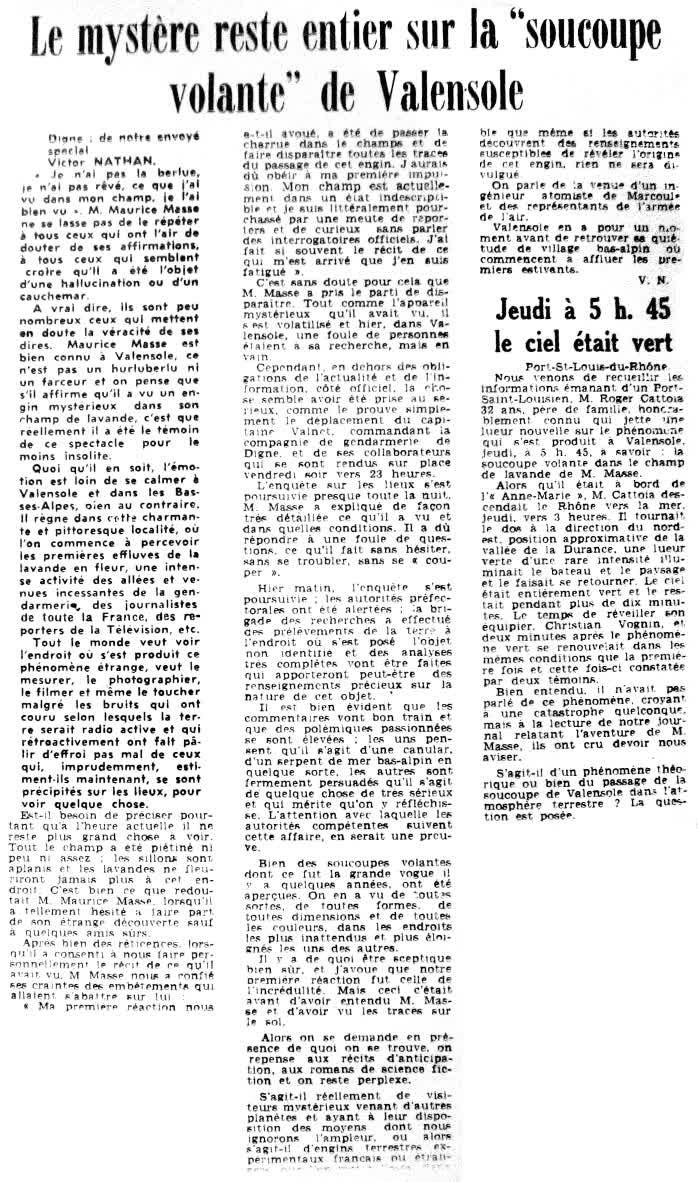
Just after 5 a.m. on 1 July 1965, Maurice Masse, a 41-year-old lavender grower, went out to work his fields on the Valensole plateau in the Basses-Alpes of south-eastern France. This case file covers what witnesses reported, the official narrative, and a two-pass assessment with its evidence tier.
What did witnesses see at Valensole?
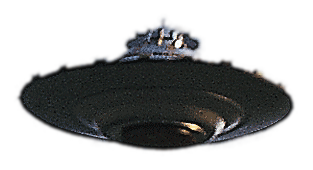
Just after 5 a.m. on 1 July 1965, Maurice Masse, a 41-year-old lavender grower, went out to work his fields on the Valensole plateau in the Basses-Alpes of south-eastern France. At about 5:45 a.m. he had stopped for a cigarette, his tractor parked by a low hillock at the end of a small vineyard along the northern edge of the field. He heard a shrill whistling and, expecting a helicopter, looked round the hillock. Instead he saw a dull, matte-coloured object about the size of a Renault Dauphine car, shaped like a rugby ball with a cupola or transparent dome on top, a sliding door on the side, standing on metal legs around a central pedestal that seemed driven into the ground.
Close to the machine, two small figures were bending over a lavender plant. Masse first took them for boys of about eight, vandals who had been pulling shoots from his plants, and crossed the vineyard to confront them. As he got within about 5 metres (15 feet) he saw they were not boys but dwarf-like beings with large bald heads. One of them turned and pointed a small pencil-like or tube-like instrument at him, and he was stopped where he stood, unable to move a muscle, though he stayed fully conscious, breathing and feeling his own heartbeat throughout.
In his fuller statement of 18 August 1965 he described the beings closely. They were under about 1.2 metres (4 feet) tall, with oversized hairless pumpkin-shaped heads, smooth white skin, wide fleshy cheeks tapering to very pointed chins, and large slanting eyes. The mouths were mere lipless slits or holes. He noted no real nose. They wore close-fitting grey-green coveralls and carried what looked like two small cases or holsters on a belt. They seemed to communicate not through their mouths but with inarticulate, gurgling, grumbling sounds that appeared to come from their mid-bodies. Masse felt mocked, yet their looks were not hostile and he never had the sense of facing monsters. He has never disclosed what passed during the rest of the time he stood immobilised.
After a few minutes the beings returned to the craft, moving in a strange way, rising and falling like bubbles, and re-entered through the sliding door. Masse could see them watching him from inside. There was a thump from the central support as it retracted, the legs began to whirl, and the object lifted off at an angle of about 45 degrees with a shrill whistle, vanishing within roughly 20 metres in the direction of Manosque. The bonds holding him did not relax at once; after about 15 minutes he slowly regained the use of his limbs. He found the soil around the central hole turned to an almost liquid mud, though there had been no rain for weeks, and marks where the legs had pressed. He hurried to the Café des Sports in Valensole and, white as a sheet, told a friend part of what had happened. That evening he took his 18-year-old daughter back to the site, where the four leg marks were now clear and the mud around the central hole had set hard as concrete.
What is the official explanation?
This case carries unusual official weight because the French gendarmerie investigated it within hours and the documents survive. The French state UAP body GEIPAN (the CNES unit, successor to GEPAN founded in 1977) published the three gendarmerie procès-verbaux in 2015 and classifies the case "D", meaning unidentified, stating in its own cover note of 26 June 2015: "Vue son étrangeté, ce cas est classé « D » par défaut" (Given its strangeness, this case is classified D by default). GEIPAN names Pierre Guérin and Jacques Vallée among the serious investigators of the affair.
The gendarmerie learned of the event by public rumour around 7:30 p.m. on 2 July. The witness was first heard at 8 p.m. on 2 July 1965 by the local brigade (PV 445), taken to the site about 10 p.m., and heard again from 11:15 to 11:30 p.m. A second brigade documented the ground on 3 July with measurements and photographs (PV 105). Masse returned on 18 August 1965 with a far more detailed account (PV 145), explaining he had held things back at first because, in his words, it was so extraordinary he feared they would think him mad and lock him up.
The gendarmerie summary recorded that at a place 2 km north-west of Valensole, Monsieur Maurice Masse, 41, farmer, declared he had seen a "flying saucer" type craft the size of a Dauphine with two passengers, one about a metre tall and stocky, in coveralls and bare-headed, that descended briefly before the craft vanished in a flash. The on-site brigade logged an unusual trace: a cylindrical hole 18 centimetres in diameter and 40 centimetres deep at the centre of four shallow furrows forming a sort of cross, in soil that was abnormally compacted while the surrounding field was loose. The contemporary Le Provençal of 4 July 1965 confirmed that the matter was taken seriously officially, noting the arrival on Friday night of Captain Valnet, commander of the gendarmerie company of Digne, and his men, who worked at the site almost all night, and that the research brigade took soil samples for thorough analysis.
Later technical findings entered the record. On the alleged departure track the lavender degenerated over about a hundred metres, and at the landing spot the lavender did not grow back until 1975. No radioactivity was found. The calcium content of the soil, negligible nearby, measured 18.3 percent in earth taken from the landing spot. The French defence-linked COMETA study of 1999, working from the gendarmerie file, concluded that despite some contradictory elements in Masse's account, the material gathered by the two brigades confirmed the plausibility of the facts, in particular the effects on the vegetation and on the witness, who for several months slept twelve to fifteen hours a day after the paralysis, and found no element pointing to mythomania or hoax. The gendarmes themselves reached no firm verdict; one summary of their report notes they allowed the possibility of hallucination or optical illusion while acknowledging they could not conclude.
What did the witnesses think it was?
Maurice Masse never wavered and never sought the spotlight. To the regional reporters in the first days he insisted, as Le Provençal printed on 4 July 1965: "Je n'ai pas la berlue, je n'ai pas rêvé, ce que j'ai vu dans mon champ, je l'ai bien vu" (I am not seeing things, I did not dream, what I saw in my field I really saw). He was a respected local man, and the gendarmes described him as a sober, level-headed person unlikely to deceive himself or others. The publicity overwhelmed him. Crowds trampled the site and reporters besieged him, and on 4 July he collapsed, seized by an irresistible need to sleep. Aimé Michel reported that Masse would have slept around the clock had his wife not woken him to eat. He worried about his own health and about possible harm to others, keeping his daughter back from the central hole for fear of an effect on her, and eventually filling in the funnel-shaped hole himself.
The investigator Aimé Michel interviewed Masse twice at Valensole in 1965 and found him anxious and distressed. It was Michel who suggested the word "immobilised" rather than "paralysed", proposing some form of hypnotic suggestion. During the second visit Michel showed Masse a photograph of a model based on the description Lonnie Zamora had given of the craft he saw at Socorro, New Mexico, on 24 April 1964. Masse was stunned that someone could have photographed his machine, but when told it had been seen in the United States by a policeman, he relaxed and said, as widely reported, "You see then that I wasn't dreaming, and that I'm not mad." Aimé Michel's own contemporary assessment was that if Masse invented the thing, the invention conformed perfectly to what was already known, especially the Socorro observation of 24 April 1964, where a craft of the same type was seen.
There were no second witnesses to the landing itself. The gendarmerie noted that no other testimony and no other clue was found around the site. A loosely connected report did surface in the same Le Provençal: Roger Cattoia, 32, of Port-Saint-Louis, said that on the morning of 1 July, descending the Rhône aboard the Anne-Marie around 3 a.m., the whole sky toward the Durance valley glowed an intense green for nearly ten minutes, twice, the second time also seen by his crewmate Christian Vognin. The strongest corroboration remained physical and physiological: the compacted soil, the cross of furrows, the long failure of the lavender, the elevated calcium and the witness's months of abnormal sleep, all of which several investigators and the COMETA panel treated as consistent with a real and unexplained event.
The dispute
The leading counter-explanation comes from French analyst Dominique Caudron, who proposed that what Maurice Masse encountered on July 1, 1965 was not a craft but a "tonne a engrais," a wheeled tank of limed liquid fertiliser parked at the spot. Caudron's reasoning is built on the ground traces: he argued that the central cylindrical hole ringed by shallow grooves in chemically altered, hardened soil, together with the high calcium reading and the lavender die-off, would follow naturally from fertiliser having been applied and a tank having stood there, rather than from a landed object. This is the one named civilian theory on the table, and it tries to absorb the strongest physical evidence in the case (the 18.3 percent calcium at the landing spot, the compacted soil, the dead lavender that did not regrow until 1975) into a mundane agricultural cause.
The problem, by this archive's standard, is that the theory was never demonstrated. No one has produced the specific tank, no one has matched a fertiliser tank's footprint to the actual four-furrow cross pattern and the 18 cm by 40 cm central hole, and the explanation says nothing about the parts of the report that are not soil chemistry: the two small beings in grey-green coveralls, the tube-like instrument pointed at Masse, the roughly fifteen minutes of paralysis, and the months afterward in which he reportedly slept twelve to fifteen hours a day. A counter-explanation that accounts for the dirt but not the witness's central experience does not close the case; it relocates one piece of evidence and leaves the rest standing.
The only other skeptical thread on the page is not an independent debunk at all but the gendarmes' own hedge. The investigating gendarmerie, while documenting the scene within hours across three procon-verbaux, allowed for "the possibility of hallucination or optical illusion," the framing of a lone man seeing a strange shape in low dawn light. The page treats this as cautious official wording rather than a developed argument, and it is undercut by the official record itself: GEIPAN, the French state UAP body, classified the case "D" for unidentified, noting "given its strangeness, this case is classified D by default." That is an apparatus declining to resolve the case, not an apparatus solving it, and under this method an official body's inability to conclude is not a verdict against the witness.
Taken together, the dispute consists of one unproven civilian hypothesis that explains only the soil and one official concession that never rises above "maybe he was mistaken." Neither shows a method that reproduces the full event, so the case largely stands as reported.
Is the Valensole Lavender-Field Landing real? The two-pass assessment
Pass one, the entirely ordinary readings. The gendarmes themselves left room for hallucination or optical illusion at dawn, a lone man, a strange shape in low light, and a story that grew between the first statement of 2 July and the detailed one of 18 August. That growth is real and worth naming, because in the first procès-verbal Masse described the occupants as ordinary "men" of European complexion and only weeks later described them as non-human, with the pumpkin heads, slit mouths and the immobilising rod. A sceptic can read that as a memory reshaped by the press storm and by his exposure to other saucer reports. The most concrete civilian counter-explanation comes from the French analyst Dominique Caudron, who argued that the ground traces, a central cylindrical hole ringed by shallow grooves in chemically altered, hardened soil, match a tonne à engrais, a wheeled tank of limed liquid fertiliser, that could have been parked on the spot, the high calcium and the lavender die-off following from the fertiliser rather than from any craft. The gendarmes' own measured hole, 18 cm across and 40 cm deep with four furrows, is also markedly tamer than the witness's recollection of a deep hole and six whirling legs, exactly the divergence you expect when a frightened man's memory outruns the physical evidence.
Pass two, if it was real. The astronomer and ufologist Pierre Guérin, who studied the soil data, rejected the fertiliser idea and held that the calcium level together with the post-landing infertility was produced by eddy currents induced by an electromagnetic radiation from the craft, not by any fertiliser the farmer spread. The fertiliser-tank hypothesis explains a hole and some dead lavender, but it does not explain the two small beings, the rod, the fifteen-minute conscious paralysis, the craft seen lifting on a central pivot toward Manosque, or the months of hypersomnia that followed and that Masse had never suffered before. Jacques Vallée, who examined the file and met Masse, ranked it among the best-authenticated close encounters on the continent precisely because it pairs a credible, uninterested witness with hard physical traces, botanical effects and a medical aftermath. And the case's internal consistency is striking: independently of the American press, Masse described a craft and occupants that lined up with Socorro fourteen months earlier, and his relief on learning of Zamora reads as the reaction of a man who thought he was alone with the impossible.
Two things keep this out of the Verified Unexplained tier and out of any discredited tier alike. There is a named, method-suggested civilian counter-explanation, the fertiliser tank, which means a real dispute exists. But that counter-explanation has never been demonstrated; no one has shown the specific tank, matched it to the cross-shaped furrow pattern, or accounted for the beings, the paralysis and the medical effects, so it does not close the case. The official French position is that the case remains unidentified, classified D by GEIPAN, and the physical traces have never been explained away. A counter-explanation exists and does not close the case. That is the definition of Disputed, and that is where Valensole sits.
Sources
- www.cnes-geipan.fr/fr/cas/1965-07-00050
- www.cnes-geipan.fr/sites/default/files/Synthese.pdf
- ufologie.patrickgross.org/press/leprovencal4jul1965.htm
- ufologie.patrickgross.org/press/dauphinelibere4jul1965b.htm
- ufologie.patrickgross.org/press/washingtonpost5jul1965.htm
- sunrisepage.com/free/et/pdf/TheUFOCasebook_MauriceMasse.pdf
- www.sentinel-news.fr/p/valensole-quand-la-gendarmerie-enquete
- verdonxp.com/en/verdon-and-extraterrestrials-the-valensole-meeting/
More cases from this region: UFO sightings in France