The Incident at Exeter
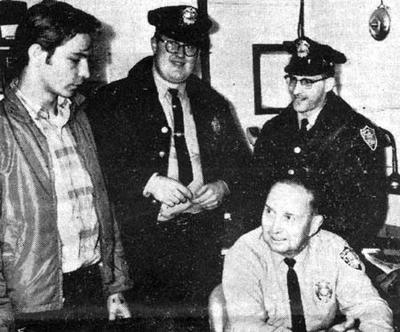
In the early hours of 3 September 1965 near Exeter, New Hampshire, teenager Norman Muscarello and two police officers separately watched a barn-sized object with five red lights pulsing in sequence hover silently a hundred feet over a field. Project Blue Book first blamed stars and a temperature inversion, then a SAC training flight called Big Blast, then admitted in writing it was "unable to identify the object" and logged the case Unidentified. A 2011 skeptical analysis argues it was a KC-97 refueling tanker, a method-shown explanation that still cannot account for the silence, the low altitude, or the fact that one officer had four years of tanker refueling experience and rejected it.
What did witnesses see at Kensington and Exeter?
In the early hours of 3 September 1965, eighteen-year-old Norman Muscarello was hitchhiking south along Route 150 toward his home in Exeter, New Hampshire, in the farm country between Kensington and Exeter. At about 2 in the morning a group of five bright red lights rose into view over a house and field roughly one hundred feet from where he stood. In his signed statement, given to police that same night, Muscarello described it plainly: "A group of five bright lights appeared over a house about a hundred feet from where I was standing. The lights were in a line at about a sixty-degree angle. They were so bright, they lighted up the area. The lights then moved out over a large field and acted at times like a floating leaf. They would go down behind the trees, behind a house and then reappear."
He then described the detail that would dominate every later analysis: "[The lights] always moved in the same sixty-degree angle. Only one light would be on at a time. They were pulsating: one, two, three, four, five, four, three, two, one. They were so bright I could not distinguish a form to the object. I watched these lights for about fifteen minutes and they finally disappeared behind some trees and seemed to go into a field. At one time while I was watching them, they seemed to come so close I jumped into a ditch to keep from being hit."
Frightened, Muscarello flagged down a passing car and got a ride to the Exeter police station, where he reported the sighting to desk officer Reginald "Scratch" Toland at 2:24 in the morning, arriving, in the station's own description, white and shaking. Toland radioed Patrolman Eugene Bertrand Jr., who was already primed: about an hour and a half earlier, while cruising Route 101, Bertrand had found a woman parked at the roadside who told him a flying object with red flashing lights had chased her car for several miles. He had watched a distant light with her, seen nothing alarming, and driven on.
Bertrand drove Muscarello back to the field off Route 150, near the Carl Dining farm, arriving just before 3 in the morning. The two walked out into the field. Bertrand then saw the lights himself. In his signed statement he wrote: "At one time they came so close I fell to the ground and started to draw my gun." He described "five bright red lights" that were "extremely bright and flashed on one at a time," adding, "The lights were so bright, I was unable to make out any form." The two men ran back to the cruiser. Bertrand radioed for backup, and Patrolman David Hunt arrived within minutes and also watched the lights before they drifted off, eastward toward the ocean, and were lost behind the trees. A central detail in every officer's account was the silence: a barn-sized array of pulsing lights moving at low altitude over open farmland, with no engine noise, no rotor wash, no rush of air. The only sound reported was the reaction of nearby farm animals, with dogs and horses agitated and noisy while the object was present. The whole encounter for the officers lasted only a few minutes, though Muscarello had watched his portion for roughly fifteen.
What is the official explanation?
The case became an Air Force matter within hours. Investigators from nearby Pease Air Force Base interviewed the three witnesses, and the sighting entered the file of Project Blue Book, the Air Force's UFO evaluation operation. The investigating officer, Major David Griffin, filed a report dated mid-September 1965 that did not close the case. Griffin wrote that "at this time I have been unable to arrive at a probably cause of this sighting," noting that "the three observers seem to be stable, reliable persons." He recorded that five B-47 aircraft from Pease had been flying in the area during the period but stated he did not believe they were connected to the sighting.
The Pentagon's first public posture was dismissive. Press statements attributed the lights to ordinary astronomy distorted by weather, the idea that the witnesses had seen stars and planets twinkling through a temperature inversion, a layer of warm air trapped above cold night air capable of producing visual shimmer. The Blue Book folder itself recorded that the office considered and then rejected an "astro / stars-planets" cause. As the file moved up the chain, the explanation shifted. In a letter dated November 1965, the chief of Project Blue Book, Major Hector Quintanilla Jr., wrote to officers Bertrand and Hunt: "Our investigations and evaluation of the sighting indicates a possible association with the Air Force operation 'Big Blast.' In addition to aircraft from this operation, there were five (5) B-47 aircraft flying in the area during this period." Operation Big Blast was a joint Strategic Air Command and NORAD training exercise flown on 2 and 3 September 1965. Blue Book noted that "the town of Exeter is within the traffic pattern utilized by Air Traffic Control in the recovery of these aircraft at Pease AFB."
There was a hard problem with the timing, and it appears in Blue Book's own paperwork. By the office's account the Big Blast exercise was active only between roughly midnight and 2 in the morning. Bertrand and Muscarello had their close encounter in the field nearly an hour after 2 a.m., which placed it after the exercise had reportedly ended. The officers said so directly. In a reply dated 2 December 1965 they told Quintanilla that the Big Blast explanation was impossible on timing alone, and that Bertrand's own background ruled out a military aircraft: "Since one of us (Patrolman Bertrand) was in the Air Force for four years, engaged in refueling operations, it was impossible to mistake what we saw for any kind of military operation." In a second letter dated 29 December 1965 they pressed the point that matters most against any aircraft explanation: "It is important to remember that this craft that we saw was not more than one hundred feet in the air and it was absolutely silent with no rush of air from jets or chopper blades whatever."
The official narrative then collapsed into an admission. In a letter dated January 1966, Lieutenant Colonel John P. Spaulding of the Office of the Secretary of the Air Force wrote to the officers: "Based on additional information submitted to our UFO Investigation Officer, Wright-Patterson AFB, Ohio, we have been unable to identify the object that you observed on September 3, 1965." Project Blue Book's final disposition logged the Exeter case as Unidentified. That classification is preserved in Don Berliner's compilation of the Blue Book "unknowns," drawn from the original case files at the U.S. Air Force Archives at Maxwell AFB before the witness names were censored from the public microfilm. The official summary in that record reads: "One large, dark, elliptical object with a row of red lights around it, moved slowly and erratically around houses and trees, while lights blinked in sequence. Farm animals were very noisy. Sighting lasted about 1 hour." The named witnesses are Patrolmen Eugene Bertrand Jr. and David Hunt and Norman Muscarello.
The case was tested on the ground as well. The astronomer J. Allen Hynek, Blue Book's longtime scientific consultant, treated Exeter as a textbook Close Encounter of the First Kind and called the astronomical evaluation "completely untenable." An Air Force officer had suggested the lights were the glare of landing lights at Pease, so investigators turned the runway marker lights and approach strobes off and on across a fifteen-minute window while observers watched from the Exeter site; they saw no effect. NICAP's New England investigator, Raymond Fowler, reached the same conclusion independently and pushed Pease to demonstrate that its airfield lighting could be mistaken for the object, which it could not.
What did the witnesses think it was?
The three principal witnesses never moved off their accounts, and they did so under conditions that gave them every reason to stay quiet. Bertrand and Hunt were serving police officers in a small New Hampshire town, and they put their names to signed statements describing a barn-sized object hovering silently a hundred feet over a field. As they told Quintanilla, in the face of the ridicule that follows any UFO report they would not have come forward at all unless they strongly believed that what they had seen was not a conventional aircraft and not a temperature inversion. Bertrand's position carried particular weight because he was not a naive observer: he had served four years in the Air Force during the Korean War era working air-to-air refueling on tanker aircraft, exactly the category of plane later proposed as the explanation. He flatly rejected that the object was any aircraft he knew.
Muscarello, an eighteen-year-old about to enter the Navy, gave his signed statement the same night while still visibly shaken, and the consistency between his independent account and what the two officers saw separately, at a different time, is part of what made the case durable. The woman on Route 101 earlier that night, who told Bertrand a red-lighted object had chased her car for miles, is a fourth witness whose report bracketed the officers' sighting and matched its character, even though her name does not survive prominently in the file.
John G. Fuller, the journalist who investigated Exeter for the Saturday Review and then for Look magazine and the 1966 book Incident at Exeter, interviewed the witnesses at length and found their accounts steady and mutually reinforcing. Fuller noted that the officers had seen a B-47 jet pass over at about the time the object departed, and that Hunt, comparing the two, said there was simply no comparison between the conventional jet and the silent lighted object. Over the weeks that followed, the Exeter area produced roughly sixty further UFO reports, a flap that the principals regarded as corroboration of an ongoing phenomenon and that skeptics later set aside as beyond the scope of their own narrower analyses. What none of the witnesses ever accepted was that they had been fooled by stars, by airfield glare, or by their own training mission.
The dispute
The dispute over Exeter runs along two tracks, an official one and a civilian one, and the page documents that neither closes the case. The official track is a sequence of U.S. Air Force claims. The Pentagon first promoted stars and planets twinkling through a temperature inversion, an explanation Project Blue Book itself rejected. Blue Book chief Major Hector Quintanilla Jr. then wrote in November 1965 that the sighting indicated a "possible association" with Operation Big Blast, a Strategic Air Command/NORAD training exercise. By the archive's method these are apparatus assertions, not demonstrated debunks, and they collapse on their own record: the inversion claim was disowned internally, and the Big Blast claim is contradicted by Blue Book's own timeline, since the exercise reportedly ended about an hour before patrolman Bertrand's encounter. The Air Force's final position was not an identification at all but an admission that it was "unable to identify the object," and the case was logged Unidentified. Pease Air Force Base, best placed to recognize its own refueling aircraft, likewise never claimed one.
The only counter-explanation the page treats as independent, civilian, and method-shown is the KC-97 Stratotanker hypothesis offered in 2011 by retired USAF Major James McGaha and skeptical investigator Joe Nickell in the Skeptical Inquirer. They pointed to specific, checkable features: a row of five red sequencing "receiver" lights that flash in a one-two-three-four-five-four-three-two-one pattern, and a refueling boom that, when lowered, hangs at sixty-four degrees by the flight manual, matching witness Norman Muscarello's reported sixty-degree angle. This is a named, concrete, falsifiable claim rather than a hand-wave, which is why it carries more weight than the official assertions.
The page documents four reasons the tanker hypothesis still does not close the case. First, silence: the officers described the object as absolutely silent with no rush of air, whereas a four-engine KC-97 at that low altitude and short range would have been deafening. Second, witness expertise: patrolman Eugene Bertrand Jr. had worked air-to-air refueling on tankers for four years and flatly rejected any aircraft or military-operation explanation, saying it was impossible to mistake what they saw. Third, timing: McGaha and Nickell themselves concede Big Blast had reportedly ended roughly an hour before the sighting, so their account requires a tanker to have remained aloft against Blue Book's own timeline. Fourth, official non-identification: the Air Force and Pease never confirmed any tanker involvement and recorded the object as unidentified. So while a plausible, method-shown counter-explanation exists, the primary record does not let the archive accept it, and the case stands as Disputed rather than resolved.
Is the Incident at Exeter real? The two-pass assessment
Pass one, the ordinary readings. Every conventional candidate was floated and most were tested. Stars and planets twinkling through a temperature inversion was the Pentagon's first line; Blue Book itself rejected the astronomical cause, and Hynek called it untenable, because point-like astronomical sources do not descend over a named field at a hundred feet, pulse in a fixed sequence, and drive farm animals into a frenzy. The glare of Pease landing lights was tested directly by cycling the runway and approach lights while observers watched from the Exeter site, with no effect. An advertising plane was ruled out because the Sky-Lite agency's ad plane was grounded between 21 August and 10 September 1965 and carried white flashing lights on a rectangular sign, not five red ones. Philip Klass floated power-line corona plasma and later backed away from it. The strongest ordinary explanation is the one offered in 2011 by retired USAF Major James McGaha and skeptical investigator Joe Nickell in the Skeptical Inquirer: a KC-97 Stratotanker conducting in-flight refueling as part of, or in the wake of, the Big Blast exercise. Their method is specific and is the reason this case is filed as Disputed rather than Unknown. They point to the KC-97's underbelly, which carries a row of five red sequencing "receiver" lights that flash in the exact one-two-three-four-five-four-three-two-one pattern the witnesses described, and to the refueling boom, which when lowered hangs at sixty-four degrees by the flight manual, matching Muscarello's "sixty-degree angle," bears small control wings that would "flutter in the air currents" like his "floating leaf," and would catch and reflect the sequencing lights. They argue the extreme brightness, which blotted out any form, made a high object look low and close, and that the slow tanker on a long refueling circuit could have seemed to chase the woman on Route 101.
Pass two, if the witnesses were right. The McGaha and Nickell reconstruction is genuinely the best skeptical work on Exeter, but it leaves the load-bearing facts unaddressed, and those facts come from the witnesses' own signed statements and the Air Force's own file. The first is silence. The officers were adamant in writing that the object was "not more than one hundred feet in the air and it was absolutely silent with no rush of air from jets or chopper blades whatever." A KC-97 is a four-engine piston-and-jet tanker; at the low altitude and short range the witnesses described it would have been deafening, not silent. The skeptical paper does not resolve this; it relocates the object to high altitude to keep it quiet, which then contradicts the witnesses' insistence on proximity, the ditch Muscarello jumped into, and the gun Bertrand started to draw. The second is Bertrand himself, a man who had worked air-to-air refueling on tankers for four years and who said it was impossible to mistake what he saw for any military operation; the proposed solution asks us to believe a tanker crewman failed to recognize a tanker doing the one job he had been trained for. The third is the timing, which McGaha and Nickell concede in a footnote: Big Blast had, by Blue Book's own account, reportedly ended about an hour before Bertrand's sighting, so the explanation rests on the assumption that some tanker happened to still be aloft and refueling after the exercise closed. The fourth is the strongest official fact in the file: the Air Force, with Blue Book, Wright-Patterson, and Pease all engaged, the very base that would have flown any such tanker, was "unable to identify the object" and logged the case Unidentified. If their own refueling aircraft were the answer, the apparatus that owned the aircraft was best placed to say so and did not.
By the project's standard an official-apparatus debunk, the inversion claim and the Big Blast claim, counts as evidence the case was real enough to need closing, not as a mark against it, and the apparatus ultimately closed it as unexplained. The KC-97 hypothesis is the only counter-explanation that is independent, civilian, and method-shown, and it is serious enough that the case cannot be called wholly without a candidate solution. But it does not close the case: it cannot account for the silence at low altitude, it is contradicted by the most qualified witness's own experience with the exact aircraft, and it conflicts with the timing in its own footnote and with the Air Force's own admission. A counter-explanation that exists but does not close is the definition of the Disputed tier. Tier: Disputed, tierClass contested. The Incident at Exeter remains, fifty years on, an officially Unidentified close encounter with three named witnesses and a plausible but unproven mundane explanation that the primary record does not let us accept.
Sources
- skepticalinquirer.org/2011/11/exeter-incident-solved-a-classic-ufo-case-forty-five-years-cold/
- centerforinquiry.s3.amazonaws.com/wp-content/uploads/sites/29/2011/11/22164321/p16.pdf
- www.thinkaboutitdocs.com/the-incident-at-exeter/
- ufologie.patrickgross.org/htm/bluebooku65.htm
- www.loc.gov/pictures/item/2016717614/
- openminds.tv/the-exeter-new-hampshire-ufo-incident-50-years-later/
- archive.org/details/incidentatexeter0000john
- www.theufochronicles.com/2005/09/ufo-incident-at-exeter-40-year.html
- jimharold.com/the-exeter-ufo-incident-is-this-cold-case-closed-worthy-of-being-reopened-micah-hanks-writes/
More cases from this region: UFO sightings in United States