The Falcon Lake Incident
On the morning of Saturday 20 May 1967, Stephen Michalak, a 51-year-old industrial mechanic from Winnipeg with a sideline in amateur geology, drove east to the Whiteshell Provincial Park to prospect for quartz and silver near Falcon Lake. This case file covers what witnesses reported, the official narrative, and a two-pass assessment with its evidence tier.
What did witnesses see at Falcon Lake?
On the morning of Saturday 20 May 1967, Stephen Michalak, a 51-year-old industrial mechanic from Winnipeg with a sideline in amateur geology, drove east to the Whiteshell Provincial Park to prospect for quartz and silver near Falcon Lake. By his account he had been chipping at a quartz vein since mid-morning when, at about 12:15 p.m., a cackle of startled geese made him look up. Two glowing, cigar-shaped objects with humps on top were descending out of the southwest, both lit a brilliant red. One stayed aloft, hovered for a few minutes, then climbed away to the southwest and was gone. The other came down and settled on a flat rock shelf he estimated at about 160 feet from where he crouched.
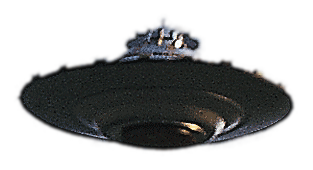
He watched it for a long stretch, by his telling close to half an hour, sketching it in a notebook as it sat. The color shifted as it cooled from glowing red to grey to the sheen of hot stainless steel, ringed by a golden glow. He put its size at roughly 35 to 40 feet across and about 12 feet high, topped by a raised cupola around 3 feet tall. The skin looked seamless, "like highly polished colored glass," with no rivets and no welds. He felt waves of warm air coming off it, caught a sharp smell he likened to sulphur or burning electrical insulation, and heard a whirring like a fast electric motor along with a hiss. A panel or door, roughly 2 feet by 3 feet, slid open on the side, and through it he saw a brilliant light and what he took to be a bank of colored lights inside.
Thinking it might be an experimental American craft in trouble, Michalak walked up to it. He called out, first in English, then in Russian, German, Italian, French and Ukrainian, offering help. No answer. He put his head near the opening and saw a maze of lights but no occupants. Reaching out, he touched the hull with his gloved hand, and the fingertips of the glove melted or scorched. Then the door slid shut, the craft rotated, and a panel he described as a grid of small round holes swung into line with him. A blast of hot gas shot out of that vent and struck him full in the chest. His shirt and undershirt burst into flame. He tore the burning clothes off, and the craft lifted, gave off a rush of air and a smell of sulphur, and shot upward and away. The whole encounter, from first sighting to departure, had run somewhere near 45 minutes.
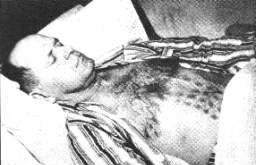
Michalak was left dazed and sick on the rock. He vomited, broke into a cold sweat, and developed a violent headache. On his bare chest was a pattern of marks where the gas had hit him, a roughly horizontal arrangement of welts that matched, in his description, the grid of holes on the exhaust panel. He staggered the mile or so back toward the highway, was disoriented and nauseous the whole way, and eventually got a lift and made his way back to Winnipeg, reaching hospital late that night.
What is the official explanation?
This is one of the most heavily documented UFO cases on record precisely because so many official bodies opened files on it. The Royal Canadian Mounted Police, the Royal Canadian Air Force, the federal and Manitoba Departments of Health and Welfare, the Whiteshell Nuclear Research Establishment of Atomic Energy of Canada, and the United States Air Force-funded Condon Committee at the University of Colorado all became involved. Library and Archives Canada holds the resulting federal case material, and the University of Manitoba Archives holds Michalak's own sketch of the object.
The medical record is the spine of the case. Michalak first presented at the Misericordia Hospital in Winnipeg late on 20 May. His attending physician, Dr. R. D. Oatway, described the chest injuries as "numerous reddish, slightly irregular, oval-shaped, slightly raised lesions" across the upper abdomen, lying mostly with their long axes running across the body, and classed them as first-degree burns. Over the following days Michalak reported vomiting, headaches, a drop in weight from about 180 to 158 pounds inside a week, fainting spells he said he had never had before, and recurring skin eruptions that came and went for months. He was later examined at the Mayo Clinic. The Mayo psychiatric assessment found "no evidence of dreams (or) hallucinations" and "no overt evidence of significant mental or emotional illness," and the medical workup recorded neurodermatitis and simple syncope rather than any radiation syndrome.
The Condon Committee assigned physicist Roy Craig to the case, and his report appears as Case 22 in the 1968 "Scientific Study of Unidentified Flying Objects." Craig's findings cut hard against the radiation story that had grown around the incident. A radiation pathologist "found no evidence of the effects of radiation on the burned area, in his blood, or on Mr. A's clothing," and the burn was assessed as an ordinary thermal burn. A whole-body radiation count run on Michalak at an atomic installation showed "no count above normal background." The rash that appeared roughly eleven days later was attributed to insect bites. Early RCMP-era soil testing had reported a small radioactive reading, on the order of 0.3 microcuries of a radium source in one sample, but the official survey found the perimeter of the scorched circle and the ground beyond it free of contamination, with activity confined to one small patch of roughly 100 square inches.
The strangest official thread is the silver. About a year after the event, in May 1968, Michalak returned to the site and produced two W-shaped bars of metal from a rock fissure. Geological Survey of Canada metallurgist R. J. Traill analyzed them. They were "pieces of thin sheet silver that have been twisted, crumpled, partly melted," running 93 to 96 percent silver with copper and cadmium in proportions matching ordinary commercial sterling silver, and coated with a layer of quartz sand and crushed pitchblende ore. Craig noted bluntly that, given how thoroughly the site had already been searched for radioactive material, it was "improbable that the particles discovered a year later would have been missed had they been present when the earlier searches were made." He concluded that the case held "many inconsistencies and incongruities" and did not offer probative information regarding an unconventional craft. No Canadian agency, by contrast, ever produced a positive conventional identification of what Michalak met. The burns and his illness were documented and went officially unexplained.
What did the witnesses think it was?
Michalak never wavered. He paid his own medical bills, refused to profit, and in 1967 self-published a short booklet, "My Encounter With The UFO," to set down his version before the story got away from him. He always insisted he had seen and touched a real, physical, manufactured machine, and he described it in the flat, specific language of a tradesman: the exhaust vent he said burned him was a grid of round holes, each about a sixteenth of an inch across, set in a panel roughly nine inches high by six inches wide, and the welts on his chest lined up with that pattern. He maintained the account through years of ill health and through repeated, skeptical official examination, and he went to his grave in 1999 telling the same story.
His credibility was tested harder than most witnesses ever are. He was examined by more than a dozen doctors in Canada and the United States, including the Mayo Clinic, and assessed psychiatrically. The Mayo finding of no hallucination, no mental illness, and no sign of fabrication mattered, because the obvious skeptical move, that a disturbed or attention-seeking man had invented or self-inflicted the whole thing, was the first thing the investigators looked for and did not find. The lead civilian investigator over the long run was Winnipeg science writer Chris Rutkowski, who worked the case for decades, interviewed Michalak, dug through the government files, and later co-wrote the definitive book "When They Appeared" (2018) with Michalak's son, Stan Michalak. Rutkowski is no easy believer. He has laid out the radiation problems and the suspicious timing of the silver in detail. Even so, his judgment is that something genuinely happened on that rock: "There is no question that some level of radiation was found at the site where Michalak said he had his experience. As well, he did exhibit some very unusual ailments." On the hoax theory he made the practical point that nobody has ever shown who would have staged it, why, or what they got out of it: "Even if the case was a hoax, it is not clear as to who might have been responsible, what was the motive, or the gain."
The physical photographs of Michalak's chest, taken in hospital in 1967, are the most-reproduced piece of evidence in the case and the reason it stuck. They show a real man with a real, oddly patterned injury, not a blurry light in the sky. That image, plus the volume of government paper, is why the incident is routinely called Canada's best-documented UFO case and why the Royal Canadian Mint struck a glow-in-the-dark commemorative coin for it in 2018.
The dispute
The skeptical case, advanced jointly by Canadian officialdom and the U.S. Air Force-funded Condon Committee, holds that Stephen Michalak suffered a genuine but mundane thermal injury on May 20, 1967, then misread or embellished its cause. The page documents the specific findings: Dr. R.D. Oatway classified the chest welts as ordinary first-degree burns; a whole-body radiation count returned no reading above normal background; blood and clothing showed no radiation effects; and Condon Committee physicist Roy Craig found no evidence of radiation effects, concluding the case carried many inconsistencies and incongruities that did not offer probative information regarding an unconventional craft. A 1994 UFOROM re-analysis added that the radioactive soil patch contained only natural uranium with no enriched material. The most concrete plank is the silver: two W-shaped bars of 93 to 96 percent commercial sterling that surfaced in a rock fissure a full year after the event, following intensive site searches, which the skeptics read as probably introduced after the fact.
What this challenge does is dent the physical-trace chain, not the encounter. The silver-bar timing is genuinely suspect and the radiation never rose to the dramatic levels the story implies, so the strongest items of corroborating evidence are weakened. But the central event, a 51-year-old industrial mechanic burned in a grid pattern matching an exhaust panel on a cigar-shaped craft, is never demonstrated to be fabricated. No Canadian agency, and no independent analyst, produced a positive conventional identification of what Michalak saw. The official explanation names a category, mundane thermal source plus embellishment, but never names the actual object, aircraft, or installation responsible.
By this archive's method that distinction is decisive. The debunk here is in large part an apparatus assertion, the burn must have come from something ordinary, with no specific ordinary source ever shown, and an apparatus assertion is a claim, not a verdict. Working against even the partial debunk, the page records that Michalak underwent exhaustive psychiatric evaluation at the Mayo Clinic that found no hallucinations and no significant mental or emotional illness, that he held an unchanging and technically specific account for 32 years, and that he made no profit. The result is a case that the dispute scratches but does not close. The suspect silver is real grounds for caution, yet a documented injury and a witness who held up under examination remain unexplained in conventional terms.
Is the Falcon Lake Incident real? The two-pass assessment
Pass one, the ordinary readings. The all-conventional explanation that fits the documented facts best is not "Michalak saw nothing." It is that he sustained a real thermal injury from a mundane source and either misread or embellished its cause, and that the radioactive and metallic "trace" evidence was contaminated or planted. The hard official findings support a lot of this. The burns were ordinary first-degree thermal burns by his own doctor's description. His whole-body radiation count was normal. His blood and clothing showed no radiation effect. The dramatic "radioactive soil" shrinks, in the official survey, to a single patch about the size of a sheet of paper, and a 1994 re-analysis by the civilian group UFOROM found only natural uranium, no enriched material and no radium signature. The single most damaging item is the silver. Two bars of nearly pure commercial sterling silver, twisted and partly melted and dusted with crushed pitchblende, do not turn up in a Precambrian rock fissure by nature, and they surfaced a year after investigators had already combed the same ground and found nothing. Roy Craig's inference, that they were probably introduced after the fact, is reasonable and method-grounded, and it casts a long shadow back over the whole "physical trace" story. A skeptic can build a coherent picture here: a burn from an unrelated cause or a deliberate act, a story grown in the telling, and later "evidence" that does not survive scrutiny.
Pass two, if the core event is real. What pass one cannot dispose of is the man and his wound. Michalak was examined exhaustively, including at the Mayo Clinic, and came back clean of mental illness, hallucination and detectable deceit. He made no money, courted no fame, paid his own way, and told an unchanging, technically specific story for thirty-two years. The chest injury was photographed and medically recorded in 1967, and its patterned, gridded layout matched the exhaust vent he described before anyone had reason to coach him. No investigator, official or civilian, ever produced a positive conventional identification of the object, and no analyst ever showed the burns themselves to be faked or self-inflicted. Even Rutkowski, who knows every weakness in the file, concludes that some level of radiation and some genuinely unusual illness are not in doubt. If the encounter happened as Michalak described, it is a daylight, close-range, physical-trace case with a surviving injured witness, which is about as rare and as serious as this field gets.
The two passes do not cancel. The burns, the illness and the absence of any conventional ID keep this from being a closed or empty case. The planted-looking silver and the collapse of the radiation claims keep it from standing as cleanly verified. That is the definition of contested. The honest verdict here is Disputed: a real, documented injury and a witness who held up under examination, set against a method-grounded challenge, Craig's and the later re-analyses', that seriously dents the physical-evidence chain without ever demonstrating the central event to be a fake. No independent analyst has shown the burns or the encounter itself to be fabricated, only that the year-later silver is suspect, so the case is contested rather than discredited.
Sources
- files.ncas.org/condon/text/case22.htm
- ufologie.patrickgross.org/htm/michalak67cr00.htm
- ufologie.patrickgross.org/htm/michalak67condon.htm
- www.cbc.ca/news/canada/manitoba/falcon-lake-incident-book-anniversary-1.4121639
- digitalcollections.lib.umanitoba.ca/islandora/object/uofm:tribpersonality?page=185&display=list
- www.mint.ca/en-us/shopping/archives/2019-4fdfd710/1-oz.-pure-silver-glow-in-the-dark-coin---canadas-unexplained-phenomena-the-falcon-lake-incident--
More cases from this region: UFO sightings in Canada