The Shag Harbour Incident
At roughly 11:20 p.m. Atlantic Daylight Time on the night of 4 October 1967, a low-flying lit object came down over the water off Shag Harbour, a fishing village on the southern tip of Nova Scotia. This case file covers what witnesses reported, the official narrative, and a two-pass assessment with its evidence tier.
What did witnesses see at Shag Harbour?
At roughly 11:20 p.m. Atlantic Daylight Time on the night of 4 October 1967, a low-flying lit object came down over the water off Shag Harbour, a fishing village on the southern tip of Nova Scotia. The first person to phone it in was Laurie Wickens, 18 at the time, driving Highway 3 with four friends. They watched what looked like a large object descend toward the harbour. Wickens stopped at a phone booth and reported to the Royal Canadian Mounted Police what he assumed was an aircraft crash. In his own words years later, "We went right to the phone booth and called the RCMP and reported a plane crash, and he didn't believe me at first, so I hung up. But he had gotten the number for the phone booth, so as I made my way back to my car, the phone booth rang, and he wanted to know where the crash was."
Wickens described the lights as a sequence, not a steady glow: "There was four lights in a row, and they were going on and off. One would come on, then two, three and four, and they'd all be off for a second and come back on again." He put the object about 250 to 300 metres offshore once it was on the water.
The RCMP did not treat the calls as a hoax because their own officers saw it. RCMP Constable Ron Pound watched the object from the road and estimated it at roughly 60 feet long. Constable Pound, Corporal Victor Werbicki, and Constable Ron O'Brien drove down to the shoreline. By the time they and a small crowd of residents reached the water, the object had moved out and was floating about half a mile from shore, showing a pale yellow light and leaving a stretch of yellowish foam behind it on the surface. Within minutes the light went under. The foam stayed visible on the water.
At least eleven people saw the object that night, including the three RCMP officers. There was also a documented earlier sighting the same evening hundreds of miles away. Air Canada Flight 305, flying over Sherbrooke and Saint-Jean, Quebec at about 12,000 feet, carried First Officer Robert Ralph and Captain Pierre Charbonneau, who at 7:15 p.m. watched a brilliantly lit rectangular object with a string of smaller lights trailing it off the left side of the aircraft. At 7:19 p.m. they saw a large silent explosion near the object, then a second flash that faded to a bluish cloud. Their report was filed independently and predates the Nova Scotia splashdown by hours.
Local fishermen pushed boats out to the foam patch expecting to pull survivors from a downed plane. The Canadian Coast Guard vessel out of Clark's Harbour, identified in the records as Coast Guard Cutter 101, reached the scene inside about an hour. There were no survivors, no bodies, no aircraft wreckage, no oil slick, only the slowly dissipating yellow foam where the light had gone down.
What is the official explanation?
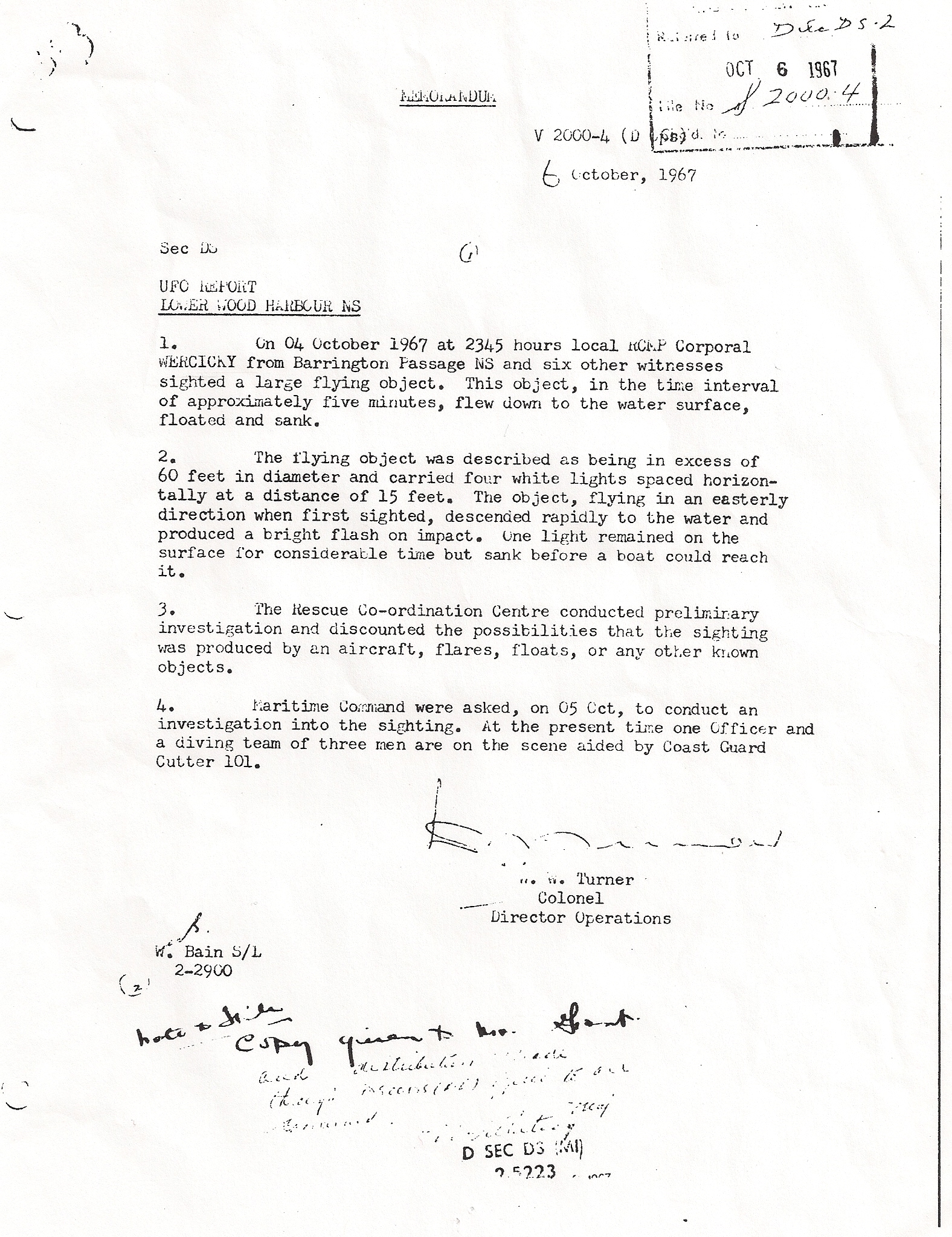
Shag Harbour is the case most often called "the world's only government-documented UFO crash," and the reason is a single contemporaneous Canadian military document that survives in the Department of National Defence files at Library and Archives Canada. It is a message headed "UFO REPORT," filed under Director of Operations W. W. Turner. Its text, reproduced from the archival scan, reads:
"On 04 October 1967 at 2345 hours a local RCMP Corporal WERBICKI from Barrington Passage NS and six other witnesses sighted a large flying object. This object, in the time interval of approximately five minutes, flew down to the water surface, floated and sank. The flying object was described as being in excess of 60 feet in diameter and carried four white lights spaced horizontally at a distance of 15 feet. The object, flying in an easterly direction when first sighted, descended rapidly to the water and produced a bright flash on impact. One light remained on the surface for considerable time but sank before a boat could reach it. The Rescue Co-ordination Centre conducted preliminary investigation and dismounted the possibilities that the sighting was produced by an aircraft, flares, floats, or any other known object. Maritime Command were asked, on 05 Oct, to conduct an investigation into the sighting. At the present time one Officer and a diving team of three men are on the scene aided by Coast Guard Cutter 101."
The structure of the response is preserved in those files and in the correspondence between Halifax and Ottawa. The Rescue Coordination Centre in Halifax ran the first-pass investigation and ruled out every conventional explanation: no aircraft were reported missing, civilian or military; NORAD radar coverage at Baccaro had nothing accounting for it; it was not a flare, a float, or any known object. With conventional causes eliminated, the RCC routed the matter to the "Air Desk" at Air Force headquarters in Ottawa, the office that handled UFO reports, and it was formally logged as a UFO report. A related inter-department note records the finding plainly: the sighting "was not caused by a flare, float, aircraft or in fact any known object."
Because the explanations were exhausted on land, the file was escalated to the Navy. Maritime Command tasked Fleet Diving Unit Atlantic with searching the seabed. Two days after the splashdown a Navy diving team went down off Shag Harbour and combed the bottom for roughly three days, into 9 October 1967. The official outcome was nothing. No object, no debris, no wreckage. The search was called off and the final report recorded no trace found. Library and Archives Canada notes that the RCMP's own reports of the sighting are no longer in the file; what remains on the government side is the DND material, the message above among it, with the case left officially unidentified. No Project Blue Book equivalent ever produced a counter-explanation, because this was a Canadian event handled by Canadian RCC, RCAF, RCMP, and Navy channels, and none of them closed it.
What did the witnesses think it was?
The witnesses here were not a fringe group. They were a teenager and his friends, a village full of fishermen, three serving RCMP constables and a corporal, a Coast Guard crew, and two Air Canada pilots, and what they reported lines up across all of them. Laurie Wickens, who made the first call, spent the rest of his life as the public keeper of the case and runs the documentary archive where the DND "UFO REPORT" scan is posted. He never wavered from the four-lights-in-sequence description or the plane-crash assumption that turned into something else once the object floated and sank.
Constable Ron Pound saw it from the road and gave the 60-foot estimate that ended up echoed in the military message. Corporal Victor Werbicki, named directly in the DND document, and Constable Ron O'Brien were on the shoreline with him. These are the "six other witnesses" the report references alongside Werbicki. Their belief was not that they had seen a flying saucer in the tabloid sense; it was that something solid, lit, and large had come down into the water in front of them and gone under, and that no aircraft had been reported lost.
The two researchers who reopened the case in the 1990s, Don Ledger and Chris Styles, gave it its second life, and Styles is more than a researcher here. He was a Halifax boy who saw the object himself as a child and spent decades chasing it. Their book "Dark Object: The World's Only Government-documented UFO Crash" (2001), with an introduction by Whitley Strieber, is built on the recovered DND files obtained through access-to-information channels and on interviews with the surviving witnesses. Ledger and Styles also documented witness testimony, some of it off the record, describing the object as having traveled submerged toward Government Point near a military magnetic-detection facility, and a possible second light arriving over the water, accounts that go beyond the paper trail and are weighed accordingly. What is not contested by any witness is the core event: a lit object, multiple independent observers including police, a splashdown, foam on the water, and an official search that found nothing.
Is the Shag Harbour Incident real? The two-pass assessment
Pass one, the ordinary readings. The most testable mundane explanation is a downed aircraft or a piece of falling space hardware. The Rescue Coordination Centre chased exactly that first and came up empty: no civilian or military aircraft were reported overdue or missing anywhere that could match, and NORAD radar had nothing. A meteor or bolide is the next candidate and would explain a bright object and a flash, but a meteor does not float on the surface showing a steady light for minutes, does not move horizontally across the water, and does not produce a persistent foam slick that fishing boats reach and circle. Flares and marine floats were considered by name in the RCC review and rejected. A hoax is hard to sustain when three RCMP officers, a Coast Guard crew, and roughly eleven independent townspeople report the same thing within minutes, and when two Air Canada pilots logged a lit object with trailing lights and silent explosions over Quebec hours earlier and independently. No analyst has ever shown a method by which the foam, the multi-witness convergence, and the negative Navy dive were manufactured. Re-entry debris remains the only conventional possibility not fully foreclosed by the record, and it does not account for the controlled-looking horizontal movement on the water or the surviving surface light.
Pass two, if real. What the witnesses describe is a structured object, in the language of the military message "in excess of 60 feet in diameter" carrying "four white lights spaced horizontally at a distance of 15 feet," that descended under apparent control, made a soft enough water entry to float, then submerged and could not be found by a dedicated three-day Navy dive. The Air Canada crew's earlier sighting of a lit rectangular object with trailing lights and silent detonations suggests, if connected, an object active across a wide area that evening. The unrecovered nature of the splashdown, in shallow coastal water that a diving team should have been able to clear, is the part that keeps the case open sixty years on.
The tier is Verified Unexplained. This is not a grainy photo or a single excited witness. It is an event that the Canadian government itself put on paper as a UFO, investigated through its Rescue Coordination Centre, its Air Force Air Desk, and its Navy diving unit, ruled out every conventional cause for in real time, searched for, and never explained. The primary document survives and is quoted here verbatim. There is no independent, civilian, method-shown analysis that resolves it as anything ordinary. The object was never identified and never found. It stands as unexplained on the strength of its own government paperwork and its credible, convergent, multi-party witness record.
Sources
- shagharbourincident.wordpress.com/category/updates/documents/
- www.barringtonmunicipality.com/Visiting-Us/shag-harbour-ufo-incident
- www.vice.com/en/article/in-search-of-the-truth-behind-canadas-most-infamous-ufo-sighting/
- web.archive.org/web/20251109050450/https://www.thescubanews.com/2025/10/16/shag-harbour-nova-scotia-ufo-incident/
- www.penguinrandomhouse.com/books/99199/dark-object-by-don-ledger-and-chris-styles-edited-and-with-an-introduction-by-whitley-strieber/
- shagharbourincident.wordpress.com/2014/08/01/don-ledger-ufo-researcher-and-author/
- www.thinkaboutitdocs.com/1967-shag-harbour-incident/
More cases from this region: UFO sightings in Canada