The Hannah McRoberts Photograph
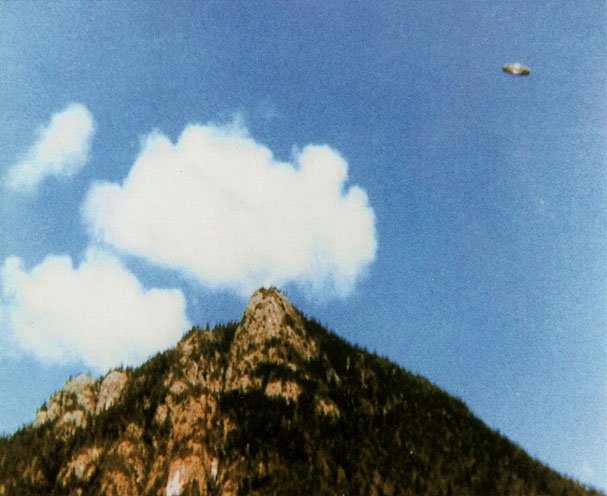
On the morning of 8 October 1981, around 11:00, Hannah McRoberts, then 25 and living in Campbell River, British Columbia, was parked with her husband and their young daughter at a highway rest area roughly 30 miles north of Kelsey Bay on the east coast of Vancouver Island. This case file covers what witnesses reported, the official narrative, and a two-pass assessment with its evidence tier.
What did witnesses see at Rest area about 30 miles north of Kelsey Bay?
On the morning of 8 October 1981, around 11:00, Hannah McRoberts, then 25 and living in Campbell River, British Columbia, was parked with her husband and their young daughter at a highway rest area roughly 30 miles north of Kelsey Bay on the east coast of Vancouver Island. They had stopped to look at the mountains. One of the peaks had a cloud sitting on it that, as they described it, looked like a volcano issuing steam, and they thought it was worth a picture. Hannah raised her 35mm Mamiya camera, fitted with a 50 to 55mm lens and loaded with ASA 100 colour film, and took the shot of the peak and its plume.
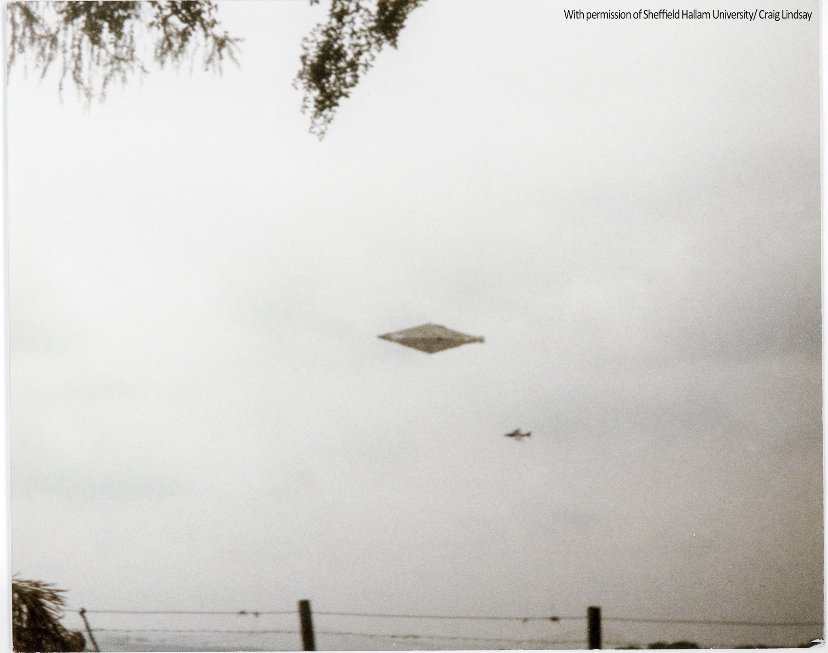
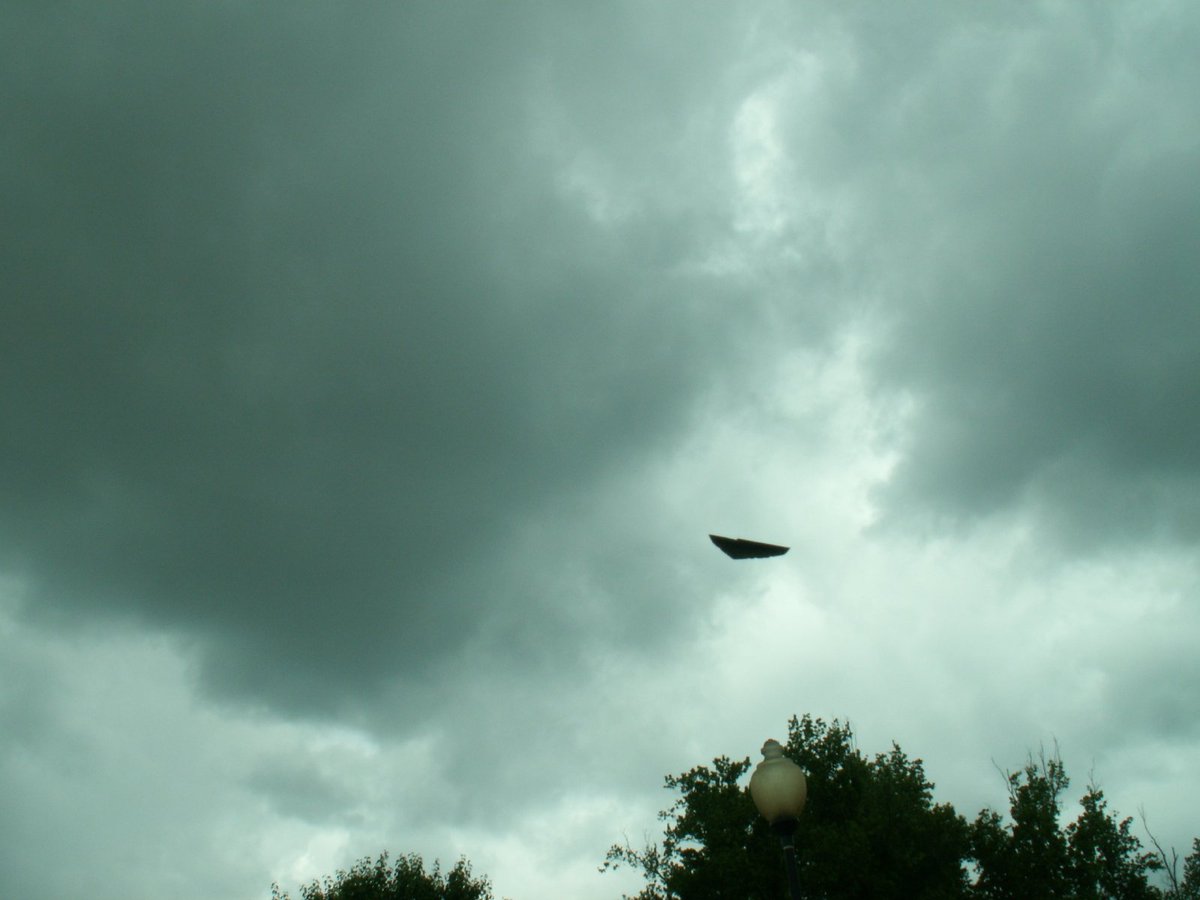
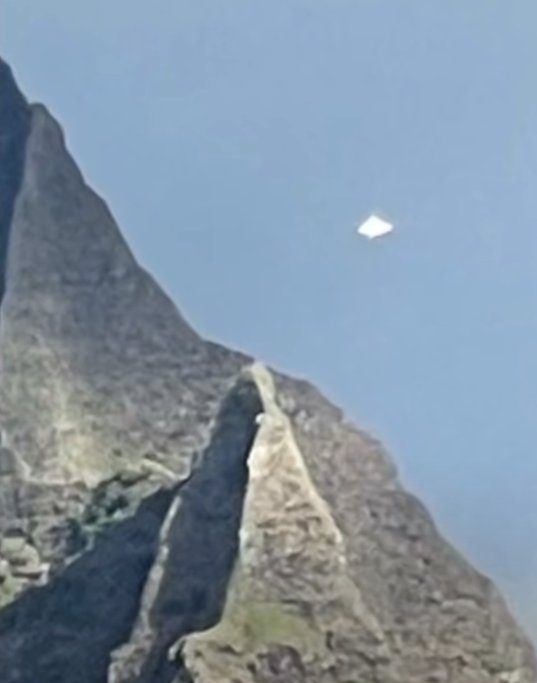
Nobody in the party saw anything else in the sky. There was no object, no light, no sound, nothing that any of them registered while they stood there. This is the defining feature of the case: it is an after-the-fact, latent-discovery sighting. The UFO only existed, as far as the family knew, once the roll came back from the lab several days later. In one frame, to the right of and above the mountain peak and its cloud plume, there sat a sharply focused, dark, disc-shaped object against clear blue sky. It has the classic profile, a flattened ellipse with a slightly raised centre, a domed look on top and a thicker rim, the shading running brighter along one side and darker underneath as you would expect from a solid form lit by the sun.
The family did not know what to make of it. In one interview the witness summed up the reaction plainly: "Well, we didn't know what to do. Eventually we showed it to our neighbors." There was no story of a craft maneuvering, no claim of contact, no excitement, just an ordinary vacation negative with something strange already baked into it. That single 35mm colour frame is the entire physical evidence in the case.
What is the official explanation?
There is no government file on this case. No air force, no Blue Book successor, no Canadian defence body investigated it. The "official" record here is the civilian scientific examination it attracted, which is unusually heavyweight for a single amateur photograph.
The image first reached serious investigators through David A. C. Powell of Vancouver, a member of the staff at the H. R. MacMillan Planetarium, who became interested in the frame and obtained an enlargement. Powell brought in Bill Allan and contacted APRO, the Aerial Phenomena Research Organization of Tucson, Arizona, then one of the most established civilian UFO groups. The McRoberts family agreed to lend the original negative so that copies and analyses could be made. Crucially for a hoax-resistant chain of custody, accounts stress the negative itself stayed firmly in the witness's possession across the process, with the negative handled by Powell and returned, dated by some accounts as delivered in June 1982 and returned on 28 January 1983.
Prints went to Percy Hennell, a photographic consultant associated with the British journal Flying Saucer Review, and to Dr. James Harder, a professor of engineering at the University of California, Berkeley, and APRO's longtime director of research. Harder's verdict, dated 4 November 1982, was specific and quotable: "the photo presented here appears to be an excellent and probably genuine photo of a classical disc photographed in daylight." Hennell's contribution was a warning rather than an endorsement. He pointed out that if the picture was genuine and the disc was as far away as a craft hanging near the mountain would be, "the disc must have been of enormous size, several hundreds of feet wide." That was a reductio, not a measurement, and it cuts both ways, as we will see.
The most rigorous study came from Dr. Richard F. Haines. Haines was a research scientist at NASA's Ames Research Center from 1967, working in aviation and space human factors within the Man-Vehicle Systems Research Division, and in 1986 he was appointed Chief of the Space Human Factors Office at Ames; archival guides to his papers place his NASA-era work between 1967 and 1988. He later co-founded NARCAP, the National Aviation Reporting Center on Anomalous Phenomena, serving as its chief scientist. Haines subjected the original negative to micro-densitometry and computer enhancement, hunting specifically for a support thread, an emulsion defect, an optical artifact inside the camera, or any sign of a hoax. He found none. His published conclusion was that the object was "a genuine airborne object and not the result of emulsion deformity or optical illusion," that it was three-dimensional, and that it sat "at a distance of at least 30 feet from the camera." He did not claim to identify it. Haines presented his work in the MUFON 1986 International UFO Symposium Proceedings, in a paper titled "A Scientifically Based Analysis of an Alleged UFO Photograph" (pages 111 to 129), and the McRoberts photograph was later among the photographic cases he brought before the Sturrock Panel, the 1997 Pocantico workshop of scientists convened by Stanford physicist Peter Sturrock, whose findings were published in the Journal of Scientific Exploration in 1998. The official-scientific upshot across all of these reviews is consistent: no tampering detected, object real and airborne, identity unknown.
What did the witnesses think it was?
Hannah McRoberts never built a UFO career on this. She was not a contactee, not a lecturer, not a writer. She was an ordinary holidaymaker who came home with a strange frame and showed it to her neighbors. Across four decades of the photograph circulating in magazines, books, and online, there is no record that Hannah or her husband ever recanted, retracted, sold an embellished story, or admitted staging anything. Their account stayed flat and consistent: they saw nothing at the time, the object turned up only on the developed film, and they could not explain it. That stability matters, because the most reliable tell of a photo hoax is usually the behaviour around it, an escalating story, a reluctance to surrender the negative, a witness who profits. None of that is present here.
The corroborating "witnesses," in the sense that counts for this kind of case, are the analysts who could find nothing wrong with the negative. Harder, an engineering professor and APRO research director, called it an excellent and probably genuine daylight disc. Haines, with a NASA human-factors and imaging background, ran the densitometry and enhancement and reported a genuine, three-dimensional, airborne object with no evidence of fakery. David Powell, the planetarium staffer who first handled the case, reportedly found no evidence of tampering either. The witness's own belief was modest by UFO standards: she believed she had accidentally photographed something solid in the sky that she could not identify, and she let the scientists argue about the rest.
The dispute
The dispute is a single, specific, mundane counter-explanation: that the disc is a small everyday object, most likely a hubcap or a chrome wheel cover or a frying-pan lid, thrown or tossed close to the camera and caught in mid-air, photographed against the distant mountain so that it reads as a large craft far away. This is the standard reading of after-the-fact, latent-discovery UFO photos, where the witnesses notice nothing at the time because the object was near the lens and fleeting.
The explanation has named proponents and a shown method, not just a hand-wave. On the analysis blog commonly cited as Photobuster, the object was sized at "about 20 to 40 centimeters in diameter, at a distance of 3 to 10 meters maximum," the dimensions of exactly such a household or automotive disc. On Metabunk, forum analyst Z. W. Wolf argued it was "much more likely to be a hubcap, just the kind of thing you'd find on the side of the road," and went further to nominate a particular model, a Volkswagen Beetle hubcap, because "the VW hubcap has the best overall shape" among the candidates he compared by eye. Metabunk founder Mick West agreed the object was "certainly the type of thing you'd find at a bumpy rest stop." Their method is visual overlay and geometric or photogrammetric reasoning about apparent size versus distance, plus the simple observation that the domed-disc-with-rim shape is a near-perfect match for the underside of common wheel covers.
What keeps this from settling the case is everything the debunk does not have. No one has ever recovered the supposed hubcap or pan lid. No one has built a model and re-shot it under the original geometry and October daylight to reproduce the object convincingly. There is no confession and no recantation; Hannah McRoberts and her family never profited from the image, never escalated the story, and never admitted a hoax. And on the other side of the ledger sits the only rigorous physical analysis of the actual negative, Richard Haines's micro-densitometry and computer enhancement, which found no thread, no emulsion defect, no optical artifact, a three-dimensional sun-lit form, and a minimum distance of "at least 30 feet from the camera," with Dr. James Harder independently calling it "an excellent and probably genuine photo of a classical disc photographed in daylight." Even Mick West conceded the side slope did not look like a clean fit. The hubcap hypothesis is reasonable and is the best ordinary story available, but it remains an unconfirmed suspicion rather than a demonstrated solution, which is why the case is only barely disputed and still largely stands.
Is the Hannah McRoberts Photograph real? The two-pass assessment
Pass one, the ordinary reading. The strongest mundane explanation is the one skeptics have pressed hardest: a small, near object thrown or tossed close to the camera and frozen in mid-air. The shape, a domed disc with a thicker rim, looks a great deal like a chrome wheel cover, a hubcap, or a pan lid. On the analysis blog often referenced as Photobuster, the object was estimated as "about 20 to 40 centimeters in diameter, at a distance of 3 to 10 meters maximum," exactly the scale of a hubcap or frying-pan lid flipped into the air. On Metabunk, forum analyst Z. W. Wolf argued it was "much more likely to be a hubcap, just the kind of thing you'd find on the side of the road," and nominated a specific candidate, a Volkswagen Beetle hubcap, on the grounds that "the VW hubcap has the best overall shape." Site founder Mick West agreed it was "certainly the type of thing you'd find at a bumpy rest stop," while flagging that the side slope did not seem a perfect match. The latent-discovery nature of the case is the engine of this explanation: because nobody saw the object live, a single person could have lofted something near the lens, or an object could have been tossed in frame, and no one in the party would have a competing memory. That is a coherent, internally consistent ordinary story.
Pass two, if it is real. Haines's negative analysis is the obstacle the ordinary reading has to clear. Micro-densitometry and computer enhancement found no thread, no emulsion deformity, no internal optical artifact, and a density gradient across the object consistent with a genuinely three-dimensional, sun-lit form rather than a flat cut-out. Haines placed it at "at least 30 feet from the camera," which already pushes back on the very-close-throw version, and Harder independently judged it an excellent and probably genuine daylight disc. If the object is real and as distant as a craft near the mountain, Hennell's reductio bites: it would have to be hundreds of feet wide, an unidentified structured object of substantial size hanging silently over Vancouver Island.
Weighing the two, this lands at Barely Disputed. The mundane candidate is named and method-shown in spirit, a hubcap or pan lid near the lens, advanced by competent analysts using visual matching and photogrammetric reasoning, and it is genuinely plausible. But it falls short of closing the case. Nobody has produced the actual prop, nobody has built a model that reproduces the object under the original lighting and geometry, there is no confession, and the witness never wavered, while the one rigorous negative analysis on record found a three-dimensional airborne object at least 30 feet out with no sign of fakery. A strong debunk would need the recovered hubcap, a matched model, or an admission; what exists is a reasonable suspicion that the original analysts could not confirm and that the image stubbornly outlives. The counter-explanation is real but partial, so the case largely stands. Tier: Barely Disputed.
Sources
- www.ufobc.ca/History/1980/Version1%20saved/kelsey.htm
- ufologie.patrickgross.org/htm/picamaca07.htm
- www.metabunk.org/threads/hannah-mcroberts-1981-ufo-revisited.10940/
- www.wyominghistoryday.org/theme-topics/collections/richard-f-haines
- txarchives.org/ricewrc/finding_aids/01189.xml
- www.narcap.org/blog/definition-of-uap
- www.ufoevidence.org/photographs/section/1980s/photo43.htm
- www.ufobc.ca/History/1980/kelsey_v2.htm
More cases from this region: UFO sightings in Canada