The Lake Michigan L-1011 Object
On the afternoon of 4 July 1981, Captain Phil Schultz, aged 54, was in command of TWA flight 842, a wide-body Lockheed L-1011 carrying passengers from San Francisco to John F. Kennedy Airport in New York. This case file covers what witnesses reported, the official narrative, and a two-pass assessment with its evidence tier.
What did witnesses see at South central Lake Michigan?
On the afternoon of 4 July 1981, Captain Phil Schultz, aged 54, was in command of TWA flight 842, a wide-body Lockheed L-1011 carrying passengers from San Francisco to John F. Kennedy Airport in New York. According to the reconstruction Dr. Richard F. Haines published as Case 86 in NARCAP Technical Report 1, the jet was over south central Lake Michigan at cruise altitude, flight level 370 (about 37,000 feet), 280 knots indicated airspeed, roughly 540 knots over the ground, with the autopilot coupled. The local time was 1646. The sky was generally clear over the lake with a high thin layer of cirrus over the southern part and some scattered mid-level cloud near 10,000 feet. The sun sat high and behind the aircraft, about 41 degrees above the horizon. Schultz, by his own account, was relaxed back in his seat with his hands behind his head, the first officer was turned around talking to the flight engineer, and nobody was hand-flying.
In the captain's own written words, quoted by Haines: "A large, round, silver, metal object descended into the atmosphere from above and to the left of my airplane to about 40,000 feet overhead and passed off to my left." Schultz told Haines the thing did not grow from a point. It appeared abruptly at full size, as if it had punched through the atmosphere, with little radiating lines fanning out from it like stress cracks. To demonstrate that effect Schultz took a paper napkin, had Haines hold two corners while he held the other two, and pushed his thumb through the middle.
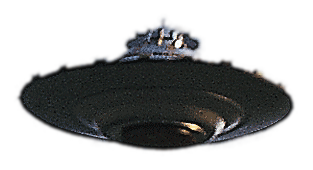
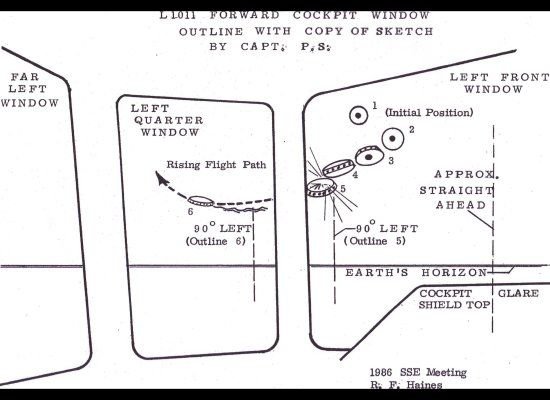
From the cockpit reconstruction Haines drew out the specifics. The encounter lasted only five or six seconds. The object moved very smoothly. It was about two and a half times wider than it was thick, with six jet-black perfect circles, which Schultz called "portholes," aligned and equally spaced around its circumference, plus a single jet-black circle centered on its bottom surface. It traveled along a roughly parabolic path and performed a high-speed turn that Haines calculated at about 20 g relatively close to the aircraft, then departed in a gradual climb to the north, leaving a darkish wavy trail behind it. Approach and departure speed worked out to about 1,000 mph. No shock wave and no turbulence were felt at any point. Schultz remembered a fan-shaped region extending out behind the object that was "of a much darker blue than the rest of the sky." The autopilot stayed coupled throughout and no electromagnetic effects were noticed. Both pilots were genuinely worried about a mid-air collision and braced themselves for impact. The object's sharp turn is what avoided it.
The first officer saw roughly the final two-thirds of the event. The flight engineer saw nothing because of his position in the rear. When Schultz called Chicago Center to ask whether there was any other traffic up there with them, he was told there was none. He did not report what he and the first officer had just seen.
What is the official explanation?
There is no government file on this event, and that absence is itself part of the story. Project Blue Book, the US Air Force's UFO investigation, had been closed in December 1969, almost twelve years before Schultz's encounter, so no Air Force apparatus existed to receive or debunk a 1981 airline sighting. The Federal Aviation Administration's near-midair-collision reporting system that Haines reviewed only holds records from 1992 onward, and in any case its definition of a near-miss is limited to proximity to "another aircraft," which structurally excludes an unidentified object. Schultz declined to file anything at the time. When he asked Chicago Center about traffic, he was simply told there was none on radar, and he let it drop. So no FAA, NTSB, or military document records the case.
The substantive "official" record is therefore the investigation by Dr. Richard F. Haines, and it is unusually heavyweight for a single-witness-led case. Haines was a senior research scientist at NASA Ames Research Center from 1967 and former Chief of the Space Human Factors Office there. After retirement he became Chief Scientist of the National Aviation Reporting Center on Anomalous Phenomena (NARCAP) and had previously been a field investigator for the Center for UFO Studies and NICAP. He investigated aviation accidents and incidents for the FAA and for attorneys, sat on the Safety and Human Factors Committees of the Aerospace Medical Association, and was a member of the International Society of Air Safety Investigators. Haines interviewed both Schultz and the first officer, got "the same story" from each, and conducted a physical reconstruction in the actual cockpit of the L-1011, having Schultz mark the object's apparent size and position on a plastic sheet taped over the cockpit windows with a grease pencil at several time steps about two to three seconds apart. From that reconstruction plus the sun angle he calculated the kinematics and concluded the solar reflections were consistent with a three-dimensional large reflecting object.
Haines first published the case in Flying Saucer Review in 1982 as a two-part article, "Commercial jet crew sights unidentified object" (Vol. 27, No. 4 and No. 5), then again in detail as Case 86 of NARCAP Technical Report 1, "Aviation Safety in America: A Previously Neglected Factor" (15 October 2000). That report's executive summary concluded, after reviewing more than one hundred close pilot encounters between 1950 and 2000, that there was no immediate collision threat to aviation "because of the reported high degree of maneuverability shown by the UAP," and it argued that documented pilot sightings have been "either ridiculed or instructed not to report." Schultz's primary file, his handwritten report and Haines's notes, survives in the Richard F. Haines papers, archived at Archives West, listed as "Aircraft Sightings UC - Phil Shultz, July 4, 1981," Box 14. The case was later carried to a wide public audience in journalist Leslie Kean's 2010 book "UFOs: Generals, Pilots, and Government Officials Go on the Record," in the section drawing on Haines's pilot work.
What did the witnesses think it was?
Captain Phil Schultz was not a casual observer. He had extensive jet combat experience as a US Navy fighter pilot in the Korean War and afterward, and Haines records that before this sighting Schultz did not believe in UFOs at all. His flying background had left him with the firmly held conviction that such objects "simply do not exist." The encounter reversed that overnight. Haines notes that when he asked Schultz what he thought the object was, the captain answered quickly, and in his own handwritten report Schultz wrote that he had no choice but to characterize what he saw as a "spaceship." That is a striking word from a career Navy combat aviator and senior airline captain, and it is the witness's own term, not the investigator's.
The corroboration is real but partial. The first officer in the right seat turned in time to see roughly the last two-thirds of the event and gave Haines an account that matched Schultz's. The flight engineer, seated to the rear, saw nothing, which is consistent with a brief object low and to the aircraft's left. There was no radar confirmation: Chicago Center reported no other traffic, and the object left no instrument or electromagnetic trace. So the case stands on two trained cockpit witnesses, one of whom saw the whole thing, plus a detailed signed report and a face-to-face reconstruction conducted by a NASA human-factors scientist who specialized in exactly the perceptual questions a skeptic would raise. Haines, who had logged over 3,000 pilot reports, treated this one as one of his higher-quality cases precisely because of the witness's reluctance, his professional credibility, and the geometric specificity of the description.
The dispute
The honest counter-case is not a confession or a recovered prop. It is the structural weakness that this is, at bottom, a brief single-primary-witness visual event lasting five or six seconds, reconstructed largely from memory, with no photograph, no radar return, no instrument anomaly, and no contemporaneous report. Everything load-bearing, the 20 g turn, the roughly 1,000 mph speed, the parabolic path, the size and distance, derives from a cockpit reconstruction in which Schultz marked positions on a plastic overlay weeks or more after the event. Memory reconstruction of angular size and motion is exactly the sort of data that can be systematically off, and the first officer caught only the final two-thirds. The figures should be read as Haines's calculations built on witness estimates, not as instrumented measurements.
The most natural mundane candidates are a bright daytime fireball or bolide, or a sun reflection. The fireball hypothesis has real pedigree for pilot cases: the celebrated 1948 Chiles-Whitted airline encounter, which Schultz's report superficially resembles in its "approaching object that swerves," was eventually assessed by J. Allen Hynek, Donald Menzel, and Project Blue Book as a bright meteor. A meteor seen nearly end-on can appear to descend, brighten suddenly, and leave a trail, and the date, 4 July, is not a notable meteor shower peak but sporadic daytime fireballs do occur. Against that, Schultz reported a sharply structured solid object with six evenly spaced black circular portholes and a central black disc, a defined edge, no fragmentation, no fire, and a banking turn, none of which fits a meteor, and Haines specifically found the solar reflection geometry consistent with a three-dimensional reflecting body rather than an incandescent one.
The decisive point for tiering is what does not exist. No independent, civilian, method-shown analysis has ever been published that reconstructs this specific event as a meteor, a sundog, an internal-reflection artifact, or anything else. None of the well-known skeptical investigators of pilot cases, Robert Sheaffer, James Oberg, Philip Klass in his lifetime, or the Center for UFO Studies, appears to have produced a worked natural solution with time, angle, and brightness fitted to Schultz's report. The dispute here is generic, the known fragility of brief single-witness reconstructions, rather than a named, demonstrated debunk. That is why the case is only barely disputed: the doubt is methodological and real, but no one has actually shown the ordinary cause.
Is the Lake Michigan L-1011 Object real? The two-pass assessment
Pass one, how this could be entirely ordinary. The honest skeptical reading starts from the case's thinness: one full witness and one partial witness, a five-to-six-second daylight glimpse, no photo, no radar, no instrument effect, and figures reconstructed from memory on a plastic overlay. The leading natural candidate is a bright daytime fireball or bolide. Pilot history supports the worry, since the famous 1948 Chiles-Whitted airline "rocket" encounter was ultimately judged a meteor by Hynek, Menzel, and Blue Book, and a meteor seen near end-on can look like a fast object that descends, brightens, trails, and seems to veer. A sun reflection or an internal cockpit-glass reflection is a second candidate given the sun was high and behind the aircraft. Either explanation would dissolve the "20 g turn" and "1,000 mph" as artifacts of misjudged distance and angular size, which are precisely the quantities humans estimate worst. None of this is proven, but it is the responsible way the case could be mundane.
Pass two, if real, what is it. Taken at face value, the report describes a structured, solid, metallic disc about two and a half times wider than thick, with six evenly spaced jet-black circular portholes and a central black disc on its underside, that descended from above, performed a high-g turn at close range, and climbed away to the north leaving a dark wavy trail, all with no shock wave, no turbulence, and no electromagnetic effect on a coupled autopilot. The witness was a Korean War Navy combat pilot and senior TWA captain who had actively disbelieved in such objects and who, against his own prior conviction, wrote the word "spaceship" in his own hand. The investigator was a NASA Ames human-factors scientist who reconstructed the geometry in the cockpit and found the solar reflections consistent with a real three-dimensional reflecting body. If accurate, the structured shape and the trail rule out a meteor, the controlled turn rules out a balloon, and the performance exceeds any 1981 aircraft.
Weighing both passes: the methodological doubt is genuine, so this is not a Verified Unexplained case, and it would be wrong to wave away the fireball possibility. But the doubt is generic. No named analyst has ever produced a method-shown reconstruction fitting a meteor, reflection, or any other ordinary cause to the specific reported geometry, and the structured-object details actively resist the obvious natural explanations. With a credible, initially hostile professional witness, a serious investigator, and no demonstrated debunk against it, the case largely stands while a real counter-explanation remains plausible but unproven. That places it at Barely Disputed.
Sources
- static1.squarespace.com/static/5cf80ff422b5a90001351e31/t/5d02ea1772637c00014776c5/1560472092579/narcap.TR1.AvSafety.pdf
- archiveswest.orbiscascade.org/ark:80444/xv847688
- archive.org/details/ufosgeneralspilo0000kean
- www.ufoevidence.org/cases/CaseView.asp?section=searchresults&offset=217&numbercases=8
- knuthlab.org/library/haines---1992---ufo-electromagnetic-effects.pdf
- web.archive.org/web/20230927221206/https://www.ufocasebook.com/2010/lakemichigan1981.html
More cases from this region: UFO sightings in United States