The Place Bonaventure Sighting
On the evening of 7 November 1990 a stationary, silent array of lights hung over downtown Montreal for nearly three hours, from about 7:15 p.m. to 10:15 p.m. The first witness was at the rooftop pool on the 17th floor of the Hilton Bonaventure Hotel. This case file covers what witnesses reported, the official narrative, and a two-pass assessment with its evidence tier.
What did witnesses see at Hilton Bonaventure Hotel?
On the evening of 7 November 1990 a stationary, silent array of lights hung over downtown Montreal for nearly three hours, from about 7:15 p.m. to 10:15 p.m. The first witness was at the rooftop pool on the 17th floor of the Hilton Bonaventure Hotel. Pool supervisor Line Saint-Pierre was alerted to it and described an oval luminous form, yellowish, with seven to ten lights arranged symmetrically and beams coming off it. She was firm that it "absolutely did not move" and that the light could not be coming from below, comparing it to a ceiling fixture seen from underneath.
Hotel security agent Albert Sterling reported six to nine lights forming a circle with rays projecting all around, three on one side and four on the other, and said his first instinct was that something was about to explode. A hotel guest, Diane Martel, described eight or ten lights in a circle with very luminous beams escaping from them. Restaurant server Patrick Teyssedou said he stood on the pool deck alongside police, RCMP officers and an Air Canada pilot watching it.
Montreal police constable Francois Lippe arrived around 8:11 p.m. and logged three round yellowish lights with three beams, a fixed and immobile luminous form. He phoned the airport control tower, National Defence and the military police. Neighbourhood post commander Sergeant Robert Masson ordered downtown construction and display spotlights switched off in case they were creating an optical effect; the lights overhead stayed put. Masson later said he was convinced he had seen something artificial and not human-made.
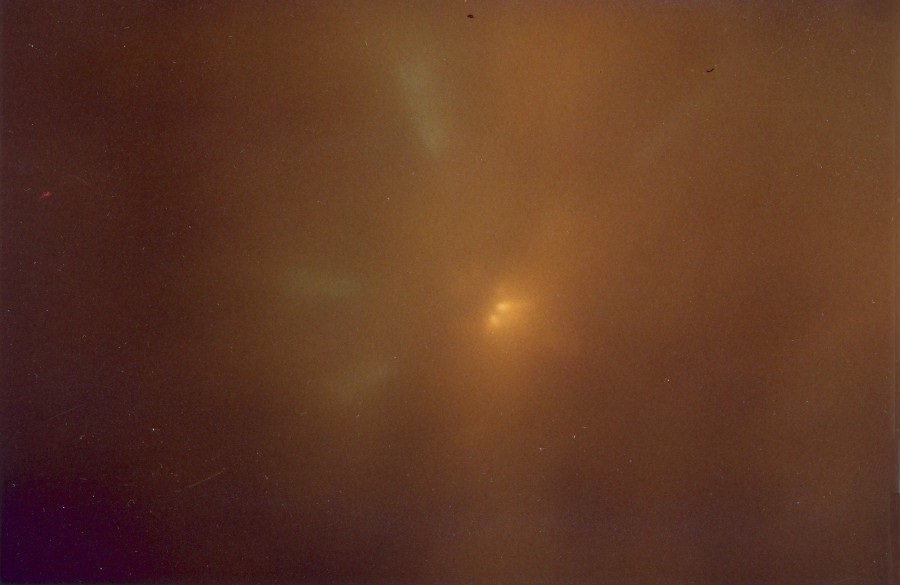
By around 9 p.m. the press had arrived. La Presse reporter Jules Beliveau counted at least six white or yellowish round lights, and La Presse photographer Marcel Laroche, on the roof around 9:15 p.m., described an object the apparent size of the moon with six or more small orange lights, and shot two frames. His automatic exposures at 1/60th of a second captured nothing, so he opened the shutter manually for about 30 seconds to record the faint glows. An RCMP officer, Luc Morin, arrived about 9:30 p.m., saw a luminous form projecting two beams, noted a slight drift from south to north before cloud closed in, and contacted the National Research Council. An Air Canada pilot among the guests put the object somewhere around 2,500 to 3,000 metres up and said it was no helicopter. Estimates of the total crowd that saw it run from roughly 40 to 75 people on the roof, with more at street level.
What is the official explanation?
There was no formal government investigation, and that absence is itself part of the record. Constable Lippe's calls reached the Dorval airport tower, which reported nothing on radar, and the St-Hubert military base, which confirmed no activity of its own. The 1992 analysis by Richard F. Haines and Bernard Guenette, "Details Surrounding a Large Stationary Aerial Object Above Montreal," notes pointedly that "no action of any kind was taken by personnel of the St-Hubert Military Base after they were notified of the aerial object hovering above the center of the city. As far as is known, they did not even report it to the North American Radar Defense (NORAD) co-ordination center." The authors observe that mobilizing Canadian forces would have needed authorization from the provincial premier, Robert Bourassa, and that because the object showed no security threat and the military had no mandate to study such things, no one pursued it.
Several accounts state that the police paperwork on the case was reportedly classified within 24 hours of the event, which is repeated in the Haines-Guenette abstract: "the original 35mm color negatives and positive color prints were subject to microscopic reexamination and to computer-based enhancements of various kinds. They were also related to the drawings and narrative descriptions of the object made by many eye witnesses."
The 25-page Haines-Guenette report is the closest thing to an official-grade investigation the case ever received, and it was a private one. Haines was a former NASA Ames human-factors scientist; Guenette was a Montreal UFO researcher who collected the witness drawings and the negatives. They digitized Laroche's frames, ran densitometry and false-color 3D enhancement, cross-checked the sketches from Saint-Pierre, Sterling, Lippe, Morin, Beliveau and Laroche, and concluded the lights came from a single solid body. Their stated finding: "The evidence for the existence of a highly unusual hovering, silent, large object is indisputable." They estimated a circular object on the order of 500 to 540 metres across at altitude, and ended the report with the line that "the aerial object remains unidentified at this time."
What did the witnesses think it was?
The witnesses, particularly the police and RCMP officers, came away convinced they had watched a structured craft, not a trick of light. Sergeant Robert Masson maintained for years afterward that he had seen something metallic and artificial that did not come from Earth. Line Saint-Pierre held that the object was fixed near the zenith and that the illumination came from the thing itself, not from the ground. Albert Sterling described a coherent ring of lights with rays, and the two La Presse journalists, Beliveau and Laroche, independently logged a circular set of lights consistent with the others.
What gives the case its weight in Canadian ufology is the calibre and number of the witnesses rather than the single dim photograph. You have municipal police, RCMP, hotel staff, named hotel guests, newspaper staff and an airline pilot, all on the same rooftop, all describing a stationary multi-light object that held position for the better part of three hours and persisted after the city's spotlights were deliberately killed. Guenette and Haines treated that convergence, plus the negatives, as proof of a physical object. Hotel sales director Christopher Marilley, interviewed years later, put the credibility argument plainly: when the police are on site and later go on record, it brings a different level of legitimacy.
The dispute
The dispute over the 7 November 1990 Place Bonaventure sighting rests on a single mundane explanation: that the lights seen by 40 to 75 people over downtown Montreal for roughly three hours were ground light reflected off a low cloud deck. Marc Gelinas, an Environment Canada meteorologist, advanced this to La Presse, arguing that beams from downtown sources could be bounced back by ice crystals and water droplets, with the low ceiling of 800 to 1,200 metres creating ideal conditions for searchlights, promotional beacons, construction lighting and car headlights to paint diffuse glows on the clouds. He cited Place Ville-Marie's beacons being visible more than 50 kilometres away under cloud cover as illustrative. Claude Lafleur of Les Sceptiques du Quebec added a structural objection: the reports clustered only around Bonaventure while other downtown towers produced none, which he argued is inconsistent with an actual 500-metre craft and more consistent with a localized optical effect. Haines's own analysis also flagged angular-size discrepancies between the photographic data and witness estimates.
The weakness of this counter-explanation is that nothing in it was ever tested or demonstrated. Per this archive's method, that matters. No specific searchlight, beacon, or spotlight was ever identified by name; Gelinas named only generic categories of light. His reflection mechanism was offered as a theoretical possibility ("beams could be bounced"), not as an experiment that reproduced the observed object. So the central debunk is a hypothesis from a credible technical figure, not a shown method that accounts for what was seen.
What undercuts the explanation most is documented on the page itself. During the event Sergeant Masson ordered downtown construction and display spotlights switched off in case they were creating an optical effect, and the lights overhead stayed put. A cloud-reflection should vanish when its source is cut; this one did not. The page also records that independent witness drawings from trained observers (a pool supervisor, hotel security, a Montreal police constable, a La Presse photographer, an Air Canada pilot) aligned consistently, and that Haines noted the beams appeared to end abruptly rather than fade, which is atypical of cloud scattering.
So while a serious mundane candidate exists and is named, it is an asserted meteorological hypothesis rather than a demonstrated identification, and it fails the one in-event test that was actually run. The cloud-reflection account narrows the case but does not close it, which is why the archive holds it as Disputed rather than resolved.
Is the Place Bonaventure Sighting real? The two-pass assessment
Pass one, the ordinary reading. The strongest mundane case is that this was light from the ground reflecting off a low cloud deck. Marc Gelinas, an Environment Canada meteorologist and secretary of the Montreal astronomy society, told La Presse within days that beams from downtown could be bounced by ice crystals and water droplets in cloud, and that the rotating beacons atop Place Ville-Marie are routinely visible more than 50 kilometres away when there is cloud cover. That night the ceiling sat low, around 800 to 1,200 metres, which is good conditions for exactly this effect: searchlights, promotional beacons, construction lighting and car headlights smeared into soft glowing patches on the underside of the clouds. Laroche's photograph supports the dim-and-diffuse reading rather than the solid-object reading. His automatic 1/60th-second exposures recorded nothing at all, and only a roughly 30-second open shutter caught the faint orange smudges and pale beams you actually see in the frame, with no hard-edged disc anywhere in it.
The skeptic Claude Lafleur of Les Sceptiques du Quebec, who interviewed Saint-Pierre and Sterling within 24 hours, added the point that does the most damage. If a solid object 500 metres wide were genuinely hovering a kilometre or two over the core of Montreal for three hours, the dozens of other downtown towers full of people should have been flooded with reports. They were not. The sighting clusters almost entirely around the Bonaventure rooftop and its immediate surroundings, which is what you would expect from a local viewing geometry of cloud-lit beams, not from a city-sized craft. Lafleur also noted the witnesses themselves disagreed on basic behaviour, with Saint-Pierre fixing it at the zenith throughout while Sterling had it climbing to the zenith only near 9 p.m. On the photographic side, reviewers flag that Haines measured the object at about 2.2 degrees of angular size on the negative, then adopted a far larger witness estimate of 27 to 53 degrees to back out a 500-metre object, an enormous discrepancy that drives the whole size claim.
Pass two, if it was real. Take the Haines-Guenette finding at face value and you have a silent, self-illuminated, structured object roughly half a kilometre across that held a fixed position over a major city for nearly three hours in front of police, Mounties and an airline pilot, projected defined downward beams, and then drifted slowly north and left. Haines noted one detail his own cloud-scattering model could not absorb: the beams appeared to end abruptly rather than fade to nothing, which is not how light scattered through droplet-laden cloud normally behaves, and he floated ionized energy paths as a possibility. The official posture is its own data point. A military base was told an object was sitting over the heart of Montreal and did nothing, did not even pass it to NORAD, and the file was reportedly closed inside a day. Under this archive's rules that institutional shrug is logged as evidence the event was real enough to notice, never as a strike against it.
Where it lands. The case has a serious, method-shown counter-explanation, cloud-reflected ground light, backed by a meteorologist, by a photograph that shows only faint glows, and by Lafleur's localized-visibility argument and the angular-size problem in Haines's own numbers. But that explanation does not cleanly close it: it strains against the object persisting after downtown spotlights were switched off, against the consistent independent drawings from trained observers, and against the abruptly terminating beams. No confession, no demonstrated hoax, no single rig anyone has reproduced. A credible counter-narrative exists and the case still stands, which is the definition of the Disputed tier here.
Sources
- univers-ovni.com/ufologie/montreal.html
- garpan.ca/wp-content/uploads/Details-sourrounding-a-large-stationary-object-above-Montreal-by-Dr.-R.-Haines-et-B.-Gu%C3%A9nette.pdf
- canadiangeographic.ca/articles/area-514-the-1990-montreal-ufo-sighting/
- area51blog.wordpress.com/2009/12/13/ovni-place-bonaventure-montreal-1990/
- www.thinkaboutitdocs.com/1990-the-place-bonaventure-incident-montreal-quebec-canada/
More cases from this region: UFO sightings in Canada