The Aegean Sea USO Photograph
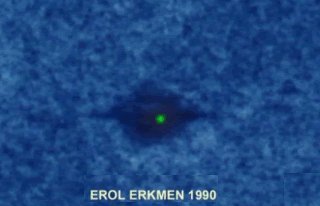
On 15 August 1990, at about 14:00, two divers were working a deep wreck-discovery dive at roughly 57 meters in Saros Bay, the long gulf at the northeastern corner of the Aegean Sea, bounded by the Thracian coast to the north and the Gallipoli peninsula to the south. This case file covers what witnesses reported, the official narrative, and a two-pass assessment with its evidence tier.
What did witnesses see at Saros Bay?
On 15 August 1990, at about 14:00, two divers were working a deep wreck-discovery dive at roughly 57 meters in Saros Bay, the long gulf at the northeastern corner of the Aegean Sea, bounded by the Thracian coast to the north and the Gallipoli peninsula to the south. The named diver was Erol Erkmen. His companion was identified only as "Mr. Kemal," with the surname withheld at the witness's request.
By Erkmen's account, recorded by Turkish researcher Sefer Murat Aksoy, he first felt a strange sense of being watched. He looked ahead and saw a greenish light in the water. It disappeared almost at once. A short while later the same green object reappeared on his left-hand side, which made him think it was maneuvering around the two divers. He watched it for close to three minutes, then decided to photograph it with an older underwater Kodak camera. The moment he took the shot, by his telling, the object's light went out. The pair then had to surface because their air was nearly spent.
The detail that defines this case is what happened to the film. Erkmen said that when he studied the negative very carefully he saw nothing at all. It was only on the printed photochrome that he located a mysterious greenish point. He then had the print enlarged 300 times, and at that extreme magnification he reported a disc-shaped object surrounding the green light. The single surviving image shows exactly that: a wash of blue water, a dark oblong smudge, and a small intense green dot at its center, with the caption "EROL ERKMEN 1990." There is no second photograph, no negative reproduced for inspection, no film footage, and no third witness named beyond Kemal. The frequently recirculated claim that Erkmen also shot fifteen seconds of video, that the water temperature dropped, that other divers saw the same thing, and that energy ripples moved through the water, does not appear anywhere in the original 1999-2000 account and surfaced only in anonymous social-media retellings around 2025. Those embellishments are not part of the primary record and contradict it; the primary record is one still frame, taken by one man, that showed nothing on the negative.
What is the official explanation?
There is no official narrative for this case, because no official body ever handled it. No Turkish navy statement, no coast guard report, no government inquiry, and no contemporary newspaper account has ever been produced. The dive was private, the wreck unnamed, and the only documentation is the witness's own later recollection. That absence is itself a finding: a case this thinly sourced never reached any apparatus that would normally generate an official paper trail.
The case entered the record through civilian UFO literature, not through any authority. The author of record is Sefer Murat Aksoy, who describes himself as "B.A. & M.S., Independent UFO Researcher of Turkey." Aksoy published it as part of a body of work he titled "Turkiye USO Gozlemleri / Turkey USO Sightings," dated 1999-2000, originally hosted on a GeoCities page at geocities.com/Area51/Aurora/3459/0021.html, a link that the database record preserves but which died with the GeoCities shutdown. Aksoy framed the photograph as, in his words, "the most interesting USO case of all Turkish UFO literature," and claimed it as "the first example of its kind," meaning the first photograph in which the witness and the submerged object were supposedly both underwater at depth.
The entry that keeps the case alive is in Carl Feindt's waterufo.net, the standing reference database for water-related UFO and USO reports. Feindt logged it as report number 642, reproducing Aksoy's text verbatim and tagging the source lineage to MUFON. The waterufo.net record fixes the catalogued location as Saros Bay at latitude 40-3-00 N, longitude 26-19-60 E, citing a dive-site reference page (diveargos.com) for the geography, and lists the UFOCAT cross-reference number as NONE, meaning the case was never assigned a formal UFOCAT identifier. From waterufo.net the account passed into UFO Casebook and later content mills. At no point in that chain did any photographic laboratory, image analyst, or investigative body examine the original negative or print. The "300 times" enlargement was performed by Erkmen himself, and the result was never independently checked.
What did the witnesses think it was?
Erkmen believed he had photographed something real and anomalous, a self-luminous green object that behaved as if it were aware of the divers, circling them and then extinguishing its own light the instant the shutter fired. Aksoy presented him as "a very reliable and sincere person," which is the only character reference in the file and comes from the same researcher who published the claim, so it carries the weight of an advocate rather than an investigator.
What is striking is that Aksoy did not push a single conclusion. In the original text he laid out three competing readings and refused to pick one. His exact framing was: "Was it a conventional submarine or a secret man-made vehicle? Was it a kind of phosphorescent underwater organism? Or was it an advanced submersible craft of alien beings? Who knows? Every alternative view has its own pros and cons." That even-handedness matters, because the mundane explanation that skeptics would later reach for, bioluminescence, is right there in the primary source, raised by the case's own champion.
Corroboration is essentially absent. The second diver, Kemal, is never quoted, never interviewed, and his surname is withheld, so there is no independent witness statement, only Erkmen's report that a companion was present. No other diver, fisherman, or boat crew is named in the primary account as having seen the light. Erkmen has been associated in later commentary with Turkish UFO and paranormal interest circles, which is relevant to weighing motive but does not by itself discredit him; a witness who is interested in the subject is still a witness. The honest position is that the case rests on one man's memory of one dive, one photograph that showed nothing on the negative, and a green dot that only became a "disc" after he enlarged the print 300 times.
The dispute
There is no contest here between an official agency and a civilian witness, because no official body ever touched this case. As the record shows, there was no Turkish navy statement, no coast guard report, and no government inquiry. The account exists only in civilian UFO literature, surfacing through researcher Sefer Murat Aksoy's 1999 to 2000 work and preserved on Carl Feindt's waterufo.net as report 642. The counter-explanation is therefore a conventional photographic and optical reading of the single artifact, and tellingly the original researcher advanced part of it himself: Aksoy listed a phosphorescent underwater organism as one of his own three candidate explanations for the greenish light.
The optical half of that reading is real physics, not bluff. At roughly 57 meters depth seawater has already absorbed almost all the red and most of the yellow, leaving an ambient spectrum that is overwhelmingly blue-green, so any point source or a patch of bioluminescent plankton at that depth would photograph as exactly the greenish glow Erkmen reported, with backscatter smearing it into the soft halo seen in the print. On top of that sits the strongest single point against the witness: the negative showed nothing. A genuine self-luminous object would register on the original film, yet the glow appears only on a paper print and only after a 300-times enlargement that Erkmen performed himself and that no one ever independently checked. At no point did any photographic laboratory, image analyst, or investigative body examine the original negative or print.
Where this falls short is the step from a plausible account to a closed one. Bioluminescence is offered as a candidate, never confirmed; nobody sampled the water, identified an organism, or matched it to the image. The blank negative and the unchecked self-enlargement are powerful reasons to distrust the photograph, but they are weaknesses in the witness's evidence, not affirmative proof that the green dot is plankton, grain, or a flare. There is no confession, no recantation, no recovered prop tied to this dive, and no shown method that positively identifies what was on the frame. So the counter-explanation reads the artifact convincingly down to thin air without ever naming what it actually was. That is why the case is dented rather than closed: the photograph is weak, the optics are demonstrable, but the core claim that something self-luminous maneuvered at depth has not been positively explained away.
Is the Aegean Sea USO Photograph real? The two-pass assessment
Pass one, the ordinary reading. Almost everything about this single frame points toward a photographic or optical artifact rather than a recorded object, and the debunk is genuinely strong on its own terms. The decisive fact is the one Erol Erkmen reported himself: the negative showed nothing. A real luminous object held three minutes in front of a lens leaves a latent image on the film emulsion. It does not appear for the first time only on a paper print, and it does not need a 300-times enlargement to be seen. An anomaly that is invisible on the negative and emerges only in a heavily blown-up print is the textbook signature of a dye cloud, a grain clump, a dust speck, a processing stain, or a flare, not of a submerged craft. The physics of light at 57 meters does the rest. At that depth seawater has already absorbed almost all the red and most of the yellow, so the surviving ambient spectrum is overwhelmingly blue-green. Any point source down there, a dive torch, a glow stick, the divers' own flash scattering off suspended particles, or a patch of bioluminescent plankton, photographs as a greenish glow, and backscatter off the particle field smears it into exactly the soft dark halo seen around the green dot. Aksoy himself listed a phosphorescent underwater organism as one of his three candidates, and Saros Bay, fed by the mixed, plankton-rich waters near the Dardanelles, is a plausible place for bioluminescence. A single, uncorroborated, low-resolution still with no negative for inspection and no independent analysis is the weakest class of photographic evidence there is.
Pass two, what the debunk does not actually close. Notice what every one of those points is. They are all reasons the photograph is weak evidence. None of them is a reason to think the photograph is a specific known thing. The optical reading is a plausible generic account of how a thin artifact could form, but no analyst ever examined the original negative or print, ran a method, and came back with a positive identification of what was photographed. Bioluminescence is named as a candidate by the case's own champion, not confirmed by anyone. The blank negative and the witness's self-performed enlargement are holes in his claim, not affirmative proof of cause. There is no confession from Erkmen, no recantation, no recovered prop or rig tied to this dive, and no demonstration that the green dot is grain or a flare rather than a light in the water. What survives, if the man's account is taken at face value, is a close-range green light at 57 meters that he watched maneuver around two divers for nearly three minutes before it went dark the instant the shutter fired.
The two passes do not cancel. The ordinary explanation is the better bet and the evidence is admittedly thin, so the case cannot stand as unexplained. But Strongly Disputed is reserved for a core claim that has been positively closed, by a confession, a recantation, a recovered prop tied to the event, or a positive identification of the specific real-world object. The whole of this case is the single photograph, so closing the photograph would close the case, yet the photograph has only been weakly explained, never closed. No one has shown a method that names what was on that frame. The missing closure is exactly that positive identification. The tier is Barely Disputed: a credible conventional explanation exists and the evidence is too thin to overcome it, while nobody has actually proven what the green dot was.
Sources
- web.archive.org/web/20191010100111/http://www.waterufo.net/item.php?id=642
- thinkaboutitdocs.com/1990-uso-photographed-aegean-sea/
- thinkaboutitdocs.com/wp-content/uploads/2015/04/aegeansea1990.jpg
More cases from this region: UFO sightings in Turkey