The Inaja Photograph
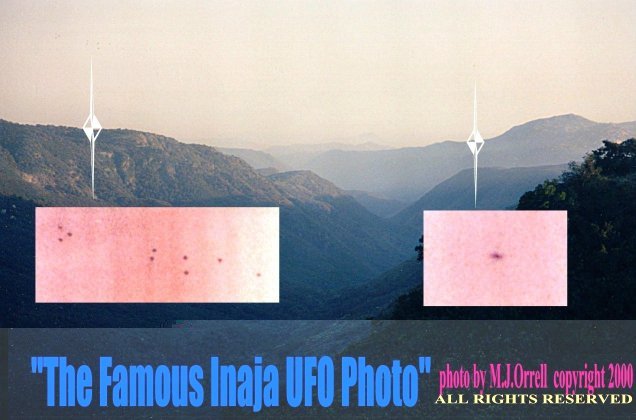
On 1 July 1990 Michael J. Orrell, then 34, a drywaller, amateur photographer and occasional bit actor living in the Pacific Beach area of San Diego, drove into the back country with two friends to shoot landscapes. This case file covers what witnesses reported, the official narrative, and a two-pass assessment with its evidence tier.
What did witnesses see at Inaja Memorial Picnic Grounds?
On 1 July 1990 Michael J. Orrell, then 34, a drywaller, amateur photographer and occasional bit actor living in the Pacific Beach area of San Diego, drove into the back country with two friends to shoot landscapes. He stopped in the hills above Santa Ysabel near the Inaja Memorial Picnic Grounds, off Highway 79 in San Diego County. By his own account the sun was getting low, around 3:30 to 4:00 in the afternoon, sinking toward the west. He set a Canon EOS 650, a 35mm body that was new on the market then, on a block of stone, pushed the lens to its maximum zoom, framed the hazy canyon and the ridge lines of the San Diego River valley, and pressed the shutter once. "I took a deep breath, I exhaled, and pulled the trigger," he told the La Mesa Patch in 2011. He saw nothing unusual in the air at the time. There is no report of anyone present, Orrell included, watching any object cross the sky. The objects exist only on the film.
The dots appeared when the prints came back. "As soon as I saw the four-by-six picture, I saw the dots," Orrell said in the 2006 KFMB News 8 piece. There were ten small dark specks against the bright haze, so faint that in the standard print they were hard to make out. Orrell had the frame enlarged "again and again" until the marks resolved. The standard count, given by Orrell himself, by KFMB and by the Los Angeles Times, is ten objects: nine clustered to the left of the frame and a single one to the right. One later secondhand account, the 2011 Patch article, says "nine," which is the left-hand cluster only and undercounts the lone right-hand mark; the ten figure is the one Orrell uses and the one the original 1991 and 2006 reporting carries.
Orrell described the shapes as having no wings and no flapping appendages, "unlike birds or planes that would have wings or appendages," and called them "uniform in density and size." He read them as "acorn shaped and triangular." In the Los Angeles Times account from 1991 the ten dots "appear triangular," several "seemed to Orrell to be flying in formation," and "some appeared to have shiny undersides, metallic maybe." He fastened on a small projecting spike on one of the objects, an acorn-and-point profile he came to call a sacred or lost pattern, and claimed to have found the same shape in other UFO photographs, in ancient artifacts, in crop circles and in the Nazca Lines of Peru. He also compared the acorn silhouette to the object some Kecksburg, Pennsylvania witnesses described in 1965.
What is the official explanation?
There is no government file on the Inaja photograph. No air force, no police agency and no aviation authority investigated it, because nothing was reported in the sky at the time and the marks were noticed only later on an enlargement. The case has never been the subject of a Blue Book entry, a military review or any official report. What stands in place of an official narrative is a single piece of independent, civilian, hands-on examination, plus a string of attributions that do not hold up to checking.
The one examination that can actually be sourced was arranged by KFMB News 8 in San Diego for a Special Assignment segment that aired 11 May 2006, reported by Stan Miller. The station took Orrell's original negative to Chrome Photo, a lab in the Sorrento Mesa district of San Diego, and asked staff there to look at it. A technician noted the marks were "irregularly shaped, though, sort of triangular." The lab ruled out the ordinary print-killers: dust on the lens, damage to the negative, mechanical defects in the camera. Staffer Dennis Reiter said on camera, "The negative itself was intact. There was no damage, no machine type damage in the process." They ran the negative through a high-resolution scanner and enlarged it on a computer. Asked whether the dots were UFOs, Reiter gave the careful answer that the case still rests on: "I would agree with him, they are flying objects and they are unidentified." Then he closed the door on the interpretation Orrell wanted: "If you're asking me if they're alien spacecraft, there's absolutely no indication they are alien spacecraft." So the only documented analysis confirms the marks are real exposures on an untampered negative and confirms nothing else. Unidentified, in Reiter's mouth, means literally not identified, not anomalous.
The other "expert" endorsements that follow the photo around do not survive sourcing. The 1991 Los Angeles Times feature quoted Don Ecker, a researcher with the Los Angeles-based UFO Magazine, who said plainly that "without a computer analysis, he could not judge the authenticity of the dots," offering only that they resembled "a wave of recent sightings" in Europe. That is a non-finding. The claim repeated across Orrell's promotion and on aggregator pages, that the Navy optical physicist Dr. Bruce Maccabee judged the objects "unidentifiable and opaque," cannot be traced to anything Maccabee wrote. Maccabee published detailed analyses of the cases he took on, McMinnville, New Zealand, Gulf Breeze, and those papers are catalogued. No Maccabee-authored report, web page or letter on the Inaja photograph exists in the public record. Every appearance of the "unidentifiable and opaque" line traces back to Orrell's own materials, not to Maccabee. It is an attribution, not a verified analysis, and it is treated here as such.
What is documented is the photo's circulation. The Los Angeles Times San Diego edition broke the story in June 1991. KFMB ran its segment in 2006. UPI carried a wire item, "Man preaches UFO gospel," on 6 July 2011. The print was displayed at the San Diego Air and Space Museum in Balboa Park as part of its "Science of Aliens" special exhibition around 2010 to 2011. None of that is authentication; it is exposure.
What did the witnesses think it was?
Michael Orrell is the sole witness, and he did not witness the objects. That is the central feature of this case. He saw nothing in the sky, framed a landscape, fired one frame, and found the dots on the developed print. His belief in what they are has grown far past what the photograph can carry. He labels it "the best UFO photo ever taken." In the 1991 Los Angeles Times piece, already a year into his mission, he said, "I believe they manifested themselves to me for a reason. It's something I'm obligated to pass down. I have the burden of knowledge." He came to read the objects as intelligently crewed spacecraft and tied them to the Nazca Lines, the Bermuda Triangle and rock formations in the Southwest. By 2011 he was telling reporters he expected the craft to return and rescue humanity, framing the photo inside a personal eschatology and calling himself a "citizen scientist" and "student of metaphysics" who planned to "spread the UFO gospel." He self-published a book, "Aliens From Above: The Last in Line." He insists he is not in it for money: "I'm not trying to make a dime off of this. I'm just trying to spread the word."
There are no corroborating witnesses to the objects. No second photographer caught them, no one on the ridge that afternoon saw anything, and the two friends with Orrell are named in no account as having seen objects in the air. The reinforcement Orrell offers is not human testimony but pattern-matching: he says the acorn-with-a-spike shape recurs in other UFO images and in ancient art, and he treats that recurrence as confirmation. That is the weakest kind of corroboration, because it is supplied by the witness himself, from his own later study, and is exactly the sort of self-similar pattern a motivated observer finds once he is looking for it. Orrell's sincerity is not in question. His interpretation is, and even the lab he relies on for credibility, Chrome Photo, refused to follow him to the alien-spacecraft conclusion.
The dispute
The mundane reading of the Inaja photograph holds that the ten dark specks, nine clustered to the left and one to the right, are ordinary things rendered as dots: distant birds, insects near the lens, dust or emulsion grains, or far-off aircraft, all compressed into ambiguity by a long lens shot at maximum zoom into low-contrast haze toward the setting sun. The objects were too small to see in the original 4x6 print and surfaced only under repeated enlargement, and there is no motion data, no second angle, no scale, no parallax, and no triangulation to test against. On the page's own account this is a credible, method-consistent explanation. It is also the kind of explanation that fits a single under-resourced frame almost by default.
What the dispute does not have is anyone who actually advanced it with a shown method. No agency advanced a finding: the page states plainly that no air force, no police agency, and no aviation authority ever investigated the photograph, and there is no government file. No skeptic or independent analyst produced a reconstruction, a lens-and-haze demonstration, a matched bird or aircraft identification, or a fakery technique. The page is explicit on this point: no independent analyst has shown the specific method by which the image is mundane or faked. The counter-explanation is therefore a reasonable hypothesis stated in the abstract, not a demonstrated result.
The one piece of hands-on work cuts the other way on the only question it touched. The lone documented analysis, done at Chrome Photo lab in San Diego in 2006 at the arrangement of KFMB News 8, had technician Dennis Reiter confirm the negative was intact and undamaged. He went on record that the marks are flying objects and are unidentified, while explicitly declining to call them alien spacecraft. That examination authenticated the negative and refused to label the specks anomalous in any exotic sense, but it produced no finding that the objects are mundane. It neither closes the case as ordinary nor confirms anything extraordinary.
By this archive's method an apparatus debunk is a claim rather than a verdict, and here there is not even an apparatus debunk, only a mundane hypothesis that no one has carried out. The weaknesses of the case are real and they all sit on the believer's side: a sole witness, Michael Orrell, who did not see the objects when he took the frame and has since become its full-time promoter, no corroborating observers, no second photographer, and a single frame with no supporting measurements. Those facts keep the photograph from proving anything. They do not amount to a demonstrated debunk, so the case stands as genuinely unidentified rather than explained, which is why the page itself tiers it Disputed and not resolved.
Is the Inaja Photograph real? The two-pass assessment
Pass one, the ordinary read. This is a single still frame, shot at maximum zoom into thick afternoon haze, in which the photographer saw nothing at the time and ten faint dark specks turned up only on heavy enlargement. Every one of those facts points the same way. A long lens stretched to its limit, firing into low-contrast haze toward a setting sun, compresses distance and flattens small distant things into shapeless dark blobs, which is precisely how Orrell describes them, dots so small he could not see them until the print was blown up "again and again." Objects too small to register on the original four-by-six, in a frame no one saw move, are the signature of distant birds, insects near the lens, dust or emulsion specks, or far-off aircraft rendered as dots. Birds soaring at distance lose visible wings and read as uniform dark shapes, and "flying in formation" is what a scattered flock looks like frozen in one exposure. The lone independent examination that exists, Chrome Photo's in 2006, found the negative physically intact and the marks really present in the scene, then went no further than "flying objects and they are unidentified," with Dennis Reiter stating outright there was "absolutely no indication they are alien spacecraft." No motion data, no second angle, no scale, no parallax, no triangulation, nothing that could establish size, distance or speed. The "acorn and triangular" shape is read into a handful of dark pixels. The corroboration Orrell offers is his own pattern-matching to Kecksburg and the Nazca Lines, which is interpretation piled on interpretation. On the ordinary reading this is an unremarkable photograph of distant specks that the photographer has spent thirty-five years elevating into a revelation.
Pass two, if it is real. Take the objects as genuinely airborne and unexplained. Even then the photograph cannot tell you what they are. Reiter confirmed the dots correspond to something that was actually in the sky and not to a lab artifact, so at minimum these are real distant objects, not scratches or paint. But "real and unidentified" is the floor, not the ceiling, and it is the same status a flock of birds or a cluster of balloons at distance would carry on a single un-witnessed frame. There is no measurement that pushes the objects out of the prosaic envelope and into the genuinely anomalous, no demonstrated velocity, no demonstrated structure, no demonstrated size. Unlike the cases where a photoanalyst could derive distance and brightness and rule out a near hoax, here no such analysis was ever done, and the one analyst most often invoked for it, Bruce Maccabee, has no traceable connection to the photograph at all.
This case has a credible, method-consistent mundane explanation (faint distant objects, most plausibly birds or specks, on a maximum-zoom haze shot that no one witnessed) sitting against a single frame with no supporting measurements and a sole witness who has become its full-time promoter. But no independent analyst has shown the specific method by which the image is mundane or faked. The only hands-on examination authenticated the negative while explicitly declining to call the objects anomalous. That combination, a strong counter-explanation that is not actually proven and an official-free record, is the definition of contested rather than discredited. Tier: Disputed. It is disputed because the evidence is one un-witnessed, un-measured frame whose only verifiable analysis says "unidentified" in the narrowest sense and "no indication of anything alien" in the same breath, and because the headline endorsements that make it sound stronger, Maccabee above all, do not trace to any primary source.
Sources
- web.archive.org/web/20230927210957/https://www.ufocasebook.com/inaja.html
- www.latimes.com/archives/la-xpm-1991-06-12-me-469-story.html
- patch.com/california/lamesa/helix-alum-had-double-take-now-he-spreads-the-ufo-gospel
- www.upi.com/Odd_News/2011/07/06/Man-preaches-UFO-gospel/53041309941000/
- web.archive.org/web/20200914232946/https://www.ufocasebook.com/inajalarge.jpg
More cases from this region: UFO sightings in United States