The Robert Taylor Encounter at Dechmont Woods
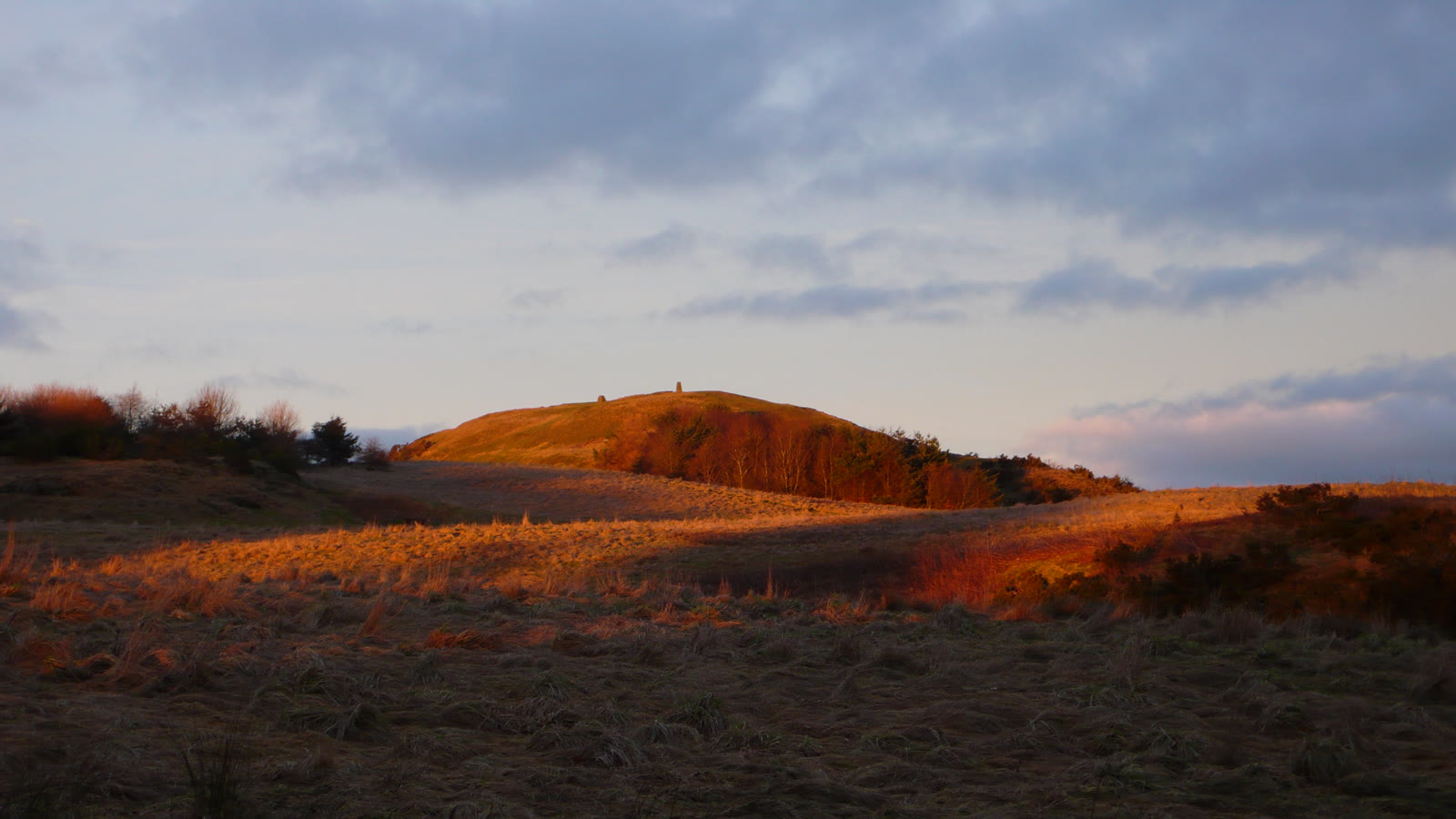
On the morning of 9 November 1979, Robert Taylor, a forester for the Livingston Development Corporation, drove his pickup to the edge of Dechmont Woods on the slope of Dechmont Law, parked, and walked up a forestry track with his red setter to inspect young trees. This case file covers what witnesses reported, the official narrative, and a two-pass assessment with its evidence tier.
What did witnesses see at Dechmont Woods?
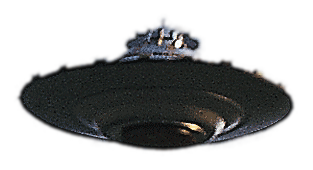
On the morning of 9 November 1979, Robert Taylor, a forester for the Livingston Development Corporation, drove his pickup to the edge of Dechmont Woods on the slope of Dechmont Law, parked, and walked up a forestry track with his red setter to inspect young trees. He was around 61, a working man on an ordinary round. According to his account, he rounded a corner into a small clearing and came face to face with something he could not place: a large dome shaped object, roughly twenty feet across and dark grey, hanging silent above the forest floor. He described the surface as a dull metallic material with a rough texture, in places almost like sandpaper, and said parts of it seemed to shift or fade as if it were trying to blend into its surroundings. Set around the lower edge was a kind of flange or outer rim carrying small projections that he likened to propellers on stalks.
What happened next is the detail that lifts this case out of the ordinary sighting category. Taylor said two smaller spheres, each perhaps the size of a beach ball and studded with spikes or rods, dropped from the main object and rolled across the ground toward him, making a sucking or plopping sound as the spikes bit into the earth. He said they reached him, attached themselves to either side of his trousers near the legs, and began to drag him toward the larger object. At the same moment a powerful, acrid stench hit him, which he later compared to burning brakes or hot metal, strong enough to choke him. He remembered a hissing noise, then nothing. His dog, the red setter Lara, was distressed and barking through the episode.
Taylor reckoned he was unconscious for around twenty minutes. When he came round the clearing was empty. The dome and the spheres were gone. He felt sick, his legs ached badly, and he could not speak properly. He could not get to his feet at first and crawled, then staggered, back toward his truck. The vehicle would not start, and in his confused state he had run it into soft ground. So he walked, roughly a mile, back to his home in Livingston, arriving filthy, grazed and badly shaken. His trousers were torn. His chin and thighs were grazed. His wife took one look at the state of him and called both a doctor and the police.
What is the official explanation?
What makes Dechmont Woods unique in British UFO history is the official response. Taylor was visibly injured and incoherent, his clothing torn, and his wife reported it as an attack. Lothian and Borders Police therefore opened the matter as a possible criminal assault, and to this day it is widely cited as the only UFO related report in the United Kingdom that was logged and investigated by the police as a potential crime. Officers went up to the woods that same afternoon, found the clearing exactly where Taylor had directed them, and recorded physical marks on the ground.
The marks are the core of the physical case. Police and later investigators described two parallel sets of impressions in the turf that looked like the rungs of a ladder pressed into the ground, each track around two and a half metres long, plus a scatter of roughly forty smaller circular holes, each about ten centimetres across, arranged in a way that seemed to follow the path the spheres would have taken. Investigators noted there were no vehicle tracks leading into or out of the clearing, and that the dimensions did not match any Development Corporation vehicle known to work the site. Some accounts attribute to a detective inspector the impression that something of several tons in weight had stood there, though the depth and significance of the marks later became a point of dispute.
Because it was being handled as an assault, Taylor's torn trousers were sent for forensic examination. The popular version of the case holds that the analysis was consistent with the cloth having been torn by a sharp upward pull rather than by snagging, which would fit Taylor's description of being dragged. Skeptical reviewers note a more deflating forensic footnote, that traces of powder on the clothing were identified as ordinary contact transfer from the sack the items were transported in, not anything exotic. The police inquiry ultimately reached no conclusion. There was a victim, an injury, physical traces and a sincere complainant, but no suspect, no object and no explanation, so the file went cold rather than being solved or dismissed. West Lothian Council and the former Livingston Development Corporation have since treated the site as a genuine local landmark, marking the spot with a plaque on a stone, later adding an information board and a waymarked UFO trail.
What did the witnesses think it was?
The witness is the reason this case has never quietly gone away. Robert Taylor was not a thrill seeker or a known eccentric. He was a long serving, well regarded forestry foreman with the Livingston Development Corporation, a churchgoing man described by those who knew him as honest, sober and entirely without interest in publicity. He had no prior involvement in UFO circles and did not court the press. The story spread because he reported an assault, not because he sold a tale. Until his death in 2007, well into his late eighties, he told the same account without embellishment and without ever trying to profit from it. That consistency, across nearly three decades and to investigators of very different sympathies, is one of the strongest single elements in his favour. People who exaggerate or invent tend to drift. Taylor did not.
His family and colleagues corroborated the things that can be corroborated, which is his physical and mental state rather than the object itself. His wife saw him arrive home grazed, muddy and unable to speak clearly, and acted immediately. The torn trousers and grazes were real and were examined. His truck really was stuck. None of this proves a craft, but it does rule out the laziest dismissal, that he simply made it up at the kitchen table, because the distress and the injuries were witnessed by others within the hour.
The case was investigated by serious researchers as well as the police. Malcolm Robinson, founder of the Scottish group Strange Phenomena Investigations, took an early and detailed interest and remained one of its principal chroniclers, later publishing a full length study of the incident. The British UFO Research Association looked at it and discussed the ground marks in its Journal of Transient Aerial Phenomena. On the skeptical side, the writer Steuart Campbell investigated the site repeatedly and built the best known mundane hypothesis, with medical input from Dr Patricia Hannaford of the Edinburgh University UFO Research Society. The fact that both believers and committed skeptics treated Taylor himself as credible, and argued instead about what caused his experience, tells you a great deal about how the witness held up.
Is the Robert Taylor Encounter at Dechmont Woods real? The two-pass assessment
Pass one, the mundane reading. The single most developed sceptical account comes from Steuart Campbell, and it is a real hypothesis with its own evidence, not a hand wave. Campbell proposed that Taylor suffered an isolated temporal lobe epileptic seizure, an idea developed with the physician Dr Patricia Hannaford. The supporting points are genuinely suggestive: the overwhelming acrid smell is a classic seizure aura, the inability to speak afterwards fits transient aphasia, the heavy aching and temporary weakness in the legs resembles post seizure paresis, and Taylor had a relevant medical background including a history of meningitis and reported headaches earlier in 1979. Crucially he declined hospital investigation, so a neurological cause was never ruled out. Campbell paired this with a trigger, a superior mirage of Venus, low and bright that morning, possibly elevated and distorted by a temperature inversion over the valley, with the spiked spheres explained as visual artefacts. The ground marks, on this reading, were not made by Taylor's encounter at all. Campbell reported that the water authority had laid a cable duct within about a hundred metres of the clearing and that stacks of pipes could have been stored there, and BUFORA's own review noted the marks were shallow, lying in the grass rather than pressed deep into the soil, which undercuts the dramatic several tons impression. The torn trousers, examined as assault evidence, yielded only mundane powder transfer from the transport sack. Put together, that is a coherent story in which there was never any object: a man with a seizure prone physiology had a fit beside pre existing ground disturbance, and an honest mind reconstructed it as an attack.
Pass two, taking it as a real event. The strength here is that this is not a lights in the sky report. It is a close encounter with physical traces, an injured witness, and a police criminal inquiry, which is about as serious an evidentiary footing as a UFO case gets in Britain. The ground marks were photographed and measured by police and independent investigators, no matching vehicle was identified, and there were no tracks in or out of the clearing. The witness was sober, consistent for the rest of his life, and corroborated by family for his state on the day. The mirage element is the weakest link in the sceptical case. Venus at low altitude in daylight is a faint and unconvincing candidate for a twenty foot textured dome seen at close range in a wooded clearing, and the epilepsy diagnosis, while plausible, was never actually made by an examining doctor. So a believer can fairly say the mundane account stacks several unproven contingencies, the right inversion, an undiagnosed seizure, conveniently placed pipes, and still leaves the close range solidity of Taylor's description unaddressed.
The honest verdict is Disputed, and strongly so, because there is real evidence on both sides rather than a clear answer on either. There genuinely were physical traces, a genuine police investigation, and a witness whose integrity even his debunkers respected, and there is also a genuine, internally consistent medical and astronomical hypothesis that would dissolve the whole thing without any craft. Neither side has closed it. What cannot be defended is calling it discredited, because the sceptical case, for all its merit, rests on a seizure that was never diagnosed and a mirage whose conditions were never confirmed. It also cannot be called confirmed, because nothing in the record demands an object. It sits exactly where the evidence leaves it, a sincere man, real marks in the grass, a cold police file, and two rival explanations that each fall just short of proof.
Sources
- www.westlothian.gov.uk/media/26988/Dechmont-Law-UFO-info/pdf/Dechmont_Law_UFO.pdf
- www.undiscoveredscotland.co.uk/livingston/livingstonincident/index.html
- www.metabunk.org/threads/scotland%E2%80%99s-socorro-the-dechmont-robert-taylor-ufo-1979.13637/
- web.archive.org/web/20250915064358/https://www.ufocasebook.com/taylor1979.html
- ufos.ac.uk/dechmont-woods/
- www.westlothian.gov.uk/media/26987/Dechmont-Law-UFO-Map/pdf/Dechmont_Law_UFO_Map.pdf
More cases from this region: UFO sightings in United Kingdom