The France Mass Sighting of 5 November 1990
On the evening of Monday 5 November 1990, somewhere around 19:00 local time, thousands of people across France looked up and watched a long, slow, completely silent train of lights cross the sky from west to east. This case file covers what witnesses reported, the official narrative, and a two-pass assessment with its evidence tier.
What did witnesses see at Across France?
On the evening of Monday 5 November 1990, somewhere around 19:00 local time, thousands of people across France looked up and watched a long, slow, completely silent train of lights cross the sky from west to east. The phenomenon was visible from the Atlantic coast all the way to Alsace, and reports also came in from Belgium, Britain and Czechoslovakia. The official French case file at GEIPAN (CNES) carries more than 150 separate gendarmerie procès-verbaux for that single evening, and the privately compiled Banque OVNI dossier later listed around 400 distinct observation accounts for the night. Witnesses included priests, mayors, notaries, lawyers, police officers, soldiers, gendarmes, airline pilots and air traffic controllers.
The descriptions splice together two very different impressions. Many people described exactly what a bright fireball or reentry looks like: a swarm of glowing fragments with trails, moving in formation, silent, taking several minutes to traverse the sky. But a large fraction of witnesses insisted they had seen a single solid structure. SEPRA in Toulouse was flooded for over a week with callers describing "an immense luminous triangle." Some put the object at only a few hundred metres of altitude. Some sketched a dark body that connected the lights, with beacons, jets, contrails and searchlight beams, and estimated the craft at hundreds of metres or even a couple of kilometres long.
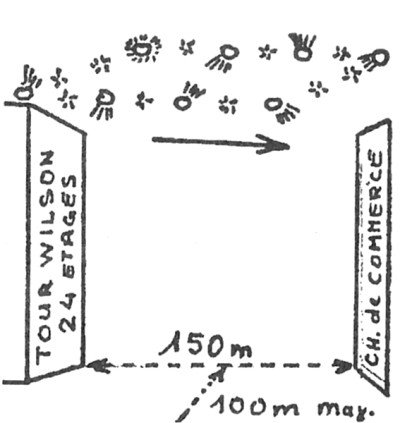
One of the most cited close accounts is the Mulhouse sighting in the Haut-Rhin. An adult woman, writing to investigators on 8 November, described looking up near the Tour Wilson around 18:30 to 18:45 and seeing what she first took for a low-flying airliner, then realised was "a squadron" of roughly fifteen lights of varied colours, sizes and intensities, with powerful beams "as projected by powerful spotlights," gliding slowly and silently from northeast to southwest in an almost geometric pattern she called "rather a rectangle than a triangle." Her own pencil sketch, the hero image here, shows the scattered lights crossing between the Tour Wilson and the Chamber of Commerce with the distances "150m" and "100m max" written underneath, capturing the central feature of the whole wave: she perceived something at street-corner range that was in fact roughly a hundred kilometres up.
Near Dax in the southwest, a military helicopter instructor pilot from the ESALAT flight school, named in the gendarmerie record as Gilles F., a man with 6,000 flight hours and the aeronautical medal, filed one of the most detailed reports. He described an enormous dark triangular craft passing below his helicopter near the Peyrehorade airfield, propelled without sound and carrying "no standard aviation lights," with orange halos, marginal vortices and erratic white scintillating lights along its leading edge like neon tubes.
What is the official explanation?
The event landed squarely on SEPRA, the CNES service in Toulouse that had inherited the old GEPAN role of studying anomalous aerial reports and atmospheric reentries. CNES later called this the single most significant case its UFO body ever had to manage. By 20:00 on 5 November the CNES duty service was overwhelmed with calls relayed from gendarmerie brigades. The identification came fast and from a primary technical source. On 6 November a trained satellite observer, the amateur astronomer Pierre Neirinck, who belonged to a visual satellite-tracking network, told SEPRA that the lights matched the decaying third stage of a Soviet Proton rocket, and supplied the trajectory. NASA confirmed the reentry on 8 November, citing the object as "20925/1990 - 94C / GORIZONT 21 PLATFORM / USSR," and CNES orbitography services validated a track crossing France from the Gulf of Gascogne to Alsace. The finding went to the press agencies on Friday 9 November.
The orbital record is independently checkable and consistent. Gorizont 21 (COSPAR 1990-094A) was launched on a Proton-K from Baikonur on 3 November 1990. Two spent pieces followed it into a low parking orbit: 1990-094B (catalog 20924), which decayed on 4 November, and 1990-094C (catalog 20925), the third stage proper, which the R.A.E. Table of Satellites 1990 logs as decaying "1990 Nov 5.75, which is about 18h UTC." SeeSat-L tracking discussion lists that stage in a roughly 147 by 148 km orbit, period 87.4 minutes, inclination 51.7 degrees, mass about 700 kg.
GEIPAN's later reconstruction nails down the physics. Using its DEBRISK fragmentation software, CNES modelled the stage breaking up from about 94 km altitude over the Bay of Biscay, the burning debris cloud crossing France at an altitude falling from roughly 100 km down to about 50 km, while decelerating from around 7 km/s to 2 km/s. CNES reentry specialist Pierre Omaly presented the simulated Google Earth trajectory for a television documentary. The case file is classified A (identified) with an étrangeté (strangeness) score of 0.12 and a consistance (data quality) score of 0.72. The official line on why so many people saw a low, near, solid craft is the classic proximity illusion: a brilliant light high in the sky carries no cues to its true distance, so the eye places it close, gives it apparent structure, and the spread of separate fragments over tens of kilometres reads as a single rigid object several minutes long, with apparent changes of speed and shape as the geometry shifts from one observer's location to the next. The same illusion is well documented for ordinary bright meteors and bolides.
What did the witnesses think it was?
A striking feature of this wave is the calibre of the witnesses who would not accept the reentry verdict for what they personally saw. Jean-Pierre Haigneré, a CNES cosmonaut and professional observer, saw the phenomenon himself and confirmed its "strangeness." Jean-Gabriel Greslé, a former airline pilot turned ufologist, reported from Gretz-Armainvilliers a triangular-section beam marked with lights and "enormous headlights" that he said descended below 400 metres, stabilised, and changed direction twice in impressive silence, behaviour that a ballistic cloud of tumbling debris cannot perform. The Dax helicopter instructor Gilles F. described powered, silent, structured flight beneath his own aircraft. A Millau driving examiner sent investigators a detailed written account followed by a drawing. The Mulhouse witness drew a low, close swarm of beamed lights. Many witnesses, the dossiers record, were "outraged" by what they saw as an explanation imposed too quickly by SEPRA, and rejected it firmly. Even the actor Alain Delon went public on 11 November to say he did not believe the official story.
The contrarian case rests on the residue the reentry model does not obviously cover: witnesses who reported a dark solid body linking the lights, who described intelligent-seeming manoeuvres, vertical ascent, or alternating slow and fast motion, and the cluster of "analogous" sightings reported across the same month. The veteran researcher Jean Sider, writing in the MUFON UFO Journal in May 1992, called it possibly "the greatest UFO flap in France since the autumn of 1954" and "one of the largest possible UFO flaps in French history." Critics also note that some witness-stated directions of travel do not line up with the southwest-to-northeast debris track.
Set against the witnesses' conviction is the documented mechanism by which the wave itself was partly manufactured downstream. The skeptical French site univers-ovni catalogues cases where the most dramatic "structured craft" reports were elaborated after the fact, as the press and ufologists fed the proximity illusion back to witnesses. Pilots and other trained observers are, ironically, among the most confident misperceivers of bright reentries precisely because their distance-estimating instincts assume a nearby aircraft. None of that erases the honesty of any individual witness, and hostile or skeptical commentary is weighed as motivated like any other. But it does mean the structured-craft testimony, however sincere, is not independent corroboration of a structured craft.
The dispute
The counter-explanation is that the entire event was the atmospheric reentry of space debris, specifically the third stage of a Soviet Proton rocket that had launched the Gorizont 21 communications satellite from Baikonur on 3 November 1990. This is not an official assertion left to stand on authority alone. It was first advanced by a civilian, the amateur astronomer and trained satellite observer Pierre Neirinck, who on 6 November told SEPRA that the lights matched the decaying Proton third stage and supplied the trajectory. It was then independently confirmed by NASA on 8 November, which named the object as catalog 20925, designation 1990-094C, "GORIZONT 21 PLATFORM / USSR." The identification rests on a specific, cataloged, named object rather than a vague "must have been space junk" hand-wave, and the orbital record is independently checkable: the R.A.E. Table of Satellites logs that stage decaying about 18h UTC on 5 November.
The method behind the verdict is fully shown rather than merely claimed. CNES modelled the stage breaking up from roughly 94 km altitude over the Bay of Biscay, with the burning debris cloud crossing France while descending from about 100 km to 50 km and decelerating from around 7 km/s to 2 km/s, reproduced with the DEBRISK fragmentation software and a Google Earth reconstruction presented by reentry specialist Pierre Omaly. The trajectory, the timing of about 19h French local time, and the physics of fragmentation all align, and the case was officially classified Identified (A) with a strangeness score of 0.12. The proximity illusion accounts for why a brilliant, distance-cue-free light high in the sky was placed close by the eye and read as a single solid triangular structure, with the spread of separate fragments across tens of kilometres misperceived as one craft. There is no balloon, drone, flare, or hoax claim involved, and there is no confession because the phenomenon was a real, identified reentry.
Where the counter-explanation falls short is that it closes the broad element while leaving the central notable claim open. The reentry ID positively accounts for the train of lights, the silence, the duration, and the formation. It does not positively identify the structured-craft residue reported by expert witnesses: helicopter instructor Gilles F. with 6,000 flight hours and the aeronautical medal, who described a dark triangular craft with no standard aviation lights passing below his own aircraft; former airline pilot Jean-Gabriel Greslé, who reported a craft that descended below 400 metres, stabilised, and changed direction twice in silence; and CNES cosmonaut Jean-Pierre Haigneré, who confirmed the phenomenon's strangeness. Many witnesses were recorded as outraged at an explanation they felt SEPRA imposed too quickly. The proximity illusion is offered as the mechanism for these reports, but it is an inference applied to the residue, not a measurement of it.
So the dispute is genuine and still live in the French literature, where it is now held that the wave can no longer be presented as the sole result of an atmospheric reentry. No independent, civilian, method-shown analysis has ever closed out the residual testimony as a hoax or as a single mundane object beyond reasonable contest, and there is no recovered prop, no recantation, and no positive identification of the specific structured craft those witnesses described. The weight of evidence points hard at the Proton reentry for the bulk of the night, but the unresolved perceptual residue carried by credible witnesses is what keeps the central claim contested at the margins rather than fully closed.
Is the France Mass Sighting of 5 November 1990 real? The two-pass assessment
Pass one, the entirely ordinary reading. This is the best-documented prosaic explanation in the whole UFO record, because the culprit is an independently catalogued object. A Soviet Proton-K launched Gorizont 21 from Baikonur on 3 November 1990. Its spent third stage, NORAD 20925 / 1990-094C, was tracked in low orbit and is logged in the R.A.E. Table of Satellites decaying at about 18h UTC on 5 November, which is roughly 19h French local time, the exact hour the lights crossed France. The trajectory ran from the Bay of Biscay to Alsace, matching the witness map. The physics of a fragmenting upper stage glowing at 50 to 100 km altitude, moving slowly across the sky for minutes, silent, in formation, with the brightness fooling the eye into placing it close and giving it false structure, accounts for the core observation cleanly. The identification came fast and from a primary technical source: the amateur astronomer and trained satellite observer Pierre Neirinck told SEPRA on 6 November that the lights matched the decaying Proton third stage, NASA confirmed the object on 8 November, and CNES reproduced the breakup with its DEBRISK fragmentation model and a Google Earth reconstruction presented by reentry specialist Pierre Omaly. The file is classified A (identified) with a strangeness score of 0.12. There is no reasonable doubt that the great mass of the 5 November 1990 reports were generated by this reentry. The proximity illusion is well documented for ordinary bright meteors and bolides, and the skeptical site univers-ovni records how the most dramatic structured-craft accounts were elaborated downstream as the press and ufologists fed the illusion back to witnesses.
Pass two, what the debunk does not close. The reentry ID positively settles the broad, ordinary element, the train of lights. It does not touch the narrow residue that makes this case notable in the literature. A minority of high-calibre witnesses, a CNES cosmonaut (Jean-Pierre Haigneré), a former airline captain (Jean-Gabriel Greslé), a 6,000-hour ESALAT military helicopter instructor (Gilles F.), insisted on features a tumbling debris cloud should not show: a dark solid body connecting the lights, controlled changes of direction, stabilisation below 400 metres, powered silent flight beneath an aircraft. Greslé reported a triangular-section craft that descended, stabilised, and changed direction twice in silence. GEIPAN itself logs the file as Identified A, yet French sources concede the wave can no longer be presented as the sole result of an atmospheric reentry, and the dispute remains live. No independent, civilian, method-shown analysis has ever closed out this residual testimony as a deliberate hoax or a single mundane object beyond reasonable contest. The proximity illusion plus narrative drift is a plausible and documented mechanism for these errors, but it is an inference applied to the residue, not a positive identification of it.
Verdict. This is Barely Disputed, not Strongly Disputed. The counter-explanation is strong, primary-sourced, and physically modelled, and it closes the large prosaic component of the night completely. What it does not do is close the central notable claim, the structured-craft residue from expert witnesses, which the case's own record describes as contested at the margins rather than fully closed. Strongly Disputed is reserved for cases where the core notable claim is positively shut, with a confession, a recovered prop, or a positive identification of the specific reported object. None of that exists for the residue here. The debunk closes the broad train of lights while the narrow anomaly that gives the case its place in the French literature still stands, so the case largely stands and is filed Barely Disputed.
Sources
- www.cnes-geipan.fr/fr/cas/1990-11-01225
- www.cnes-geipan.fr/en/actualites/simulation-rentree-atmospherique-1990
- aerogend.com/5-novembre-1990-rencontre-du-1er-type/
- ufologie.patrickgross.org/alsacat/1990-11-05-mulhouse.htm
- www.satobs.org/seesat/Dec-2005/0126.html
- www.satobs.org/seesat/Dec-2005/0101.html
- satobs.org/seesat_ref/Oberg/901105-French_wave.pdf
- rr0.org/science/crypto/ufo/enquete/dossier/5Novembre/
- www.sciences-faits-histoires.com/blog/ovni-ufo/ovnis-retour-sur-l-evenement-du-5-novembre-1990.html
More cases from this region: UFO sightings in France