Air France Flight 3532 (1994)
On 28 January 1994 at 13:14 GMT, Air France flight AF 3532, an Airbus A320 (registration F-GFKG) flying the Nice to London leg at cruise altitude near Coulommiers in Seine-et-Marne, southeast of Paris, carried Captain Jean-Charles Duboc, copilot Valerie Chauffour, and a chief steward who happened to be in the cockpit. This case file covers what witnesses reported, the official narrative, and a two-pass assessment with its evidence tier.
What did witnesses see at Over Coulommiers?
On 28 January 1994 at 13:14 GMT, Air France flight AF 3532, an Airbus A320 (registration F-GFKG) flying the Nice to London leg at cruise altitude near Coulommiers in Seine-et-Marne, southeast of Paris, carried Captain Jean-Charles Duboc, copilot Valerie Chauffour, and a chief steward who happened to be in the cockpit. The COMETA Report records the altitude as roughly 11,900 meters (around flight level 390) under excellent weather, with an underdeck of altocumulus and visibility the crew put past 300 kilometers.
The steward saw it first. In the COMETA text he "signale un phenomene lui paraissant etre un ballon meteorologique," a phenomenon that looked to him like a weather balloon. Chauffour confirmed the sighting at once. Duboc looked next and his first read was an aircraft banked at about 45 degrees of inclination. He rejected that almost immediately. As he put it in his own account, "I found this slope absolutely abnormal because aircraft are not inclined at this altitude beyond 30 degrees without risking to fall down." Within seconds all three agreed that what they were looking at resembled nothing they knew.
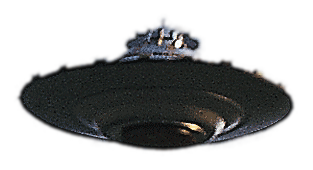
Using the altocumulus layer as a reference, Duboc estimated the object sat at about 10,500 meters altitude and roughly 50 kilometers away, off to the left of the aircraft at the ten-o'clock position. Given that distance and its apparent diameter, the crew concluded the thing was very large. What struck them most was that it kept changing shape. The COMETA Report describes it appearing first as "une cloche de couleur brune," a brown bell, "avant de se transformer en lentille de couleur brun-marron," before turning into a chestnut-brown lens. Duboc later described "the impression to observe a gigantic lens in evolution," with a "dark red color and of the fuzzy edges."
The end was the strangest part. The object did not fly off. It vanished where it sat. Duboc said, "We saw it becoming translucid, transparent, diluted in space. That was absolutely amazing." In the COMETA wording it disappeared "sur la gauche de l'appareil d'une facon quasi instantanee, comme s'il etait devenu subitement invisible," instantaneously on the left of the aircraft, as if it had suddenly become invisible. The whole observation lasted on the order of one to two minutes by Duboc's account, longer by the copilot's. Chauffour, in the SEPRA witness statements, described the form evolving in three dimensions, the lens blurring and shifting toward a chevron-like shape, rather than the simple stationary disc Duboc emphasized.
Duboc reported the phenomenon to air traffic control at Reims, which had no aircraft logged in the vicinity. Following procedure, Reims notified the Air Defense Operations Center (CODA) at Taverny and asked Duboc to file an "Airmiss" report on landing.
What is the official explanation?
This is one of the most heavily documented aviation cases in the French official record, because two separate state bodies examined it: SEPRA at CNES (the French space agency), and the COMETA committee of senior officers and IHEDN auditors.
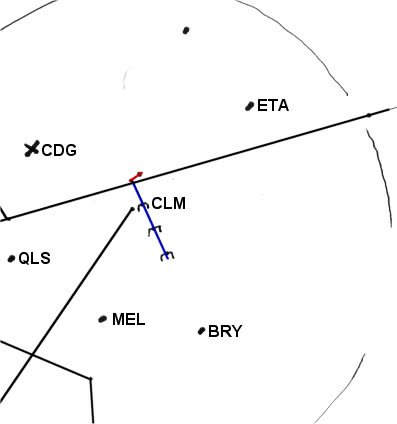
The pivot of the official file is the radar. The COMETA Report states it plainly: "Le CODA a effectivement enregistre au meme moment une piste radar initiee par le centre de controle de Cinq-Mars-la-Pile correspondant en lieu et en heure au phenomene observe." The CODA had in fact recorded, at the same moment, a radar track initiated by the control center at Cinq-Mars-la-Pile, corresponding in place and time to the observed phenomenon. "Cette piste radar, qui a ete enregistree pendant 50 secondes, croise bien la trajectoire du vol AF 3532 et ne correspond a aucun plan de vol depose." This track, recorded for 50 seconds, crossed the trajectory of flight AF 3532 and matched no filed flight plan. Crucially, "le phenomene disparait au meme instant a la vue de l'equipage et des scopes radar," the phenomenon vanished at the same instant from both the crew's eyes and the radar scopes.
From the geometry of that crossing, COMETA reports, "Les investigations menees par le CODA permettent a la fois d'exclure l'hypothese du ballon meteorologique et de connaitre la distance precise de croisement des deux trajectoires et par consequent de ramener a 250 m de long la taille approximative de l'engin." The CODA investigations let the analysts exclude the weather balloon hypothesis and, from the precise crossing distance, bring the approximate size of the object down to about 250 meters. COMETA also noted that the North regional air navigation center, which handles 3,000 movements a day, had opened only three such cases in seven years, AF 3532 among them. The report reproduced a reconstitution diagram of the two trajectories built from the Cinq-Mars-la-Pile radar recordings (page 49 of the GS Presse edition).
SEPRA, headed by Jean-Jacques Velasco, ran the formal investigation after Duboc filed his report on 27 February 1997, prompted by a February 1997 Paris-Match article by former Air Force pilot Jean-Pierre Biot that first revealed the radar signature. Investigator Dominique Weinstein recorded detailed statements from the crew. Velasco set out his analysis in his 2004 book "L'Airbus, le radar et l'OVNI." The COMETA panel, chaired by General Denis Letty, heard Duboc for roughly 90 minutes and settled on an estimate of about 300 meters in diameter after discussion with him.
The case remains officially open. The CNES/GEIPAN public case file, reference 1994-01-01345, classifies it "D1," its label for "cas inexplique moyennement consistant avec un caractere d'etrangete marque," an unexplained case of medium consistency with a marked strangeness. GEIPAN's own conclusion text reads, "Ce cas s'avere donc inexplique, avec des temoignages coherents pour une observation tout a fait etrange," the case is therefore unexplained, with coherent testimony for a thoroughly strange observation. GEIPAN noted only two remote residual possibilities, an unknown atmospheric optical phenomenon, or a flexible object drifting with the wind, and adopted neither.
What did the witnesses think it was?
Jean-Charles Duboc was a senior Air France captain, not a fringe figure, and he sat on the symptomatic side of this story for three years before saying anything. By his own account he did not file a report at first because he could not see how to document "such a mysterious and unexplained phenomenon" without inviting ridicule. It was only the 1997 Paris-Match piece revealing that a military radar had logged a matching track that moved him to write it up formally.
His firsthand testimony is consistent across the years. He repeatedly stressed three things: the abnormal 45-degree bank that ruled out an ordinary airliner, the bell-to-lens shape change, and the dematerialization in place rather than a departure. On the radar, Duboc noted that the airborne weather radar on the A320 was not running at the time, since it is only needed in instrument flight, so the cockpit had no independent radar fix of its own; the radar confirmation came entirely from the ground military system. Confronted later with the objection that the radar track did not perfectly line up with the visual, Duboc offered a speculative answer, suggesting modern military aircraft can synthesize a virtual radar image while staying visually distinct, and warned that any interception attempt could endanger civilian aviation. That is his interpretation, not established fact, and it is weaker than the rest of his account.
The corroboration is the strongest feature of the case. There are three independent cockpit witnesses, the steward, copilot Valerie Chauffour, and Duboc, who saw the object together and agreed it was anomalous, even though they differed on details such as exact duration and whether the object was strictly stationary. Chauffour's SEPRA statement diverged from Duboc's on the geometry, describing a shape evolving in three dimensions and an apparent trajectory rather than a fixed point, which argues against a tidy shared confabulation. Both COMETA and GEIPAN treated all three witnesses as credible and their testimony as coherent. Duboc went on to become a public advocate for transparency on the phenomenon, citing his own case as one of the indisputable files studied by GEIPAN.
The dispute
The dispute is narrow but real, and it targets the single feature that made AF 3532 famous: the claim that a ground military radar independently confirmed the crew's UFO. The counter-explanation was advanced by named French skeptics David Rossoni, Eric Maillot and Eric Deguillaume, associated with the Association Francaise pour l'Information Scientifique (AFIS), in their 2007 book and an AFIS review dated 17 March 2008. Their method is geometric reconstruction of the radar and visual positions. They show that the radar track recorded at Cinq-Mars-la-Pile approached from the right of the Airbus and was relatively close to it, the signature you would expect from a small or light aircraft, whereas all three crew members consistently placed their object far away and to the left. If the radar and the visual are not the same object, then the dramatic "simultaneous radar confirmation" collapses, and the visual sighting stands alone as a distant, shape-shifting, ill-measured form. Maillot proposed it could have been a weather balloon or another commercial aircraft, the same prosaic reading the steward and copilot reached in their very first seconds.
This critique is strong enough to demote the case from verified, because the radar correlation was the load-bearing claim and the skeptics show, with a stated method, that the spatial geometry does not obviously support it. It is also worth noting that even the official side conceded the correlation was not airtight: the SEPRA/Velasco investigation acknowledged it could not establish an absolute correlation between the radar signature and the observed phenomenon, and GEIPAN's own record states the radar signature did not correspond to the visual observation. So the dispute is not a fringe attack; it overlaps with what the investigators themselves admitted about the radar.
It does not, however, close the case. The skeptics dispose of the radar leg but not the visual one. A weather balloon or an airliner does not present as a roughly 250 to 300 meter object, does not transform from a brown bell into a chestnut lens, and does not become translucent and dematerialize in place within seconds in front of three trained aircrew under 300-kilometer visibility. The angular-size work derived from Duboc's own report form still implies a hundreds-of-meters object at 46 to 50 kilometers. And the timing coincidence flagged in the COMETA primary text, the object leaving both the eye and the radar scope at the same instant, remains unaddressed by the light-aircraft hypothesis. GEIPAN, fully aware of the radar problem, still classifies the case D1 "inexplique" with coherent witness testimony. The dispute therefore wounds the case's headline claim without resolving the underlying observation, which is exactly why it lands at Barely Disputed rather than Strongly Disputed.
Is the Air France Flight 3532 (1994) real? The two-pass assessment
Pass one, the ordinary explanations. The strongest is the one named, method-shown skeptics actually advanced. David Rossoni, Eric Maillot and Eric Deguillaume, writing in the Association Francaise pour l'Information Scientifique orbit, argued the celebrated radar-visual correlation is an artifact. Their point is geometric and specific: the recorded radar track approached from the right of the Airbus and was close to it, consistent with a small aircraft, while all three crew described their object far off to the left. If the radar and the visual are two different things, then the visual loses its hard data and becomes a fuzzy, color-changing, distant shape, which Maillot suggested could be a weather balloon or another commercial aircraft (a Guppy-type cargo plane has been floated). The steward's and copilot's own first impression, a weather balloon, sits inside this lane. This is a real, named, method-shown critique and it is why the case is disputed rather than verified.
Pass two, if it is not ordinary. Even granting the skeptics' separation of radar from visual, the visual phenomenon is not explained by a balloon or an airliner. A balloon does not present as a 250 to 300 meter object, does not morph from a bell into a lens, and above all does not turn translucent and dissolve in place in seconds while three trained aircrew watch. The angular-size analysis on Patrick Gross's site, drawn from Duboc's report form (about half a moon diameter, roughly 15 arcminutes) and a 46 to 50 kilometer distance, yields a width in the low hundreds of meters, which no drifting balloon supplies. And the timing coincidence remains stubborn: per the COMETA primary text, the object vanished from the crew's eyes and from the radar scopes at the same instant, which the radar-is-a-light-aircraft theory has to dismiss as luck. The official apparatus did not close the case to make it go away; SEPRA, COMETA and GEIPAN all examined it and left it unexplained, with GEIPAN holding a D1 "inexplique" classification to this day. Under the rule that official engagement is evidence a case was real enough to need studying, that weighs in the object's favor, not against it.
So we have a genuine dispute that bites on the radar leg of the case and a residual visual phenomenon that none of the conventional candidates fit. The skeptical analysis is named and shows its method, but it does not settle the matter; it converts a two-channel case into a one-channel case and then leaves that channel unexplained. SEPRA's and GEIPAN's standing verdict is "unexplained." That combination, a real counter-explanation that is partial and contested, with the core observation still open, is the textbook shape of Barely Disputed, and that is the tier.
Sources
- documentaires-toniques.fr/wp-content/uploads/2018/11/rapport-cometa.pdf
- www.cnes-geipan.fr/fr/cas/1994-01-01345
- ufologie.patrickgross.org/ufology/af3532rt.htm
- ufologie.patrickgross.org/ufology/af3532ta.htm
- ufologie.patrickgross.org/htm/duboc01.htm
- rr0.org/science/crypto/ufo/enquete/dossier/Duboc
- www.afis.org/Trente-ans-d-etudes-du-CNES
- ufologie.patrickgross.org/ufology/af3532.htm
More cases from this region: UFO sightings in France