The America West Flight 564 Encounter
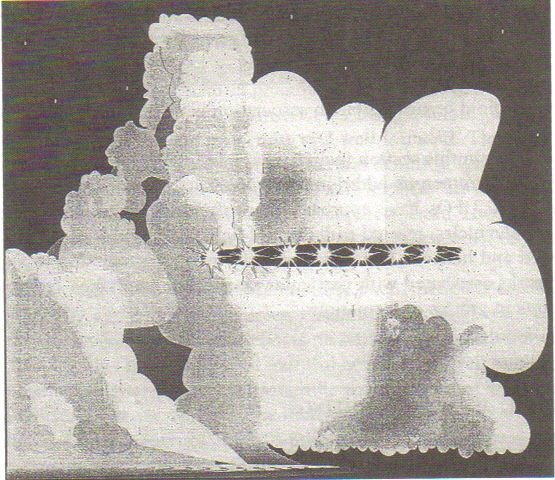
On the night of 25 May 1995 the crew of America West Flight 564, a Boeing 757 using the call sign "Cactus 564", was westbound from Tampa, Florida to Las Vegas, Nevada, cruising at 39,000 feet across the Texas panhandle and into eastern New Mexico. This case file covers what witnesses reported, the official narrative, and a two-pass assessment with its evidence tier.
What did witnesses see at Near Bovina?
On the night of 25 May 1995 the crew of America West Flight 564, a Boeing 757 using the call sign "Cactus 564", was westbound from Tampa, Florida to Las Vegas, Nevada, cruising at 39,000 feet across the Texas panhandle and into eastern New Mexico. In the cockpit were Captain Gene Tollefson, First Officer John J. Waller, and a flight attendant. At about 9:29pm, off to the aircraft's right and somewhat below their altitude, the crew saw a horizontal row of bright white lights that strobed on and off in sequence from left to right. First Officer Waller got on the radio to Albuquerque Air Route Traffic Control Center and asked the controller to identify it: "Cactus 564, off to our 3:00, got some strobes out there. Could you tell us what it is?" The controller did not know, noting only that the lights were over a restricted area the military used in the daytime.
The crew kept watching as the airliner pulled ahead and the lights fell behind into a bank of thunderclouds. When lightning lit the clouds from behind, the strobing lights resolved into the silhouette of a dark, wingless, elongated, cigar-shaped object. Waller and Tollefson could not fix the object's exact range, but estimated its length at 300 to 400 feet. On the FAA tape Waller can be heard telling Albuquerque, "When it lightning'd you could see the dark object. It was like a cigar shape from the altitude that we could see it, and the length is what got us, sort of confused, because it looked like it was about 300-400 feet long." He placed the strobe sequence as starting from the left and running right, "counter-clockwise," and the object at roughly 30,000 feet. He told the controller it was "the first time in 15 years I've ever seen anything like this."
The object did not show on FAA radar, and the controller checked with several sector positions and outside facilities while the sighting was in progress. He called Cannon Air Force Base near Clovis to ask whether a tethered balloon had been released over a spot the controllers called "tieband"; Cannon said no, they had nothing up. The controller called a facility near Fort Sumner and an outfit identified only as "Bigfoot" at Sector 87, asking if anyone knew of a 300 to 400 foot cylindrical object with a strobe near Tucumcari, north of Cannon, at 30,000 feet. Every site came back negative. The controllers, audibly rattled, joked on the tape that "it's a ufo or something, it's that Roswell crap again." Importantly, this was not a single pair of eyes: a second aircraft was vectored to look, and Waller reported back, "Three of us up here saw it." The visible part of the encounter ran roughly from 9:29pm to past 9:40pm, with controller follow-up traffic continuing to 9:48pm.
What is the official explanation?
There is no formal government report that adjudicates this case; the United States military stopped publicly investigating UFO reports when Project Blue Book closed in 1969. What exists instead is the contemporaneous official radio record and the responses of the agencies the controllers phoned that night, all captured on the FAA voice tape that investigator Walter N. Webb later obtained.
The radar picture splits in two. First, while the sighting was in progress, the object was not painted on FAA radar at all. One Albuquerque controller contacted the North American Aerospace Defense Command (NORAD), which initially reported an unidentified radar track in the vicinity. That first track was run down and turned out to be a small aircraft whose transponder was not initially operative, an ordinary explanation for that one return. Second, and separately, the next morning the controller said he checked with NORAD again and was told they had tracked "another, very unusual target" in the same general area a short time after the first: something that sat stationary, then accelerated rapidly and stopped abruptly, repeating the cycle several times, with bursts of speed computed at between 1,000 and 1,400 mph. Richard Hall's report is careful to flag the status of that second claim: it rested on the word of a single air traffic controller relaying a second-hand NORAD remark and "could not be confirmed." It should be treated as an unverified lead, not as established radar data.
On the ground, Cannon Air Force Base told Albuquerque it had no tethered balloon, weather balloon, or aircraft aloft that could account for the object, and the restricted areas the airliner passed were reported inactive. Walter Webb, investigating for the UFO Research Coalition (a joint effort of the Fund for UFO Research, CUFOS, and MUFON), filed Freedom of Information Act requests for government records on the night's activity and checked military installations directly for anything that could explain the sighting. He found nothing that correlated. Webb issued an interim report in 1995 and a final report in 1996 through the Fund for UFO Research; his conclusion, in Hall's summary, was that "no known object or phenomenon could be found that correlated with the sighting." The case was later aired on the History Channel program "Black Box UFOs," which played the actual audio of the conversations with the Flight 564 crew, with NORAD, and with an F-111 pilot.
What did the witnesses think it was?
First Officer John J. Waller was the most engaged witness, doing all the radio work and producing a drawing of the object as it appeared silhouetted against the lightning-lit thunderclouds; that sketch is copyrighted to him and dated 1995. Captain Gene Tollefson corroborated the size estimate, the two pilots together putting the object at 300 to 400 feet long. The flight attendant in the cockpit also saw the row of lights. Waller's own words on the tape convey what he believed he was looking at: an object of genuinely unusual length carrying a sequenced strobe, unlike anything he had seen in fifteen years of flying. At one point he allowed that it was "probably military in that restricted area," the reasonable first guess of a working pilot, but the controllers' own checks knocked that down when Cannon AFB and the other facilities all reported nothing aloft and the restricted areas inactive.
The corroboration is the strongest feature of this case. This was not one excited observer. Three people in the Flight 564 cockpit saw it, Waller stating flatly on the recording, "Three of us up here saw it." Beyond that, the FAA tape captures multiple controllers at Albuquerque Center discussing the object in real time ("you know we're all up here huddled up talking about it"), a second aircraft being vectored to look toward it, and other pilots on frequency overhearing and asking about "that cactus guy." Walter Webb interviewed the crew and the air traffic controllers and cross-checked their accounts against the voice tape, which is why the human testimony here is unusually well anchored to a contemporaneous official recording rather than to memory recalled years later.
The dispute
The case carries one genuine, named counter-explanation that keeps it out of the fully unexplained tier, but that explanation is partial and was never demonstrated, which is why it sits at Barely Disputed rather than anything stronger. The candidate is a large tethered aerostat or research balloon. A 300 to 400 foot, dark, wingless, cylindrical body that holds station, carries lights, and is not painted on air traffic radar is a fair physical description of a high-altitude balloon or a tethered aerostat seen edge-on, and the controllers themselves reached for exactly this idea in real time, phoning Cannon Air Force Base to ask whether a tethered balloon had been released over "tieband." Skeptics who have looked at the case have leaned on that same balloon reading.
The problem is that the official record cuts against it rather than for it. Cannon AFB answered the balloon question directly and said no, nothing was up, and the further calls to facilities near Fort Sumner and to "Bigfoot" Sector 87 all came back negative, with one site stating it had no "high balls" published that day. So the most natural prosaic explanation was put to the people who would have launched such a thing, on the night, and they denied it. No one has since produced a balloon manifest, a launch record, or any documentary proof that a 300 to 400 foot aerostat was aloft near Tucumcari that evening. The balloon hypothesis therefore remains an unproven assertion, not a method-shown debunk: no analyst has identified the specific balloon, matched its track, or shown how it produced the left-to-right sequenced strobe the crew described.
Two further wrinkles are sometimes folded into the dispute but do not actually settle it. The first NORAD radar track, the one that was real, was resolved as an ordinary small aircraft with an inoperative transponder; that explains a blip on a scope, not the large lighted cigar the crew watched against the clouds, and the two should not be conflated. The dramatic second NORAD claim, of a target darting at 1,000 to 1,400 mph, runs the other way and would make the object more anomalous, but it rests on one controller's second-hand account and was never confirmed, so it cannot be used as evidence in either direction. What remains is a multiple-witness, multiple-controller sighting of a very large lighted object that no contacted agency would claim and that Walter Webb's FOIA and field inquiries could not tie to any known activity. The balloon idea is plausible enough to log and weak enough that the case largely stands.
Is the America West Flight 564 Encounter real? The two-pass assessment
Pass one, the ordinary readings. The leading mundane candidate is a large tethered aerostat or high-altitude research balloon. The shape fits: a long, dark, wingless cylinder that hangs roughly in place, carries lights, and may not return a strong radar signal is consistent with a balloon, and the crew watched it fall behind them rather than maneuver, which is what a near-stationary balloon would do relative to a fast-moving jet. A second ordinary thread is the first NORAD track, which was genuinely resolved as a small aircraft with a transponder that was not working at first. A third is simple range and size misjudgment at night against thunderclouds, where a pilot's "300 to 400 feet" is an estimate of an object whose distance he openly said he could not fix. None of these is idle. But each runs into the record. The balloon was specifically denied by Cannon AFB and by every other facility the controllers called, and no launch record has ever surfaced. The small-aircraft resolution covers one radar blip, not the lighted cigar three people in the cockpit watched. And the misjudgment angle has to contend with multiple independent observers, including controllers and at least one other aircraft, all engaging with the same object in real time on a recorded frequency.
Pass two, if it is not an everyday object. Then what stands is a very large, dark, cylindrical craft carrying a horizontal bank of sequentially strobing white lights, holding a position that made it appear stationary as a Boeing 757 overtook it at 39,000 feet, invisible to civil radar, and unclaimed by the Air Force base whose restricted airspace it sat in. The unconfirmed second-hand NORAD remark, if it were ever substantiated, would push it further from anything conventional by adding stop-start accelerations to 1,400 mph, but that claim cannot be leaned on. What can be leaned on is the unusually clean evidentiary chain: a contemporaneous FAA voice tape, multiple named and unnamed witnesses across two aircraft and several controller positions, a witness drawing made at the time, and a methodical follow-up by Walter Webb that included FOIA requests and direct checks of military installations, all of which failed to find a correlating object or activity.
Weighing both passes, this is not a case with a method-shown debunk, and it is not a case with zero counter-explanation either. A specific prosaic candidate, the balloon, exists and was reached for by the controllers themselves, which keeps the file honest and out of the fully unexplained tier. But that candidate was denied at the source, never demonstrated, and never tied to a real launch, so it is an official-flavored assertion without a shown method rather than a settled answer. The corroboration is strong, the documentation is strong, and the case largely stands. That places it at Barely Disputed.
Sources
- www.nicap.org/reports/950525rep.htm
- web.archive.org/web/20250130103038/https://www.ufocasebook.com/americanwest564.html
- www.ufoevidence.org/cases/case225.htm
- www.theblackvault.com/casefiles/america-west-airlines-flight-564-ufo-case/
- www.nicap.org/images/950525draw.jpg
More cases from this region: UFO sightings in United States