The Manchester Airport Near-Miss (1995)
At about 1848 hours on the evening of 6 January 1995, a British Airways Boeing 737-200, operating as flight BA5061 inbound from Milan with around 60 people aboard, was descending through 4,000 feet over the Pennines roughly 8 nautical miles southeast of Manchester Airport. This case file covers what witnesses reported, the official narrative, and a two-pass assessment with its evidence tier.
What did witnesses see at Over the Pennines?
At about 1848 hours on the evening of 6 January 1995, a British Airways Boeing 737-200, operating as flight BA5061 inbound from Milan with around 60 people aboard, was descending through 4,000 feet over the Pennines roughly 8 nautical miles southeast of Manchester Airport. The aircraft was under radar vectors from Manchester approach control, being turned onto the downwind leg for an instrument approach to Runway 24. The captain was Roger Wills and the first officer was Mark Stuart. It was dark, with visibility better than 10 kilometres and a fairly strong wind out of the northwest (recorded as roughly 340 degrees at 30 knots).
Both pilots saw a lighted object come down the right-hand side of the aircraft at high speed, travelling in the opposite direction. The sighting lasted only about two seconds. There was no sound and no wake, and the object made no attempt to alter course or avoid the airliner. First Officer Mark Stuart instinctively ducked as it went past, convinced something solid had just flashed by the cockpit at close range.
What is striking about the case, and what investigators wrestled with, is that the two trained observers in the same cockpit described the object differently. In his account to the CAA, Captain Wills said the thing carried "a number of small white lights, rather like a Christmas tree." First Officer Stuart instead described a dark, solid body: he reported a "wedge-shaped" object "with what could have been a black stripe down the side," and felt it may have been lit up by the Boeing's own landing lights rather than carrying lights of its own. Stuart was emphatic that he had seen "a solid object, not a bird, balloon or kite." Both men were experienced enough to rule out, to their own satisfaction, a balloon, a kite, a model aircraft, and even a military stealth type, which Wills said he was familiar with and did not believe this was.
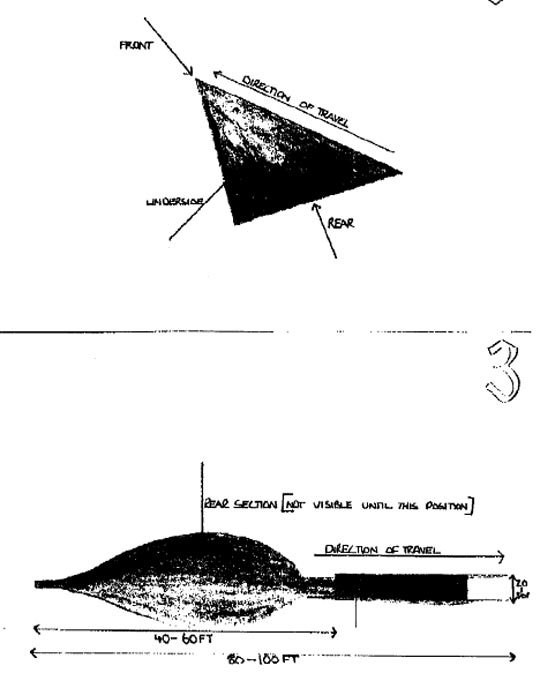
After landing the two pilots independently drew what they had seen. The released file holds a pilot sketch showing a dark triangular or wedge form annotated "FRONT," "UNDERSIDE," "REAR" and "DIRECTION OF TRAVEL," with a side profile giving size estimates of roughly 40 to 60 feet and an overall span of about 80 to 100 feet, plus a note that the rear section was "not visible until this position." Concerned enough to act, the crew filed a formal airmiss report, the standard aviation paperwork for a dangerous close approach, which is what pulled the encounter into the CAA's official machinery rather than into a UFO hotline.
There was also at least one independent report from the ground. A member of the public named Mark Lloyd reported seeing a strange craft in the same general area, which he described as an oblong object with a curved front and a series of small nozzle-like features at the rear, and he too produced a drawing. A separate ground sketch in the released files depicts an object so large the witness estimated it at many times the size of a football pitch. The ground material is weaker than the cockpit testimony and was handled separately, but it is on record alongside the airmiss file.
What is the official explanation?
This is one of the rare UFO encounters that generated a genuine official aviation-safety document rather than a brush-off. The investigating body was the United Kingdom Civil Aviation Authority's Joint Airmiss Working Group, the same panel that adjudicated ordinary near-collisions between aircraft. Its finding was published as Airmiss Report No 2/95, released in February 1996 after roughly a year of inquiry. The working group had the pilots' written reports and sketches, transcripts of the relevant radio frequencies, the air traffic controllers' reports, and recorded radar data. The group went out of its way to commend the crew for their courage in filing the report and their company for its open attitude, language that signals the panel took the witnesses seriously rather than treating them as cranks.
The report worked methodically through conventional explanations and discarded them. On radar, it concluded that "despite exhaustive investigations the reported object remains untraced," and noted that at no time during the relevant leg was any other radar contact seen near the 737. On the possibility of unauthorised military activity, the group judged it "most unlikely that such a flight would have been conducted in CAS [controlled airspace] and so close to a busy international airport," and pointed out the area was well covered by several radars that would normally catch such traffic. On the lighter-than-aircraft and recreational options, the panel found that "this kind of activity, together with the hang glider/microlight theory, could not be regarded as a realistic possibility," given the darkness, the strong wind, the terrain of the Pennines, and the speed and behaviour described. Balloons, kites and model aircraft were likewise dismissed as not fitting what two professional pilots had reported.
Having eliminated its candidates, the working group recorded the two key verdict lines as "Cause: Unassessable" and "Degree of Risk: Unassessable," and closed with the plain statement that "the incident therefore remains unresolved." It was, by the CAA's own count, the fourth such airmiss involving an unidentified object since 1987, but it was the one that drew the most attention because the testimony was so clean and the safety paperwork so formal.
A second strand of officialdom is the Ministry of Defence. Because an airmiss can touch on air defence, the CAA routinely notified the MoD of the pilots' report. The MoD's position survives in a letter later opened to the public. An official wrote that the department had been "notified about the pilots' report by the Civil Aviation Authority shortly after the incident occurred," that he had "discussed the matter with the departmental air defence experts who confirmed that they were not aware of anything which would indicate a matter of defence significance associated with the sighting, or any evidence that the UK's air defences had been compromised," and that "in the absence of such evidence, MoD interest in the sighting has long since ceased." This is the standard MoD UFO-desk formula of the period: no defence angle, therefore no further interest, which is not the same as an explanation.
The documentary trail later became public when the National Archives released the MoD's UFO files. The airmiss material sits in file DEFE 24/2042 (around pages 182 to 183), and a ground-witness sketch from the same day sits in DEFE 24/1991 (around page 264). The pilots' sketches were reproduced again in researcher David Clarke's "UFO Drawings from the National Archives." Crucially, no official body, not the CAA and not the MoD, ever named an identified object. The closest thing to a "debunk" on the official side is the MoD saying the case posed no defence threat, which under standing order is logged as evidence the report was real enough to be processed through formal channels, not as a finding against it.
What did the witnesses think it was?
Captain Roger Wills and First Officer Mark Stuart (British Airways flight BA5061); independent ground witness Mark Lloyd
The dispute
The dispute is a single, specific counter-explanation: that the pilots saw a bright meteor, or fireball, rather than any solid craft. It was advanced most prominently by Ian Ridpath, an astronomy writer and long-standing UFO skeptic, on his own website, where he reproduces the CAA report and adds his analysis. His method is to match the reported characteristics to the known signature of a fireball. He points out that a bright streak lasting only a couple of seconds, leaving no radar return and producing no wake or sonic boom, is "entirely characteristic of a bright fireball," and that Captain Wills's description of the object as resembling a Christmas tree "is a typical description of a fireball." He concludes there is "no good reason to suppose that it was anything else," and criticises the CAA for confining itself to aircraft explanations and never consulting astronomers at nearby Jodrell Bank.
That explanation has real force for one half of the testimony. It accounts cleanly for the captain's lights, the very short duration, the silence, and above all the total absence of a radar contact, which is genuinely hard to reconcile with a large solid aircraft passing close to a well-covered airport. If the only witness account were Wills's, the fireball reading would be close to decisive.
It does not close the case, for two connected reasons. First, it is unanchored. Ridpath does not cite a specific fireball report, a named meteor shower active at that hour, or any observatory, all-sky-camera, or fireball-network record for the evening of 6 January 1995. The claim that "a likely answer would not have been difficult to find" is an assertion that the data would support a fireball, not a demonstration that any particular fireball was logged. Second, it contradicts the other professional in the cockpit. First Officer Mark Stuart did not describe a luminous streak. He described a dark, solid, wedge-shaped object with a possible black stripe, apparently lit by the Boeing's landing lights, and he drew its front, underside and rear with size estimates. Meteors have no dark structured body, no underside, and no measurable span, and they do not make a trained pilot duck because a solid mass seems about to clip the aircraft. The fireball hypothesis therefore has to treat Stuart's account as mistaken while accepting Wills's, even though both are primary, contemporaneous testimony recorded by the CAA.
Set against a regulator that examined radar tapes, controller reports and crew statements and still recorded the cause as "unassessable" and the case as "remains unresolved," and against a corroborating ground witness the same evening, the meteor explanation is a plausible but partial and unproven counter-claim. It is enough to make the case disputed, but not enough to settle it, which is why the verdict is Barely Disputed rather than Strongly Disputed.
Is the Manchester Airport Near-Miss (1995) real? The two-pass assessment
Pass one, how this could be entirely ordinary. The strongest mundane candidate, and the one advanced by a named independent analyst, is a bright meteor or fireball. The astronomy writer and veteran UFO skeptic Ian Ridpath argues exactly this. On his reproduction of the CAA report he writes that "the basics of the report, a bright streak lasting a couple of seconds, no radar returns, and no wake or sonic boom, are entirely characteristic of a bright fireball," and he notes that the captain's "Christmas tree" description "is a typical description of a fireball." On his astronomical-causes page he goes further, saying that "had the CAA chosen to consider astronomical explanations, a likely answer would not have been difficult to find," that "from the captain's description, the object sounds like a bright fireball," and that "in view of the lack of a radar return or a wake there is no good reason to suppose that it was anything else." He also chides the regulator for not consulting nearby Jodrell Bank, jotting on the report "wonder why they never asked Jodrell Bank." This is a real, named, method-described counter-explanation, and it accounts neatly for the captain's lights, the two-second duration, the silence and the radar void. Other ordinary possibilities, raised and rejected by the CAA itself, include unlogged military traffic, a microlight or hang glider, a balloon, a kite, or a model aircraft.
But Ridpath's explanation has a clear gap, and it is the reason this case does not collapse. He never cites a specific dated fireball record, a meteor shower active at 1848 on 6 January 1995, or any observatory or fireball-network log for that night. The argument is phenomenological: it matches the profile of a fireball, therefore it probably was one. It also has to explain away First Officer Stuart's account, and a fireball does not. Stuart did not describe a streak of light. He described a dark, solid, wedge-shaped body with a black stripe, lit by the aircraft's own landing lights, structured enough that he drew its front, underside and rear and estimated its size. Meteors do not have a dark daylit-looking structure, an underside, or a measurable span, and they do not provoke a trained pilot to duck because a solid mass appears to be passing the canopy. The fireball reading effectively privileges the captain's "lights" wording and discards the first officer's "solid wedge" wording, when both are primary testimony from the same cockpit.
Pass two, if real, what is it. If the object was a physical craft, the candidates split into the prosaic and the exotic. The prosaic version is some unacknowledged man-made vehicle, a secret or test aircraft of the kind the area's military use sometimes invites speculation about, which the pilots could not identify and which somehow stayed off the radars that the CAA insisted should have caught it. The exotic version is an unidentified structured object of unknown origin, which is where the witnesses themselves stopped, declining to name it. The wedge or triangular form, the apparent size, the high closing speed with no sound and no wake, and the absence of any radar return all sit uneasily with both known aircraft and known natural phenomena, which is exactly why the CAA's professionals, with radar tapes and controller reports in hand, signed off the case as "unassessable" and "unresolved."
Weighing the two passes, this lands at Barely Disputed. There is a counter-explanation, it is offered by a credible named analyst, and it is internally coherent, which keeps the case from being Verified Unexplained. But the fireball hypothesis is not anchored to a single piece of dated astronomical evidence, it has to overwrite half of the cockpit testimony to work, and it stands against an official aviation-safety body that examined the radar and the witnesses and still could not identify the object. A meteor explanation that cannot quote a meteor, set against two professional pilots, a corroborating ground witness, and a CAA verdict of "remains unresolved," is a weak debunk, not a settled one. The case largely stands, so the tier is Barely Disputed.
Sources
- www.ianridpath.com/ufo/CAA-Manchester-UFO-report.html
- www.ianridpath.com/ufo/astroufo1.html
- ufologie.patrickgross.org/htm/manchester95.htm
- www.thinkaboutitdocs.com/1995-civil-aviation-authority-report-on-near-miss-with-ufo/
- www.ufoevidence.org/cases/case31.htm
- aidan.co.uk/eyewitness-in-manchester/mwn/mwn126UFO.shtml
- www.manchestersfinest.com/long-reads/unsolved-mysteries-the-curious-near-miss-of-flight-ba5061/
- openminds.tv/uk-ufos-unsolved-080610/
- www.openminds.tv/wp-content/uploads/triangle1.jpg
- web.archive.org/web/20251002094534/https://www.telegraph.co.uk/news/newstopics/howaboutthat/ufo/7254652/UFO-had-near-miss-with-Boeing-737.html
More cases from this region: UFO sightings in United Kingdom