The Trans-en-Provence Landing Trace
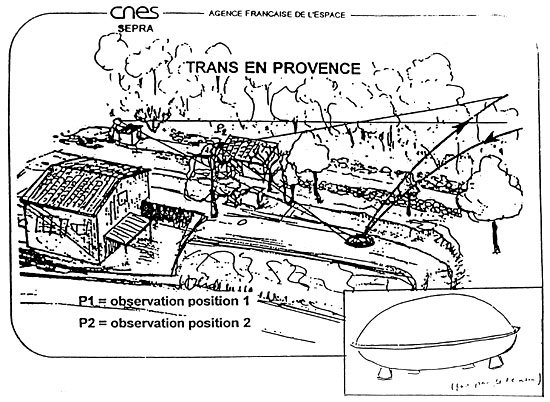
On the afternoon of 8 January 1981, at about 5pm, Renato Nicolai, a 55-year-old farmer and engine fitter, was building a concrete shelter for a water pump on a terrace above his property at Trans-en-Provence, in the Var department of southeastern France. This case file covers what witnesses reported, the official narrative, and a two-pass assessment with its evidence tier.
What did witnesses see at Trans-en-Provence?
On the afternoon of 8 January 1981, at about 5pm, Renato Nicolai, a 55-year-old farmer and engine fitter, was building a concrete shelter for a water pump on a terrace above his property at Trans-en-Provence, in the Var department of southeastern France. He told the gendarmes he heard a low whistling sound coming from behind him, "a kind of little whistling," turned, and saw an object descending toward a terrace below his garden, roughly thirty meters away.
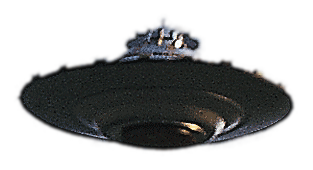
In his statement Nicolai described a craft "in the form of two saucers upside down, one against the other." He put its height at about 1.5 meters and its color at the dull grey of lead. He said it had a raised border or brace running around its circumference, and that as it settled and then immediately lifted off he saw two round protrusions underneath, "two kinds of round pieces which could have been landing gear or feet," extending perhaps 20 centimeters below the body, along with what looked like two small circular openings or trap doors on the underside.
The object rested on the ground only a few seconds. Nicolai said it lifted off "still emitting a slight whistling sound" and departed on a rising trajectory. He described it as being about the height of a pine tree at the moment he first saw it. The whole observation lasted on the order of thirty to forty seconds.
When he walked down to the terrace where the thing had sat, Nicolai found a roughly circular mark about two meters across pressed into the soil, with scuffed or scraped arcs ("ripage" marks, sliding striations) at points around its circumference. He did not touch it. The next morning, 9 January, he and his wife showed the trace to the local gendarmerie, who came out, photographed the ground, interviewed him, and collected soil and plant samples from inside and around the ring. That fast, official sample collection within roughly a day of the event is what separates Trans-en-Provence from almost every other landing-trace story: there was physical material in a laboratory chain of custody before anyone had time to think about it.
What is the official explanation?
Trans-en-Provence is the rare UFO landing case investigated by a national government's own science arm, on the record, with the file later released. The body was GEPAN, the Groupe d'Etudes des Phenomenes Aerospatiaux Non-identifies, set up in 1977 inside CNES, the French national space agency, in Toulouse. The gendarmerie's rapid response fed straight into that machinery. The case carries the official CNES/GEIPAN reference number 1981-01-00849, and the modern GEIPAN catalog still lists it.
The detailed findings were published as GEPAN Note Technique No. 16, "Enquete 81/01, Analyse d'une Trace," in March 1983, with Jean-Jacques Velasco as the lead investigator. Velasco later published the analysis in English in the peer-reviewed Journal of Scientific Exploration, Vol. 4, No. 1, 1990, pages 27 to 48, under the title "Report on the Analysis of Anomalous Physical Traces: The 1981 Trans-en-Provence UFO Case." Soil samples were sent to four laboratories for independent physico-chemical work, including electron diffraction and mass spectrometry, and the plant material went to the biochemist Michel Bounias at the French National Institute for Agronomic Research (INRA), who published his own findings in the same 1990 JSE issue.
The physical results, as documented in Note Technique 16 and the JSE paper, were specific. The trace was modeled as two concentric rings about 10 centimeters wide, an inner circle about 2.2 meters in diameter and an outer one about 2.4 meters, forming a crown. The ground inside the ring had been compressed by a mechanical force GEPAN estimated at about 4 to 5 tons. The soil showed signs of heating, with the analysts estimating temperatures reached somewhere between roughly 300 and 600 degrees Celsius, not exceeding about 600. The samples from inside the trace differed in their iron, phosphate and other trace constituents from control soil taken progressively outward to about ten meters away.
Bounias's plant work was the part that drew the most attention. He analyzed wild alfalfa (Medicago) growing in and around the trace and found the photosynthetic pigments, the chlorophyll, depleted by roughly 30 to 50 percent compared with control plants, with the effect strongest closest to the trace and falling off with distance. He reported that young leaves nearest the trace carried biochemical signatures normally seen only in much older leaves, a kind of forced premature aging, and stated plainly that this "doesn't resemble anything that we know" from ordinary causes. GEPAN's own interpretation in the report was cautious but pointed: the pattern of compression, heating and biochemical disturbance was, in their words, consistent with a "powerful emission of electromagnetic fields, pulsed or not, in the microwave frequency range."
The official bottom line was not "extraterrestrial." GEPAN classified the event Type D, its category for a strange, well-documented case that resists conventional explanation despite adequate data. The CNES/GEIPAN file states the conclusion directly: "Un phenomene important inhabituel s'est produit ce jour la, et l'enquete n'a pas permis d'en determiner l'origine," that an important unusual phenomenon occurred that day and the investigation could not determine its origin. Velasco, in the JSE paper, went so far as to call it among the most thoroughly documented physical-trace cases on record.
What did the witnesses think it was?
Renato Nicolai never claimed to know what the object was. He was a working farmer and mechanic, not a UFO enthusiast, and the GEPAN file portrays a man who simply reported what he saw and then let the scientists run with it. His wife was, by the contemporary accounts, openly skeptical when he told her, which is part of why they went to look at the trace together the next morning before involving the gendarmes. He was originally pseudonymized in early publications to protect his privacy, sometimes rendered as "Renato Collini," but the GEPAN and later GEIPAN record names him as Renato Nicolai, and that name is now standard.
What gives the witness account weight is less Nicolai's certainty, which was modest, than the speed and officialdom of what followed his report. He produced a hand sketch of the object for investigators showing the lens or double-saucer shape with the central band and the small feet underneath, and the CNES/SEPRA dossier later rendered a reconstruction diagram of the scene marking his two observation positions, P1 and P2, with his own sketch of the craft set in an inset. There was only one direct eyewitness to the object itself, which is a real limitation. But the corroboration here is not a second pair of eyes; it is the ground. Four laboratories and an INRA biochemist, working from samples a gendarme collected within about a day, independently found compression, heating and plant-pigment depletion that all clustered at the same spot Nicolai pointed to. The biological evidence in particular could not have been faked by a man with no laboratory access salting his own field, because the chlorophyll-loss gradient was only measured weeks later by Bounias and would have had to be planted in living plants in a way no one has demonstrated.
The dispute
The dispute is driven primarily by French skeptical investigators Eric Maillot and Jacques Scornaux, whose argument is reproduced and cited in the ufoskeptic.org material on the case. Their counter-explanation is that the trace was produced by ordinary vehicle or machinery activity, not by a craft. They point out that in the photographs the mark is not a single clean circle but reads as two roughly semicircular arcs crossing one another, on or beside a path that vehicles in fact used, and that the gendarmerie's own initial impression was that the marks looked like those made by a car tire. In their reconstruction, the marks could pre-date the "sighting" entirely, with the UFO narrative emerging as an ex-post interpretation of mundane traffic marks, whether through honest misperception or a remark by Nicolai that became fixed once officials took it seriously and he could not retract it.
The skeptics also press on the biological evidence. They question Michel Bounias's neutrality given his interest in the subject, and they argue the 30 to 50 percent chlorophyll reduction he reported in the alfalfa could be explained by ordinary stressors such as soil compaction, frost, plant age, sampling differences and natural variability, rather than by any exotic electromagnetic or microwave field. On their reading, GEPAN over-interpreted laboratory data that do not uniquely point to anything anomalous, and relied too heavily on a single witness's account.
This critique is genuine, named and methodologically aware, which is why the case is disputed rather than clean. But it stops short of settling the matter, which is why it is only barely disputed. The skeptics have offered a plausible alternative story; they have not demonstrated it. No specific vehicle or tire was matched to the trace, and crucially no one has shown that ordinary farm traffic reproduces the full measured package: an estimated 4 to 5 ton compression, a soil-heating signature in the 300 to 600 degree Celsius range, the trace-element shifts found by four laboratories, and a distance-graded chlorophyll depletion with premature biochemical aging in young leaves measured by an independent lab weeks afterward. The witness-hoax scenario likewise rests on no confession, no recovered prop and no shown technique. Set against an authenticated, officially unexplained Type D finding from the French national space agency's own investigators, the ordinary explanation remains an unproven possibility rather than a demonstrated debunk, and the case largely stands.
Is the Trans-en-Provence Landing Trace real? The two-pass assessment
Pass one, how this could be entirely ordinary. The strongest mundane reading comes from French skeptics, principally Eric Maillot and Jacques Scornaux, whose critique is summarized on the ufoskeptic.org material. Their central point is geometric and contextual: the trace was not a clean single ring but, in the photographs, reads as two more-or-less semicircular arcs crossing each other, sitting on or beside a path that vehicles actually used. The gendarmerie's own first impression, they note, was that the marks resembled those a car tire might leave, a possibility the investigators set aside largely because the witness rejected it. From there the skeptics build a prosaic scenario: ordinary vehicle or machinery traffic on the terrace produced compaction and scraping; localized heating and surface change could come from mechanical action rather than a craft; and the "sighting" may have grown out of Nicolai pointing at pre-existing marks, whether as a misinterpretation or a remark that hardened into a fixed story once the gendarmes and then GEPAN took it seriously and he could no longer walk it back. They also question Michel Bounias's objectivity given his interest in the field, and argue the 30 to 50 percent chlorophyll reduction could reflect ordinary stressors, soil compaction, frost, sampling differences, plant age, and natural variation, rather than an exotic electromagnetic event. This is a real, named, method-aware critique and it has to be taken seriously: a single eyewitness, a contested ring geometry, and a site with vehicle access is exactly the recipe for an ordinary explanation.
It does not, however, close the case, which is why this sits in the disputed-but-standing band rather than the strongly disputed one. The skeptics have shown a plausible alternative narrative, not a demonstrated one. Nobody produced the specific vehicle, ran the specific tire against the specific trace, or replicated the full package of measured effects, the 4 to 5 ton compression, the 300 to 600 degree heating signature in the soil, the trace-element shifts, and a distance-graded chlorophyll depletion with premature biochemical aging in young leaves, from a car turning on a farm path. The chlorophyll gradient is the awkward part for the ordinary reading, because it was measured by an independent lab weeks after the event from living plants and tracks with distance from the trace; "frost or compaction" is asserted as sufficient but never shown to reproduce that specific gradient at that site. The witness-hoax scenario is likewise a story rather than a finding: there is no confession, no recovered prop, no demonstration that Nicolai created or staged anything.
Pass two, if it is not ordinary, what is it. GEPAN, an arm of the French space agency, stopped short of any extraterrestrial label and instead described a real physical interaction with the environment, compression, heating and biochemical disturbance, that its analysts found most consistent with a powerful pulsed electromagnetic or microwave emission from a structured object that briefly contacted the ground. The official verdict was Type D, unexplained with good data, and the file's own words are that an important unusual phenomenon occurred and its origin could not be determined. Critically, this is a civilian science verdict, not an official debunk; there was no apparatus trying to discredit the case, the government's own laboratory simply could not explain it and said so.
Weighing both passes: there is authenticated, laboratory-documented physical material here that remains officially unexplained after a multi-lab national investigation, which is the high end of evidentiary quality for a landing case. Against it stands a named, plausible, but unproven ordinary explanation, vehicle marks plus a witness story plus mundane plant stress, that has never been demonstrated to reproduce the measured effects. Because a real counter-explanation exists and is advanced by serious investigators, but it is partial and unproven and the case largely stands on its physical evidence and its official Type D status, the tier is Barely Disputed.
Sources
- www.cnes-geipan.fr/sites/default/files/Note%20techn16-R.pdf
- www.cnes-geipan.fr/sites/default/files/Photos-R.pdf
- www.cnes-geipan.fr/fr/cas/1981-01-00849
- www.theblackvault.com/casefiles/trans-en-provence-france-physical-trace-case-january-8-1981/
- www.bibliotecapleyades.net/ciencia/ufo_briefingdocument/1981.htm
- www.ufoevidence.org/cases/case110.htm
- www.semanticscholar.org/paper/Report-on-the-Analysis-of-Anomalous-Physical-Traces-Velasco/ed22f17638e0d3430aa0864fe42b3b64e4cc99d2
- calphysics.org/ufoskeptic.org/trans.html
- web.archive.org/web/20170630130927/http://www.thinkaboutitdocs.com/trans-en-provence-physical-trace-case/
- artlark.org/2022/01/08/the-trans-en-provence-ufo-sighting/
More cases from this region: UFO sightings in France