Japan Air Lines Flight 1628
On the evening of 17 November 1986, Japan Air Lines Flight 1628, a Boeing 747-200F freighter carrying Beaujolais wine from Paris to Tokyo by way of Iceland and Anchorage, was cruising at 35,000 feet over eastern Alaska in clear, dark air. This case file covers what witnesses reported, the official narrative, and a two-pass assessment with its evidence tier.
What did witnesses see at Over eastern Alaska near Fort Yukon?
On the evening of 17 November 1986, Japan Air Lines Flight 1628, a Boeing 747-200F freighter carrying Beaujolais wine from Paris to Tokyo by way of Iceland and Anchorage, was cruising at 35,000 feet over eastern Alaska in clear, dark air. The cockpit crew was Captain Kenju Terauchi, a former military fighter pilot with more than 10,000 flight hours, First Officer Takanori Tamefuji, and Flight Engineer Yoshio Tsukuba. At about 5:09pm Alaska Standard Time, roughly 100 miles or so northeast of Fort Yukon and heading toward Anchorage, Terauchi noticed lights off to his left and below the aircraft that did not behave like other traffic.
According to the FAA's own timestamped chronology built from the air traffic control tape, the sequence unfolded over the next 40-odd minutes. Around 6:19pm Terauchi asked Anchorage Center for traffic information on what he was seeing. Two clusters of lights paced the 747. Terauchi described each smaller object as carrying two rectangular arrays of what looked like glowing nozzles or exhaust ports, amber and whitish, that pulsed rather than strobed, throwing off colors he later listed as salmon, red, orange, white and a weak green. The two craft shifted their arrangement, first stacked one above the other, then side by side, and at one point sat off the nose so brightly that Terauchi said the glare lit the cockpit and he felt warmth on his face. He likened the flares to gasoline or carbon fuel burning.
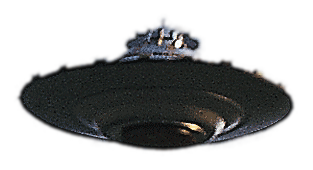
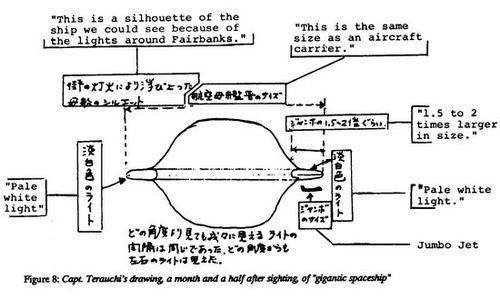
Then, he reported, a far larger object appeared. Terauchi described an enormous silhouette he could make out against the lights of towns on the ground, a shape he drew for the FAA as a flattened body with bulges above and below, which he and later writers compared to a walnut, a peeled chestnut, or the ringed planet Saturn. In his FAA interview he gave the comparison that fixed the case in the public mind, saying the object was very big, "two times bigger than an aircraft carrier." The crew watched it pace the freighter for a long stretch.
The official record tracks the rest. At about 6:26pm a military radar reported a primary return roughly 8 miles from the aircraft. At 6:31pm Terauchi said the object was quite big. At 6:32pm Anchorage Center cleared JAL 1628 to descend from 35,000 to 31,000 feet, and Terauchi reported the object descended with him, staying in formation. At 6:36pm controllers had him fly a full 360 degree turn to see whether the object would follow. The crew briefly lost it around 6:39pm, then it reappeared off the left side near the 9 o'clock position around 6:44pm. Center tried to get independent eyes on it: a northbound United Airlines flight was vectored toward JAL 1628 around 6:50pm and reported it could see the JAL jumbo against the lighter western sky but could see no other traffic near it. Shortly after, around 6:53pm, the crew lost the object for good after roughly half an hour of sustained sighting, and the flight continued to a normal landing at Anchorage.
What is the official explanation?
Because the encounter happened in controlled airspace and was reported live to controllers, it generated a real paper trail rather than just a witness story. The Federal Aviation Administration treated it as an airspace matter. FAA spokesman Paul Steucke framed the agency's interest plainly when the story broke, saying the reason they were looking into it was that it was a violation of airspace, which he conceded "may sound strange, but that's what it was."
In the first days the FAA's public posture was that ground radar had backed the pilot up. Period newspapers reflect that. The San Francisco Chronicle reported on 1 January 1987 that "a veteran pilot whose UFO sighting was confirmed on radar screens said the thing was so enormous that his Japan Air Lines cargo jet, a Boeing 747, was tiny compared with the mysterious object." That early confirmation is the high-water mark of the case, and it is also the part the FAA walked back.
Within weeks the agency reviewed its radar data and reversed itself. By 8 January 1987 the press was reporting the FAA's revised finding: "the unidentified object on radar now appears to be an unexplained split image of the JAL Boeing 747 and not a separate object," that "no second object was present," and that this represented "a reversal of earlier FAA statements that a second object was confirmed on radar." Steucke put it bluntly: "The bottom line is that this tells us that we don't have any radar confirmation of the object that the pilot said he saw." At a 5 March 1987 press conference the FAA's settled position, in Steucke's words, was that the agency was "accepting the descriptions of the crew, but unable to support what they saw." The technical core of that finding is in the FAA's own analysis of an "uncorrelated primary return," the argument that a controller's scope can paint a primary echo and a transponder beacon as two targets when they are really one aircraft, a known radar quirk.
The FAA then closed the matter. Steucke stressed the agency "does not have the resources or the Congressional mandate to investigate sightings" of unidentified objects and had not tried to determine, by scientific analysis, what the crew actually saw. The FAA assembled a large document package and, notably, charged 194 dollars and 30 cents for the complete set of records, photographs and tapes, a price the skeptic Robert Sheaffer suggested was designed to deter the many people badgering the agency for the file. Those records did not vanish. The investigator John Greenewald spent years pursuing them under the Freedom of Information Act, was told by 2009 they had been destroyed, and later located more than 1,500 pages in the National Archives in Record Group 237 (Records of the Federal Aviation Administration), identifier 733667, including the air traffic control transcript, radar printouts, crew interviews, and Captain Terauchi's own written statement and sketches.
A separate strand of the official story comes from John Callahan, who in 1986 was an FAA division chief over accident and incident investigations. Callahan has said for years that he and colleagues matched the radar data to the voice tape on video at the FAA Technical Center, briefed the FAA administrator, and then ran a meeting attended by FAA staff plus representatives from the CIA and FBI and Reagan administration scientists, at the end of which, he says, a CIA man told the room "this event never happened, we were never here," confiscated the data, and swore them to secrecy. Callahan has said he kept copies. That dramatic account is contested even by other people who were in the room, which is addressed in the assessment below.
What did the witnesses think it was?
Captain Terauchi never softened his interpretation. He believed he had seen structured craft under intelligent control, and he was open about thinking they were extraterrestrial. In his January interview with the FAA he speculated that the large object deliberately kept to the "darkest easterly side" of the sky because, in his words, "I think they did not want to be seen," which let it watch the 747 silhouetted against the western sunset glow. In his written statement to the FAA, titled in translation "Meeting the Future," he expressed the hope that "we humans will meet them in the new future." He had flown the polar routes many times and insisted these were not stars or planets he knew well, but objects that held station, changed brightness suddenly, and shed real light and heat into his cockpit.
The corroboration from his own crew is partial and honest, and the case is stronger for not hiding it. First Officer Tamefuji and Flight Engineer Tsukuba both confirmed they saw lights, and both held that the lights looked like nothing ordinary. Tamefuji said it was clear enough to make him believe an aircraft was coming at them. Tsukuba described clusters of lights that undulated and that struck him as different from the town lights below. But under FAA questioning neither man would go as far as their captain on the giant structured ship. Tsukuba said he "was not sure whether the object was a UFO or not." When investigators asked Tamefuji whether he could distinguish the lights "as being different" from a star, he answered "No." So the crew testimony splits cleanly: three men saw anomalous lights, but only Terauchi reported and drew the enormous mothership.
The strongest outside advocate for the case is the optical physicist Bruce Maccabee, who obtained the FAA data, attended the FAA meeting Callahan describes, and published the long technical study "The Fantastic Flight of JAL1628" in the International UFO Reporter in May and June of 1987. Maccabee took the multiple-witness sighting of the smaller objects with their distinct light arrays seriously and found it hard to write off as imagination or a single natural source, while being more cautious about the giant object than the captain was. Leslie Kean later featured the case, and Callahan's testimony, in her 2010 book on pilot and official UFO reports. Against all of this stands Terauchi's own status as a believer, which the skeptics used to argue he was a motivated observer rather than a neutral one.
The dispute
The dispute runs along two tracks, and the archive's page documents both. The first is the FAA's own ruling. After initially suggesting its radar had confirmed a second target, the agency reversed and settled on an "uncorrelated primary return," the idea that the radar painted the JAL aircraft's transponder and its own primary echo as two separate blips, a known radar quirk. The FAA explicitly said it was "accepting the descriptions of the crew, but unable to support what they saw," then closed the matter and declined further scientific analysis. By this archive's method that is an apparatus debunk, an official body asserting a quirk to retire the radar evidence while doing no civilian-reproducible work to demonstrate it, so it is a claim, not a verdict, and it leaves the visual core untouched.
The second track is the skeptical counter-explanation, advanced by Philip Klass of the Committee for the Scientific Investigation of the Paranormal. Klass first proposed misidentification of Jupiter (magnitude -2.6, low on the left) and Mars, then revised to a theory that the colored lights were moonlight reflecting off turbulent ice crystals in thin cloud, with Jupiter as the remaining light source and the radar return blamed on an ice-cloud echo. This is a named analyst offering a stated mechanism, but the page records that it does not hold up cleanly. Fellow skeptic Robert Sheaffer of the Skeptical Inquirer called Klass's moonlight theory close to "scientific garbage" even while siding with the skeptics overall, so the strongest version of the ordinary explanation is contested from inside the skeptical camp itself.
The reason neither track closes the case is the structured detail the page emphasizes in its second pass. Captain Kenju Terauchi, a pilot with over 10,000 flight hours, reported an enormous structured craft with distinct rectangular light banks, and the encounter included two objects, formation flying, descent coordination, and the object following a 360-degree turn, behavior that resists a planet-and-ice-crystal account. Optical physicist Bruce Maccabee found the smaller-object sighting "genuinely hard to explain away." The page is careful about the weaknesses too: the giant-craft claim rests largely on Terauchi alone, since First Officer Takanori Tamefuji and Flight Engineer Yoshio Tsukuba saw only anomalous lights and were unsure it was a UFO, and the radar reversal removes any hard instrument confirmation. The separate cover-up allegation by FAA official John Callahan is also contested, with Ryan Daube's 2007 check finding that Maccabee and CIA analyst Ron Pandolfi recalled an FAA meeting but neither a cover-up declaration nor a confiscation order. The net effect is a real, documented event with a credible ordinary explanation that is partial, contested, and never demonstrated, against an unexplained core it does not reach.
Is the Japan Air Lines Flight 1628 real? The two-pass assessment
Pass one, the ordinary explanations, and here the case has a serious civilian challenge that has to be laid out fairly. The leading mundane account is astronomical, advanced by Philip Klass for the Committee for the Scientific Investigation of Claims of the Paranormal and amplified by Robert Sheaffer in the Skeptical Inquirer. Klass noted that as the incident began near Fort Yukon the 747 was flying south in twilight with an extremely bright Jupiter, magnitude minus 2.6, low on the pilot's left at about 10 degrees above the horizon, which at altitude can read as roughly the aircraft's own level, with Mars fainter and about 20 degrees to Jupiter's right. His point was pointed: those bright bodies had to be visible to the crew, yet the pilot never once reported seeing Jupiter or Mars, only a UFO, which to Klass suggested he had misread a planet as the object. Klass's first version did not survive contact with the geometry, so in the Summer 1987 Skeptical Inquirer he shifted to a second account, that the colored lights were moonlight reflecting off turbulent ice crystals in thin cloud, which would flare and vanish as cloud conditions changed, with Jupiter still in the frame as the leftover light the captain chased once the rest faded, and the aircraft's own radar return blamed on an echo from ice cloud. Klass also pulled the witnesses apart, calling Terauchi a "UFO repeater" with prior and subsequent sightings, a flag experienced investigators treat with caution, and he leaned on the crew's hedging, that the flight engineer "was not sure whether the object was a UFO or not" and the copilot said "No" when asked if he could tell the lights from a star. Sheaffer's blunt summary was that the crew saw only lights and that the other aircraft sent to look saw nothing. The official radar reversal belongs here too, not as proof of a craft but as a removed prop: the FAA concluded the second radar target was a split image of the 747 itself, an "uncorrelated primary return," so the case loses its hard ground-radar confirmation.
It is worth being honest that not every piece of the debunk is equally strong. Sheaffer himself, while siding with the skeptics, called Klass's moonlight-on-ice-crystals idea close to "scientific garbage" and noted it could not account for the heat Terauchi reported on his face or the distinct, independent arrays of lights on two separate objects seen for many minutes. So the prosaic case rests mainly on the two smaller light sources being misidentified bright planets or ground or cloud lights, plus the demotion of the giant ship to "unexplained lights" reported by a single believing witness whose own crew would not fully back him, plus the loss of radar support. That is a real explanation for much of the event, and it is method-shown with named analysts, exact magnitudes and positions, and the FAA's own technical finding, which is why this case is Disputed rather than Verified Unexplained.
Pass two, if it was not all planets and ice. The hardest thing to dissolve is the structured detail at close range, the two objects each with two rectangular banks of pulsing amber lights, shifting formation, pacing a 747 through a controlled descent and a 360 degree turn, with a third, much larger silhouette. Planets do not change configuration, descend in formation, or follow you around a turn, and a planet does not throw enough light to brighten a cockpit or warm a face. Maccabee, an optical physicist with the data in hand, judged the smaller-object sighting genuinely hard to explain away. And the case's most cinematic official claim, Callahan's account that a CIA officer declared the event never happened and confiscated the data, is exactly where caution is required: when the UFO researcher Ryan Daube checked it in 2007, both Maccabee and the CIA science analyst Ron Pandolfi confirmed to him that they had attended an FAA meeting matching the one Callahan describes, but neither recalled anyone saying the meeting never happened or ordering a cover-up. So the cover-up flourish is contested by two other people who were apparently in the room, even though the underlying briefing seems real. The defensible unexplained residue is not the mile-wide mothership, which leans on one believing witness, but the close, multi-witness, instrumented behavior of the smaller lights during an active air traffic control event.
Weighing both passes: this is a genuine, fully documented airspace event with a rich FAA file, live controller transcripts, and three professional witnesses, and it also has a serious, named, method-shown counter-explanation for its lights together with an official radar reversal and witnesses who would not all confirm the spectacular part. The planetary and cloud explanations do not cleanly close the structured, formation-flying behavior, but they do enough damage, and the case rests heavily enough on a single believing observer for the largest object, that it cannot be called verified unexplained. Tier: Disputed. The encounter is real and the record is real; what the crew saw is still argued, with a credible ordinary explanation on the table and a credible unexplained core that the ordinary explanation does not fully reach.
Sources
- www.nicap.org/861117alaska_dir.htm
- skepticalinquirer.org/wp-content/uploads/sites/29/2014/11/p19.pdf
- www.theblackvault.com/documentarchive/ufo-case-japanese-airlines-jal1628-november-17-1986/
- ufologie.patrickgross.org/htm/japan86.htm
- www.ufoevidence.org/documents/doc1316.htm
- www.upi.com/Archives/1986/12/31/A-veteran-pilot-whose-UFO-sighting-was-confirmed-on/2755536389200/
- badufos.blogspot.com/2014/07/jal-1628-capt-terauchis-marvellous.html
- www.theufochronicles.com/2015/10/john-callahan-jal-1628-ufo-encounter.html
More cases from this region: UFO sightings in United States