The Betty and Barney Hill Abduction
Barney and Betty Hill of 953 State Street, Portsmouth, New Hampshire, were driving home down U.S. Route 3 through the White Mountains late on the night of September 19, 1961, returning from a vacation at Niagara Falls and Montreal. This case file covers what witnesses reported, the official narrative, and a two-pass assessment with its evidence tier.
What did witnesses see at U.S. Route 3 near Indian Head and Lincoln?
Barney and Betty Hill of 953 State Street, Portsmouth, New Hampshire, were driving home down U.S. Route 3 through the White Mountains late on the night of September 19, 1961, returning from a vacation at Niagara Falls and Montreal. Their dachshund Delsey rode in the back seat. They had left a restaurant in Colebrook around 10:00 p.m. EDT. Somewhere south of there, near Groveton, Betty noticed a bright point of light below the moon and the planet Jupiter that moved upward and to the west, then north, in a way no star or plane should. The sky was clear, lit by a 10-day-old gibbous moon.
These details come straight from Walter Webb's NICAP report and Major Henderson's Blue Book report, both written from the witnesses' own accounts. As they drove south at no more than 30 mph, Betty grew excited and Barney stopped the car several times so she could watch the object through their 7x50 binoculars. He kept insisting it was an airliner bound for Montreal. Then it curved west, then came back eastward toward them, which puzzled him because no airliner changes course like that. The road was empty, the country almost uninhabited. Uneasy, Barney took his .32 caliber pistol out of the trunk and slid it under his seat.
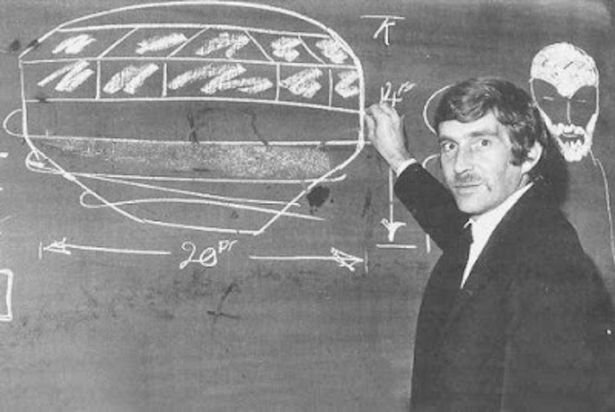
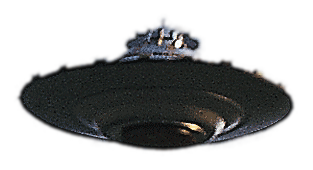
Through the binoculars Betty made out a band of light, first straight, then curving as if conforming to the edge of a flattened disc, and the object moved in a strange step-like pattern, tilting up, leveling off, dropping, all while it seemed to spin. They watched it pass behind the 4,077-foot summit of Cannon Mountain in Franconia Notch. Driving on past The Flume and Indian Head into more open ground, they saw the lighted band ran only about halfway around the rim, so it twinkled as it rotated. Barney slowed the car. The craft swung down over a field, pulled around in front of them, and stopped in mid-air to the right of the highway, eight to ten stories up and a few hundred feet away. Now they could see a row of windows with a cold bluish-white glow behind them and a red light on each side. They judged it at least as big as a four-engine airplane.
Barney braked to a halt in the middle of Route 3, left the engine running and the lights on, picked up the gun, and stepped out onto the road, bracing his arms on the roof to look through the binoculars. He was 2.3 miles north of North Woodstock by Webb's later odometer and topographic-map measurements. The object moved silently across the highway, passing an estimated 100 feet in front of the car, and stopped over the field to the left. Barney walked out into the field toward it, stopping to use the binoculars, and watched it descend in his direction. He could see eight to eleven figures standing at the windows in what looked like a corridor around a central section. Suddenly there was a burst of activity, the figures scurried and turned, working what looked like levers on the wall, while one stayed at the window. At that moment two red-tipped, fin-like structures slid outward from the sides.
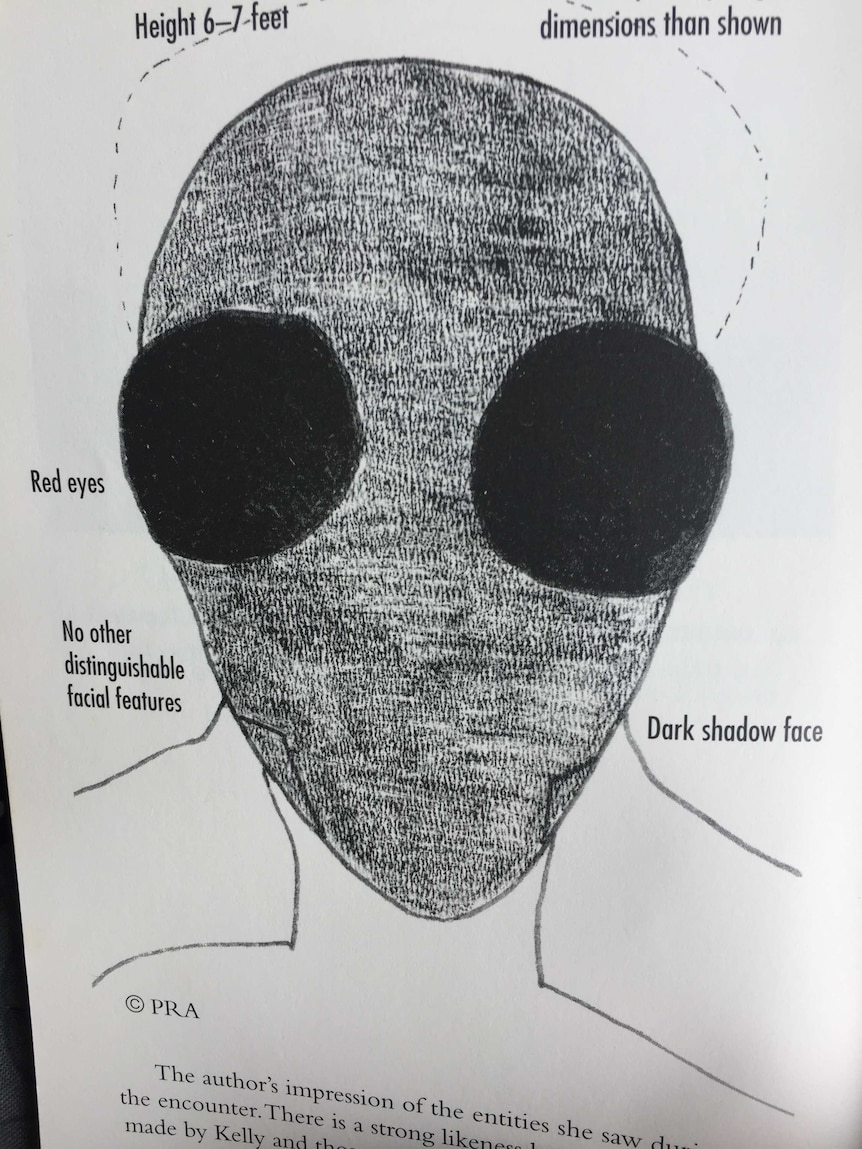
Barney described the figures as human in form, dressed in shiny black uniforms and peaked caps, moving with the cold precision of German officers, one of them grinning over his shoulder. The "leader" at the window held his attention and terrified him. He felt he was going to be captured "like a bug in a net." Knowing it was no conventional aircraft, he screamed "I don't believe it," dropped the binoculars so hard the strap broke, ran back to the car laughing or crying that "they're going to capture us," and sped off. Almost at once both Hills heard a series of beeping or buzzing sounds, like code, that they felt strike and vibrate the rear trunk. Then came a stretch of road neither could clearly remember. About 30 miles south, near Ashland, they heard the beeps a second time. They reached home in Portsmouth around 5:00 a.m., about two hours later than the drive should have taken.
The morning after, Betty told her apartment neighbors and phoned her sister Janet in Kingston. A police chief visiting Janet advised them to call Pease Air Force Base. Going out to the car at Janet's suggestion, they found more than a dozen shiny circular spots the size of a half dollar on the trunk, and a compass needle spun wildly when held near them. These spots faded by that winter.
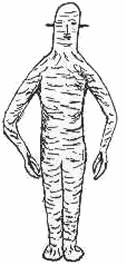
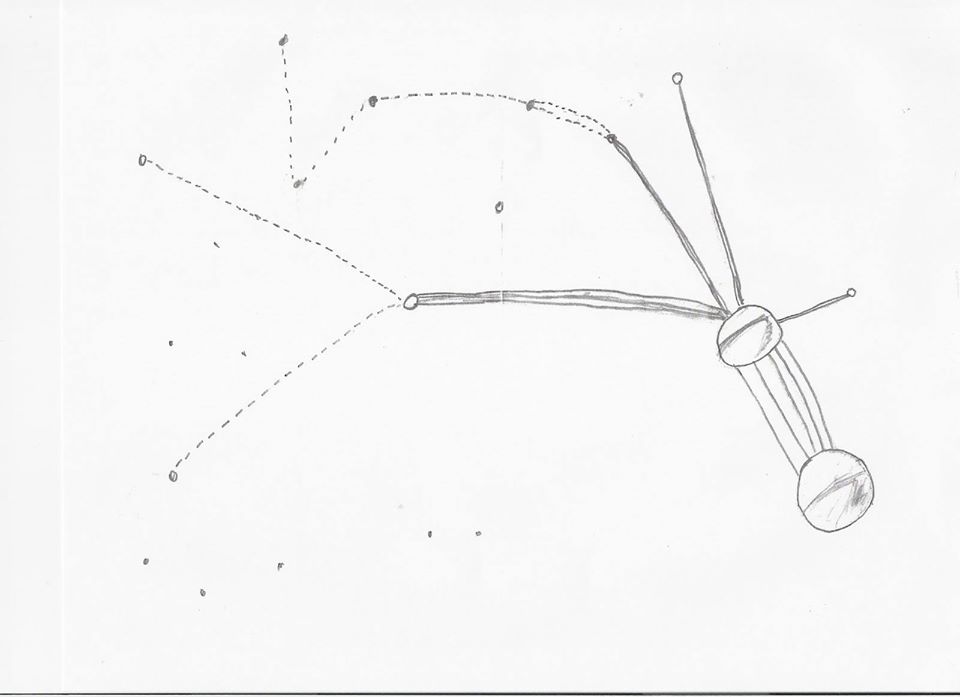
The fuller, stranger account came later. From late November 1961, Betty had vivid dreams over about six straight nights of being stopped on a back road by a group of men, taken aboard a landed craft, and medically examined. She wrote a five-page account of those dreams. Years of anxiety followed, and in 1964 both Hills underwent hypnosis with Boston psychiatrist Dr. Benjamin Simon. Under hypnosis, separately, each described being taken aboard. Betty recounted an examiner who scraped her skin and took hair and nail samples, ran a cluster of needles over her body to check her nervous system, and thrust a long needle into her navel that he called a pregnancy test, a pain the leader waved away with his hand. She said she was shown a star map of dots and lines that the leader called trade routes between worlds. Barney, under hypnosis, recalled keeping his eyes shut, a cup-like device at his genitals, and a probe. Both said the figures stood about five feet tall, with grayish skin, large eyes, and dark clothing, and that they spoke English with an accent or communicated by thought. They believed they were aboard the craft for 30 to 40 minutes.
What is the official explanation?
The case was reported to the U.S. Air Force the very next day, and the official paper trail survives in full. The day after the sighting Betty telephoned Pease Air Force Base near Portsmouth. Major Paul W. Henderson of the 100th Bomb Wing called the Hills back twice, told them on one call that the conversation was being monitored, and said on another that he had worked all night on the report. He filed Information Report No. 100-1-61, dated September 21, 1961, which describes a "continuous band of lights - cigar shaped," that "appeared to be about the size of a nickel at arms length" and later, when "a matter of hundreds of feet above the automobile," about "the size of a dinner plate." It records the wings that "seemed to appear from the main body... shaped with red lights on tips," the erratic step-like flight that "ascended and descended numerous times very rapidly," the binoculars, and the "series of short loud buzzes" the couple "could feel" in the auto, heard again near Ashland 30 miles on. Henderson wrote that Barney "doesn't possess any technical or scientific training" and that "the reliability of the observer cannot be judged" though "his apparent honesty and seriousness appears to be valid."
Project Blue Book carried the case as "insufficient data." Its statement dated September 27, 1963 reads: "The case is carried as insufficient data in the Air Force Files. No direction (azimuth) was reported and there are inconsistencies in the report. The sighting occurred about midnight and the object was observed for at least one hour... The planet Jupiter was in the South West, at about 20 degrees elevation and would have set at the approximate time that the object disappeared. Without positional data the case could not be evaluated as Jupiter. There was a strong inversion in the area. The actual light source is not known. As no lateral or vertical movement was noted, the object was in all probability Jupiter. No evidence was presented to indicate that the object was due to other than natural causes." In a letter of October 1, 1963 to a Mr. Herbert Taylor, Major Maston Jacks of the Pentagon's Public Information Division repeated the line that the object "was in all probability Jupiter."
Walter Webb, the NICAP investigator who was also an astronomer on the staff of the Hayden Planetarium, dismantled the Jupiter conclusion point by point in his report. He noted the witnesses saw the UFO and Jupiter in the sky at the same time, that they did report direction (southwest to north to west to east) and complex maneuvers, momentary hovering, a shift across the highway, and a final descent. He called the planet explanation "completely ridiculous" for an object that "grew in apparent size from a star-like light to a disc with a row of windows and a red light on the ends of fin-like structures, an object that filled the binoculars' entire field of view." Webb concluded the official replies showed "the USAF's policy of stretching conventional explanations for UFOs to the point of scandal and absurdity," and pointed out that the size increase as the object descended to within "hundreds of feet" of the car, recorded in Henderson's own report, was simply ignored. The Air Force never questioned the Hills in person and never visited the site.
It is worth being precise about what the official apparatus did and did not do. The Air Force was told the basic object details, including the extendable fins, but was never told about the figures Barney saw and had no knowledge of the later abduction account. The "insufficient data" and "probably Jupiter" findings are an official disposition that closes a file, not an independent demonstration that the object was ordinary. By UAP Globe's standard an official debunk is logged as a claim with its own weight, and this one fails on the witnesses' own simultaneous sighting of both Jupiter and the object.
What did the witnesses think it was?
Betty and Barney Hill were credible, reluctant witnesses, not publicity seekers. Barney, 39 at the time, was a postal clerk at Boston's South Station post office, active in the New Hampshire NAACP, on the board of the Rockingham County Economic Opportunity Program, and appointed to a state advisory role on the U.S. Commission on Civil Rights. Betty, 41, was a child welfare worker for the New Hampshire Department of Public Welfare. Webb wrote that he was "impressed by their intelligence, apparent honesty, and obvious desire to get at the facts and to underplay the more sensational aspects of the sighting." Barney had been a complete UFO skeptic before the event and "still detests the term flying saucer." Henderson recorded that Barney "did not originally intend to report this incident" and felt "somewhat foolish," reporting only because "he and his wife did in fact see this occurance."
The Hills believed the first encounter was a real, unexplained craft. On the abduction, they came to believe it had genuinely happened to them, and they were dissatisfied with their own psychiatrist's dream explanation. Betty in particular held that the experience was real. In her September 26, 1961 letter to Keyhoe she wrote, "We both have been quite frightened by this experience but fascinated. We feel a compelling urge to return to the spot where this occurred in the hope that we may again come in contact with this object." She did not at first tell the Air Force about the figures "as it seems too fantastic to be true."
Several people corroborated pieces of the story. Robert Hohmann and C.D. Jackson, two NICAP members employed by IBM, interviewed the Hills on November 25, 1961. Major James MacDonald, a retired Air Force officer and friend of the Hills who had been interested in UFOs, was present and afterward vouched to NICAP for the couple's reliability. Three psychiatrists examined the Hills over the years (Dr. Quirk at Baldpate, Dr. Duncan Stephens at the Exeter Clinic, and Dr. Benjamin Simon), and Webb noted that "everyone who has questioned the Hills, including three psychiatrists and even Air Force officials, has ruled out a hoax and simultaneous hallucination." Betty's sister Janet had her own UFO sightings, and Betty's father shared her mild interest in the sky, though neither Hill had read UFO books before the event.
Barney's own physical aftermath troubled him. He inspected his genitals for no conscious reason when he got home, and months later developed a ring of wart-like growths around the same area that required three minor operations. Webb raised, without claiming proof, whether these could be "symptomatic of a real experience, the cup-like device placed at that spot on his body."
The dispute
The dispute runs on three separate tracks, and the page documents that not one of them closes the case. The official explanation came from the Air Force and Project Blue Book, which filed Information Report No. 100-1-61 describing a "continuous band of lights, cigar shaped," logged the case as "insufficient data," and asserted the object was "in all probability Jupiter," leaning on a strong temperature inversion and Jupiter's southwest position that night. This is an official-apparatus assertion rather than a demonstrated identification, and per this archive's method an apparatus debunk is a claim, not a verdict. It was directly dismantled by Walter Webb, a Hayden Planetarium astronomer, who noted the witnesses watched Jupiter and the unknown object in the sky at the same time, and that the object grew from a star-like light into a disc with a row of windows while performing complex maneuvers and momentary hovering. An object seen alongside Jupiter cannot be Jupiter, so this strand collapses on the page's own evidence.
The second track is psychiatric. Dr. Benjamin Simon, the Hills' own treating psychiatrist, concluded the abduction "happened only in Betty Hill's dreams" and that Barney, highly suggestible, absorbed her repeatedly told dreams, calling the narrative bizarre and inconsistent with "all the earmarks of a nightmare." But the page treats this as non-conclusive on its face: Simon "refused to read the literature" on the subject and "admits he cannot prove the dream hypothesis is correct," and, decisively, he remained convinced the first UFO encounter actually took place as reported and that a craft of some sort was witnessed. So the practitioner offering the dream explanation still affirmed the underlying sighting; his account disputes the abduction memory, not the event.
The strongest and most method-driven challenge targets the star map, the piece of post-hoc corroboration rather than the sighting itself. Carl Sagan and Steven Soter argued in Astronomy magazine in 1975 that a memory sketch of dots invites chance pattern-matching and selection bias, and later parallax data, including the Hipparcos measurements of the early 1990s, undercut Marjorie Fish's reconstruction: applying Fish's own selection criteria to corrected data, six of her fifteen chosen stars must be excluded. The Armagh Planetarium's published verdict is that "the Fish interpretation falls to pieces," and Betty Hill herself conceded "I really do not know if they exist and in that position, or if I added them." This is a genuine, measurement-backed debunk, but it only weakens one strand of corroboration; it says nothing about the radar-era sighting or the witnesses' credibility.
Taken together, the official finding was refuted by an astronomer, the psychiatric explanation is unproven by its own author and coexists with his belief in the sighting, and the strongest debunk only dissolves a piece of secondary corroboration. The page records that "no independent analyst has shown methodically that the object was an ordinary aircraft, planet, or fabrication," and that three psychiatrists ruled out a hoax and simultaneous hallucination while witnesses Barney and Betty Hill were judged credible for their intelligence and apparent honesty. The dispute trims the case at its edges but leaves the core sighting standing.
Is the Betty and Barney Hill Abduction real? The two-pass assessment
Pass one, how this could be entirely ordinary. The official line is on record: Project Blue Book carried the case as "insufficient data" and judged the object "in all probability Jupiter," noting a strong temperature inversion in the area that night and that Jupiter sat in the southwest and would have set about when the object vanished. A planet low on the horizon, twinkling and seeming to wander through an inversion, can fool a tired driver on a dark mountain road, and the Hills had been driving for hours. The abduction layer has a strong ordinary reading that does not even require deception. The Hills' own treating psychiatrist, Dr. Benjamin Simon, a Harvard-trained specialist who had pioneered hypnosis and narcosynthesis for war trauma, concluded after seven months and eleven hours of taped sessions in 1964 that the abduction "happened only in Betty Hill's dreams," that Barney, highly suggestible, absorbed her repeatedly told dreams until he too felt he had been taken, and that the kidnap story "has all the earmarks of a nightmare, its bizarre nature, inconsistencies." Crucially, Betty's five-page dream account was written in late November 1961, more than two years before the hypnosis that supposedly recovered it, so the abduction narrative demonstrably existed as a dream first. And the most famous piece of physical corroboration, the star map Betty drew under hypnosis and Marjorie Fish modeled as Zeta Reticuli, has been challenged with method shown. Astronomers Carl Sagan and Steven Soter argued in Astronomy magazine in 1975 that a memory sketch of dots invites chance pattern-matching and selection bias, and later parallax data, including the Hipparcos measurements of the early 1990s, removed the ground under Fish's reconstruction: using her own selection criteria with corrected data, six of her fifteen chosen stars must be excluded (two are variable, two are close binaries), and the published verdict of the Armagh Planetarium analysis is that "the Fish interpretation falls to pieces." Betty herself, on her own background dots, said "I really do not know if they exist and in that position, or if I added them."
Pass two, if it was real. The first encounter is the hard core, and it resists the ordinary readings. Webb, himself a Hayden Planetarium astronomer, demolished the Jupiter explanation: the Hills watched the object and Jupiter in the sky at the same time, reported clear direction changes and a structured object that grew from a point of light into a windowed disc filling the binoculars, with red-tipped fins that extended on cue and silent movement to within hundreds of feet of the car, a size increase logged in the Air Force's own Henderson report and then ignored. A planet does not do that. Three psychiatrists and the Air Force ruled out a hoax and simultaneous hallucination. There are physical traces logged within hours: a dozen shiny spots on the trunk that spun a compass needle and faded by winter, Barney's broken binocular strap he could not account for, and his later genital growths. And Simon's own position is more careful than the popular shorthand. He was "convinced the first UFO encounter actually took place as reported and that a craft of some sort was witnessed," only preferring an earthly aircraft he never identified, and Webb records that Simon "refused to read the literature" on the subject and "admits he cannot prove the dream hypothesis is correct." Webb's closing judgment stands: "if the first encounter took place, then I feel we cannot positively rule out the possibility, however remote, that the second encounter did in fact occur."
This is the textbook Disputed case. There is a genuine official finding and a method-shown independent challenge to one strand of corroboration, the star map. But neither closes the matter. The Blue Book "insufficient data" disposition is an administrative pigeonhole, not an explanation, contradicted by the witnesses' simultaneous view of Jupiter and the object. The star map criticism neutralizes one piece of evidence; it does not account for the structured, maneuvering, fin-extending craft three observers ruled non-ordinary, nor for the trunk spots and the missing time. The abduction account rests on hypnotically recovered memory and a prior dream, which is exactly the kind of testimony that cannot be promoted to fact, but the witnesses are not on trial, and an estrangement from certainty about the second encounter is not a discredit of the first. No independent analyst has shown, with method, that the object itself was an ordinary aircraft, planet, or fabrication. The case is set to Disputed / contested: a counter-explanation and an official finding exist, and they do not close it.
Sources
- www.nicap.org/reports/610919hill_report2.pdf
- www.nicap.org/reports/0450-74.htm
- www.nicap.org/reports/hill.htm
- www.nicap.org/reports/hillmap.htm
- archive.org/details/interruptedjourn00full
- armaghplanet.com/betty-hills-ufo-star-map-the-truth.html
- library.unh.edu/find/archives/collections/betty-barney-hill-papers-1961-2006
More cases from this region: UFO sightings in United States