The Rendlesham Forest Incident
Rendlesham Forest is often called "Britain's Roswell," and it is the rare UFO case backed by an official memo from a senior military officer, a real-time audio tape made during the event, written statements from the airmen, and an independent police report. This case file covers what witnesses reported, the official narrative, and a two-pass assessment with its evidence tier.
What did witnesses see at Rendlesham Forest?
Rendlesham Forest is often called "Britain's Roswell," and it is the rare UFO case backed by an official memo from a senior military officer, a real-time audio tape made during the event, written statements from the airmen, and an independent police report. It unfolded over two nights at the edge of two adjoining US Air Force bases, RAF Woodbridge and RAF Bentwaters, in Suffolk, then home to the 81st Tactical Fighter Wing.
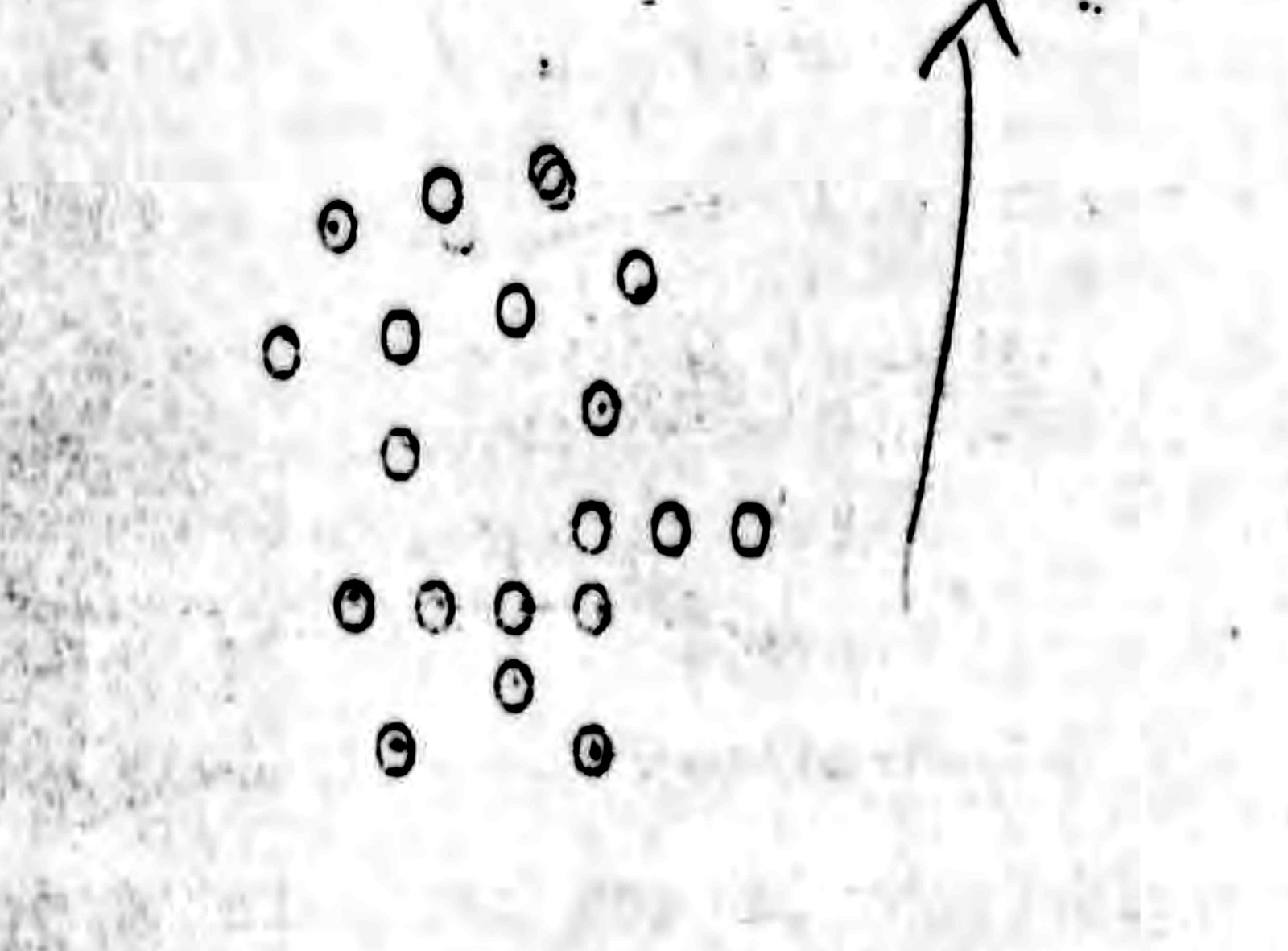
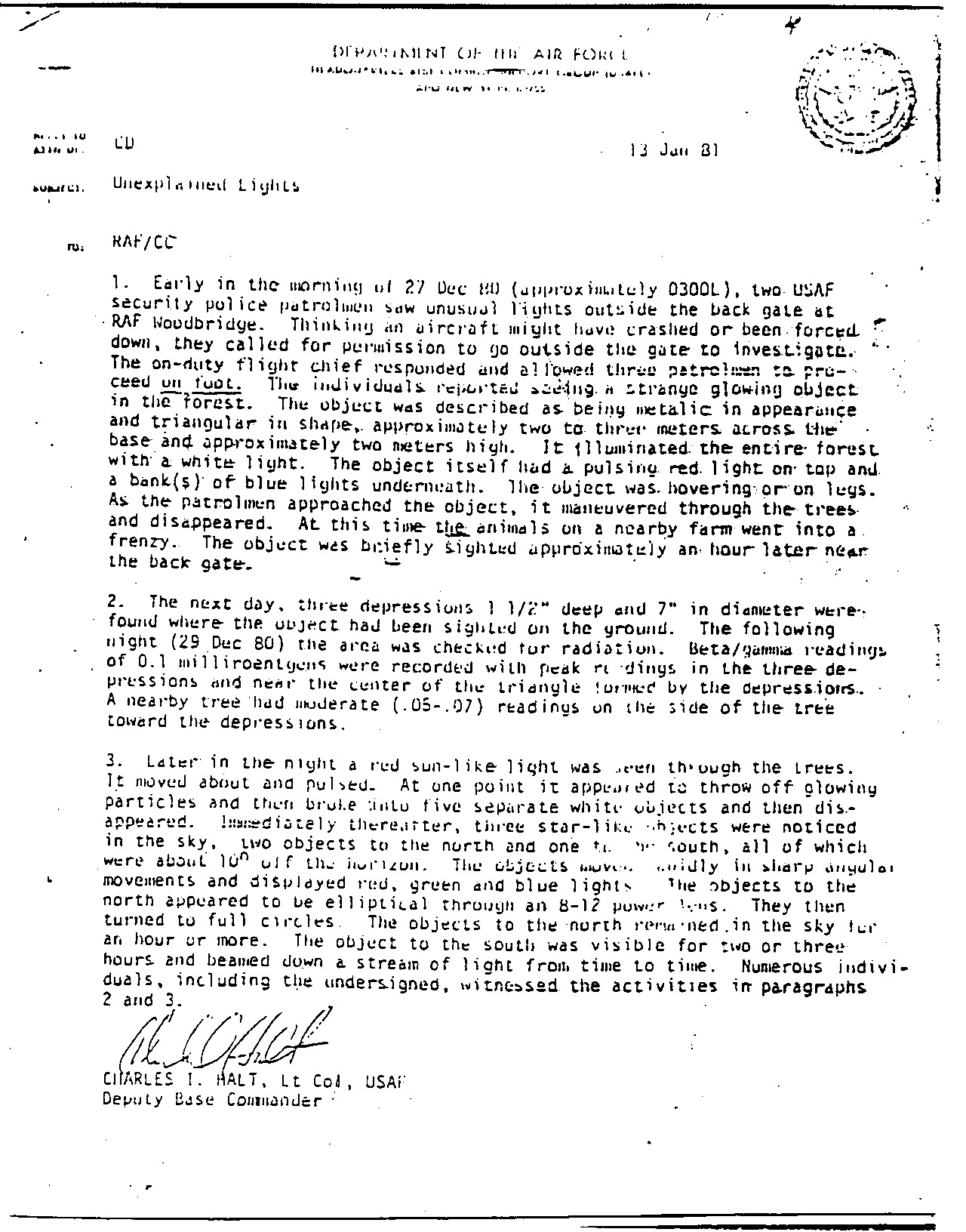
Night one. Early on 26 December 1980, at about 0300 local time, two USAF security police at the Woodbridge East Gate saw lights descending into the trees beyond the runway. Thinking an aircraft might have crashed, they got permission to go outside the gate. Three patrolmen went in on foot: Airman First Class John Burroughs, Staff Sergeant Jim Penniston, and Airman Edward Cabansag. In Halt's later memo the object on the ground is described as "metallic in appearance and triangular in shape, approximately two to three meters across the base and approximately two meters high," lighting up the whole forest with a white light, with "a pulsing red light on top and a bank(s) of blue lights underneath," apparently "hovering or on legs." As the men approached, the object "maneuvered through the trees and disappeared." Animals on a nearby farm went into a frenzy, and the object was briefly seen again near the back gate roughly an hour later. Penniston went much further in accounts given years later, claiming he walked right up to a solid craft, touched its warm metallic skin, and copied strange symbols, "hieroglyphic-type," from its side into a pocket notebook. Burroughs and Cabansag, a few yards away the whole time, described only lights, not a landed craft.
The next morning, three small depressions about 7 inches across and 1.5 inches deep were found in the forest floor, arranged in a rough triangle, with what looked like scorch or abrasion marks on nearby trees.
Night two. In the early hours of 28 December, Deputy Base Commander Lt Col Charles Halt led a team back into the forest to investigate. Halt carried a hand-held Lanier micro-cassette recorder and taped the whole expedition, switching it on and off. Sergeant Monroe Nevels ran an AN/PDR-27 type civil-defense Geiger counter; Lt Bruce Englund and Sergeant Bobby Ball were also present. The tape, just over 18 minutes long, captures the team taking radiation readings at the depressions, finding "abrasions" on trees all facing the centre of the supposed landing site, and using a starlight scope (night-vision image intensifier). Two-thirds of the way through, Englund finally points out a flashing light through the trees: "Straight ahead, in between the trees, there it is again. Watch, straight ahead, off my flashlight there, sir. There it is." Halt and his men then chased the light east out of the forest, across two fields and a creek, never reaching it. Through the starlight scope Halt said it had "a hollow centre, a dark centre, like a pupil of an eye looking at you, winking." Later the team reported objects in the sky to the north and south showing red, green and blue lights and, from the southern object, a beam of light coming down to the ground. Halt's final taped words, around 0400, describe one object "still hovering over Woodbridge base," "still moving erratic and similar lights and beaming down as earlier." His on-tape reaction to the lights was "This is unreal," followed by a laugh, not the often-quoted line "it's not from this world," which does not appear on the recording at all.
What is the official explanation?
The single most important official document is the memo Halt wrote on 13 January 1981, headed "Unexplained Lights," addressed to the UK Ministry of Defence. It was on US Air Force headed notepaper, was never classified, and runs to three short paragraphs. Paragraph two records that "three depressions 1.5 inches deep and 7 inches in diameter were found where the object had been sighted," that the area was later checked for radiation, and that "Beta/Gamma readings of 0.1 milliroentgens were recorded with peak readings in the three depressions and near the center of the triangle," with a nearby tree giving "moderate (0.05-0.07) readings." Paragraph three describes a "red sun-like light" that pulsed and broke into "five separate white objects," then "three star-like objects" moving in "sharp, angular movements" with red, green and blue lights, the southern one beaming "down a stream of light from time to time." Halt signed it as Deputy Base Commander. The USAF later threw away its own copy, judging it of no further interest, and had to obtain a fresh one from the British MoD when researcher Robert Todd of Citizens Against UFO Secrecy requested it under the US Freedom of Information Act in June 1983. The original is held at The National Archives at Kew.
The MoD's response was minimal. The Defence Intelligence Staff and the UFO desk officer, Simon Weeden, who received the memo, made only cursory checks. They never interviewed the airmen and never contacted the Suffolk police. The MoD's settled position, stated repeatedly over the years, is that the incident had "no defence significance." A two-page briefing paper prepared in October 1985 for Defence Minister Lord Trefgarne ahead of a meeting with former Chief of the Defence Staff Lord Hill-Norton, found in file DEFE 24/1925 (pages 115-116, released at The National Archives in May 2008), spells out the reasoning: "Our own view also was that no additional action was required... the fact that Col. Halt did not report these occurrences to MoD for almost two weeks after the event, together with the relatively low-key manner in which he handled the matter, are indicative of the degree of importance in defence terms which should be attached to the incident." Weeden told journalist David Clarke that the MoD's only real concern was air defence: whether anything had appeared on the radars at Neatishead and Watton, which were manned around the clock. Once the basic checks found nothing on radar, no obvious explanation and no threat, the file was closed. RAF Watton did log a call from Bentwaters at about 0325 on 28 December reporting a UFO, made at Halt's instruction while the sky lights were being watched, but Watton reported nothing on radar.
There was no formal US investigation either. Halt's superior, base commander Col Ted Conrad, and his successor Col Sam Morgan both treated it as a non-event. Morgan, who found the only surviving copy of the tape in a desk drawer in 1981, summed it up to skeptic Philip Klass as "just a bunch of guys screwing around in the woods."
What did the witnesses think it was?
The witnesses were experienced security personnel, which is a large part of why the case has endured. John Burroughs and Jim Penniston both maintained for decades that they encountered something genuinely unexplained in the forest, and both later campaigned over health problems they attributed to the event, Burroughs eventually winning US Department of Veterans Affairs recognition and treatment for his condition. Penniston went the furthest of any witness, describing a solid landed craft he examined for some 45 minutes and physically touched. Under hypnosis in September 1994 he produced a far stranger story still: that the craft's occupants were not aliens but time travellers, humans from Earth's future, who communicated telepathically and had come to collect genetic material. "They are us," he said. From 2010 he added that pages of his notebook contained binary code telepathically downloaded from the craft.
Charles Halt is the central witness and stands by his account to this day. He has always insisted he saw something intelligently controlled and that the lights he chased were not a lighthouse. In a notarised affidavit signed in June 2010, and at a Washington press conference that September, he restated and in places expanded his claims, putting the lighthouse well off to the side of the UFO and increasing the number of sky objects.
Crucially, not all on-site testimony supported a craft. Suffolk police constables were called to the scene on the first night and recorded that the only lights they could see were those of the Orford Ness lighthouse. Local Forestry Commission forester Vince Thurkettle, who was shown the landing marks, identified the flashing light as the lighthouse and the ground depressions as rabbit diggings. A former Bentwaters security guard, Richard Bertolino, who was on duty that morning, described seeing a "very bright falling star" with a "blue-green luminescence" that seemed to fall between the two bases, a classic bright meteor, immediately before the radio call about a UFO.
The dispute
The dispute here is unusually well-evidenced, because for once the counter-explanation is civilian and method-shown rather than a bare official assertion. Astronomer Ian Ridpath and Forestry Commission forester Vince Thurkettle, working from the witnesses' own materials, broke the famous sequence into ordinary parts. The first-night descent of lights, the page documents, coincided almost to the minute with an exceptionally bright fireball, a meteor as bright as the three-quarter Moon lasting three to four seconds seen over southern England at 0250 UT on Boxing Day 1980. What the airmen then chased toward was, on this reading, the Orford Ness lighthouse about 5 km east, one of the brightest in the country at five million candelas, flashing white every five seconds. The decisive piece of method is on Charles Halt's own tape: the interval between "there it is again" and "there it is" is five seconds, matching the lighthouse flash exactly. Thurkettle, who was shown the landing marks in person, identified the ground depressions as rabbit diggings, and the radiation readings that were treated as alarming were judged "of little or no significance" by the instrument's own manufacturer and the UK National Radiological Protection Board.
That is what separates this case from the typical apparatus debunk. The Ministry of Defence's contribution is exactly the kind of claim that this archive's method discounts: its settled position is only that the incident had "no defence significance," and the briefing paper held that no additional action was required, with the file closing once radar checks revealed nothing. That is an administrative shrug, not an investigation, and on its own it would not move the case at all. The weight here comes instead from Ridpath and Thurkettle, who advanced a falsifiable mechanism, the lighthouse flash rate, the dated fireball, the named animal burrows, and the manufacturer-and-NRPB radiation finding, and tied each one to a specific piece of the witness record. By the standard this archive uses, that is genuine discredit-grade material rather than an unsupported assertion.
What keeps the case from being fully closed is that the lighthouse-plus-meteor account does not cleanly absorb the close-range testimony from the first night. Multiple trained personnel described a structured, self-illuminated object maneuvering deliberately, and Jim Penniston went much further in later accounts, claiming he walked right up to a solid craft, touched its warm metallic skin, and recorded "hieroglyphic-type" symbols. A lighthouse five kilometers away does not obviously become a solid object an airman says he touched. The central witnesses, Halt, Burroughs and Penniston, have never recanted across decades. So this is a strong, civilian, method-shown counter-explanation that comes close to settling the night-two light-chase as ordinary, which is why the dispute is rated strong, but it remains a contest rather than a verdict because the first-night structured-object encounter is left unresolved and the prime witnesses reject it. The page accordingly tiers the case Disputed and flags the proposed discredit for separate human review.
Is the Rendlesham Forest Incident real? The two-pass assessment
Pass one, how this could be entirely ordinary. There is a detailed, method-shown, civilian explanation, and it covers nearly every element. The first-night descent of lights coincided almost to the minute with an exceptionally bright fireball: the British Astronomical Association Meteor Section Newsletter no. 4 (February 1981) records a fireball as bright as the three-quarter Moon, lasting 3 to 4 seconds, seen over southern England at 0250 UT on Boxing Day 1980. Fireballs look much closer and lower than they are and routinely make people think something has crashed nearby, which is exactly what the East Gate guards thought. That primed three armed men to go hunting in the dark for a downed craft. What they then chased was almost certainly the Orford Ness lighthouse, about 5 km east, one of the brightest in the country at 5 million candelas, flashing white every 5 seconds. On Halt's own tape the interval between "there it is again" and "there it is" is 5 seconds, matching the lighthouse exactly, and Halt's described position at the forest edge put the lighthouse directly in his line of sight, lined up with a farmhouse just as he said the UFO was. The starlight-scope "pupil winking at you" is what a brilliant point source looks like through a first-generation image intensifier. The Suffolk police, independently, saw only the lighthouse on night one. The triangle of "landing marks" was identified as ordinary rabbit diggings by both the forester and the police, and photographs taken the next morning show shallow scrapes in pine needles next to position sticks. The radiation scare collapses on inspection: the instrument's own manufacturer and the UK National Radiological Protection Board judged the readings "of little or no significance," the tape shows mostly background levels of 0.03 to 0.07 mR/h with one brief random spike, and identical readings were recorded half a mile away after the team crossed two fields. The sky objects to the north and south, low on the horizon, moving and twinkling in colour, fit bright stars and planets seen through atmospheric distortion. The Cosmos 749 rocket body re-entered over northwest Europe the previous evening and seeded UFO talk on the radio. Penniston's solid-craft story is uncorroborated by the two men beside him, his notebook is dated and timed wrongly (27 Dec, 12-hour clock) for a military policeman, and his hypnotic "time travellers, they are us" account closely mirrors the 1993 TV film Official Denial, broadcast months before his 1994 hypnosis. Halt's 2010 affidavit contradicts his own contemporaneous tape and memo.
Pass two, if real, what is it. Strip away the prosaic candidates and a residue remains that the lighthouse and fireball do not obviously cover. Multiple trained security personnel reported a structured, self-illuminated object at close range on night one, behaving as if it maneuvered deliberately among the trees. Halt, a senior officer with no apparent motive to invent, recorded in real time that the object he chased threw off glowing particles, split into pieces, and that a separate object beamed light to the ground, and he concluded it was intelligently controlled. If that testimony is taken at face value, the case points to a physical, intelligently directed craft of unknown origin operating beside nuclear-capable NATO bases at the height of the Cold War, exactly the security penetration Halt worried about in his memo's third paragraph. No official body ever produced positive evidence for that reading; the only official action was to close the file as having no defence significance, which is an absence of investigation, not a debunk, and so under our rules counts on this side of the ledger, not against the case.
Tier: Disputed. An independent, civilian, method-shown counter-explanation exists and is strong: named analysts (Ian Ridpath, forester Vince Thurkettle) tied the flashing light to the Orford Ness lighthouse by its 5-second flash rate and line of sight, tied night one to a documented fireball, tied the ground marks to rabbit diggings, and showed the radiation readings were background. That is real discredit-grade material and it is logged honestly here. But it does not fully close the case: it does not cleanly account for the close-range, structured-object testimony of several experienced witnesses on the first night, and the central witnesses, Halt, Burroughs and Penniston, have never recanted. A counter-explanation that the prime witness rejects and that leaves the first-night close encounter unresolved is a contest, not a verdict, so the case sits in Disputed rather than the strong tier, and the proposed discredit is flagged for separate human review.
Sources
- www.ianridpath.com/ufo/appendix.html
- www.ianridpath.com/ufo/halttape.html
- www.ianridpath.com/ufo/halttape2.html
- www.ianridpath.com/ufo/halttape3.html
- www.ianridpath.com/ufo/police.html
- www.ianridpath.com/ufo/rendlesham1d.html
- www.ianridpath.com/ufo/rendlesham4.html
- www.ianridpath.com/ufo/rendlesham5.html
- www.ianridpath.com/ufo/trefgarne.html
- www.ianridpath.com/ufo/pennistonnotebook.html
- www.ianridpath.com/ufo/officialdenial.html
- www.theblackvault.com/documentarchive/the-halt-memo-the-rendlesham-forest-incident/
More cases from this region: UFO sightings in United Kingdom