The USS John F. Kennedy Glowing Sphere
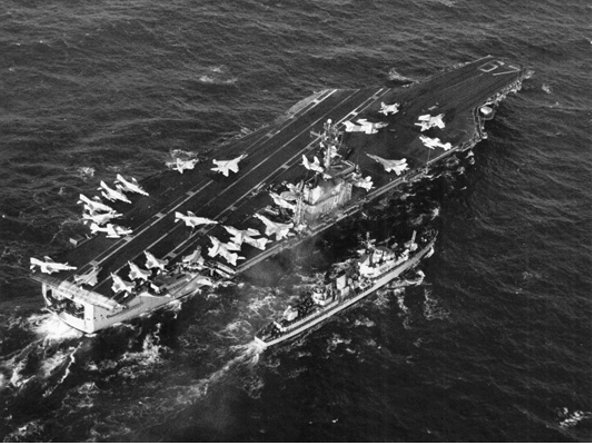
The case rests entirely on the first-person account of one man, Jim Kopf (he also gives his name as James Kopf, of Mt. Airy, Maryland), who served in the communications department of the United States Navy supercarrier USS John F. Kennedy, hull CVA-67. This case file covers what witnesses reported, the official narrative, and a two-pass assessment with its evidence tier.
What did witnesses see at USS John F. Kennedy (CVA-67)?
The case rests entirely on the first-person account of one man, Jim Kopf (he also gives his name as James Kopf, of Mt. Airy, Maryland), who served in the communications department of the United States Navy supercarrier USS John F. Kennedy, hull CVA-67. By his own account he had been in that section about a year. He places the ship in the Atlantic, in the stretch of ocean popularly called the Bermuda Triangle, returning toward Norfolk, Virginia after what he describes as a two-week operational readiness exercise in the Caribbean.
Kopf says it was evening, around 8:30, after the carrier had finished an eighteen-hour stretch of flight operations. He was on watch in the communications center, where his job was to monitor eight teletype machines printing the Fleet Broadcasts and to pull messages off them. He took a message off one of the broadcasts, turned back to the teletypes, and saw that the primaries were printing garbage. He walked to the intercom to Facilities Control and reported the broadcasts as out. The voice that answered told him all communications were out, not just his circuits. He lists the failures by name: the eight Fleet Broadcast teletypes printing garbage, the NAVCOMMOPNET ship-to-shore circuit, and the Task Group ship-to-ship circuit, all dead at once.
A friend who was a radar operator in the Combat Information Center later told him the radar screens during this period were "just glowing." Personnel on the navigation bridge told him the ship's compasses had gone non-functional. He says two of the Ready CAP F-4 Phantom fighters on alert could not be started. According to Kopf, a boatswain's mate standing lookout on the signal bridge saw the object directly overhead and had to be sedated by the medics afterward.
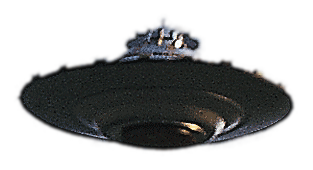
Kopf went topside and there saw it himself: a large glowing sphere hanging over or near the ship. In his words the light "wasn't too bright, about half of what the sun would be," it "sort of pulsated a little," and it ran from yellow to orange. He estimated that if the sphere were low, say a hundred feet above the ship, it would have been roughly two to three hundred feet in diameter, and larger if it were higher up. It made no audible sound. He watched it for something on the order of twenty seconds before it was gone, with the electronic disruption lasting on the order of twenty to twenty-five minutes in total. He stresses that of the roughly five thousand men aboard, only a small number actually saw the object, because most of the crew were below decks or off watch at that hour.
What is the official explanation?
No public US Navy report, deck log entry, command operational report, or message traffic for the event has been produced; Project Blue Book was already closed (December 1969). The only official element is internal and secondhand: a captain's closed-circuit TV reminder that shipboard events are classified, as quoted by Kopf, plus a rumor of "men in trench coats." The Naval History and Heritage Command history of CVA-67 places the ship back in Norfolk on 1 March 1971 and training off the Virginia Capes through the rest of 1971.
What did the witnesses think it was?
Jim Kopf (James Kopf), of Mt. Airy, Maryland, communications department, USS John F. Kennedy (CVA-67)
The dispute
The dispute is not a debunk so much as a documentation gap plus a calendar conflict, and it is worth being precise about both. First, the entire case is one man's recollection, Jim Kopf's, first committed to writing and posted online around 2000, describing an event he dates only to "1971" and that took place, on the popular reckoning, in 1971, nearly three decades earlier. Every corroborating witness in the account, the CIC radar operator, the navigation-bridge crew, the sedated signal-bridge lookout, the other communications-center men, is named or described only by Kopf. Out of a crew of roughly five thousand, not one independent witness has come forward in the public record to confirm a fleet-wide blackout, a glowing sphere over the deck, or men in trench coats. There is no deck log, no command operational report, no message traffic, no photograph and no instrument trace. Project Blue Book had closed in December 1969, so there is not even a contemporaneous Air Force channel that would have filed it.
Second, there is a real conflict with the ship's documented movements. The Naval History and Heritage Command history of USS John F. Kennedy records that a planned two-week Caribbean training cruise became a roughly 35,000-mile, six-month Mediterranean deployment, and that she returned to Norfolk on 1 March 1971, then trained off the Virginia Capes through the year and did not deploy again until December 1971. Kopf frames the night as the ship returning to Norfolk after a two-week operational readiness exercise that grew longer, which matches the deployment that ended on 1 March 1971, not the 2 July 1971 date that the National UFO Reporting Center attached to the report when it was logged on 23 July 2000. In other words, the witness's own homeward framing and the database's summer date do not line up with each other against the official record.
What this dispute does not contain is just as important. There is no confession, no recantation, no recovered hoax prop, and no positive identification of a specific real-world cause, no named drone or aircraft, no traced rocket or balloon, no identified ship or atmospheric event that this object demonstrably was. No independent analyst has shown a method by which the story was fabricated. The case is weakened by silence and by a date mismatch, not closed by affirmative counter-evidence. Under a standard that reserves strong dispute for confessions, recovered props, or a demonstrated identification of the specific object, this is a barely disputed case: a detailed single-witness military narrative that mostly stands on the witness's word while lacking any of the documentation that a real fleet-wide electromagnetic incident aboard a US supercarrier should have left behind.
Is the USS John F. Kennedy Glowing Sphere real? The two-pass assessment
Single-witness military testimony, vivid and internally detailed, first published online around 2000 about an event placed in 1971. It is corroborated by no independent witness, no document, no photograph, and no instrument log, and its assigned date of 2 July 1971 conflicts with the carrier's logged schedule (returned to Norfolk 1 March 1971, then training off the Virginia Capes). There is no confession, recovered prop, or positive identification of a specific real-world object, so the case falls short of strong dispute. Tier: Barely Disputed. It largely stands on the witness's word while lacking the documentation a genuine fleet-wide electromagnetic incident aboard a US supercarrier should have left.
Sources
- www.nicap.org/jfk.htm
- nuforc.org/sighting/?id=13385
- web.archive.org/web/20220520142450/https://www.ufocasebook.com/2011/1971johnfkennedy.html
- www.history.navy.mil/browse-by-topic/ships/aircraft-carriers/uss-john-f-kennedy.html
- www.navysite.de/cruisebooks/cv67-71/index.html
More cases from this region: UFO sightings in International waters (US Navy vessel, western Atlantic)