A B-17 Encounters Nine Flying Discs (1947)
The single source for what happened is a first-person account written by a man who signed himself "ETW, Colonel, USAF (Retired). This case file covers what witnesses reported, the official narrative, and a two-pass assessment with its evidence tier.
What did witnesses see at Promontory Point and the Great Salt Lake salt flats?
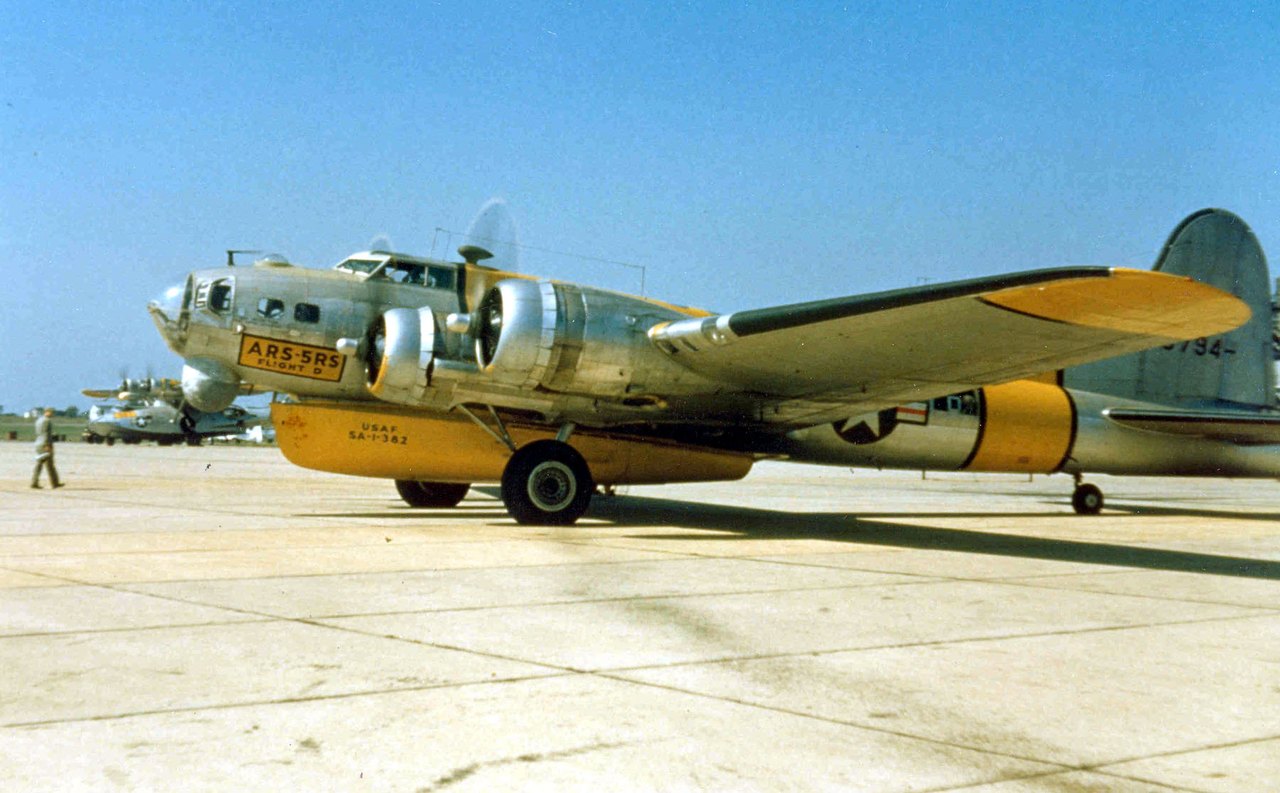
The single source for what happened is a first-person account written by a man who signed himself "ETW, Colonel, USAF (Retired)." He said that on 16 July 1947, at 15:30, he was aboard a B-17 over Promontory Point, Utah, crossing the Great Salt Lake salt flats. He was riding as a passenger, not flying the aircraft. He wrote that he first saw several pale objects rising up off the white salt flats below and to the front. His first read was that they were big white birds. They closed on the bomber so fast that he became alarmed, because birds do not move at that speed and he expected a collision.
In the few seconds before they reached the aircraft the objects banked and passed off to the left, close enough for him to make out detail. He counted nine of them. He described them as round, metallic discs, roughly 40 to 60 feet in diameter, with sand-colored tops and light blue undersides. They were holding a V formation built from three groups of three, a 3-3-3 arrangement. After clearing the left wing they pulled up into a climb and were gone within seconds. He said the whole encounter, from first sighting to the discs vanishing, was over almost as fast as it began, in clear weather with excellent visibility over the flats.
He immediately went forward to the cockpit to tell the pilot. The pilot had missed them entirely. The flight engineer, whom he identified only as Technical Sergeant "GJH," had seen the objects and confirmed what he described. So by his telling there were two witnesses aboard, himself and the engineer, with the pilot a non-witness. He added a detail that he clearly found painful in hindsight: he had just bought a movie camera with a telephoto lens while in the States on this trip, and it was sitting right in front of him during the encounter, and he never thought to lift it and film. There is no photograph or film of the event.
What is the official explanation?
There is no official narrative for this case, and that absence is the central fact about it. In July 1947 the United States Air Force did not yet exist as a separate service, and the Army Air Forces had no standing UFO investigation. Project Sign did not begin until 1948 and Project Blue Book not until 1952, so there was no apparatus in place to take, number, or file a disc report on 16 July 1947. No Project Blue Book card, no Air Materiel Command memorandum, and no contemporaneous military document tied to this sighting has ever surfaced.
The witness wrote that he "dutifully reported my sighting to the Operations Section at Travis Air Force Base as had been directed by the Senior Officer." That sentence does not hold up against the record and is worth quoting precisely because it dates the memory. The California base he names was Fairfield-Suisun Army Air Field in July 1947. It was not renamed Travis Air Force Base until 1951, after Brigadier General Robert F. Travis died in an August 1950 crash, with the dedication held on 20 April 1951. So the account uses a name that did not exist for another four years. That is a normal artifact of a man recalling events 58 years later and back-filling a familiar later name, but it also means his claim of having filed an official report cannot be matched to any 1947 paperwork under the name he gives.
The independent 1947 indexes are blunt on this. The NICAP "Report on the UFO Wave of 1947" states that between 16 and 19 July 1947 no sighting reports were found in the records examined. The widely cited table of 1947 flying-disc-craze reports contains no entry for 16 July, and nothing for Promontory Point, the salt flats, or a B-17. In short, every official and quasi-official channel that would normally hold a trace of this event holds nothing. The case never entered the documentary record in its own time.
What did the witnesses think it was?
ETW, identified only by initials, signed as Colonel, USAF (Retired); in 1947 the Aircraft Distribution Officer, Far East Air Materiel Command, Fuchu, Japan. Corroborating witness: the flight engineer, Technical Sergeant "GJH" (full name withheld). The pilot did not see the objects.
Is the A B-17 Encounters Nine Flying Discs (1947) real? The two-pass assessment
Pass one, the ordinary readings. Several mundane candidates fit a few-seconds, high-speed pass of pale shapes over bright salt flats. Sun glare bouncing off a flat white surface can throw confusing reflections, and a flock of birds catching light was the witness's own first interpretation before he upgraded it. Aircraft, contemporary military traffic, or a misjudged sense of size and distance against a featureless white background are all live possibilities, since the salt flats give the eye almost no scale cues. The encounter was very brief, there was no instrumentation, no radar, no photograph despite a camera being in his lap, and the account was committed to writing 58 years after the fact, by which point ordinary memory drift is expected. The named-base anachronism, calling it Travis in 1947, is direct evidence that the recollection has been reshaped by later knowledge. None of this proves a prosaic cause, but all of it keeps prosaic causes firmly on the table.
Pass two, if it happened as described. Then a B-17 crew watched nine metallic discs, 40 to 60 feet across, rise off the ground, close on a bomber at a speed that alarmed an experienced air officer, hold a precise 3-3-3 V, bank as a unit, and climb away in seconds. That is the classic 1947 disc report, and it lands inside the exact window of the summer disc wave, with a witness whose stated rank and air-materiel posting are consistent and whose mission detail (SB-17 rescue conversions) is historically real. If genuine, it is one more credentialed-aircrew sighting of structured craft that no agency ever explained, because no agency ever logged it.
The problem for tiering is that neither pass can be closed. There is no authenticated photograph, no film, no radar return, no contemporaneous newspaper, no Blue Book file, and no 1947 index entry, so nothing material can be verified, which blocks "Verified Unexplained." Equally, no one has produced a confession, a recantation, recovered props, or a positive identification of a specific real-world object, and no independent analyst has shown a method that explains it, so there is no debunk to dispute and no basis for either disputed tier. What remains is a single, internally coherent, retrospective aircrew account, corroborated only by the narrator's own report of one crewmate, with no official narrative ever attached for or against it. A case that stands purely on its witnesses with no official story is the definition of the Unknown tier, and that is where this one sits.
Sources
- web.archive.org/web/20260313110253/https://www.ufocasebook.com/ninediscs1947.html
- www.thinkaboutitdocs.com/1947-nine-flying-discs-encountered-by-b-17/
- nicap.org/waves/Wave47Rpt/ReportUFOWave1947_SectionI.htm
- www.nationalmuseum.af.mil/Upcoming/Photos/igphoto/2000571683/
- web.archive.org/web/20260119180059/https://planehistoria.com/sb-17/
- www.spokesman.com/stories/2005/feb/24/jennings-examines-ufo-sighting-claims/
- www.militarymuseum.org/TravisAFB.html
More cases from this region: UFO sightings in United States