The Battle of Los Angeles
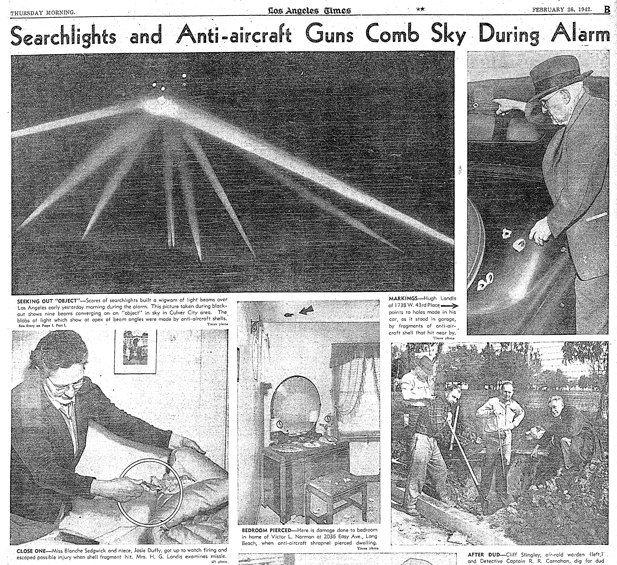
In the early hours of 25 February 1942, less than three months after Pearl Harbor and barely two days after a Japanese submarine had shelled the California coast, the air defenses of Los Angeles opened fire on something nobody ever identified. This case file covers what witnesses reported, the official narrative, and a two-pass assessment with its evidence tier.
What did witnesses see at Los Angeles and Santa Monica?
In the early hours of 25 February 1942, less than three months after Pearl Harbor and barely two days after a Japanese submarine had shelled the California coast, the air defenses of Los Angeles opened fire on something nobody ever identified. The sequence is fixed by the Army's own paperwork. At about 2:00 a.m. Army radar reported an unidentified contact roughly 120 miles west of Los Angeles, moving toward the coast. Anti-aircraft batteries were placed on green alert at 2:15 a.m., a blackout order went out at 2:21 a.m., and the air raid sirens began wailing across the county at about 2:25 a.m. The whole basin went dark.
For roughly the next hour the sky over the coast filled with crossing searchlight beams while thousands of volunteer air raid wardens scrambled to their posts. At 3:06 a.m. observers reported a balloon carrying a red flare over Santa Monica. Around 3:12 to 3:16 a.m. the guns of the 37th Coast Artillery Brigade opened up, and other coastal batteries joined in. The barrage was enormous. Crews fired off 12.8-pound anti-aircraft shells and .50-caliber machine-gun rounds at targets in the beams, and the firing did not taper off until the last of 1,430 to 1,440 rounds went up at around 4:15 a.m. All-clear signals were not fully sounded until between 7:21 and 8:34 a.m.
What people on the ground reported seeing varied wildly, which is exactly what you would expect from a frightened city firing blind in the dark. Some witnesses described a large, slow object held in the converging searchlights and seemingly absorbing direct hits without falling. Others reported fast aircraft, loose formations at 9,000 to 18,000 feet, single slow-moving lights, and at the lower, panicked end of the spectrum, falling bombs, Japanese paratroopers, and a downed enemy plane in Hollywood, none of which were ever found. General Marshall's memo to Roosevelt put the spread of estimated speeds at anywhere from officially reported "very slow" to as much as 200 mph, and the number of objects at "as many as fifteen." Nothing was shot down. No bombs fell. The damage was entirely self-inflicted: shrapnel from the city's own shells punched through houses, smashed cars, and reportedly killed a farmer's cow, and five people died, three in blackout-related traffic accidents and two of heart attacks suffered during the chaos.
What is the official explanation?
The official record on this event is unusually rich because two cabinet secretaries publicly contradicted each other within twenty-four hours, and the Army Chief of Staff put the Army's version on paper for the President. On 25 February, Secretary of the Navy Frank Knox told a press conference the whole thing had been a false alarm, stating flatly, "There were no planes over Los Angeles last night," and attributing the barrage to "jittery nerves." The same day, Secretary of War Henry Stimson took the opposite line, saying that as many as fifteen unidentified aircraft had been over the city, and floating the theory that they could have been commercial planes "operated by enemy agents" flying from secret strips in Mexico to probe defenses and spread panic. Stimson later walked the claim back. When the Pacific coast congressional delegation demanded answers and Knox was grilled on Capitol Hill on 2 March, he softened his "false alarm" line and said he had been misunderstood.
The single most important document is General George C. Marshall's memorandum to President Roosevelt dated 26 February 1942 (declassified per an OSD letter of 3 May 1972 and filed at the National Archives). It reads in part: "Unidentified airplanes, other than American Army or Navy planes, were probably over Los Angeles, and were fired on by elements of the 37th CA Brigade (AA) between 3:12 and 4:15 AM. These units expended 1430 rounds of ammunition." It continues: "As many as fifteen airplanes may have been involved, flying at various speeds from what is officially reported as being 'very slow' to as much as 200 MPH and at elevations from 9000 to 18000 feet." Marshall recorded that no bombs were dropped, no planes were shot down, and there were no casualties among the troops, and noted that investigation was continuing. The word "probably" is the hinge of the whole affair: the Army's own Chief of Staff would not say for certain that anything had been there.
The institutional verdict drifted toward "nothing was there" over the following decades. The IV Antiaircraft Command's own wartime history attributed the trigger to a weather balloon. The official Army Air Forces history compiled under William A. Goss recorded the 120-mile radar contact and noted that after the war Japanese officers, including Commander Masatake Okumiya, confirmed Japan had flown no aircraft over the area that night. In a 1983 study, the Office of Air Force History concluded the episode was a case of war nerves set off by meteorological balloons that had been released to track winds, whose lights and silvery color could have been mistaken for aircraft and whose effect was compounded by stray flares and the shell bursts of the batteries firing on one another's smoke.
What did the witnesses think it was?
The witnesses here were not a handful of contactees but a metropolis. Hundreds of thousands of Angelenos were jolted awake by sirens and stood in blacked-out streets watching tracer fire and searchlights for an hour, and the anti-aircraft crews themselves were firing at something they believed was up there. That is the core of why the case has never fully died: a large, disciplined military force, primed by genuine intelligence warnings, committed to an hour of live fire against targets its gunners and spotters insisted they could see in the beams. Several gun crews and observers maintained for years that a large, slow object hung in the converging lights and shrugged off direct hits, the detail that turned a war-nerves incident into a UFO legend.
The context behind that conviction was real and recent. On 23 February 1942, two nights earlier, the Japanese submarine I-17 had surfaced off Santa Barbara and shelled the Ellwood oil field, the first attack by a foreign power on the U.S. mainland since the War of 1812. The following day naval intelligence circulated a warning that an attack on the California coast could be expected within roughly ten hours. So when radar lit up on the night of the 24th to 25th, the men at the guns were not imagining a threat from nothing; they were acting on a fresh, official expectation of exactly such a raid.
Stimson's public insistence that fifteen real aircraft had been present, against Knox's flat denial, meant that even at the cabinet level credible figures held that genuine objects were over the city. On the other side, no wreckage, no bodies, no bomb craters, and no downed aircraft were ever produced, and Japan's postwar confirmation that it sent nothing removed the most obvious candidate. The witnesses believed they were defending the city against a real incursion. What they could not do, then or since, was produce a single recovered object to prove it.
The dispute
The dispute has two distinct strands, and it matters which one is method-shown. The first strand concerns the famous photograph. Larry Harnisch, a Los Angeles Times staffer who wrote an extended series on the image for the paper's history blog, examined an old print and concluded the published 26 February 1942 picture was heavily worked over by the photo desk, a routine 1940s practice to force contrast for newsprint. In his words, "much of what you see in this photo is painted: The beams from the searchlights are airbrushed. The supposed bursts of antiaircraft shells are blobs of paint," and the bottom quarter of the frame was painted black. Independent analysis of the negatives, later associated with UCLA Special Collections, found that beams were lightened and widened with white paint while others were eliminated. Historian Brett Holman, looking at a less-retouched version, argued the bright central form is simply searchlights illuminating a small cloud. On the image alone, this is a positive, method-shown explanation: the "disc" is a darkroom product, not a craft.
The second strand concerns the event itself, and here the counter-explanation is weaker. The 1983 Office of Air Force History study and the wartime IV Antiaircraft Command history attribute the alarm to war nerves triggered by a meteorological balloon, compounded by flares and friendly shell bursts. That is a plausible reconstruction, and it is bolstered by Japan's postwar confirmation that it flew no aircraft over Los Angeles. But it was never closed the way a strongly disputed case requires. No specific balloon was recovered or traced, no individual object was positively identified, and the Army's own contemporaneous record, General Marshall's 26 February 1942 memo to Roosevelt, states that unidentified airplanes were "probably" over the city, with "as many as fifteen" possibly involved at speeds from "very slow" to 200 mph. Secretary of War Stimson publicly maintained that real aircraft had been present, while Secretary of the Navy Knox's flat denial was partly retracted under congressional questioning.
So the dispute does not close the case, it reshapes it. The retouching argument convincingly removes the photograph as evidence of a UFO, which is why this is not filed as Verified Unexplained. But removing the photo does not explain a 120-mile radar contact, an hour of live fire by the 37th Coast Artillery Brigade, or the gun crews who insisted a large slow object hung in the beams. Because the official explanation for the event is an assertion and a reconstruction rather than a recovered object or a traced launch, and because the Army never affirmatively identified what it tracked and fired on, the case sits at Barely Disputed rather than Strongly Disputed. The strong, method-shown part of the debunk applies to the picture; the event behind the picture remains officially unresolved.
Is the Battle of Los Angeles real? The two-pass assessment
Pass one, the entirely ordinary reading. There is a strong, partly documented mundane case. The city was on a hair trigger after the Ellwood shelling and a same-day intelligence warning of an imminent raid. Meteorological balloons were aloft, and the IV Antiaircraft Command's own history and the 1983 Office of Air Force History study both land on a stray balloon, possibly carrying a flare, as the initial trigger, after which gun crews began firing at flares, drifting smoke, and each other's shell bursts in the dark. The "very slow" objects in Marshall's memo are consistent with drifting balloons; the faster "200 mph" estimates are consistent with frightened spotters misjudging shell bursts and lights. Crucially, the single piece of imagery everyone remembers, the Los Angeles Times searchlight photograph of 26 February 1942, is not clean evidence. Larry Harnisch of the Los Angeles Times, working from prints later associated with the paper's archive and UCLA holdings, documented that the published image was heavily airbrushed: in his words, "The beams from the searchlights are airbrushed. The supposed bursts of antiaircraft shells are blobs of paint," with the bottom of the frame painted black. Historian Brett Holman, examining a less-retouched version, argued the bright central shape is searchlights playing on a cloud, not a craft. So the "disc" in the famous photo is largely a darkroom artifact, and Japan confirmed after the war that it flew nothing over the city.
Pass two, if something real was there. Set the photo aside entirely, because the photo was never the strongest evidence. What remains is a radar contact 120 miles out, an hour of live anti-aircraft fire, multiple gun crews and observers reporting a large slow object that took hits without falling, and the Army Chief of Staff telling the President in writing that "as many as fifteen airplanes" were "probably" over Los Angeles. Knox's same-day "no planes" claim was an assertion he then partly retracted under congressional questioning, and the war-nerves-plus-balloon explanation, while plausible, was never closed with a recovered, traced balloon or a positively identified object. The Army never said what its radar tracked or what 1,430 rounds were aimed at for an hour.
This is the textbook shape of a barely disputed case. The mundane explanation is strong on the photograph specifically, which is genuinely method-shown as a retouched newsprint artifact, and that detail alone would sink a case that rested on the image. But the event is more than the image. The official counter-explanation for the event itself, war nerves and a weather balloon, is an institutional assertion and a reconstruction, not a recovered object or a traced launch, and the Army's own contemporaneous memo records unidentified objects as "probably" present rather than absent. Because the underlying military event is officially documented and was never affirmatively resolved, even as the iconic photo is compromised, the case lands at Barely Disputed. The retouching demolishes the photo as proof; it does not tell us what the gunners of the 37th Coast Artillery Brigade were shooting at.
Sources
- luforu.org/marshall-roosevelt-memo/
- historynet.com/the-battle-of-l-a/
- www.history.com/articles/world-war-iis-bizarre-battle-of-los-angeles
- ladailymirror.com/2011/03/07/another-good-story-ruined-saucers-over-la-part-1/
- airminded.org/2011/04/20/new-light-on-the-battle-of-los-angeles/
- www.military.com/daily-news/investigations-and-features/2025/11/13/wwii-mystery-behind-1942-battle-of-los-angeles-axis-planes-aliens-or-mass-hysteria.html
- www.laalmanac.com/history/hi07s.php
- www.theufochronicles.com/2014/02/iconic-photo-shows-searchlights.html
More cases from this region: UFO sightings in United States