The Minot AFB B-52 Encounter (1968)
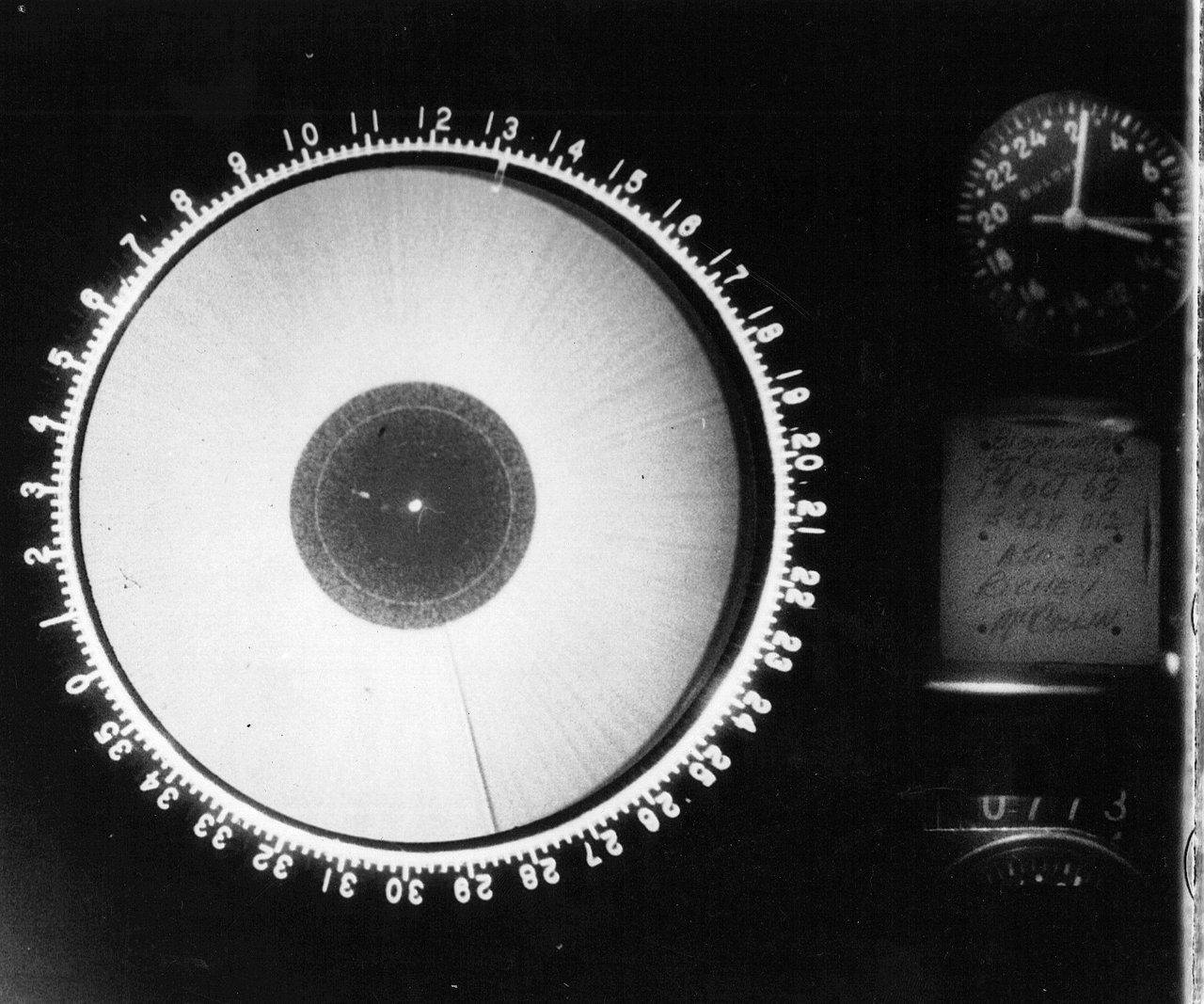
In the early morning hours of 24 October 1968, Air Force personnel scattered across the Minuteman intercontinental ballistic missile complex around Minot Air Force Base in North Dakota reported one and at times two large luminous objects over a span of roughly three hours. This case file covers what witnesses reported, the official narrative, and a two-pass assessment with its evidence tier.
What did witnesses see at Minot Air Force Base and surrounding Minuteman missile complex?
In the early morning hours of 24 October 1968, Air Force personnel scattered across the Minuteman intercontinental ballistic missile complex around Minot Air Force Base in North Dakota reported one and at times two large luminous objects over a span of roughly three hours. The first report came from a two-man maintenance crew at the November-7 Launch Facility. Electrician Robert M. O'Connor and heating and air-conditioning technician Lloyd M. Isley described a glowing object standing off in the dark, with O'Connor at one point hearing a low muffled sound and Isley comparing the object's apparent size to a KC-135 Stratotanker. Their report went up the chain to the November Flight Security Control center, where the controllers dispatched a Security Alert Team.
Staff Sergeant James F. Bond, a flight security controller, and his alert team responded toward N-7 and watched the object themselves, estimating it ten to twelve miles off. Security policemen on the ground, including Airman First Class Joseph P. Jablonski and Gregory Adams, tried to gauge its size by holding a match at arm's length: Jablonski reckoned the flame covered about half the object, Adams about a third, figures that put the thing at hundreds of feet across if it sat a few miles out. Over the night the object brightened, dimmed, appeared to shift position, and at times split into two lights. Jablonski's later statement records the final illuminations beginning around 0510 and lasting until roughly 0518.
The encounter escalated when a B-52H Stratofortress, serial number ending 012, of the 5th Bombardment Wing returned from a training sortie under the call sign JAG 31. The aircraft commander and instructor pilot was Captain Don Cagle, with instructor pilot Major James Partin aboard for an evaluation, instructor co-pilot Bradford Runyon Jr., navigator Patrick D. McCaslin, radar navigator Charles Richey, electronic warfare officer Thomas G. Goduto, and gunner Technical Sergeant Arlie E. Judd. Radar Approach Control vectored the bomber to overfly the object. On the aircraft's own ASQ-38 bombing radar a hard return appeared off the right side, then crossed to within about one nautical mile off the left wing, pacing the B-52 down a ground track of some twenty to twenty-five miles as the aircraft descended from 20,000 feet. The crew rolled radarscope camera film, capturing fourteen frames numbered 771 to 784 over about thirty-seven seconds near 0906Z. As the return closed on the aircraft, both UHF transmitters quit. Runyon recalled that the controllers told them the radio went dead in mid-word, not mid-sentence, the word simply breaking off, and that transmission returned to normal the moment the object pulled away.
On the descent the crew got a visual. From the cockpit they saw a large illuminated object low ahead of and below the bomber as it flew the traffic pattern, then passed over it on the base leg at close range. Crewmen described it variously as orange and elliptical, egg-shaped, football-shaped, and cough-drop-shaped, some two hundred feet long, several reporting a trailing glow or exhaust of the same color. McCaslin remembered the rest of the crew scrambling forward to look. A general officer up the chain ordered the crew to turn back and overfly the object again to photograph it. Near the same window, the maintenance men found the Oscar-7 Launch Facility standing open, its weather cover, vault door, and secondary B-plug door unsecured, with the security alarms never having triggered.
What is the official explanation?
The incident was worked as a formal Air Force case under Regulation 80-17. Lieutenant Colonel Arthur J. Werlich, the Minot base operations chief, was designated investigating officer. He collected AF-117 questionnaires from at least seven witnesses between 25 and 30 October 1968 and transmitted the Basic Reporting Data to Project Blue Book on 28 October. Werlich's own notes recorded the radar object as having moved roughly two and a half miles in three seconds, which he put at about 3,000 miles per hour. Strategic Air Command headquarters at Offutt declined to supply the technical assistance Werlich requested.
The 5th Bombardment Wing intelligence section examined the radarscope film. Staff Sergeant Richard Clark, who handled targeting studies, analyzed the frames and estimated a minimum average speed for the radar object of about 3,900 miles per hour, with direction changes occurring within single radar sweeps. Clark's blunt assessment was that nothing in the inventory of the day could do what the object did: in his words it had to have been a UFO because we had nothing that could do the kind of speed it had back then and be able to change directions. Clark later supplied higher-quality prints of the radarscope photographs to civilian researchers, the poor microfilm copies in the Blue Book file being nearly illegible.
Blue Book chief Lieutenant Colonel Hector Quintanilla Jr. filed the final case report on 13 November 1968 and broke the event into four parts, each given an ordinary cause. He wrote that the ground visual sightings appeared to be of the star Sirius and of the B-52 flying in the area; that the B-52 radar contact and temporary loss of UHF transmission could be attributed to a plasma similar to ball lightning; that the air visual from the B-52 could be the star Vega which was on the horizon at the time, or a light on the ground, or possibly a plasma; and that the physical violation of the lock of Oscar 7 did not seem to be related to UFOs in any way. In the Air Force's year-end statistical tally for 1968 the case was logged as Identified (Other), the radar portion carried as plasma. Quintanilla noted that plasmas of this class will paint on radar and can affect some electronic equipment at certain frequencies. The case was assigned file number 12,548 within the Project Blue Book records (project number 10073). Notably, Blue Book never interviewed co-pilot Bradford Runyon, one of the closest air-visual witnesses, whose detailed account and sketches only entered the record through civilian researchers decades later.
What did the witnesses think it was?
The B-52 crew were experienced Strategic Air Command flyers who insisted they had tracked and seen something solid and unfamiliar. Richard Clark, the intelligence sergeant who studied the film, was unequivocal that the radar object outran anything either side flew in 1968 and called it phenomenal. The ground witnesses were security police and missile maintenance technicians trained to know the look and sound of jet aircraft at night; their statements describe a silent luminous object distinct from the clearly audible B-52, watched from multiple separated launch facilities over the course of hours.
Co-pilot Bradford Runyon Jr. became the most thorough witness on the record, though only because civilian investigators reached him long after the Air Force closed the file. Interviewed in May 2000 by researchers working with Thomas Tulien's Sign Oral History Project, Runyon produced drawings of the object in November 2000 and described it as a large illuminated craft passed at close range, with a trailing crescent of glow. He confirmed the UHF transmitters failed twice during the closest approaches and recovered each time the object withdrew, the controllers reporting his words cut off mid-syllable.
The case rests on an unusually broad and mutually corroborating witness base for a UFO event: more than sixteen ground observers at different missile sites, a full bomber crew, the aircraft's own onboard radar film, the RAPCON radio transcription that timestamps the transmission losses, and the contemporaneous AF-117 questionnaires. The witnesses did not claim to know what the object was. They reported what their eyes, ears, and instruments registered, and they rejected the suggestion that seasoned military personnel had spent three hours mistaking a star and their own aircraft for an intruder over a nuclear weapons complex.
The dispute
The standing dispute is the Project Blue Book disposition signed by Lieutenant Colonel Hector Quintanilla Jr. on 13 November 1968, which logged the event as Identified (Other) and split it into four ordinary causes: the ground sightings as the star Sirius and the B-52 itself, the air-visual as the star Vega or a ground light or a plasma, and the close radar return with its UHF transmission loss as a plasma similar to ball lightning. This is the only formal counter-explanation on the record, and it carries the weight of the official Air Force investigation, which is why the case sits in a disputed tier rather than as a clean Unknown.
The dispute does not close the case, because it is an official assertion without a shown method, and independent analysts have dismantled each leg. On the radar and radio side, Quintanilla offered no plasma model, no measured atmospheric profile, and no reconciliation with the documented kinematics. Radar specialist Martin Shough, reviewing the scope film and the refractivity data in 2006, rejected anomalous propagation and every other conventional candidate and concluded that no convincing explanation of the unidentified echoes is found. Claude Poher, founder of the French government's GEPAN UFO project, computed accelerations around 189 g and speeds near Mach 8 from the radarscope frames, far beyond any plasma or aircraft. The researchers showed the ball-lightning label contradicts the physics it invokes on duration, size, altitude, and weather: this object paced a bomber for about ten minutes across thousands of feet of altitude in clear cool air, where ball lightning lasts seconds, stays small, and hugs the ground in storms.
On the visual and astronomical side, the Sirius and Vega identifications fail on geometry and on the witness profile. At the time of the air-visual, Vega was roughly two degrees below the horizon and on the wrong side of the aircraft's heading for the crew to have seen it as the light ahead and below them. Attributing more than sixteen ground sightings to a single star and to the crew's own clearly audible aircraft asks trained security and missile-maintenance personnel to have mistaken a star and a B-52, over three hours, for an intruder at a nuclear weapons site. Blue Book also never interviewed co-pilot Bradford Runyon, one of the nearest witnesses, and never seriously analyzed the radarscope film, work that civilian investigators only completed decades later. Because no confession, no recovered hoax materials, and no positively identified real-world object, balloon, aircraft, or traced natural source has ever been produced, and because the strongest independent technical reviews land on unexplained, the official debunk weakens but does not resolve the encounter. The case is Barely Disputed.
Is the Minot AFB B-52 Encounter (1968) real? The two-pass assessment
Pass one, the ordinary readings. The Air Force itself supplied the conventional case, so it can be tested directly. The ground sightings were attributed to the star Sirius plus the B-52 in the pattern; the air-visual to the star Vega, a ground light, or a plasma; the radar return and radio loss to a ball-lightning-class plasma. Temperature inversion and haze were invoked to magnify and make stars appear to move. These are real mechanisms. Stars near the horizon do scintillate and seem to drift through autokinesis, inversions do bend radar, and a charged plasma could in principle both register on radar and disturb electronics. If the witnesses were less practiced or the object had been seen for seconds rather than hours, the star-and-plasma package would be a strong fit.
Pass two, if the conventional package does not hold, what was it. The independent technical work pulls hard against Blue Book. Radar specialist Martin Shough, in a 2006 study for the principal investigators, walked through aircraft, missiles, meteors, precipitation, lightning, auroral ionization, satellites, and anomalous propagation, and concluded no convincing explanation of the unidentified echoes is found, noting that the atmospheric refractivity data do not indicate any obvious cause of strong unexplained echoes on the airborne radar, and that a contact held at constant bearing across roughly twenty-five miles of ground track is itself inconsistent with anomalous propagation. Claude Poher, the physicist who founded France's official GEPAN UFO project at the space agency CNES, analyzed the radarscope frames and derived accelerations on the order of 189 g and speeds near Mach 8 from the inter-frame jumps, figures no conventional craft or atmospheric artifact reaches. The researchers also showed the plasma label fails point by point: ball lightning lives seconds to a minute, this paced the bomber about ten minutes; ball lightning is the size of a grapefruit, this read as large as an aircraft; ball lightning drifts a meter above the ground at a few meters per second in stormy weather, this tracked from 20,000 to 9,000 feet in clear cool air with 25-mile visibility. The Vega identification fails on geometry, since at the time Vega sat about two degrees below the horizon and on the wrong side of the aircraft heading to be the light the pilots saw.
Weighing both passes, this is a Barely Disputed case. An official counter-explanation exists and it is on the record in detail, which is why the case is not filed as simply Unknown. But that explanation is an assertion rather than a demonstrated identification. Blue Book named a plasma without showing one, named stars that the geometry and the witnesses contradict, and never interviewed the closest air-visual witness or analyzed the film with any rigor. No confession, no hoax props, no positively identified aircraft, balloon, or traced natural source has ever been produced for this event. The two strongest independent reviewers, Shough on radar physics and Poher on the scope kinematics, both land on unexplained. The official debunk here reads more as a file-closing exercise than a solved case, and under a two-pass test the encounter largely stands. Barely Disputed.
Sources
- minotb52ufo.com/narrative/endnotes.php
- minotb52ufo.com/investigation/section-6.php
- minotb52ufo.com/shough/ms_sec1.php
- minotb52ufo.com/poher/cp-part1.php
- minotb52ufo.com/interviews.php
- minotb52ufo.com/introduction.php
- minotb52ufo.com/radarscopes/radarscope-index.php
- www.explorescu.org/post/the-investigation-of-ufo-events-at-minot-air-force-base
- scienceandtheufocontroversy.blogspot.com/2013/01/the-extraordinary-1968-minot-b52-ufo.html
More cases from this region: UFO sightings in United States