The Buff Ledge Camp Abductions

On the evening of 7 August 1968, two staff members at Buff Ledge Camp, a private girls' camp of about thirty acres off Clay Point Road in Colchester, Vermont, on the Malletts Bay shore of Lake Champlain, were sitting on the camp's boat dock during a slack day with most campers and counselors away at a swim meet. This case file covers what witnesses reported, the official narrative, and a two-pass assessment with its evidence tier.
What did witnesses see at Buff Ledge Camp?
On the evening of 7 August 1968, two staff members at Buff Ledge Camp, a private girls' camp of about thirty acres off Clay Point Road in Colchester, Vermont, on the Malletts Bay shore of Lake Champlain, were sitting on the camp's boat dock during a slack day with most campers and counselors away at a swim meet. Michael Lapp, sixteen, worked maintenance. Janet Cornell, nineteen, was a water-ski instructor. ("Michael Lapp" and "Janet Cornell" are the pseudonyms Walter Webb used in his book to protect the witnesses.)
As the sun set, Lapp noticed a bright light low in the western sky that he first took for the planet Venus. The light brightened, then began to descend toward the lake and flatten as it dropped. From the larger object three smaller lights detached and moved off, performing what the witnesses described as zigzag maneuvers, loops, and a fluttering, falling-leaf descent. The three formed a brief triangle, and two of them withdrew with a sound Lapp likened to "a thousand tuning forks."
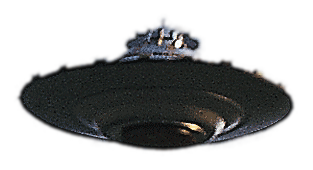
The remaining object came on toward the dock. It was disc-shaped with a transparent dome, and inside the dome the two witnesses said they could see two small childlike figures with large heads, thin necks, and large wraparound eyes. Lapp reported a sense of telepathic contact and said that when he slapped his knee, one of the beings copied the gesture. The craft then put a beam of light down on the two of them. Lapp said the beam felt almost liquid and that he could see the bones of his hand through the skin, as if X-rayed, and that both of them felt themselves floating. He recalled trying to pull Janet down and saying words to the effect of not wanting to go. The next thing either of them was clearly aware of, the sky had gone fully dark, far darker than the early evening they remembered, and the object was climbing away with repeated flashes of light. They were left with a gap of roughly an hour they could not account for, and Janet in particular seemed dazed and unwell afterward.
What is the official explanation?
There is no government file on Buff Ledge. The United States Air Force closed Project Blue Book in December 1969, the year after the event, and the incident was never reported to it. There is no Blue Book card, no FOIA record, and no police or military report. The case exists entirely in the civilian research record, which in this instance is unusually thorough.
The investigation of record was conducted by Walter N. Webb. Webb was not a hobbyist. He was a professional astronomer and a lecturer at the Charles Hayden Planetarium in Boston, he had trained in the late 1950s under J. Allen Hynek at the Smithsonian Astrophysical Observatory's optical satellite tracking program, he served for years as the scientific (astronomy) advisor to NICAP, and he was the first investigator to interview Betty and Barney Hill, sitting with them for a six-hour interview on 21 October 1961 and writing the early NICAP report on their case. Lapp first contacted the Center for UFO Studies in 1978, ten years after the event, and Webb took the case and worked it for roughly five years.
Webb's method is the reason the case is taken seriously. He treated independent verification as the first task: rather than build everything on Lapp, he located Janet Cornell separately and interviewed her to see whether her account would match before either of them had compared notes. Because the conscious memories were fragmentary and bracketed by missing time, Webb arranged separate regression hypnosis sessions for each witness, conducted by Dr. Harold Edelstein. Under hypnosis Lapp described being lifted aboard a larger craft and seeing Janet on an examination table, with the beings shining a light into her eyes, scraping her skin, and taking fluid samples; he gave the beings' purpose as something like making "life like ours" in "other places." Cornell, regressed separately, described the same abduction from her own point of view, recalling the cold table and the sensation of something pulling her hair and pinching her neck. Webb documented the consistency between two people who, he stressed, had had no realistic opportunity for collusion across the intervening decade. His conclusion, published as "Encounter at Buff Ledge: A UFO Case History" through the J. Allen Hynek Center for UFO Studies in 1994 (306 pages, ISBN 0929343603, bibliography pp. 295 to 299), was that the two witnesses were telling the truth about a real external event of unknown origin.
What did the witnesses think it was?
Lapp and Cornell both maintained that what they reported actually happened to them. Lapp carried the experience for ten years before approaching researchers, and Webb records that part of what drove him to come forward was recurring disturbing recall about the night. Cornell was, by Webb's account, a reluctant witness who had to be located and persuaded, which matters: she did not seek publicity, and her independently obtained account nonetheless lined up with Lapp's on specifics neither could have rehearsed with the other.
The strongest corroboration is that the lights over the lake were not seen only by the two on the dock. Webb tracked down several other Buff Ledge people who recalled seeing strange lights over Lake Champlain that same evening, and he documented a separate sighting earlier that summer in which two other camp employees watched unidentified objects over the water for about twenty minutes. That independent same-night confirmation of an actual aerial display is what lifts Buff Ledge above a pure two-person abduction narrative: something was in the sky over the lake that night, witnessed by people who were not party to the later hypnosis.
Webb himself, a credentialed astronomer who had spent decades sorting genuine reports from misidentified stars, aircraft, and balloons, came down on the side of the witnesses. Having entered the case as exactly the kind of investigator equipped to explain it away as Venus or a plane, he instead concluded after five years that the two had experienced a real event he could not reduce to a conventional cause.
The dispute
The substantive dispute is methodological and centers on the hypnosis. The conscious, non-hypnotic memory of both witnesses ends at the beam and an hour of missing time. Everything specific about the beings, the dome interior, the examination table, the skin scraping, and the fluid extraction was recovered only under separate regression sessions with Dr. Harold Edelstein, ten years after the event. Critics of abduction research generally, not of Buff Ledge specifically, hold that hypnotic regression does not reliably recover buried memory and can instead generate detailed, sincere, and internally consistent false memories shaped by the subject's expectations and the interviewer's cues. On that view the agreement between Lapp's and Cornell's accounts shows that two people absorbed from the same cultural script, not that an abduction occurred. This is a genuine and serious criticism, but it is a contested general argument about a technique, not a demonstration that these two specific memories were fabricated, and it does nothing to explain the independent same-night witnesses to the lights over the lake. Under the tiering rules a contested psychological argument of this kind is weak counter-evidence, not a method-shown discredit.
The second strand is a specific hoax claim. An anonymous blog post titled "The Buff Ledge Incident / Hoax," published in 2013 on the WordPress site "eye of the cyclone" under the handle lahar9jhadav, asserts that the sighting was an elaborate camp prank and presents two photographs said to show constructed props, a model craft and figures. On inspection the claim collapses under its own evidentiary weight. The author gives no name, no credentials, and no chain of custody for the images; the photographs are undated and unverified, with nothing tying them to Buff Ledge, to August 1968, or to this event; no participant in the alleged prank is named; there is no confession; and no analyst performs any examination of the photographs or identifies what they actually depict. It is assertion plus unsourced images, which is the textbook profile of method-less skepticism rather than a demonstrated debunk.
Against both strands sit the case's load-bearing strengths: an investigator who was a professional astronomer and a career debunker of ordinary lights, two witnesses interviewed separately whose accounts matched without an opportunity to collude across ten years, and, most importantly, additional Buff Ledge staff who independently saw unexplained lights over Lake Champlain that same evening and earlier that summer. Because no confession, recantation, recovered prop with provenance, or positively identified real-world object has ever been produced, the disputes chip at the case without closing it. It is therefore filed as Barely Disputed, a case that largely stands while honestly carrying the hypnosis caveat and the unproven hoax allegation.
Is the Buff Ledge Camp Abductions real? The two-pass assessment
Pass one, the ordinary readings. The opening object is a textbook misidentification setup: Lapp himself first thought the bright light was Venus, and dusk over open water is prime territory for an astronomical body, an aircraft on approach to Burlington, or a slow-moving light distorted by haze. The fluttering "falling leaf" motion and the splitting into smaller lights could in principle describe distant aircraft, flares, or even balloons catching the last sun. The core abduction content, however, does not come from the dock memory at all; it comes from regression hypnosis conducted a decade later, and hypnosis is well known to be capable of producing confident, detailed, internally consistent memories that are partly or wholly confabulated, especially when an interviewer's expectations leak into the session. So a skeptic can fairly say that a real but mundane light in the sky, plus an hour of ordinary lost time, plus two hypnosis sessions a decade later, could in theory assemble into a vivid shared abduction story without anything unearthly happening. There is also one online claim, examined in the dispute, that the whole thing was a camp prank.
Pass two, if it is what the witnesses and Webb describe. Then two camp employees with no later opportunity to coordinate independently reported the same close-approach craft, the same childlike occupants, the same beam, and the same medical examination, and crucially the aerial display itself was separately confirmed by other camp staff who saw lights over the lake that same night and earlier that summer. That outside confirmation is the part hypnosis cannot manufacture. The investigator was not a believer looking to be convinced but a planetarium astronomer who had professionally debunked countless lights and who had been the first serious investigator of the Hill case, and he spent five years before concluding the pair were truthful and the object unidentified.
Weighing it: the case rests on credible, cross-checked human testimony plus genuine independent same-night witnesses, documented by an unusually qualified investigator, with no recovered hoax materials, no confession, and no positive identification of a specific aircraft, balloon, drone, or staged prop. The counter-explanations that exist are real but unproven, an initial Venus-grade misidentification and the known unreliability of decade-late hypnosis, and a single anonymous hoax claim with no chain of custody. None of that rises to a confession, a recantation, recovered props, or a named identified object. That is the definition of a case that is contested at the edges but still standing, which places it at Barely Disputed.
Sources
- archive.org/details/encounteratbuffl0000webb
- books.google.com/books/about/Encounter_at_Buff_Ledge.html?id=fYxYAAAAYAAJ
- www.colchestersun.com/news/on-the-shores-of-buff-ledge/article_217a73e1-36e5-5690-a736-031184c46143.html
- vermontdailychronicle.com/the-buff-ledge-ufo/
- rr0.org/people/w/WebbWalterN
- digitalseance.wordpress.com/2013/05/07/the-buff-ledge-incident/
More cases from this region: UFO sightings in United States