The Florida Everglades Encounter (Flynn, 1965)
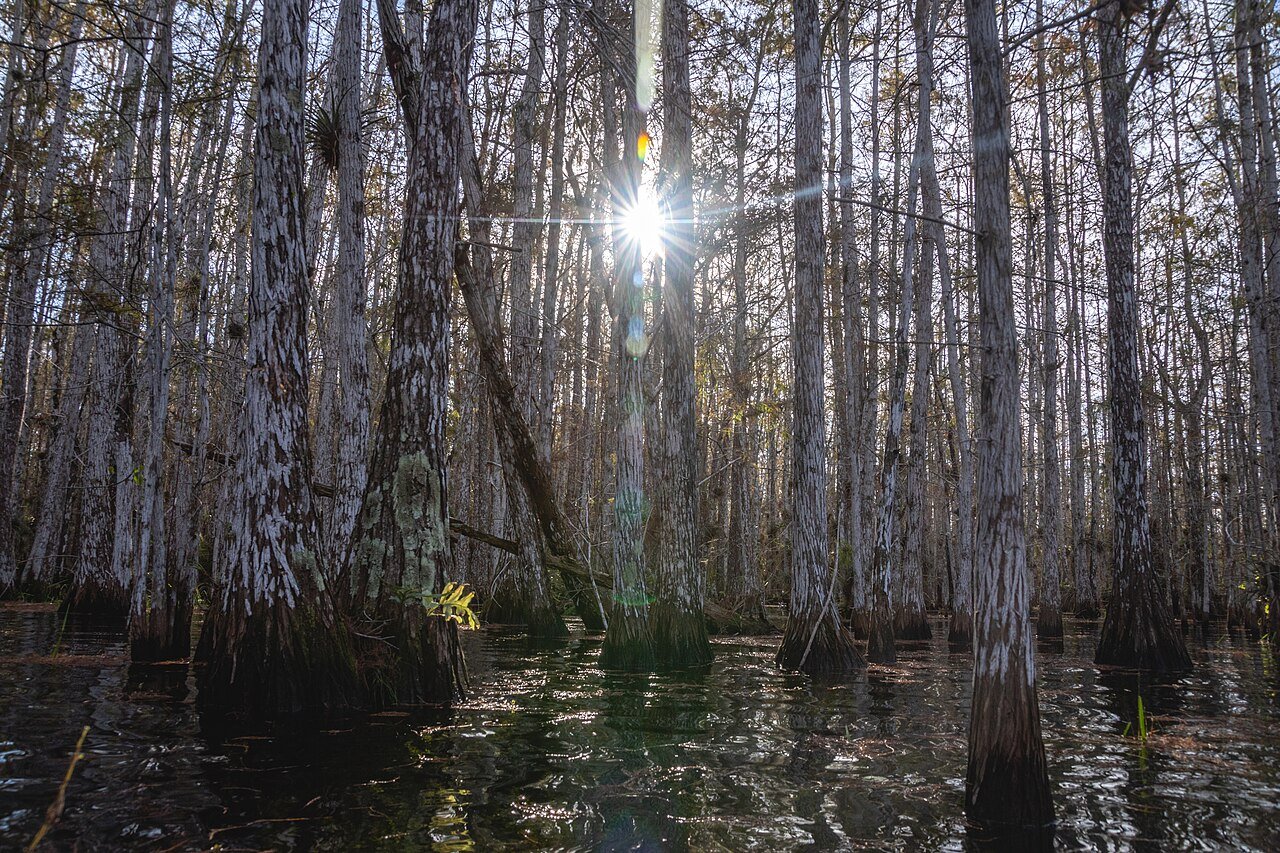
James W. Flynn, a 45-year-old East Fort Myers cattleman and experienced woodsman, drove his custom swamp buggy deep into the Everglades around the middle of March 1965 to exercise and train four of his hunting dogs, planning to camp several days. This case file covers what witnesses reported, the official narrative, and a two-pass assessment with its evidence tier.
What did witnesses see at Everglades wetlands east of Fort Myers?
James W. Flynn, a 45-year-old East Fort Myers cattleman and experienced woodsman, drove his custom swamp buggy deep into the Everglades around the middle of March 1965 to exercise and train four of his hunting dogs, planning to camp several days. On the night of 14 March his dogs broke off after a deer and vanished into the sawgrass. Flynn heard what he took for a gunshot in the distance, started the buggy, and set off to find them.
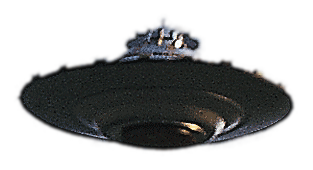
Shortly after midnight, between roughly 1 and 2 a.m., he saw a bright, oscillating yellow light low over the cypress, which he first judged to be more than a mile off. He at first thought it might be a helicopter. As he closed the distance in the buggy he stopped about 400 yards out, then continued on foot. Up close the thing was no aircraft. He described a large inverted cone, broad at the top and tapering down, hovering with a slight wobble just above the sawgrass. He put the base diameter at roughly 75 to 100 feet and the height at about 25 to 30 feet. The body looked metallic and plated, as if built from four-foot panels held with rivets, and ran four tiers or rows of roughly two-foot-square ports or windows that glowed yellow. The lowest tier sat about twelve feet up from the bottom, with the rows evenly spaced above it. He could see only a blank yellow interior wall through the openings, no figures and no machinery. The object gave off a heavy whirring or droning sound he compared to a diesel generator, and a reddish-orange glow lit the ground for about 75 feet around its rim.
Flynn walked to within a few yards, maybe 150 feet by the NICAP reckoning, stepped into the circle of light, and raised his left hand as a friendly gesture in case anyone was watching. The object then put out a blast of air or wind and a jet-like roar that staggered him. As he stood there a narrow beam, which he later likened to a welder's torch or a pencil-thin blue light, came from the craft and struck him squarely on the forehead between the eyes. In his own words to the local paper, I felt a blow like a sledgehammer between the eyes, and that's all I know. He dropped unconscious.
He came to many hours later, by his account roughly twenty-four hours after being hit, slumped against a cypress, partly blind, with a sore depressed bruise and a small dark mark on his forehead. His dogs had returned and were near him. He managed to get the swamp buggy back out of the wetland and sought medical help. Where the object had hovered there was a black, oily-looking scorched circle in the sawgrass and the tops of nearby cypress were burned.
What is the official explanation?
The United States Air Force, through Project Blue Book, never published a substantive finding on the Flynn encounter, and that absence is itself documented. Intelligence officers from Homestead Air Force Base telephoned Flynn while he was hospitalized, reportedly under orders from a General O'Keefe, took a preliminary account, and said they would interview him again on his release. To the best of the record, that follow-up never took place. When pressed, the Air Force fell back on the statement that it had nothing in its files concerning the Flynn incident.
That statement is contradicted by the archive. The case does appear in the Project Blue Book records as Case Number 9337 on the redacted NARA microfilm copy of Blue Book released to the National Archives in 1975, National Archives Microfilm Publication T1206, roll 1, and it also appears, without a case number assigned, on the unredacted Maxwell Air Force Base microfilm copy, roll 30,363. So the official apparatus both held a file reference and publicly disclaimed having one, while declining to investigate the physical and medical evidence in any visible way. Under the standing approach here, an official body's move to distance itself from a case is logged as evidence the case was real enough to need closing, not as a strike against it.
The serious investigation was civilian. The National Investigations Committee on Aerial Phenomena (NICAP) reported the case in The U.F.O. Investigator, Vol. III No. 1, March-April 1965, p. 6, summarizing the object, the medical aftermath, and the ground trace, and concluded that the character testimony and physical evidence seemed to authenticate the incident. NICAP carried the case forward into Richard Hall's compendia, including the account later reprinted in Uninvited Guests (Aurora Press, 1988, pp. 250 to 251). The Aerial Phenomena Research Organization (APRO), the Lorenzens' group, reconstructed the event from correspondence with Flynn and his physician Dr. Harvie J. Stipe and ran it in the APRO Bulletin. The atmospheric physicist Dr. James E. McDonald of the University of Arizona looked into it independently. In a letter to Richard Hall dated 31 October 1966, McDonald wrote that he was inclined to give credence to Flynn's account but wanted more cross-checks, noting that separate interviews with Flynn and his wife jibed well with each other and with the APRO account. McDonald recorded that hospital X-rays of Flynn's skull showed no concussion, that Flynn had suffered a temporary loss of hearing and numbness with no lasting reflex damage, and that his right eye remained cloudy or fuzzy in the mornings, with a small darkened forehead spot about the size you would make by twisting an eraser around on it.
What did the witnesses think it was?
Flynn maintained the same account from 1965 onward and never recanted. He was not a fringe figure looking for attention. Lee County Sheriff Flanders Thompson, who had known him for years, told the press, Knowing Jimmy as I know him, I don't believe he would cook up a story like this, and the Fort Myers News-Press described him editorially as a substantial citizen, a practical, down-to-earth type. A thirty-year acquaintance separately vouched for his honesty. Flynn himself stayed openly puzzled rather than triumphant, telling reporters, I'm waiting for the day someone turns up the truth about this thing. I hope I live that long.
The strongest corroboration is medical, and it comes from two named physicians who examined him in the days after. The Fort Myers ophthalmologist Dr. Paul R. Brown examined Flynn on 17 March 1965 and found him nearly blind in the right eye, vision 20/800 there against 20/60 in the left, with a slight bruise over the right brow and upper lid and a gross hyphema, a pool of blood inside the right eye, so dense the retina could not be seen. Flynn's right pupil was measured about a millimeter larger than the left. The damage then resolved fast: by 29 March his vision had recovered to about 20/20 right and 20/25 left, and by July 1966 he tested 20/15 in each eye with correction. Flynn's personal physician, Dr. Harvie J. Stipe, examined him as well and ran a brain scan using radioactive mercury-203, which came back negative, ruling out a gross brain lesion. Stipe and others documented impairment of deep muscle and tendon reflexes, numbness in the arms and hands, and temporary hearing loss during the roughly five-day hospitalization. Flynn's doctor regarded the reflex impairment in particular as something that could not have been faked. Both Flynn and Stipe took APRO and McDonald's inquiries seriously enough to correspond at length, though Flynn at one point asked McDonald to stop contacting Stipe, who had been bothered a lot about this already.
The physical trace was inspected too. On a return trip on or about 26 March 1965, Flynn, Dr. Stipe, and others reached the spot and found a roughly circular burned area in the sawgrass, measured at about 72 to 74 feet across, that looked swept clean of leaves, twigs, and forest litter, with about eight cypress trees scorched from their crowns down to roughly halfway to the ground, and scuff marks on the trunks. Soil samples were collected. A sheriff's investigator, Robert Daubenspeck, was among those who looked at the case alongside Sheriff Thompson.
Is the Florida Everglades Encounter (Flynn, 1965) real? The two-pass assessment
Pass one, the ordinary readings. A lone witness alone in a swamp after midnight is the weakest possible observational setup, and no second person saw the object, so the sighting itself rests entirely on Flynn. A skeptic can reach for a misperceived aircraft, a helicopter with lights, or a hoax. But the prosaic options struggle against the hard parts of the record. The forehead injury, the dense bleed inside the right eye dropping his vision to 20/800, the depressed bruise, the documented reflex impairment, numbness, and temporary hearing loss were recorded by two named physicians within days, with vision figures, a negative mercury-203 brain scan, and skull X-rays showing no concussion. That is not the signature of someone who saw a helicopter. A self-inflicted hoax would have to fake a gross hyphema, an objective clinical sign a hoaxer cannot will into being, and Flynn's own doctor judged the reflex changes unfakeable. The ground trace, a swept 72-foot scorched circle with eight cypress burned from the crown down, was inspected by the witness, his physician, and a sheriff's investigator, not merely asserted. No confession, no recovered props, no rival witness recantation, and no identified mundane object have ever surfaced. The injuries are real and documented; the only live question is the cause.
Pass two, if the encounter happened as reported. Then a structured, metallic, cone-shaped craft of roughly 75 to 100 feet hovered low over the Everglades, projected a directed beam that produced localized burns and ocular trauma without lasting brain injury, and left a thermal ground signature, all consistent with the object Flynn described and with the four tiers of glowing ports. This is one of the better-documented physical-and-medical close encounters of the 1960s wave precisely because the damage was charted by independent doctors and the trace was walked by multiple people. The Air Force's posture cuts in the case's favor rather than against it: a file reference exists in the Blue Book microfilm as Case 9337 (NARA T1206 roll 1) and on the Maxwell roll, yet the service publicly claimed to have nothing and never ran the physical or medical evidence to ground. That is an apparatus closing a case it could not explain, which under the rules here is logged in pass two, not held against the witness.
The medical record is authenticated by two named, locally identifiable physicians and corroborated by an independent physicist (McDonald) and two civilian investigative bodies (NICAP and APRO), the ground trace was inspected by several people including law enforcement, and the object itself remains unidentified. No civilian, method-shown analysis has ever produced a confession, recovered props, or a positive identification of a specific mundane cause. The injuries are objective and documented, while the lone-witness sighting is the soft spot. On balance the material effects are real and unexplained, so the case sits at Verified Unexplained.
Sources
- nicap.org/650315everglades_dir.htm
- www.nicap.org/reports/650315ufoi.htm
- www.nicap.org/reports/650315press.htm
- www.nicap.org/reports/650315rep2.htm
- www.nicap.org/reports/650315rep3.htm
- www.nicap.org/reports/650315McD.htm
- www.ufoevidence.org/cases/case23.htm
More cases from this region: UFO sightings in United States