The Foo Fighters of World War II
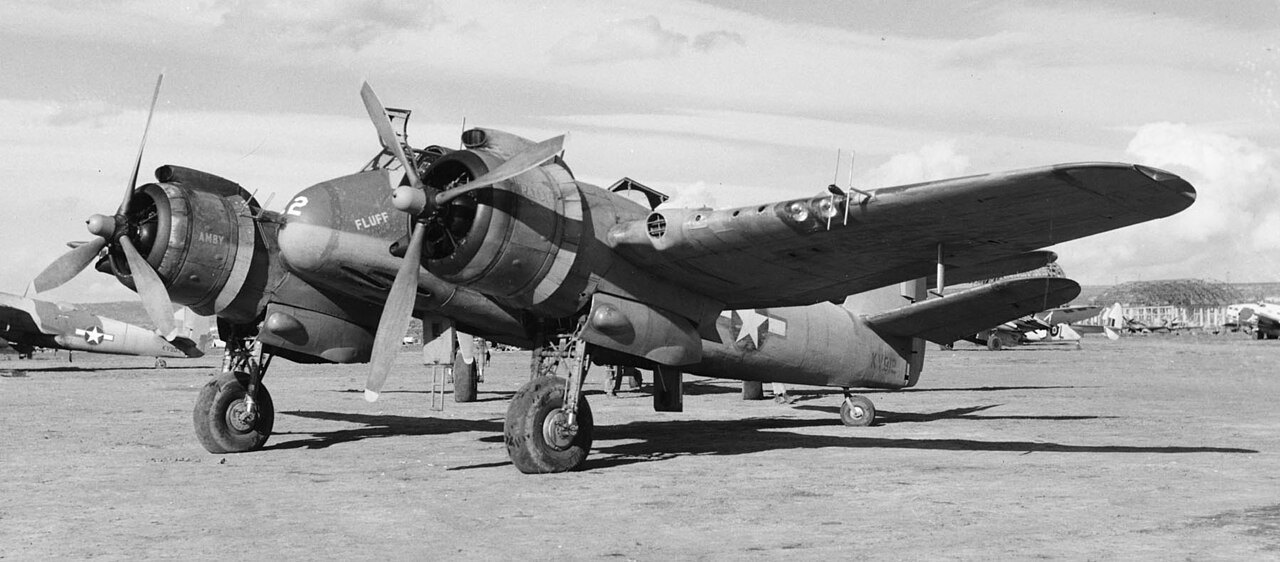
Through the late autumn and winter of 1944 to 1945, American night-fighter crews flying intruder missions over the German frontier began reporting glowing balls of light that paced their aircraft. This case file covers what witnesses reported, the official narrative, and a two-pass assessment with its evidence tier.
What did witnesses see at Rhine Valley and Hagenau region?
Through the late autumn and winter of 1944 to 1945, American night-fighter crews flying intruder missions over the German frontier began reporting glowing balls of light that paced their aircraft. The earliest traceable encounter came in November 1944, over the Rhine Valley north of Strasbourg, in a Bristol Beaufighter of the United States Army Air Forces 415th Night Fighter Squadron. The crew that night was pilot Lt. Edward Schlueter of Oshkosh, Wisconsin, radar observer Lt. Donald J. Meiers, and intelligence officer Lt. Fred Ringwald, who happened to be riding along. Ringwald was first to notice them. As Jo Chamberlin recorded the account in his December 1945 American Legion Magazine article, Schlueter saw "eight or ten of them in a row, orange balls of fire moving through the air at a terrific speed." Schlueter turned his Beaufighter toward the lights and they vanished, then reappeared farther off. Ground control radar at the time reported no other aircraft in the sky, and the Beaufighter's own airborne radar registered nothing.
Over the following weeks the sightings multiplied across the squadron. The lights came in red, orange, and sometimes greenish or white, singly or in rows, occasionally in clusters of up to roughly fifteen that one observer compared to a Christmas tree hung in the air. They held formation alongside the aircraft, matched its turns, and never attacked or made contact. Meiers, who is generally credited with naming them, gave one of the most quoted descriptions: "I turned to starboard and two balls of fire turned with me. I turned to the port side and they turned with me. We were going 260 miles an hour and the balls were keeping up with us."
The best-documented single episode is the Hagenau incident of December 22 to 23, 1944, flown by pilot Lt. David L. McFalls of Cliffside, North Carolina, with radar observer Lt. Ned Baker of Hemet, California. The 415th war diary entry, preserved on US Air Force microfilm at the National Archives, reads: "In vicinity of Hagenau. Saw 2 lights coming toward A/C from ground. After reaching the altitude of the A/C they leveled off and flew on the tail of Beau for 2 minutes and they peeled up and turned away." McFalls described large orange glows that climbed from the ground, leveled at the aircraft's altitude, trailed it for about two minutes, then peeled off "flying under perfect control." On the second night he reported a glowing red object shooting straight up that suddenly resolved into the view of an aircraft doing a wing-over. Other named 415th men whose reports Chamberlin collected included Lt. Henry Giblin of Santa Rosa, California, and Lt. Walter Cleary of Worcester, Massachusetts. Identical phenomena were also reported by Allied crews in the Pacific theater, showing the sightings were not confined to one front. The best documented of those is the B-24 Liberator that was paced from Truk Atoll to Guam on 2 May 1945, which Chamberlin summarised in a single paragraph of the same article. The primary military record behind that paragraph, Headquarters VII Bomber Command Mission Report No. 11-327, was published by the National Archives in August 2026 and is covered in full at /cases/truk-atoll-1945.
What is the official explanation?
The military took the reports seriously from the start, and the first official reaction treated the lights as a possible enemy device. When the story broke in the press in late December 1944, Supreme Headquarters Allied Expeditionary Force handling framed the glowing objects as a possible "new German weapon," and a War Department classified message dated January 2, 1945, preserved among the records reproduced by the Project 1947 research archive, asked for an explanation of the "foo fighters" press reports then circulating. The suspicion of a secret weapon was eventually set aside because the lights never caused any damage, never fired, and, decisively, because captured German and later Japanese sources showed enemy pilots had reported the same kind of luminous objects pacing their own aircraft. Whatever the lights were, both sides were seeing them and neither side had built them.
The name itself entered the record through the squadron. A 415th radar observer, Donald Meiers, took the term from Bill Holman's "Smokey Stover" firefighter comic strip, which ran the catchphrase "Where there's foo, there's fire." The press fixed the label in print. Associated Press war correspondent Robert C. Wilson spent New Year's with the 415th and his dispatch ran widely on January 2, 1945, including in the New York Times under the headline "Balls of Fire Stalk U.S. Fighters in Night Assaults Over Germany." Time magazine ran a "Foo-Fighter" item on January 15, 1945, reporting "balls of fire which for more than a month have been following their planes at night," and Newsweek the same day described "two red balls of fire cruising alongside his wingtips." The St. Louis Post-Dispatch had already carried the "mysterious balls of fire which race along beside their planes for miles" on January 2, and the Spokane Spokesman-Review followed on January 9 with "objects following or paralleling the course of American planes."
The phenomenon outlived the war in official files. It was raised again at the highest level of US UFO study, the CIA-convened scientific panel chaired by Caltech physicist Dr. H. P. Robertson, which met January 14 to 18, 1953. The panel's summary, the Durant Report, lists the foo fighters in its discussion of why such phenomena posed no direct danger: "These were unexplained phenomena sighted by aircraft pilots during World War II in both European and Far East theaters of operation wherein 'balls of light' would fly near or with the aircraft and maneuver rapidly." The report suggested they "might have been electrostatic (similar to St. Elmo's fire) or electromagnetic phenomena or possibly light reflections from ice crystals in the air, but their exact cause or nature was never defined." Panelist Dr. Luis Alvarez and Robertson himself had reportedly looked into the wartime sightings. Decades later, researcher Keith Chester, in roughly 150 trips to the National Archives for his book "Strange Company: Military Encounters with UFOs in World War II," pulled the surviving 415th war diaries, mission reports, and intelligence traffic and confirmed there had been a joint US and British wartime interest in the foo fighters, with no closing identification ever produced.
What did the witnesses think it was?
The men who reported the foo fighters were not green recruits or rear-area observers. They were combat night-fighter crews flying one of the most demanding missions of the war, intruder sorties deep over enemy territory in the dark, and they were intimately familiar with flares, searchlights, tracer, flak bursts, St. Elmo's fire, enemy jets, and every other thing that glows or moves at night. That experience is exactly why their testimony carried weight. The 415th crews specifically considered and rejected the ordinary candidates. Chamberlin's 1945 account records that flares, weather balloons, German jet aircraft, and electrical discharge on the airframe were all weighed and discarded by the very men best placed to recognize them, because none accounted for objects that paced a Beaufighter at 260 miles an hour, matched its turns, held formation, and then climbed away under what looked like control while leaving radar blank.
What the witnesses believed varied. Most did not claim the lights were craft or that they were extraterrestrial; that vocabulary did not yet exist in 1944, a point the Robertson Panel itself made when it noted that had the term "flying saucers" been current in 1943 to 1945, these objects would have been called that. The crews believed they were seeing something real, external, and unexplained, and many were frankly unsettled by it. A pilot of the 415th interviewed by Keith Chester recalled the feeling bluntly as being "scared shitless." Lt. Donald Meiers' detailed, repeated descriptions of the lights turning with his aircraft show a man convinced he was tracking a physical object, not a reflection on his own canopy. Corroboration was broad rather than isolated: multiple separate 415th crews on different nights, plus the historian of the neighboring 417th Night Fighter Squadron, Richard Ziebart, who heard the accounts firsthand from the 415th men and concluded the foo fighters did not register on radar because they were "plain light." Crucially, the corroboration crossed the front line, with German and Japanese aircrew reporting the same luminous companions, which is the strongest single argument that the witnesses were describing a genuine shared phenomenon and not a local rumor or a single mistaken crew.
The dispute
The dispute is not about whether the sightings happened, which the squadron war diaries and contemporaneous 1945 press establish beyond question, but about what the lights were. The principal counter-explanation is natural atmospheric and electrical phenomena. This was advanced most authoritatively by the CIA's Robertson Panel of January 1953, chaired by Caltech physicist Dr. H. P. Robertson, whose Durant Report proposed the foo fighters "might have been electrostatic (similar to St. Elmo's fire) or electromagnetic phenomena or possibly light reflections from ice crystals in the air." Variants of this argument over the years have added ball lightning, the autokinetic illusion of a stationary light appearing to move against a dark sky, misidentified flares, tracer, enemy jet exhaust, and combat stress and fatigue.
The reason this dispute is weak rather than strong is that it is a menu of plausible mechanisms, not a demonstrated identification of any actual sighting. The Robertson Panel itself, in the very passage that offered these explanations, conceded that the foo fighters' "exact cause or nature was never defined." No analyst has ever taken a documented foo fighter encounter, such as the Hagenau war diary entry of December 22 to 23, 1944, and shown by reconstruction that St. Elmo's fire or ice-crystal reflection produced an object that climbed from the ground, leveled at the aircraft's altitude, paced it for two minutes, and peeled away under apparent control. St. Elmo's fire adheres to the airframe and does not fly in formation off the wing; the autokinetic illusion applies to fixed lights, not to objects that mirror an aircraft's turns at matched speed.
Against the natural-phenomena case stand three facts the explanation does not absorb. First, the witnesses were elite night-fighter crews who knew flares, St. Elmo's fire, and enemy jets intimately and explicitly rejected those candidates, as recorded in Jo Chamberlin's 1945 American Legion Magazine account. Second, the lights consistently failed to appear on either airborne or ground radar while behaving as solid maneuvering objects. Third, the phenomenon was reported across theaters and across the front line, by German and Japanese aircrew as well as American, which points to a genuine shared phenomenon rather than a local misperception. Because the counter-explanation is an unproven, official-and-academic assertion of plausible causes without a method shown against any specific sighting, it does not close the case. The case is therefore Barely Disputed and largely stands.
Is the Foo Fighters of World War II real? The two-pass assessment
Pass one, the ordinary explanations. Several real-world phenomena can produce glowing balls that appear to accompany an aircraft at night. St. Elmo's fire, a corona discharge on the airframe in charged air, was the leading natural candidate even at the time and was the first explanation offered by the Robertson Panel in 1953. Ball lightning, electrostatic and electromagnetic plasma effects, and reflections of moonlight or ground light off ice crystals in the air were all floated as causes. Misidentified flares, tracer arcs, reflections on the canopy, German Me 262 jet exhaust seen at night, and the well-known autokinetic illusion, where a fixed point of light appears to drift and dart against a dark background, can each explain individual reports. Combat fatigue and the extreme stress of night intruder missions were also raised as factors. Taken together, these are plausible and were genuinely advanced by serious people, which is why this case is disputed rather than clean. They are also why the dispute does not rise above weak: none of these explanations was ever tied to a specific reconstructed sighting, no analyst ever demonstrated that St. Elmo's fire or ice-crystal reflection produced the documented behavior, and the experienced crews who saw the lights were the same people who ruled those candidates out.
Pass two, if the reports describe something real and external. The consistent and well-attested behavior is the problem for every mundane explanation. Objects that pace a Beaufighter at 260 miles an hour, hold position off the wingtip, mirror the aircraft's turns to port and starboard, climb away "under perfect control," and do all of this while leaving both airborne and ground radar blank, do not match St. Elmo's fire, which clings to the airframe, or autokinesis, which is an illusion of a stationary light, or ice-crystal glint, which does not maneuver. The cross-theater, cross-belligerent nature of the sightings, with German and Japanese crews reporting the same thing, argues for a genuine widespread phenomenon. The honest position is that the foo fighters were never identified. The Durant Report conceded their "exact cause or nature was never defined." No confession exists, no recovered hardware, no positively identified specific object or cause, and no method-shown civilian debunk of any particular sighting. What exists on the skeptical side is a menu of plausible natural mechanisms asserted without ever being demonstrated against the record, which under the tiering rules is precisely a weak, partial, unproven counter-explanation. The documentary backbone, the squadron war diary on NARA microfilm, the 1945 contemporaneous press, the Chamberlin article, and the 1953 panel, is authentic and the objects remain unexplained. That combination places this at Barely Disputed: the natural explanations are real candidates and keep it off the Verified Unexplained tier, but they fall well short of closing the case, and the case largely stands.
Sources
- ufologie.patrickgross.org/htm/hagenau1944.htm
- project1947.com/articles/amlfoo.htm
- www.project1947.com/fig/1945a.htm
- ufologie.patrickgross.org/htm/durantreport.htm
- www.smithsonianmag.com/air-space-magazine/what-were-mysterious-foo-fighters-sighted-ww2-night-flyers-180959847/
- taskandpurpose.com/history/foo-fighters-military-world-war-ii/
- catalog.archives.gov/id/659965402
- catalog.archives.gov/medialz/electronic-records/rg-615/656595571/00467939_Lights_Seen_Over_Japan.pdf
More cases from this region: UFO sightings in France