The New Berlin Double Landing

On the night of 25 November 1964, just north of the hamlet of New Berlin in Chenango County, New York, Mrs. Hatzenbuhler and her mother-in-law watched two craft come down in the fields across New York State Route 80 from her home and sit there for roughly four hours while figures worked on them. This case file covers what witnesses reported, the official narrative, and a two-pass assessment with its evidence tier.
What did witnesses see at New Berlin?
On the night of 25 November 1964, just north of the hamlet of New Berlin in Chenango County, New York, Mrs. Hatzenbuhler and her mother-in-law watched two craft come down in the fields across New York State Route 80 from her home and sit there for roughly four hours while figures worked on them. The account survives in detail because the psychiatrist who later investigated it, Dr. Berthold E. Schwarz, recorded long passages of the witness's own words.
It started with what looked like a falling shooting star dropping onto a hillside about two thirds of a mile away. A second light then descended vertically, halted, and began moving horizontally above and along a creek bed. The object grew, in the witness's phrase, "intensely bright," and put out "a low humming noise." Two cars passed on the road and the object appeared to pace the second one. When it seemed to come straight at the house she ran inside. It then moved off to the north and settled in a field she estimated at about 3,800 feet away.
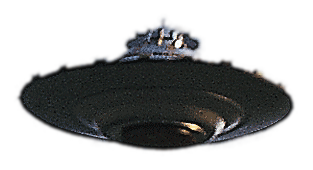
Through high-powered binoculars the two women said they could make out a round structure lowering what looked like landing struts, lit from underneath. Five or six figures came out carrying boxes and what she called "strange hand-held tools," and the crew used those tools to extract a large contraption from the side of the craft. A second object then came down from the northeast and landed on the hillside behind the first. Five more figures climbed out of it and hurried over to help the first crew.
She described the figures carefully. They were "built like men" but taller, she put them between six and a half and eight feet, with hands lighter in color than the rest of them. "They seemed to be dressed in something like a skin diver's wetsuit," she said, dark colored, and "they seemed to have hair like we do, although their hair wasn't long, it seemed to be well barbered, fairly close to their heads." The crews cut and shifted long sections of what looked like heavy dark cable and worked without a break. By her account they tried three times to refit the contraption they had pulled out of the first craft and failed, then on the fourth attempt succeeded.
She also described the cleanup. "I could see them quickly pick up everything they could pick up," she said. "These men were running with something extremely heavy, like two men with a toolbox, one that required two men to carry." Around 4:55 AM the upper craft left first. "It went straight up, almost like an instantaneous disappearance in the direction it had come from, south, southwest." About a minute later the second one "rose straight up, went to the crest of the hill, rose a little further again and shot off in the same direction, at the same speed."
The next day the witnesses went to the site and found physical traces: two sets of evenly spaced triangular depressions, each about fourteen inches wide and around eighteen inches deep, consistent with the tripod-style struts she had watched the craft put down. They also recovered a length of unusual cable-like material. She said "the outer part of it looked like wrapping, something like a brown paper towel, only it wasn't like our paper towels," and inside was "something that looked like finely shredded aluminum strips. It had the color and feel of aluminum, although it wasn't aluminum. It didn't behave like aluminum. Aluminum will crumple and this wouldn't crumple. You couldn't crease it." That piece was lost before any investigator could examine it.
What is the official explanation?
There is no military or government file on the New Berlin landing. By late 1964 the U.S. Air Force was still running Project Blue Book, but this case does not appear in its case list and the witnesses do not seem to have reported it to the Air Force. What documentation exists comes entirely from the civilian research community of the day.
The hardest contemporary anchor is the NICAP chronology, the master event list kept by the National Investigations Committee on Aerial Phenomena. Its entry reads in full: "November 25, 1964; New Berlin, NY. Two objects landed on hilltop, large group of humanoid beings engaged in apparent repair operation for four hours," with the source tag "UFOE Section XII," meaning NICAP's own reference work The UFO Evidence, Section XII, the section dealing with landing and physical-trace reports. That entry fixes the date, the place, the two objects, the large group of beings, the repair behavior and the four-hour duration as part of the formal NICAP record rather than later folklore.
The three largest civilian investigative bodies of the period each looked at the case: NICAP, APRO (the Aerial Phenomena Research Organization), and CSW (Civilian Saucer Watch). The accounts that descend from their work say all three interviewed the primary witnesses and did ground investigation at the site, and that the three independent inquiries agreed with one another on the facts. None of them recovered the anomalous cable material, because it had already been lost.
The most substantial investigation was Dr. Berthold E. Schwarz's. Schwarz was a board-certified psychiatrist in private practice in Montclair, New Jersey, with a long-running interest in paranormal and UFO reports, and he later collected his casework in the book UFO-Dynamics: Psychiatric and Psychic Dimensions of the UFO Syndrome (Rainbow Books, copyright 1983, third updated edition 1988), where the New Berlin encounter appears. Schwarz interviewed the witness at length, both awake and under hypnosis, and ran a battery of standard psychological instruments on her, including the Cornell Medical Index Health Questionnaire and the Minnesota Multiphasic Personality Inventory. He reported that she came across as a happy, well-adjusted woman, that the tests showed her to be healthy, open and straightforward, and that her account stayed well organized with no inconsistencies across different interviews and across time. Outside his written report he is quoted as calling her about as truthful a close-encounter witness as he had ever interviewed. Schwarz also published the case in the British journal Flying Saucer Review in the 1970s; the exact volume is cited inconsistently across secondary sources, which variously give Volume 19, 20 or 21, and because the original journal scans could not be opened and read directly, no single volume number is asserted here as verified.
What did the witnesses think it was?
The witnesses, Mrs. Hatzenbuhler and her mother-in-law, did not frame what they saw as anything occult. They believed they had watched a real, structured craft, two of them, make an emergency stop and effect repairs, crewed by tall figures in close-fitting suits who behaved like a work party rather than apparitions. The detail in the account is the detail of someone describing labor: tools handed back and forth, a heavy component pulled out and refitted, three failed attempts and a fourth that worked, a brisk cleanup, then a fast vertical departure. Her recovered piece of "cable" that looked like aluminum but would not crease was, to her, ordinary physical debris left behind by something that had been physically present in her field.
Her credibility is the spine of the case, and it is unusually well examined for a 1964 report because a practicing psychiatrist put her through formal testing rather than just listening to a story. Schwarz's conclusion, that she was psychologically healthy, consistent across time, and as truthful a close-encounter witness as he had met, is the witness-side evidence here. The mother-in-law corroborated the sighting at the time, and the three separate civilian investigations are reported to have found the two women's accounts consistent with one another. Secondary retellings add that her husband worked as a chemical engineer, a detail offered to support the household's general credibility, though that occupational claim traces only to later write-ups and is not independently confirmed here.
What the case does not have on the witness side is a second fully independent observer outside the immediate family, a surviving physical sample, or any photograph or sketch that can be traced back to 1964. The triangular ground marks were measured but not preserved with any chain of custody, and the one piece of physical material was lost before an investigator could test it. So the witness record is strong on internal consistency and on the investigator's assessment of the primary witness, and thin on anything that can be checked independently today.
Is the New Berlin Double Landing real? The two-pass assessment
Pass one, the ordinary readings. With no surviving photograph, no recovered material and a single household of witnesses, almost every prosaic explanation stays on the table because nothing can be ruled out by hard evidence. A nighttime light that falls, brightens, hums and appears to pace a car can start as a misperceived astronomical or aircraft light embellished over a long, cold, frightening watch. The "round structure on struts," the figures and the four-hour repair were seen at an estimated 3,800 feet through binoculars in the dark, conditions that strain any positive identification of shape or height, and an eight-foot stature judged at that range and that hour is exactly the kind of figure-and-ground error long vigils produce. The triangular ground depressions could be pre-existing or unrelated, since they were found and measured by the witnesses themselves rather than excavated by an investigator, and the one anomalous artifact, the aluminum-like cable that would not crease, conveniently vanished before anyone qualified could test it, so its strangeness rests entirely on the witness's description. A deliberate hoax is also formally possible, although no one has ever produced a confession, a prop, a motive or a method, and the psychiatric testing cuts against it. None of these ordinary readings has been demonstrated; they are live because the evidence is too thin to close any of them out.
Pass two, if it happened as described. Then this is a high-strangeness close encounter of the rarest type, two structured craft on the ground at once, a visible multi-member crew carrying out a coordinated mechanical repair over four hours, complete with failed attempts, a successful refit, a cleanup and a synchronized departure. That is not the usual fleeting light. It reads as machinery and a work crew, and it left measured tripod-style traces and, briefly, a physical sample. The investigative footprint is also unusually serious for the era: three independent civilian organizations on the ground agreeing on the facts, and a board-certified psychiatrist who tested the main witness with the Cornell Medical Index and the MMPI and judged her healthy, consistent and truthful. The official-apparatus angle, the absence of any Air Force or Blue Book file, is logged here as context, not as a strike against the case; the case was carried instead by the civilian groups whose records preserve it.
Weighing the two passes, the New Berlin landing has no authenticated photograph, no surviving material, no second independent non-family witness and no contemporary newspaper trace that could be located, but it also has no method-shown debunk, no confession and no positively identified mundane cause. No one has advanced a specific, demonstrated counter-explanation, a named aircraft, a traced balloon, a recovered prop, so there is nothing concrete enough to push it into a disputed tier. It rests on the testimony of credible witnesses, a measured set of ground traces, a now-lost artifact, and the assessment of a psychiatrist who examined the primary witness in depth. With no official narrative either explaining it or explaining it away, the honest classification is Unknown: a serious, well-documented account that stands on its witnesses and cannot, on the surviving evidence, be either confirmed or closed.
Sources
- www.nicap.org/chronos/1964fullrep.htm
- web.archive.org/web/20240420065045/https://www.ufocasebook.com/2014/double-ufo-landing-berlin-new-york-1964.html
- www.latest-ufo-sightings.net/2014/05/1964-double-ufo-landing-account-at-new.html
- www.thinkaboutitdocs.com/1964-two-alien-craft-land-in-berlin-new-york/
- www.ufoinsight.com/ufos/waves/1964-ufo-wave
- www.nicap.org/ufoeII.htm
- www.biblio.com/book/ufo-dynamics-psychiatric-psychic-dimensions-ufo/d/1502035354
More cases from this region: UFO sightings in United States