The Staunton, Virginia Cone-Shaped Object
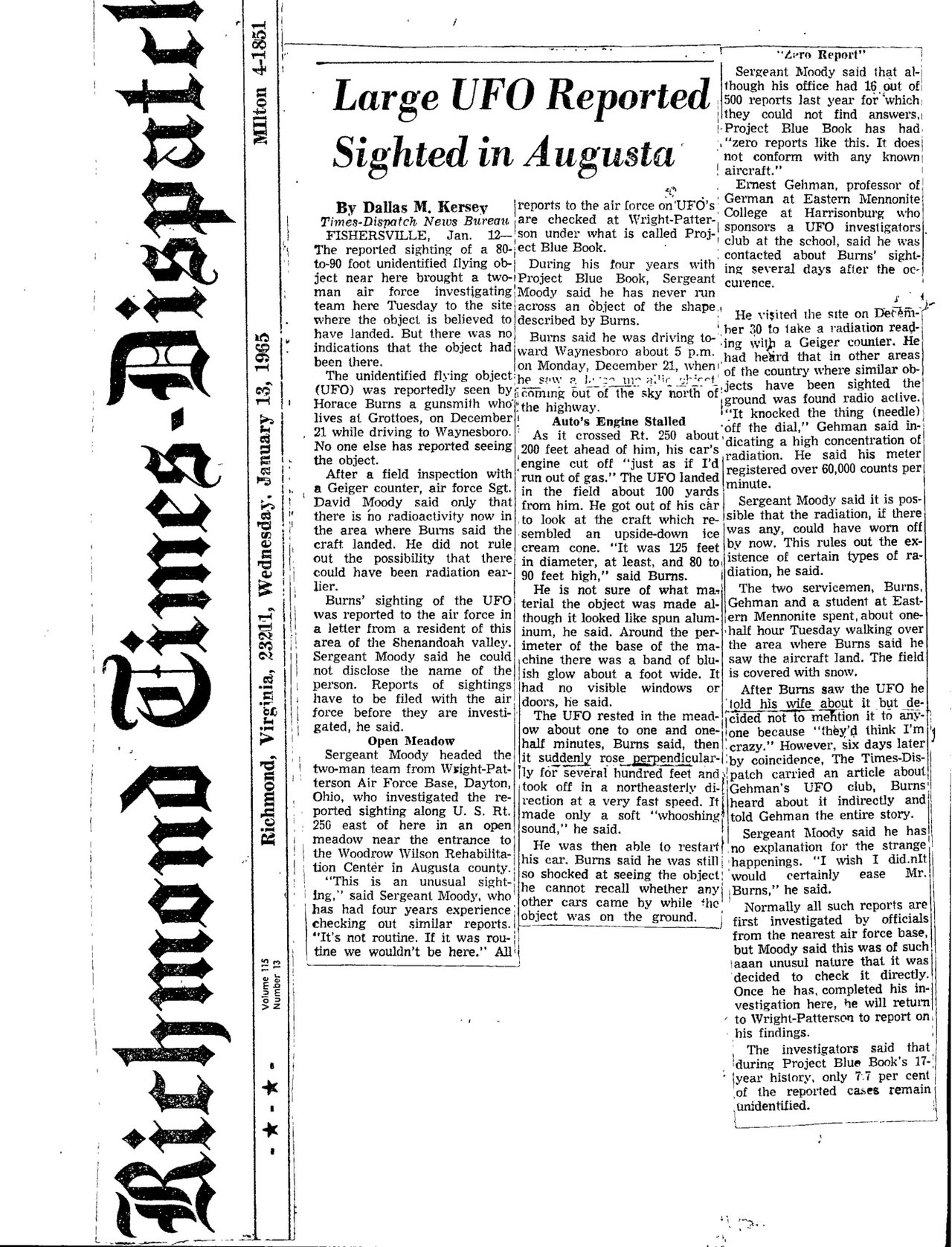
Late on the afternoon of Monday, 21 December 1964, Horace Burns, a 54-year-old gunsmith who lived at Grottoes and ran a small gun shop on North Main Street in Harrisonburg, was driving home from Staunton. This case file covers what witnesses reported, the official narrative, and a two-pass assessment with its evidence tier.
What did witnesses see at U.S. Route 250 near Fishersville?
Late on the afternoon of Monday, 21 December 1964, Horace Burns, a 54-year-old gunsmith who lived at Grottoes and ran a small gun shop on North Main Street in Harrisonburg, was driving home from Staunton. By his own account he had left a Staunton hardware store at about 4:30 p.m. after buying supplies for the shop, and roughly half an hour later, about eight miles east of Staunton on U.S. Route 250, near the entrance to the Woodrow Wilson Rehabilitation Center at Fishersville, he saw a large dark metallic object float in from the north.
The object crossed Route 250 roughly 200 feet ahead of his car. As it did, his engine cut off. Burns described it in the Richmond Times-Dispatch as stopping "just as if I'd run out of gas," and in the Daily News-Record he said "some sort of force was exerted on the car because of the way it slowed down." The car came to what witnesses and reporters described as an unnaturally quick stop. The object then settled gently into a meadow about 100 yards from the highway. Burns told a public meeting it came down "like a bubble."
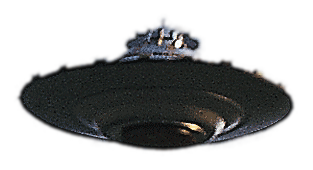
Burns got out and stared. He estimated the craft at "125 feet in diameter, at least, and 80 to 90 feet high." It was shaped, he said repeatedly, like an upside-down ice cream cone, a beehive, or an upside-down spinning top: circular sloping sides that rose in about six large concentric rings or convolutions, each smaller than the last, up to a dome at the top. It looked dull metallic, like spun aluminum, though in the gathering twilight he could not be certain of the material. Around the entire perimeter at the base ran a band of bluish glow about a foot wide. He could see no windows, no doors, no seams, and no landing gear, and there was no sign of occupants.
The object rested in the field for about one to one and a half minutes, by Burns's count 60 to 90 seconds, then rose straight up for several hundred feet and shot off to the northeast at a speed far greater than the roughly 15 miles per hour at which it had crossed the road. It made only a soft "whooshing" sound, which Burns took to be air rushing past it. When he pressed the starter button, his car started immediately. He drove off so shaken that he could not recall whether other cars had passed.
A partial corroboration surfaced in January. Kenneth Norton Jr., a 14-year-old Staunton High School student and a Civil Air Patrol cadet, told the Times-Dispatch that at about 4:50 p.m. on the same 21 December, roughly ten minutes before Burns's encounter, he had watched a strange object from his bedroom window. Norton drew a picture of what he had seen before he was shown any sketch of Burns's object. Both put the diameter at about 125 feet, but Norton described his object as cigar-shaped rather than cone-shaped, which he attributed to the angle from which he saw it. His family had kept quiet at first because, his mother said, "We didn't want anybody to think he was nuts," and because her husband held a responsible position.
What is the official explanation?
The case became an official Project Blue Book file. Burns's sighting was reported to the Air Force in a letter from a Shenandoah Valley resident, and on Tuesday, 12 January 1965, a two-man team from Wright-Patterson Air Force Base in Dayton, Ohio, came to the meadow off Route 250. The team was headed by Technical Sergeant David N. Moody, accompanied by Staff Sergeant Harold Jones. Moody, who told reporters he had four years of experience with Blue Book, called this "an unusual sighting" and added, "It's not routine. If it was routine we wouldn't be here," and said he had never run across an object of the shape Burns described. Burns and Professor Ernest Gehman were present, and a Times-Dispatch photo by Dallas Kersey shows Burns watching as Moody worked a Geiger counter over the ground.
The official report was released about 29 to 30 January 1965 and quoted in the Richmond Times-Dispatch. Sergeant Moody, who headed the investigation and prepared the final report, wrote that the "available information fails to reveal any evidence of an alleged landing" and that "there was a total lack of any indication that a vehicle had landed in the field." The Air Force pointed out that no other witnesses to the landing had been found, and reasoned that an object 125 feet across and 80 to 90 feet tall "would be observed by additional witnesses." The team found no radioactivity at the site 22 days after the event.
On the radiation question the report directly contradicted the civilian reading. Major James Sproul, described as an Air Force radiation specialist, was consulted on Gehman's finding, and the report stated, "Major Sproul stated that radioactive isotopes deposited on 21 Dec. 64 and yielding returns with a strength indicated would yield a positive return on 12 Jan." In other words, the Air Force argued that genuine radiation strong enough to peg Gehman's meter should still have been detectable when its own team arrived three weeks later, and it was not.
Two points in the official report cut against an easy dismissal. Moody concluded that Burns's "reliability as a witness is not questioned," and the report explicitly ruled out the possibility that the sighting "could have been a prank or a hoax." It then offered no further explanation at all. The Air Force public-affairs apparatus treated the file cautiously. A Blue Book spokesman told reporters by telephone that the Air Force was at that moment receiving UFO reports from nowhere except Virginia, and that "Our cases are never closed until the reported objects are sufficiently identified." Later in 1965, NICAP's acting director Richard Hall had difficulty even obtaining the Air Force document on the case, a difficulty serious enough that he wrote to Congressman John E. Moss, chairman of the House Government Information subcommittee, whose office acknowledged the request on 2 July 1965. The document NICAP eventually obtained, loaned by Times-Dispatch bureau chief Dallas Kersey, carried no Air Force letterhead, a detail NICAP's Harold Deneault flagged as characteristic of these reports.
What did the witnesses think it was?
Burns insisted he was an ordinary, level-headed man caught off guard. "I am not looking for notoriety or publicity, or anything like that," he told the audience at Eastern Mennonite College, saying only that he was "astonished" at what he saw. He had at first kept the story to himself and his wife, telling her but refusing to go public because, he said, "They'd think I'm crazy." He came forward only after WSVA radio in Harrisonburg announced the existence of the college's UFO Investigators club and his wife persuaded him to report it. Nearly 400 people turned out to hear him describe the encounter at the college in early January 1965. Once the account was published he was, by the Times-Dispatch's telling, called "crazy" and "nuts" many times, yet he never altered his story through repeated questionings.
His strongest backer was Ernest G. Gehman, professor of German at Eastern Mennonite College, a NICAP member and the sponsor of the college's UFO Investigators group. Gehman, who had heard that ground at other reported landing sites elsewhere in the country had tested radioactive, drove alone to the meadow on 30 December 1964, nine days after the event, with a Geiger counter. He said the reading "knocked the thing (needle) off the dial," and reported a count of more than 60,000 counts per minute, a figure he repeated to several papers, with one account quoting "more than 600,000 counts." He located the exact landing spot by the meter readings.
Crucially, Gehman did not stand alone on the radiation. He said two passing motorists, one of whom he knew personally, watched him work the Geiger counter and could substantiate his account. More important, his reading was independently confirmed on the same day by H. M. Cook of Staunton, a research engineer at the Du Pont plant at Waynesboro who had considerable professional experience with Geiger counters. Cook said, "Gehman was having a tizzy because the needle was all the way off the dial." He described the spot as "a hot area," adding, "We spent 45 minutes in the field trying to tone this reading down. We checked the radium dials on our watches, even went over a small hill from the field, but this was definitely an accurate reading. The only thing I can say is that it was hot (radioactive)." Gehman planned to take soil samples for laboratory testing to determine whether alpha, beta, or gamma radiation was present, and he believed it was alpha radiation, which he argued the Air Force's beta-gamma survey meter was poorly suited to detect.
Gehman also challenged the Air Force's method directly, noting that the airmen never consulted the original witnesses about their findings, that the meadow had since been mowed for hay and was snow-covered, and that Moody's quick adjustment of the meter when the needle began to rise drove the instrument toward a null reading. NICAP, through Richard Hall, framed the case as "a pretty typical UFO sighting," citing the engine-stall electromagnetic effect that had been reported in earlier cases, and the dome-shaped, ringed body that the committee said was a common report. The event was catalogued in NICAP's compendium The UFO Evidence and in Jacques Vallée's Magonia listing as case 628.
The dispute
The dispute is twofold and both prongs come from the Air Force investigation conducted by Technical Sergeant David N. Moody of Project Blue Book, whose report was released around 29 to 30 January 1965. First, the no-witness argument: only Horace Burns saw the landing, and Moody's report reasoned that "a vehicle of this size would be observed by additional witnesses," that no others were found, and that there was "a total lack of any indication that a vehicle had landed in the field." Second, the radiation rebuttal: the Air Force team found no radioactivity at the site on 12 January 1965, and Major James Sproul, an Air Force radiation specialist consulted on the case, asserted that isotopes deposited on 21 December strong enough to peg a meter "would yield a positive return on 12 Jan." On that logic the off-scale civilian reading nine days after the event should have left a detectable residue three weeks after the event, and it did not.
These points are genuine but they do not close the case, for several reasons. The radiation objection is an official assertion about expected isotope behavior set against an actual same-day measurement that was independently confirmed. Professor Ernest Gehman's reading on 30 December was not a lone enthusiast's claim. H. M. Cook, a research engineer at the Du Pont plant at Waynesboro with professional Geiger-counter experience, was on the field, spent 45 minutes trying to tone the reading down, checked the radium dials on the team's watches and walked over a hill to rule out interference, and still concluded "it was hot (radioactive)." Gehman further argued the emission was alpha radiation, which the Air Force's beta-gamma survey meter would not properly detect, and noted the airmen adjusted their meter downward the moment its needle began to climb. A null reading from an instrument poorly matched to the suspected emission, taken 22 days after the event, does not overturn a positive reading by two people including a qualified engineer taken nine days after it.
The no-witness argument is also softer than it sounds. Burns's account was partially corroborated by 14-year-old Kenneth Norton Jr., who independently reported a large object in the sky over the same area at roughly the same time and drew it before seeing any sketch of Burns's object, and Gehman cited passing motorists who watched him take the reading. More tellingly, the Air Force undercut its own dismissal. Moody's report states that Burns's "reliability as a witness is not questioned" and explicitly ruled out a prank or a hoax, then offered "no attempt to offer any further explanation." That is an official body conceding the witness was credible and the event was not faked while declining to identify what it was. Critically, the counter-explanation never produces a positive identification of any ordinary object or cause, no aircraft, balloon, drone, ship, rocket, recovered prop, or confession, which is what a strongly disputed verdict would require. What remains is an official negative finding without a demonstrated mechanism, set against credible witnesses and an independently confirmed physical trace, which is why the case is rated Barely Disputed rather than anything harsher.
Is the Staunton, Virginia Cone-Shaped Object real? The two-pass assessment
Pass one, the ordinary readings. The most obvious mundane path is a single-witness misperception. Only Burns saw the landing itself, and the Air Force leaned hard on that: an object 125 feet across crossing a state highway at rush hour in good December light "would be observed by additional witnesses," yet none came forward to the landing. The young Kenneth Norton's report is real corroboration of something in the sky at about the same time, but he described a cigar shape, not Burns's ringed cone, so it does not lock the two accounts together. The engine stall has prosaic candidates in a 1964 vehicle, from vapor lock to a stalled carburetor to simple driver shock, and a car that restarts at once is consistent with no real fault at all. The radiation is the load-bearing physical claim, and here the Air Force's argument has teeth: Major James Sproul reasoned that isotopes strong enough to peg a meter on 30 December should still register on 12 January, and the service's own survey meter found nothing. A skeptic can also note that Gehman went looking for radiation because he had heard other sites tested hot, which is a setup for confirmation bias, and that a Geiger counter slammed off-scale can signal instrument behavior as much as a genuine source. No hoax props were ever found, and no one confessed, so a deliberate fabrication is not demonstrated, but a sincere misperception plus an over-read meter remains a coherent ordinary story.
Pass two, if real. If Burns saw what he reported, this is a structured-craft close encounter of the second kind with three independent physical signatures: vehicle electromagnetic interference timed exactly to the object crossing his path, a gentle powered landing and vertical departure with no aerodynamic surfaces, and elevated radioactivity at the touchdown point. The radiation is not a lone eccentric's claim. It was confirmed the same day by H. M. Cook, a Du Pont research engineer who handled Geiger counters professionally and who methodically tried for 45 minutes to explain the reading away, ruling out the radium watch dials and walking off the field, before concluding the spot was genuinely "hot." That is independent, technically competent corroboration of a physical trace. The Air Force's own investigator found Burns reliable and explicitly excluded a prank or hoax, then declined to offer any explanation, which is the apparatus closing a case it could not actually account for rather than solving it.
Weighing the two passes, the dispute here is real but it is weak. The counter-case rests on an absence of additional landing witnesses and on a delayed null radiation reading explained by an Air Force assertion, not on any positive identification of a mundane object, no balloon, no aircraft, no recovered prop, no confession, and no demonstrated natural cause for the same-day off-scale reading taken by two people including a qualified engineer. An official negative finding without a shown mechanism does not close a case under this archive's standard. Because the dispute is an official assertion plus a single-witness-landing objection, set against a credible same-day independent radiation confirmation and an Air Force concession of witness reliability, this lands at Barely Disputed. The case largely stands on its witnesses and its corroborated trace.
Sources
- cufos.org/PDFs/UFOI_and_Selected_Documents/cases/1964_12_21_US_VA_Fishersville_NICAP_Burns-Landing-EM.pdf
- www.nicap.org/chronos/1964fullrep.htm
- www.theblackvault.com/documentarchive/project-blue-book-the-alleged-1964-ufo-landing-in-harrisonburg-virginia/
- roanoke.com/news/local/history/ufo-western-virgina-little-men-flying-saucer-augusta-county-fisherville-staunton-waynesboro-1964/article_e23e265c-bbff-11ef-9190-8377718b2e7e.html
- www.whsv.com/2023/04/25/story-alleged-1964-fishersville-ufo-landing-chaos-that-ensued/
- www.whsv.com/2023/06/07/14-year-old-reports-cigar-shaped-ufo-near-staunton-1964/
- www.ufoevidence.org/cases/case553.htm
More cases from this region: UFO sightings in United States