The Bexleyheath Encounter
Just before noon on 17 July 1955, a hot summer Sunday, something is reported to have come down in the residential streets of Bexleyheath in southeast London. This case file covers what witnesses reported, the official narrative, and a two-pass assessment with its evidence tier.
What did witnesses see at King Harold's Way?
Just before noon on 17 July 1955, a hot summer Sunday, something is reported to have come down in the residential streets of Bexleyheath in southeast London. The clearest single account comes from Rodney Maynard, who was fifteen at the time and working as a labourer on a building site at nearby Streamway. By his telling, the crew was on its lunch break when word reached them that something was happening over in King Harold's Way, so they walked up to look. "This thing had landed in the roadway," he said. "It took up the whole width of the road and overlapped onto the pavements. It wasn't on the ground, it had about eight massive suckers." He described a craft whose centre stayed still while the outer rim turned slowly, with white lights that flashed "like a camera flash," and he said roughly thirty people were standing and staring at it while it gave off an audible humming.
Maynard went on: "It had what looked like windows but the glass was concave and moulded together so you couldn't see in. A couple of us went forward to try and touch it and it began to spin faster. Then it lifted slowly off the ground and hovered above our heads, tilting slightly." His summary of the object's look was specific: "It was black, sleek and streamlined with a surface like polished metal. It was very fine and beautiful. It certainly wasn't a prank." He named several of the workmates he said were with him, among them Ron Deadman, Tony Savin, Vic Clarke and Tommy Staggs, and said his older brother, sixteen at the time, also saw it.
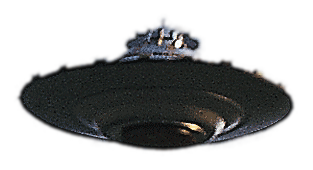
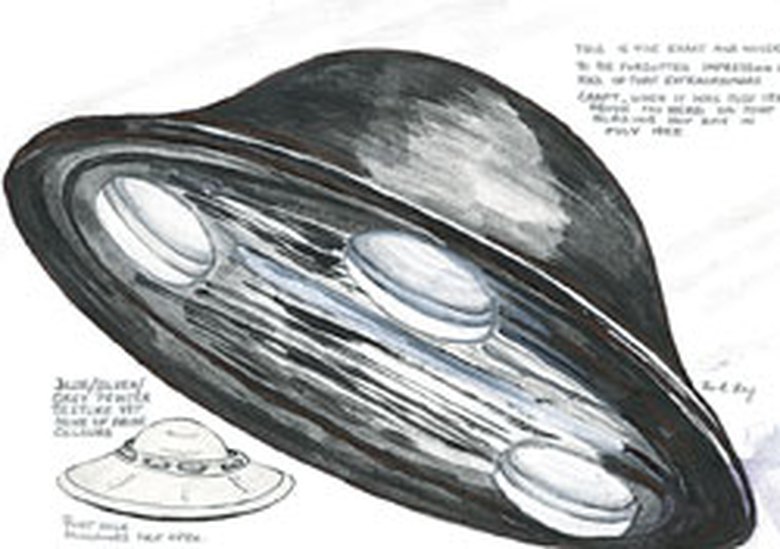
The second strand of testimony comes from Margaret Fry, then a young woman living in Hythe Avenue, who was walking to her GP's surgery in King Harold's Way that same midday. She described an enormous saucer-shaped craft hanging low, by her account about 18 feet above her head, with a colour she could never quite name, "blue, silver, grey, pewter in texture, yet none of those colours." She said it carried three spheres inset into its underside, and that one of these spheres "flopped out" and came to rest on the ground near the junction of Ashbourne Road and Whitfield Road. A group of about a dozen children playing in the street went over to look at it before the object rose back up and climbed away into the sky within a few minutes. In later interviews Fry went further, saying it was not one object but two that came down at noon that day, three or four streets apart, and that the crowd in King Harold's Way alone "must have been at least 170 people standing around this thing."
What is the official explanation?
There is no official record of the Bexleyheath landing. No Air Ministry file, no police report, and no Royal Air Force or government statement has ever been produced for 17 July 1955 at this location, and no investigating body of any kind looked at it at the time. The case has no Project Blue Book analogue because it never entered any official channel; it simply happened in a street, was talked about locally, and then sat unrecorded for decades. That absence cuts both ways and is dealt with honestly in the assessment below.
What exists instead is a civilian documentary trail that begins almost half a century later. The earliest traceable publication is the News Shopper, the local southeast London paper, which ran an appeal in its 4 September 2002 edition seeking witnesses to a remembered 1955 sighting. That appeal drew Rodney Maynard out: the paper reported that Maynard, by then 62 and living in Belvedere, contacted them to say he had been one of the youngsters who saw the object featured in the September 4 piece. The News Shopper returned to the story in later features, including a 7 March 2007 article headlined around the "famous landing," which reproduced Margaret Fry's own drawing of the craft alongside her caption that it was "the exact impression I had of that extraordinary craft, just 18ft above my head on that blazing hot day in July 1955."
The serious investigative write-up belongs to John Hanson, a retired West Midlands CID officer, and his research partner Dawn Holloway, who placed the case in Volume One of their Haunted Skies series covering 1940 to 1959. Hanson, who ran the witness appeal through the News Shopper and gave a contact address of PO Box 10467, Kings Norton, Birmingham, re-investigated the landing together with Margaret Fry and called it "probably one of the best documented accounts" of an object having landed in Britain. Hanson and Fry also reported that a British television production approached them about featuring the case and then dropped it, with the producers telling them, in Hanson's account, that the real story "wouldn't do the viewing figures any good, we will stick to our original script." Margaret Fry herself set the encounter down in her own books, including Link To The Stars, where she presents it as the event that turned her into a lifelong UFO researcher.
What did the witnesses think it was?
The witnesses did not waver in believing they had seen a real, structured, physical craft rather than any conventional aircraft, weather effect, or trick. Rodney Maynard was emphatic that it was solid and engineered, "black, sleek and streamlined with a surface like polished metal," close enough that men stepped toward it to lay hands on it, and his line "it certainly wasn't a prank" was a direct rejection of the idea that he and thirty other people had been fooled by a stunt. His detail that the object sped up its spin as people approached, then lifted, hovered and tilted over their heads, is the testimony of someone describing apparent behaviour and response, not a static shape in the distance.
Margaret Fry is the central figure, and her credibility as a witness has to be weighed against what she became. She was an ordinary young Bexleyheath resident in 1955 with no stake in the subject, walking to the doctor, and she always described that midday as the seminal moment that redirected her life. She went on to join BUFORA in 1964, was a founder member of Contact International UK in 1967 under the Earl of Clancarty, co-founded the Wales Federation of Independent Ufologists in 1993, and spent more than four decades investigating hundreds of reports across England and Wales, becoming arguably Wales's best known UFO researcher and the lead civilian investigator of the 1974 Berwyn Mountain incident. A skeptic can fairly note that she is therefore not a neutral party, since the 1955 sighting is the origin story of her entire career. A fair reading the other way is that she reported the same core details, the saucer shape, the unnameable pewter colour, the inset spheres and the one that detached, consistently across decades, and that she drew exactly what she said she saw rather than embellishing it into something more dramatic.
The corroboration is what makes the case more than a single person's memory. Fry named her own doctor, Dr Thukarta, as a fellow witness, though he died in 1965 and could never be re-interviewed. She placed about a dozen children at the scene, and Rodney Maynard, found independently through the newspaper appeal almost fifty years later, described the same midday, the same King Harold's Way, the same landed disc and the same crowd of onlookers without having been coached into Fry's wording. The differences between their accounts, Maynard's thirty onlookers and eight suckers against Fry's later figure of at least 170 people and her two craft, read like two ordinary people remembering a chaotic event from different vantage points decades on, rather than a rehearsed shared script.
Is the Bexleyheath Encounter real? The two-pass assessment
Pass one, how this could be entirely ordinary. The hardest fact about Bexleyheath is the documentary gap. Nothing was written down in 1955, and the first traceable account appears in a 2002 newspaper appeal, 47 years later, which means every detail we have is a decades-old memory rather than a contemporary record. Memory over that span is unreliable and can converge: once the News Shopper printed Margaret Fry's version in 2002, any later witness, including Rodney Maynard who came forward after reading that very edition, may have unconsciously reshaped his own recollection to fit it. The internal inconsistencies fuel this reading, since the crowd is "about 30" in one account and "at least 170" in another, and the event is one craft in most tellings but "two, three or four streets apart" in Fry's later interviews. A daylight disc with a spinning rim and flashing lights over 1950s suburban London also sits squarely in the golden age of flying-saucer culture, when expectations of what a landed saucer should look like were vivid and widely shared, which is exactly the cultural soil in which a misremembered or embroidered story grows. No physical trace, no ground marking, no photograph and no film was ever produced, and the one named adult corroborator, Dr Thukarta, died in 1965 and was never interviewed by any researcher.
Pass two, if it is real. Set against that, what survives is unusually concrete for a memory case. This is a claimed daylight landing in a built-up residential street with multiple independent adult and child witnesses, not a distant night light. The two main witnesses were traced separately, almost half a century apart, and still produced the same load-bearing core, a metallic disc that came down across the width of the road around noon on 17 July 1955 in King Harold's Way, hovered, and lifted away, with Fry's specific and consistently repeated detail of inset spheres on the underside and one that detached. Margaret Fry, whatever her later role, was a private citizen with nothing to gain in 1955, and her own contemporary-style drawing matches her verbal description rather than inflating it. John Hanson, a retired CID detective trained in taking statements, judged it one of the best documented British landing accounts after re-interviewing the principals.
The tier is Unknown. There is no official narrative to dispute, because no government or military body ever examined this case, so it cannot sit in the official-documentation lane of Verified Unexplained. At the same time, no independent, method-shown debunk exists: nobody has identified a specific aircraft, balloon, or known object, nobody has produced a confession, and no witness has recanted, so there is nothing concrete enough to move it into the disputed tiers. What we have is a multiple-witness daylight landing that rests entirely on its witnesses and their late testimony, with a genuine and openly stated weakness in the 47-year gap before documentation. That is the definition of Unknown: a case that stands or falls on its witnesses, with no official story and no shown explanation either way.
Sources
- www.beamsinvestigations.org/1955%20Bexley,%20UK%20Multiple%20Witnesses%20Observe%20Saucer%20Above%20Road.htm
- www.london-now.co.uk/news/375838.ufo-kids-urged-phone-home/
- www.dailypost.co.uk/news/north-wales-news/public-denial-over-ufos-says-2824999
- hauntedskies.blogspot.com/2011/09/special-blog-to-celebrate-volume-3.html
- www.uapmedia.uk/articles/bexleyheath
- www.ufoinsight.com/the-bexleyheath-ufo-landing/
- www.goodreads.com/book/show/21198406-link-to-the-stars
- www.thinkaboutitdocs.com/1955-bexley-ufo-encounter/
More cases from this region: UFO sightings in United Kingdom